
How to Stay Calm in Co-Parenting Conversations
You're standing in the kitchen, reading a text from your co-parent about next weekend's schedule. Within three sentences, your jaw tightens, your pulse quickens, and you're typing a response you already know you'll regret. The conversation started about soccer practice logistics and somehow landed on everything that went wrong in the last two years.
If that scenario feels painfully familiar, you're not alone. Research from the American Psychological Association shows that ongoing parental conflict is one of the strongest predictors of negative outcomes for children after separation—not the separation itself. Learning to stay calm in co-parenting conversations isn't just about keeping the peace for your own sanity. It directly shapes your children's emotional security.
This article gives you concrete, in-the-moment techniques for when a co-parenting conversation starts going sideways. Not vague advice. Not platitudes. Specific things you can think, say, and do—right now, today—to break the cycle of escalation.
Key Takeaways
- Your body warns you before you blow up. Learn to recognize your personal physiological escalation signals—and use a 90-second reset to interrupt the stress response before it hijacks the conversation.
- Pre-written scripts remove the guesswork. Having go-to phrases for redirecting, pausing, or declining a conversation means you don't have to think clearly when you're emotionally flooded.
- The BIFF method keeps written exchanges from spiraling. Brief, Informative, Friendly, and Firm responses neutralize high-conflict messages without surrendering your boundaries.
- Choosing your medium matters more than you think. Switching from phone calls to text-based communication can cut escalation by giving you time to regulate before you respond.
- Repair is always available. Even after a conversation goes badly, a brief, honest acknowledgment can prevent lasting damage to the co-parenting relationship.
Why Co-Parenting Conversations Escalate So Fast
Before we get to solutions, it helps to understand the mechanics of what's happening in your nervous system during these exchanges.
Your co-parent isn't just another person. They're someone deeply wired into your emotional circuitry—someone who knows your triggers because they lived alongside them. When they say something that feels dismissive, controlling, or unfair, your brain doesn't process it the way it would from a coworker. It processes it through layers of shared history, old wounds, and unresolved grief.
Dr. Dan Siegel, clinical professor of psychiatry at UCLA, describes this as "flipping your lid"—the prefrontal cortex (your rational brain) loses connection with the amygdala (your threat-detection center), and suddenly you're operating in fight-or-flight mode. You're not thinking about what's best for the kids. You're defending yourself.
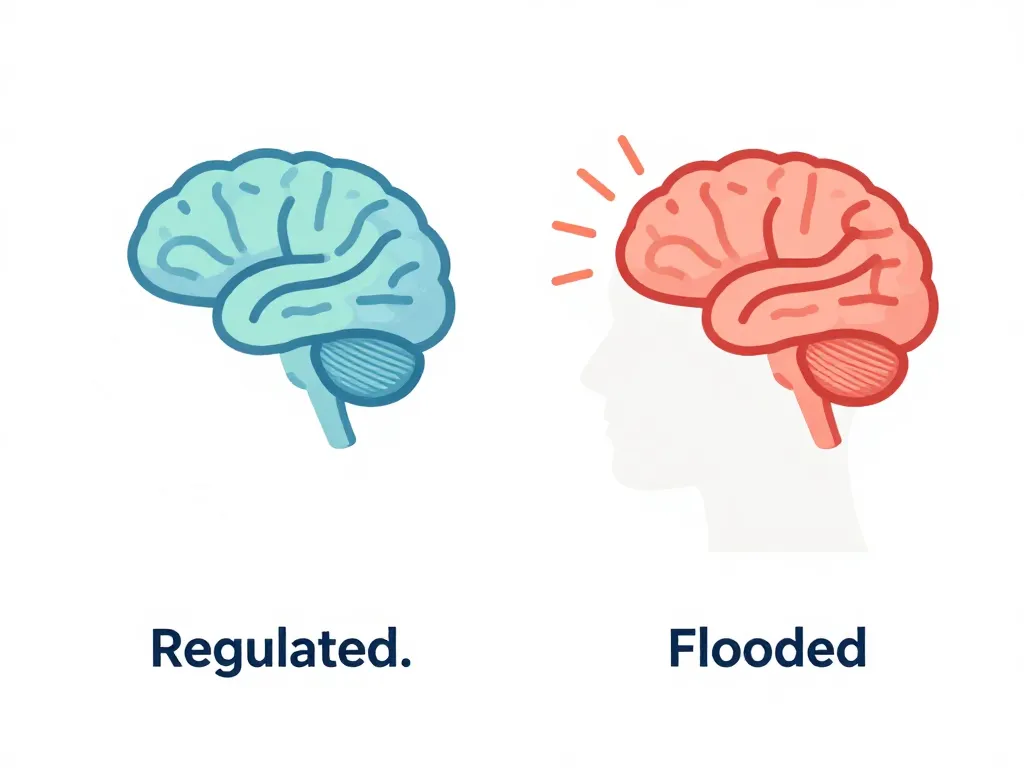
Here's the critical insight: once you're fully flooded, you cannot communicate effectively. The goal isn't to white-knuckle through a heated exchange. The goal is to catch escalation early and intervene before flooding takes over.
Recognize Your Escalation Signals
Every person has a unique set of physiological warning signs that show up before a full emotional hijack. Learning yours is the single most important skill in co-parenting communication.
Common Early Warning Signs
- Physical: Clenched jaw, shallow breathing, heat in your chest or face, tight shoulders, clenched fists, churning stomach
- Cognitive: Racing thoughts, mentally rehearsing counterarguments, fixating on a single word or phrase, thinking in absolutes ("always," "never")
- Behavioral: Typing faster, speaking louder, interrupting, pacing, scrolling back through old messages to build a case
Build Your Personal Warning List
Take five minutes today—seriously, right now if you can—and write down the three earliest signals your body sends you when a co-parenting conversation is going south. Be specific. Not "I get stressed." Something like: "My right hand grips my phone harder" or "I start holding my breath."
These signals are your early-warning system. They're the moment where intervention is still easy.
The 90-Second Reset: What to Do in the Moment
Neuroanatomist Dr. Jill Bolte Taylor's research shows that the chemical lifespan of an emotion in the body is approximately 90 seconds. After that, any continued emotional response is being re-triggered by your thoughts about the situation—not the situation itself.
This gives you a practical window. When you notice your escalation signals:
Step 1: Name It Silently
Say to yourself: "I'm getting activated." This tiny act of labeling engages your prefrontal cortex and begins to restore the connection between your thinking brain and your emotional brain. Neuroscience research calls this "affect labeling," and brain imaging studies confirm it reduces amygdala reactivity.
Step 2: Buy Time
You need 90 seconds. Here's how to get them in different scenarios:
In a text conversation: - Simply stop typing. Put the phone face-down. Set a timer for two minutes.
On a phone call: - "I want to give this the attention it deserves. Let me think about it and get back to you by [specific time]."
In person (during a pickup or handoff): - "I hear you. I need a minute to think about that. Can we come back to it tonight by text?"
Step 3: Discharge the Stress Physically
During those 90 seconds, do something physical:
- Box breathing: Inhale for 4 counts, hold for 4, exhale for 4, hold for 4. Two rounds takes about 60 seconds.
- Cold water: Run cold water over your wrists or hold something cold. This activates the dive reflex and lowers your heart rate.
- Bilateral movement: Walk, even just a few steps back and forth. The bilateral stimulation helps your brain process the emotional charge.

The 90-second reset isn't about suppressing your emotions. It's about giving your rational brain time to come back online so you can respond instead of react.
Scripts That Prevent Spirals
When you're emotionally activated, your verbal skills degrade. This is biology, not weakness. Having pre-prepared phrases means you don't have to craft the perfect response while your nervous system is screaming at you.
Redirecting Scripts
Use these when the conversation drifts from logistics into old grievances or personal attacks:
- "I want to focus on what we're deciding about [child's name]. Can we stay on that?"
- "That's a separate issue. Right now I need to sort out [specific logistics]."
- "I hear that this matters to you. Right now, can we solve the Saturday question?"
Pausing Scripts
Use these when you feel yourself approaching the point of no return:
- "I want to handle this well, and I need some time to think. I'll respond by [day/time]."
- "This is important, and I don't want to rush it. Let me get back to you tonight."
- "I'm not in the right headspace for this conversation right now. Can we revisit it tomorrow?"
Boundary Scripts
Use these when name-calling, blame, or personal attacks enter the conversation:
- "I'm not able to continue when the conversation goes in this direction. I'm available to discuss [child's name]'s schedule when we can keep it focused."
- "I won't respond to messages about our past relationship. If there's something about the kids you need, I'm here for that."
Notice what these scripts share: they're short, they don't explain or justify, and they redirect to the child's needs. You're not winning a debate. You're protecting a communication channel that your children depend on.
The BIFF Method for Written Communication
Developed by Bill Eddy, co-founder of the High Conflict Institute, the BIFF response method is one of the most effective frameworks for high-conflict co-parenting communication. It stands for:
- Brief: Keep it short. Two to five sentences maximum. Every additional sentence is an additional opportunity for misinterpretation.
- Informative: Stick to factual information. Dates, times, logistics, decisions.
- Friendly: A brief, neutral opening. "Thanks for letting me know" is enough. This isn't warmth—it's de-escalation.
- Firm: End the conversation or decision clearly. No open-ended questions that invite argument.
BIFF in Practice
Incoming message from co-parent:
"You ALWAYS change the schedule last minute. This is so typical. You clearly don't care about disrupting the kids' lives. I need you to pick them up at 3, not 5, on Friday and I'm not discussing it further."
Non-BIFF response (what your activated brain wants to write):
"Are you serious? I changed the schedule ONCE in three months because of a work emergency. You're the one who canceled two weekends in a row last month. Don't lecture me about disrupting the kids."
BIFF response:
"Thanks for raising the Friday schedule. I can do pickup at 3:30—that's the earliest I can manage with my work schedule. Let me know if that works, or I'll plan on 5 as originally agreed. Either way, I'll make sure the kids have their overnight bags packed."
The BIFF response doesn't take the bait on "always," doesn't counter-attack, doesn't defend. It solves the problem. It will feel deeply unsatisfying to write—and that's exactly how you know it's working.
Choose Your Communication Medium Strategically
The channel you use for co-parenting conversations has an outsized impact on whether those conversations escalate.
When to Use Text or Written Platforms
- Schedule changes and logistics
- Decisions that benefit from a written record
- Any conversation you anticipate could become contentious
- When you need time to regulate before responding
Written communication is inherently slower, which gives your 90-second reset a natural home. AI-powered mediation platforms like Servanda can add additional structure to written co-parenting exchanges by helping you draft agreements and keep conversations focused on solutions rather than grievances.
When a Phone Call Might Work
- True emergencies involving the child's immediate safety
- Brief, time-sensitive logistics ("I'm stuck in traffic, running 10 minutes late")
- When both parents have demonstrated they can keep a specific topic calm
When to Avoid In-Person Conversations
- During child handoffs, when children can overhear
- When either parent is visibly upset
- When alcohol has been involved
A practical rule: the higher the conflict level, the slower the medium should be. High conflict belongs in writing, where you have time and space to apply every technique in this article.
The "Newspaper Test" and the "Future Self" Check
Two quick mental frameworks that take less than five seconds and can prevent a month of regret:
The Newspaper Test
Before you send any message, ask: "Would I be comfortable if a family court judge read this out loud?" If the answer is no, rewrite it. This isn't about paranoia—it's about alignment. If you wouldn't want a judge to see it, it's probably not serving your child either.
The Future Self Check
"Will I be proud of this response in 24 hours?" Not whether it felt good to type. Whether, tomorrow morning over coffee, you'll feel it represented the parent you want to be.

What to Do After a Conversation Goes Badly
Even with all these tools, you will sometimes lose it. You'll send the angry text. You'll raise your voice at pickup. You'll say the thing you swore you wouldn't say. This doesn't mean you've failed.
Repair With Your Co-Parent
A brief, non-dramatic acknowledgment goes further than you might expect:
- "That last exchange got off track. I want to handle things better. Here's what I actually need to sort out about Friday..."
- "I didn't respond the way I wanted to earlier. Let me try again: [state your actual point calmly]."
You don't need to grovel. You don't need to accept blame for their behavior. You just need to signal that you're committed to a functional communication channel.
Repair With Yourself
Self-compassion research by Dr. Kristin Neff at the University of Texas shows that beating yourself up after a mistake doesn't make you perform better—it makes you more likely to repeat the same pattern. Instead:
- Acknowledge: "That was hard, and I didn't handle it the way I wanted."
- Normalize: "This is an incredibly difficult situation. Many co-parents struggle with exactly this."
- Recommit: "Next time, I'm going to [specific technique] when I notice [specific warning signal]."
Repair With Your Children
If your children witnessed a heated exchange, keep it simple and age-appropriate:
- "Mom/Dad and I had a disagreement, and we didn't handle it well. That's a grown-up problem, and it's not your job to worry about it. We're both working on doing better."
Don't badmouth your co-parent. Don't over-explain. Don't recruit your child as an ally. Just name what happened, own your part, and reassure them that they are safe and loved.
FAQ
How do I stay calm when my co-parent is deliberately trying to provoke me?
Recognize that provocation only works if it gets a reaction. When you suspect deliberate baiting, shift your internal goal from "responding to what they said" to "solving the logistical problem underneath the noise." Use the BIFF method to strip the message down to its factual core and respond only to that. Their tone is their problem; your response is yours.
What if my co-parent accuses me of being cold or unresponsive when I try to stay calm?
This is common, especially early on. Staying calm can feel like withdrawal to someone accustomed to high-intensity exchanges. You don't need to explain your emotional regulation strategy. A simple response like "I'm here and I want to work this out. I just need a little time to think it through" acknowledges them without abandoning your boundary.
Is it okay to just not respond to a hostile message from my co-parent?
It depends. If the message contains a genuine logistics question buried under hostility, respond to the logistics and ignore the hostility—that's the BIFF approach. If the message is purely an attack with no actionable content, it's reasonable not to respond at all. However, if custody agreements or court orders require you to respond within a certain timeframe, make sure you're meeting that obligation with a brief, factual reply.
How long should I wait before responding to an upsetting co-parenting message?
There's no universal rule, but a good guideline is: long enough to pass the "Future Self Check," short enough that logistics don't stall. For most non-urgent topics, responding within a few hours to 24 hours is reasonable. If you need longer, a brief holding message—"Got your message. I'll respond by tomorrow evening"—prevents your silence from being interpreted as stonewalling.
Can co-parenting communication actually get better over time?
Yes. Research from family systems psychologists shows that co-parenting conflict often peaks in the first one to two years post-separation and can decrease significantly when even one parent consistently applies de-escalation strategies. You don't need your co-parent to change first. Your regulated responses change the dynamic of the entire interaction pattern over time.
Moving Forward, One Conversation at a Time
Staying calm in co-parenting conversations isn't a personality trait you either have or you don't. It's a set of skills—recognizing your warning signals, using the 90-second reset, relying on pre-written scripts, applying the BIFF method, and choosing the right communication medium. Skills get stronger with practice and easier with repetition.
You won't get it right every time. No one does. But every single conversation where you catch yourself before escalation, where you pause instead of fire back, where you respond to the logistics and let the provocation pass—that's a conversation where your children didn't have to absorb their parents' conflict.
That's not a small thing. Over months and years, those moments compound into something your kids will carry with them long after they've stopped needing pickup schedules: the knowledge that their parents could be counted on to put them first, even when it was hard.