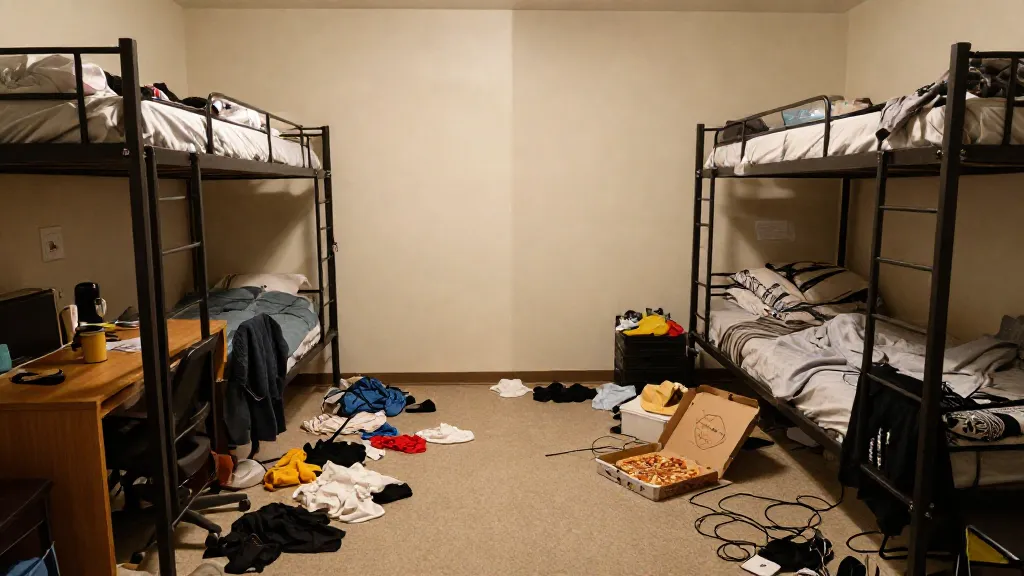
How to Talk to a Roommate You're Mad At
It's 11:47 p.m. on a Tuesday. Your roommate's friends are in the living room — again — and someone just cranked the speaker up. You have an 8 a.m. exam. Your jaw is clenched. You've been "fine" about this for three weeks, but tonight you fantasized about leaving a passive-aggressive sticky note on the fridge. Maybe two.
You know you need to say something. But every version of the conversation you rehearse in your head ends in a shouting match, tears, or an icy silence that lasts until the lease is up.
Here's the thing: knowing how to talk to a roommate you're mad at is a skill, not a personality trait. It can be learned. Resident Advisors teach incoming students a specific framework for these exact conversations — and it works just as well for adults sharing a two-bedroom apartment as it does for freshmen in a dorm.
This article gives you that framework, word for word, so you can have the conversation tonight.
Key Takeaways
- Cool down before you speak up. Waiting 20–60 minutes (not days or weeks) prevents you from saying something you'll regret while the issue is still fresh enough to address.
- Use the "When you… I feel… I need…" formula. This three-part 'I' statement is the exact script RAs teach — it keeps the focus on the problem, not the person.
- Pick the right moment and setting. Never ambush your roommate in front of other people, right when they walk in the door, or over text.
- Propose a specific, measurable solution. Vague requests like "be more respectful" fail. Clear ones like "headphones after 10 p.m. on weeknights" stick.
- Write it down afterward. Verbal agreements are forgotten within days. A quick shared note or written roommate agreement makes everything stick.
Why You're Avoiding the Conversation (And Why That Makes It Worse)
Let's be honest about what's really happening. You're not avoiding the conversation because you're lazy. You're avoiding it because your brain is trying to protect you from one of three outcomes:
- They'll get angry, and you'll have to live with someone who's hostile.
- They'll dismiss you, and you'll feel stupid for bringing it up.
- You'll lose control of your own emotions and say something damaging.
These fears are rational. They're also the exact reason the resentment keeps building. Research from relationship psychology consistently shows that unaddressed conflict doesn't dissolve — it compounds. That dirty dish you shrugged off in September becomes evidence of fundamental disrespect by November.
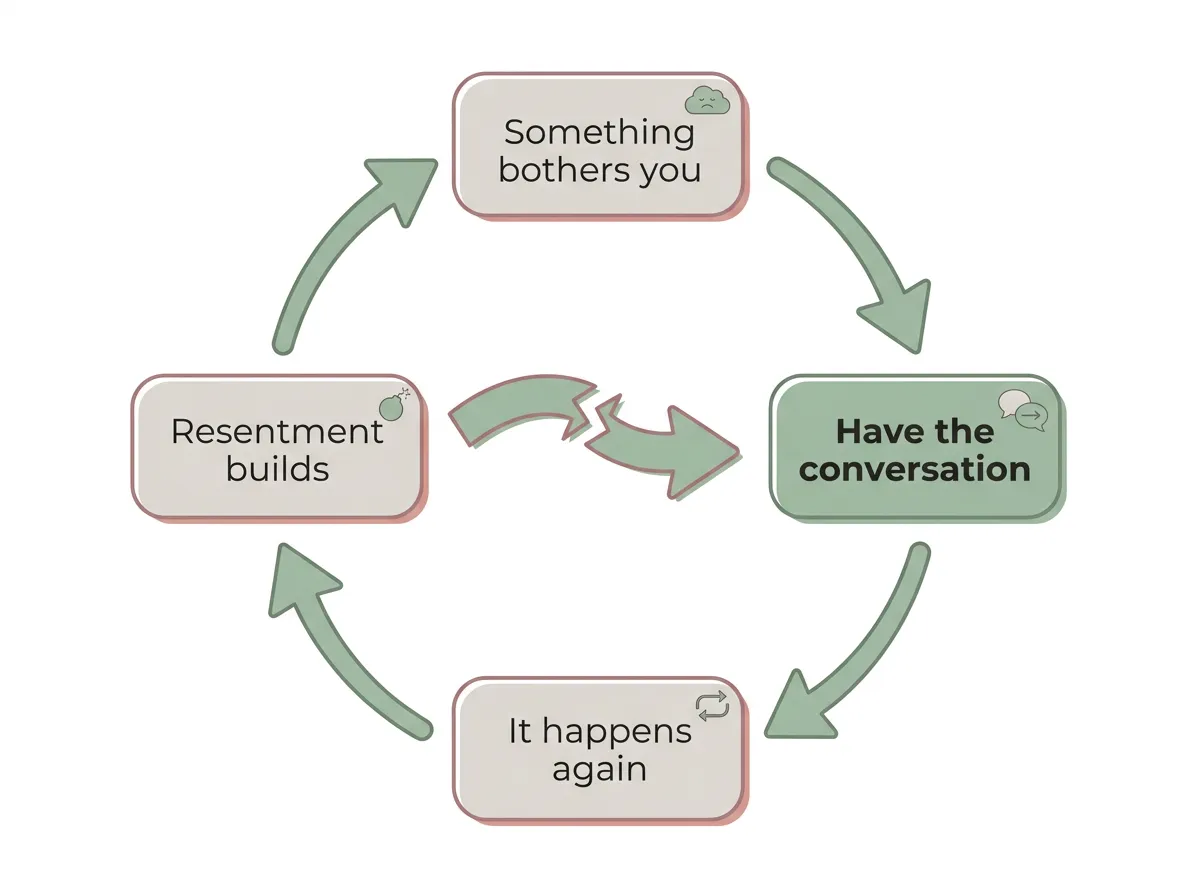
The avoidance cycle looks like this:
- Something bothers you → you say nothing
- It happens again → you feel disrespected
- It happens a third time → you start keeping score
- It happens again → you blow up or shut down entirely
The framework below breaks that cycle by giving you the conversation before you hit the explosion point.
Step 1: Cool Down (But Don't Cool Off)
There's a critical difference between calming down and burying your feelings.
Calming down means waiting 20 to 60 minutes until your heart rate returns to normal and you can form complete sentences without your voice shaking. Go for a walk. Put in earbuds. Take a shower.
Burying your feelings means waiting three weeks, telling yourself it's not a big deal, and then snapping when your roommate leaves a single cup in the sink.
The sweet spot is addressing the issue within 24 to 48 hours of the specific incident. Any sooner and you risk emotional flooding. Any later and the details get fuzzy, the moment passes, and you've trained your roommate to believe the behavior is acceptable.
A Quick Self-Check Before You Speak
Ask yourself these three questions:
- Can I describe the specific behavior that bothered me without using words like "always" or "never"?
- Can I name what I actually need going forward — not just what I want to stop?
- Am I looking for a solution, or am I looking for an apology?
If you can answer yes to the first two, you're ready. (If you only want an apology, that's valid — but it's a different conversation with a different structure. Focus on the solvable problem first.)
Step 2: Set the Stage
How you start the conversation determines 90% of how it ends. The Gottman Institute's research on conflict (originally studied in marriages but widely applied to any cohabitation) calls this the "startup." A harsh startup — accusation, sarcasm, ambush — almost always produces a defensive response.
Here's how to set yourself up for success:
Choose the Right Time
- Not when they just walked through the door
- Not when either of you is hungry, exhausted, or about to leave
- Not over text (tone is invisible in text messages; they'll read it in the worst possible voice)
- Ideal: A neutral moment when you're both home and relatively calm. Weekend morning. After dinner. A low-stakes window.
Use a Soft Open
Don't launch into the issue. Give your roommate a heads-up so they don't feel blindsided.
Scripts you can use tonight:
"Hey, do you have a few minutes? There's something I want to talk about — it's not a huge deal, but I want to bring it up before it becomes one."
"I want to talk about something that's been on my mind. Is now an okay time, or would later work better?"
"Can we chat about the living room situation? I want to figure something out that works for both of us."
Notice what these openers do: they signal respect (asking permission), lower the stakes ("not a huge deal"), and frame the conversation as collaborative ("works for both of us").

Step 3: The 'I' Statement Framework (Word for Word)
This is the core of what RAs, mediators, and therapists teach. It's called the "When you… I feel… I need…" formula, and it works because it removes accusation from the equation.
Here's the structure:
The Formula
| Part | Purpose | Example |
|---|---|---|
| "When you…" | Describe the specific, observable behavior | "When you have friends over past midnight on weeknights…" |
| "I feel…" | Name your emotional response (not a thought — a feeling) | "I feel frustrated and anxious because I can't sleep…" |
| "I need…" | State a clear, specific, forward-looking request | "I need the common areas to be quiet by 10:30 on school nights." |
Why This Works
- "When you…" grounds the conversation in a fact, not an interpretation. You're not saying "You're inconsiderate." You're describing what a camera would record.
- "I feel…" makes it about your experience, which is not debatable. They can argue about whether they're "too loud," but they can't argue about whether you feel frustrated.
- "I need…" gives them a clear, doable action. They don't have to guess what would make you happy.
Common Mistakes to Avoid
"I feel like you don't care about me." This is a thought disguised as a feeling. Replace it with the actual emotion: "I feel disrespected" or "I feel ignored."
"When you always leave your stuff everywhere…" "Always" triggers defensiveness instantly. Be specific: "When you leave dishes in the sink overnight…"
"I need you to stop being so messy." "Messy" is a character judgment. Describe the behavior: "I need us to clean our dishes before bed."
Real-World Examples
Here are five common roommate conflicts turned into 'I' statements you can adapt:
-
Noise: "When you play music without headphones after 10 p.m., I feel stressed because I can't fall asleep. I need us to agree on a quiet hours policy for weeknights."
-
Dishes: "When dishes sit in the sink for more than a day, I feel overwhelmed because the kitchen feels unusable. I need us to each wash our dishes within 24 hours."
-
Guests: "When your partner stays over four or five nights a week, I feel like I've lost my private space. I need us to set a limit on overnight guests — maybe three nights a week?"
-
Rent/Bills: "When the utility payment is late, I feel anxious because it affects my credit. I need us to set up auto-pay or agree on a specific payment date."
-
Borrowing stuff: "When you use my groceries without asking, I feel frustrated because I budget carefully for food. I need us to keep our food separate or ask before using each other's things."
Step 4: Listen Like You Mean It
Here's where most guides stop, and most conversations fall apart. You delivered your 'I' statement beautifully — and now your roommate is responding. Maybe defensively. Maybe with their own grievance. This is the hard part.
What to Do When They Get Defensive
Defensiveness is normal. It doesn't mean the conversation is failing. It means their nervous system just did the same thing yours did when you first realized you needed to have this talk.
Try reflective listening:
"It sounds like you feel like I'm saying you're a bad roommate. That's not what I mean. I'm trying to solve one specific thing."
"I hear you — you didn't realize it was bothering me, and that makes sense because I hadn't said anything until now. That's on me."
Don't: - Interrupt to correct their version of events - Bring up a second issue (one issue per conversation) - Say "calm down" (this has never once calmed anyone down in the history of language)
What to Do When They Raise a Counter-Complaint
This is extremely common. You say, "The dishes bother me," and they say, "Well, you leave your shoes all over the hallway."
Resist the urge to debate which issue is "worse." Instead:
"That's a fair point, and I want to talk about it. Can we finish this one first and then address yours? I don't want either issue to get lost."
This validates their concern without derailing yours.
Step 5: Agree on Something Specific (And Write It Down)
The conversation isn't done when the tension drops. It's done when you both agree on a concrete, specific action.
Vague agreements fail: - ❌ "We'll both try to be more considerate." - ❌ "Let's just communicate more."
Specific agreements stick: - ✅ "Quiet hours from 10:30 p.m. to 8 a.m. on Sunday through Thursday." - ✅ "All dishes washed before bed. If you cook a big meal, you have until the next morning." - ✅ "Overnight guests max three nights per week, and we text each other a heads-up."
Why Written Agreements Matter
Memory is unreliable — especially when emotions were involved. What you "agreed on" last Tuesday will be remembered differently by each of you within a week.
Write it down. It doesn't have to be formal. A shared note in your phone, a Google Doc, or even a text thread labeled "Roommate Agreements" works. Tools like Servanda can help you create structured written agreements and keep both parties accountable — which is especially useful if you've got multiple issues to work through over time.
The point isn't to create a legal contract. It's to have a shared reference so neither of you has to rely on memory or assumptions.
What If It Doesn't Go Well?
Sometimes you do everything right and the conversation still goes sideways. Your roommate shuts down, storms off, or refuses to engage. That's painful, but it's information.
If they need space: Let them have it. Say, "I can see this is a lot. Let's come back to it tomorrow." Then actually follow up.
If they refuse to engage at all: Put your concern in writing (email or a note — not a passive-aggressive sticky note, an honest one). Sometimes people process written words better than spoken ones.
If the pattern continues after the conversation: This is where third parties help. An RA, a mutual friend, or a mediator can provide neutral ground. You're not "escalating" by asking for help — you're being responsible.
If you feel unsafe: Skip all of this. Contact your RA, landlord, or local tenant resources. Your physical and emotional safety comes first, always.
The Cheat Sheet: Your Conversation Template
Here's the entire framework compressed into a quick-reference script:
- Open softly: "Hey, do you have a few minutes to talk about something?"
- Name the behavior: "When [specific thing happens]…"
- Name the feeling: "I feel [emotion]…"
- Name the need: "I need [specific, doable request]."
- Listen and reflect: "I hear you saying [their concern]. Let's talk about that too."
- Agree on specifics: "So we're saying [clear action]. Does that work for you?"
- Write it down: Put the agreement in a shared note or document.
Print this out. Screenshot it. Tape it inside your notebook. Having the structure in front of you when you're nervous is not cheating — it's preparation.
FAQ
What if my roommate gets really angry when I bring up the issue?
Stay calm, acknowledge their reaction ("I can see this caught you off guard"), and offer to pause and come back to it later. You're not responsible for managing their emotions, but you can de-escalate by lowering your own voice and sticking to specific facts rather than character judgments. If the anger feels threatening, remove yourself from the situation and seek support from an RA or trusted third party.
Is it okay to text my roommate about a conflict instead of talking face-to-face?
For minor logistical things ("Hey, can you grab your laundry from the dryer?"), text is fine. For anything involving emotions, frustration, or ongoing patterns, have the conversation in person. Tone is invisible in text, and people almost always read ambiguous messages in the most negative way possible. If in-person feels too intense, a phone or video call is a reasonable middle ground.
How do I bring up something that's been bothering me for months?
Own the delay honestly. Start with something like, "I should have brought this up sooner, and that's on me. I was avoiding it because I didn't want to make things awkward. But it's still bothering me, and I think we should talk about it." This disarms the "why didn't you say something earlier?" response and resets the conversation to the present.
What if we agree on a solution but my roommate doesn't follow through?
Give it one clear, non-aggressive reminder: "Hey, just wanted to check in — we said we'd do quiet hours by 10:30. Last night was a little loud. Can we get back on track?" If the pattern continues after two or three reminders, revisit the conversation and ask what's preventing them from following through. Sometimes the original agreement needs adjusting; sometimes a third party needs to get involved.
Can I talk to my roommate about something that's technically their right but still bothers me?
Absolutely. Having a right to do something doesn't mean it has no impact on the people around you. Your roommate has the right to cook at midnight, but you can still say, "When you cook late at night, the noise and smells make it hard for me to sleep. Can we figure out a compromise?" Frame it as a request for collaboration, not a demand that they stop. They'll be more receptive if they don't feel like their autonomy is being attacked.
Moving Forward
Talking to a roommate you're mad at isn't about winning an argument or proving you're right. It's about protecting a living situation that you both depend on.
The framework in this article — cool down, set the stage, use 'I' statements, listen actively, and agree on specifics — isn't complicated. But it does require a small act of bravery: choosing honesty over avoidance.
The good news is that most roommate conflicts, once they're actually addressed out loud, are surprisingly fixable. The dirty dishes, the noise, the overnight guests — these are logistics problems, not character flaws. And logistics problems have solutions.
The hard part was never the conversation itself. The hard part was starting it. Now you have the script. Use it tonight.