
How to Talk to Your Roommate When You Hate Conflict
It starts small. A pile of dishes that's been sitting in the sink for five days. Music playing at midnight on a Tuesday. A thermostat war nobody acknowledges. You tell yourself it's not a big deal. You tell yourself you're being "chill." But three weeks later, you're seething silently while your roommate eats cereal on the couch—completely unaware that anything is wrong.
If you'd rather endure almost any discomfort than have a potentially awkward conversation, you're not alone. Research from the University of Michigan suggests that most people in shared living situations delay raising concerns for weeks or even months, often until the issue has ballooned into genuine resentment. The problem isn't that you don't know what to say—it's that every version of the conversation you rehearse in your head ends in disaster.
This guide is specifically for people who hate conflict. Not a pep talk about "just being honest." Instead, you'll find concrete frameworks, word-for-word opening lines, and strategies designed for people whose instinct is to avoid, accommodate, and silently stew.
Key Takeaways
- You don't need to be "good at conflict" to have a productive roommate conversation. A simple, structured framework can carry you through even when your instinct is to retreat.
- Timing and setting matter more than the perfect words. Choosing the right moment dramatically reduces the chance of defensiveness.
- Use "I notice" statements instead of accusations. This single language shift makes conversations feel collaborative rather than confrontational.
- Write it down first if speaking feels impossible. A brief, honest text or shared note can open the door to a face-to-face conversation on your terms.
- Small, early conversations prevent big, painful ones. Addressing a minor issue today saves you from an emotional blowup next month.
Why Conflict Avoidance Makes Roommate Problems Worse
Let's be clear: there's nothing wrong with disliking conflict. Conflict-avoidant people are often deeply empathetic. They pick up on tension quickly, they care about how others feel, and they genuinely want harmony. These are strengths.
But in a roommate situation, avoidance has a compounding cost.
The Resentment Spiral
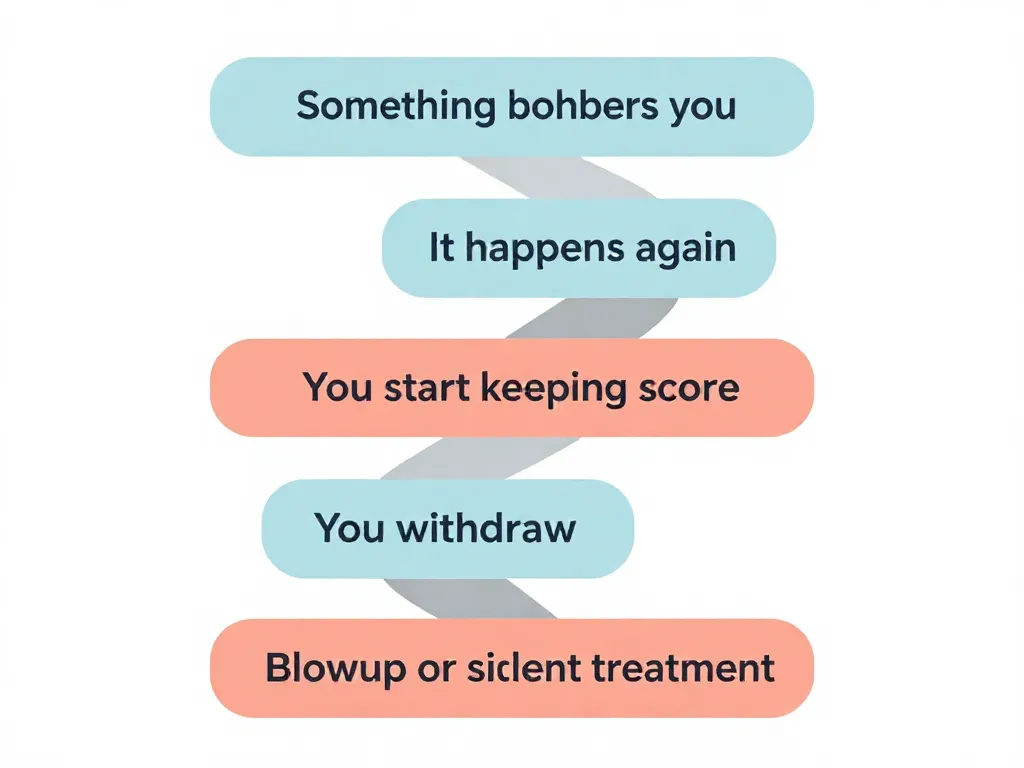
Here's the pattern most conflict-avoidant roommates recognize:
- Something bothers you. It's minor. You say nothing.
- It happens again. You notice it more. You still say nothing.
- It keeps happening. Now you're interpreting it as disrespect. You start keeping a mental scoreboard.
- You emotionally withdraw. Your roommate senses something is off but doesn't know what.
- Something small triggers a disproportionate reaction. Or you just stop talking to each other entirely.
The cruel irony is that the conversation you avoided at Step 1—when it would have been a 30-second, low-stakes exchange—has now become the explosive confrontation you were afraid of all along.
What Your Roommate Is Actually Thinking
Here's something that might help: most of the time, your roommate has no idea there's a problem. That behavior you've been fuming about? They probably think it's totally fine because nobody told them otherwise. The story you've constructed—"They obviously know this is inconsiderate and just don't care"—is almost always wrong.
This isn't about excusing bad behavior. It's about recognizing that the conversation you're dreading is probably going to be much less dramatic than the version you've been rehearsing.
How to Talk to Your Roommate: A Step-by-Step Framework for Conflict-Avoidant People
Forget vague advice about "open communication." Here's a concrete, repeatable process.
Step 1: Get Clear on What You Actually Need
Before you say a word, spend five minutes answering these questions privately:
- What is the specific behavior? (Not "they're messy"—something observable, like "dishes left in the sink for more than two days.")
- How does it affect you? ("I can't cook dinner" or "I feel anxious in my own home" are both valid.)
- What would "good enough" look like? You're not demanding perfection. What change would actually resolve this for you?
This step matters because conflict-avoidant people tend to either minimize the issue ("It's fine, never mind") or catastrophize it ("Everything about this situation is unbearable"). Pinpointing the specific behavior and a realistic solution keeps the conversation grounded.
Step 2: Choose Your Moment Carefully
Timing is at least half the battle. The wrong moment turns a reasonable request into a fight.
Good times to bring something up: - When you're both relaxed and not rushing somewhere - During a natural lull—after dinner, on a weekend morning - When neither of you is hungry, tired, or stressed about something else
Bad times: - In the middle of the problem happening ("Can you turn that down RIGHT NOW") - When they just got home from work - Through the bedroom door - When either of you has been drinking
A line that works well: "Hey, do you have a few minutes to talk about something house-related? Nothing urgent—I just want to get on the same page about something."
That last part—"nothing urgent"—is important. It signals that this isn't an ambush.
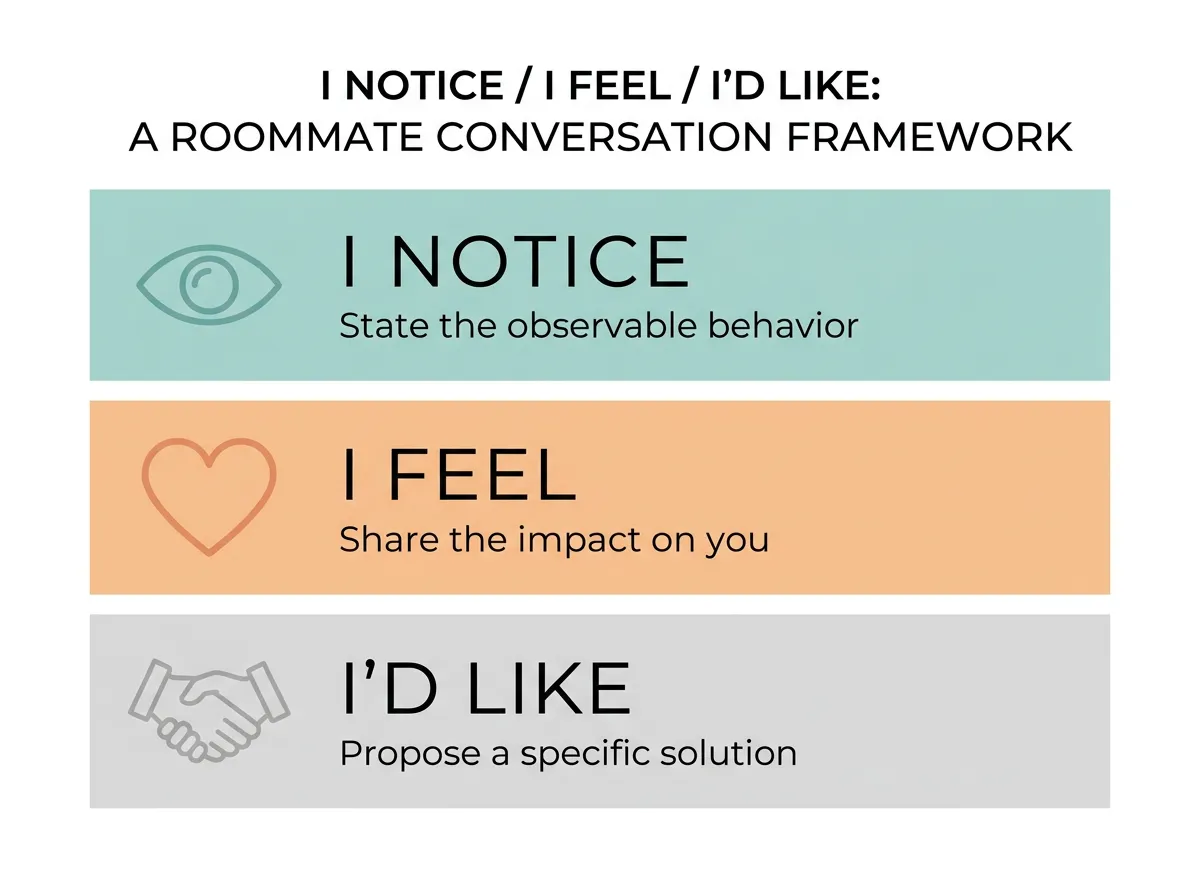
Step 3: Use the "I Notice / I Feel / I'd Like" Framework
This is the core of the conversation. Three sentences. That's it.
"I notice" — State the observable behavior without judgment. "I feel" — Share the impact on you (not an accusation about them). "I'd like" — Propose a specific, reasonable solution.
Here's what this looks like in practice:
Dishes: "I've noticed dishes tend to pile up in the sink for a few days. It makes it hard for me to cook, and honestly, I start to feel stressed about it. Would you be open to a rule where we both wash our dishes within 24 hours?"
Noise: "I've noticed the TV is on pretty late some weeknights. I'm a light sleeper, and it's been affecting my rest. Would it work for you to use headphones after 11?"
Guests: "I've noticed your partner has been staying over most nights this week. I'm totally fine with guests—I just didn't expect it to be this frequent. Could we talk about what works for both of us?"
Notice what's not in these examples: blame, character judgments, or the word "always." You're describing a situation and inviting collaboration.
Step 4: Listen and Negotiate
This is the part conflict-avoidant people fear most—the response. Here's how to handle the most common reactions:
If they're receptive: Great. Agree on the specifics and move on. Don't over-apologize for bringing it up.
If they get defensive: Stay calm and try: "I'm not saying you're doing anything wrong. I just want us to figure out something that works for both of us." Then give them a moment. Defensiveness is usually a first reaction, not a final position.
If they dismiss it: "I hear you, but this is something that's been bothering me for a while, and I'd really appreciate if we could find a middle ground."
If they bring up something about you: Don't panic. Say, "That's fair—I'm glad you're telling me. Let's figure out both things." This is actually a sign the conversation is working. They feel safe enough to be honest too.
Step 5: Put It in Writing
This might sound formal, but it's one of the most effective things you can do. After a productive conversation, a quick text or shared note that summarizes what you agreed to eliminates ambiguity and gives both of you something to reference without having another uncomfortable conversation.
Something as simple as:
"Thanks for chatting earlier. Just to recap: we'll both aim to do dishes within 24 hours, and we'll use headphones for TV/music after 11 pm on weeknights. Sound right?"
Tools like Servanda can help roommates formalize these kinds of agreements into clear, written documents—so expectations stay transparent and you don't have to have the same conversation twice.
What If You Really Can't Say It Out Loud?

Sometimes, no matter how many frameworks you read, the idea of a face-to-face conversation feels paralyzing. That's okay. You have other options.
The Text-First Approach
Sending a thoughtful text isn't avoidance—it's a legitimate communication strategy, especially if you tend to freeze up in person. Here's a template:
"Hey [name], I wanted to bring something up but I'm honestly not great at these conversations in person so I figured I'd text first. I've noticed [specific behavior] and it's been bugging me a bit. I didn't want to let it fester. Can we figure out a solution that works for both of us? Happy to chat about it whenever."
This text works because it's honest about your discomfort, specific about the issue, and opens the door to further conversation without demanding an immediate response.
The Roommate Check-In
If bringing up one specific issue feels too targeted, suggest a regular roommate check-in instead. Frame it as something you want to do before problems come up:
"I was thinking—would it be cool if we did a quick monthly check-in about house stuff? Just ten minutes to make sure everything's working for both of us. I've heard it helps people avoid bigger issues down the road."
This gives you a built-in, recurring, low-pressure container for raising concerns. It's no longer "I need to talk to you about something" (terrifying). It's "Hey, it's our monthly check-in" (routine).
Real Scenarios and What to Say
Let's walk through a few more common situations with specific language you can borrow.
"My roommate never cleans the shared spaces."
Opening line: "I want to figure out a cleaning system that feels fair to both of us. Right now I feel like I'm doing most of the kitchen and bathroom cleaning, and I'm starting to feel a little resentful—which isn't fair to either of us. Can we split it up somehow?"
Pro tip: Suggest a specific system (alternating weeks, dividing by room) rather than a vague "let's both try harder."
"My roommate's partner is basically a third roommate."
Opening line: "I like [partner's name]—I want to say that first. But with them here most nights, it's starting to feel like I have an extra roommate I didn't sign up for. Can we talk about a guest policy that works for everyone?"
Pro tip: Lead with something positive. It disarms defensiveness and shows this isn't personal.
"My roommate is loud late at night."
Opening line: "I know we have different schedules, and I don't want to cramp your style. But I've been losing a lot of sleep because of noise after midnight. Could we agree on a quiet-hours window?"
Pro tip: Acknowledge the difference in lifestyles so they don't feel judged.
"My roommate ate my food."
Opening line: "Hey, this is kind of minor, but I noticed some of my groceries have gone missing. Can we set up a system—maybe separate shelves—so we both know what's fair game?"
Pro tip: Offering a structural solution (separate shelves, labeling) beats asking someone to change their behavior through willpower alone.
What If the Conversation Goes Badly?
Sometimes it will. Not every roommate is reasonable, and not every conflict has a tidy resolution. If you've tried a calm, specific, solution-oriented approach and your roommate refuses to engage—or worse, retaliates—you have options:
- Document the issues. Dates, specifics, and any written exchanges.
- Involve a neutral third party. An RA, landlord, or mutual friend can mediate.
- Know your rights. If you're on a lease, your landlord may be able to help with habitability issues or lease violations.
- Make an exit plan. Some living situations aren't fixable, and it's not a failure to recognize that.
The goal of speaking up was never to guarantee a perfect outcome. It was to give yourself the chance at one—and to stop carrying the full weight of the problem alone.
FAQ
How do I bring up a problem with my roommate without making it awkward?
Choose a relaxed moment, lead with something like "Hey, can we chat about something house-related?" and use specific, non-accusatory language. Awkwardness is temporary—unresolved resentment lasts much longer. Most roommates actually appreciate directness because it shows respect.
Is it okay to text my roommate about a problem instead of talking in person?
Absolutely. A well-written text can be more effective than a face-to-face conversation, especially if you tend to freeze up or get emotional in person. Just make sure your text is specific, non-blaming, and invites a response rather than issuing an ultimatum.
What if my roommate gets mad when I bring up an issue?
A defensive reaction doesn't mean the conversation was a mistake. Give them space to process, stay calm, and avoid escalating. You might say, "I'm not attacking you—I just want us to solve this together." If they consistently respond with anger or hostility, consider involving a neutral mediator.
How do I stop being passive-aggressive with my roommate?
Passive aggression usually comes from unspoken frustration. The antidote is direct, low-key communication before resentment builds. Start with small issues—practice using the "I notice / I feel / I'd like" framework for minor annoyances so that speaking up becomes a habit rather than a crisis.
Should roommates have a written agreement?
Yes—even if you're friends. A simple written agreement covering chores, guests, noise, and shared expenses prevents most common roommate conflicts. It's not about distrust; it's about making sure everyone's on the same page from the start.
Conclusion
Hating conflict doesn't mean you have to live with problems you never address. It means you need a different approach—one that works with your temperament instead of against it. The frameworks in this guide are designed to lower the stakes, give you specific words to say, and make the conversation feel less like a confrontation and more like a quick problem-solving session.
Start small. The next time something bothers you, try raising it within 48 hours using the "I notice / I feel / I'd like" framework. You'll probably be surprised by how undramatic it is. And each time you do it, the next conversation gets easier.
You don't need to become someone who loves difficult conversations. You just need a system that makes them survivable. You already have one. Now go use it.