
Stop Saying 'You': How I-Statements Save Roommates
It's 11:47 p.m. on a Tuesday. You have an 8 a.m. exam. And your roommate is on a speakerphone call — laughing, loud, completely oblivious. Your jaw tightens. You rip out your earbuds and say the first thing that comes to mind:
"You are SO inconsiderate. You never think about anyone but yourself."
And just like that, the problem isn't the noise anymore. It's a full-blown character attack. Your roommate gets defensive, fires something back, and now you're both lying in the dark seething — and neither of you is sleeping.
This scene plays out in dorm rooms and shared apartments every single night. The issue was solvable in thirty seconds. But the language made it personal. The good news? There's a deceptively simple communication shift — backed by decades of psychotherapy research and endorsed by every resident advisor who's ever knocked on a door at midnight — that can stop this spiral before it starts. It's called the I-statement, and it might be the single most useful skill you develop while sharing a living space.
Key Takeaways
- "You" language triggers defensiveness instantly. When people hear "you always" or "you never," their brain treats it as an attack — and they stop listening.
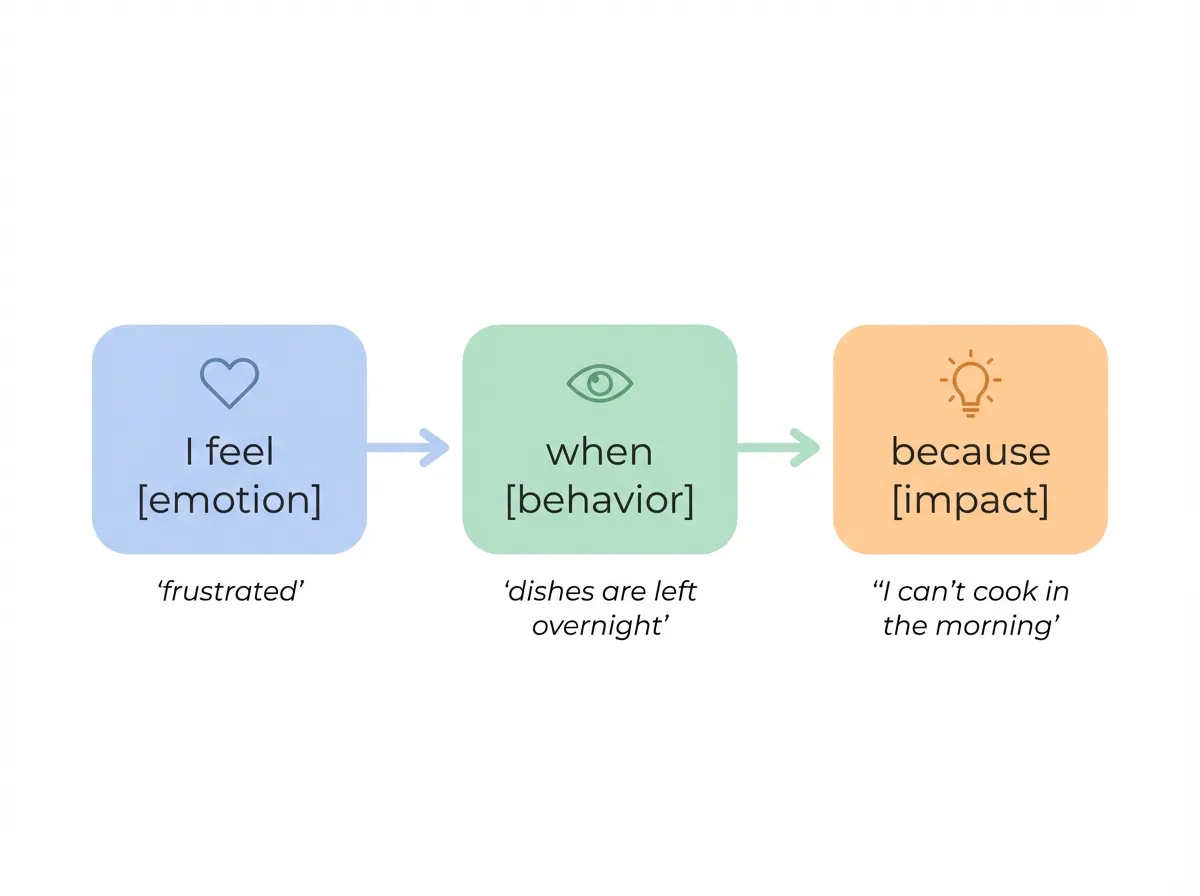
- I-statements follow a simple formula: "I feel [emotion] when [specific behavior] because [impact on you]." This keeps the focus on the problem, not the person.
- You don't need your roommate to learn this too. Using I-statements unilaterally changes the dynamic of any conversation.
- Small language shifts prevent big blowups. Most roommate friendships don't end over one catastrophic event — they erode through dozens of poorly handled small moments.
- Practice tonight, not "someday." The framework takes five minutes to learn and gets easier every time you use it.

Why "You" Is a Loaded Word
Let's start with why your current instinct — pointing the finger — backfires so reliably.
When you say "You left your dishes in the sink again," your roommate doesn't hear a factual observation about dishware. They hear: "You are a bad, lazy, disgusting person." That's not an exaggeration. Psychotherapist Dr. John Gottman's research on conflict identified criticism — framing complaints as character flaws — as one of the most destructive communication patterns in any relationship, including non-romantic ones. He calls it one of the "Four Horsemen of the Apocalypse" for relationships.
Here's why it happens:
- "You" + negative verb = identity threat. The listener's brain goes into fight-or-flight mode. They're no longer processing your request — they're defending their sense of self.
- Absolutes make it worse. Pairing "you" with "always" or "never" ("You never clean up") feels like an unfair verdict, not a conversation starter.
- The response becomes symmetrical. Once one person attacks, the other mirrors it. "Well, you leave your hair all over the bathroom." Now you have two unresolved problems instead of one.
Resident advisors see this pattern constantly. As one RA at a large state university described it in a housing forum: "By the time roommates come to me, they've each built a mental case file against the other. They don't want solutions — they want a judge. My first job is getting them to stop prosecuting each other."
The I-statement is how you avoid needing that judge in the first place.
What Is an I-Statement? The Exact Formula
An I-statement is a structured way of expressing a concern that keeps the focus on your experience rather than your roommate's character. It was originally developed in the 1960s by psychologist Thomas Gordon and has since become a foundational tool in couples therapy, family therapy, workplace mediation, and — yes — roommate conflict resolution.
The Formula
"I feel [emotion] when [specific, observable behavior] because [concrete impact on you]."
That's it. Three parts. Let's break each one down.
1. "I feel [emotion]"
Name a genuine feeling. Not a thought disguised as a feeling. This is the part most people get wrong on the first try.
| ✅ Actual Feelings | ❌ Thoughts Disguised as Feelings |
|---|---|
| frustrated | like you don't care |
| anxious | like you're being selfish |
| overwhelmed | that you're a slob |
| disrespected | like you're doing this on purpose |
"I feel like you don't care" is still a "you" statement wearing a trench coat. Stick to one-word emotions: frustrated, stressed, anxious, hurt, uncomfortable, overwhelmed.
2. "When [specific, observable behavior]"
Describe what happened like a security camera would — no interpretation, no motive-guessing, no editorializing.
| ✅ Observable | ❌ Interpreted |
|---|---|
| when there are dishes in the sink overnight | when you trash the kitchen |
| when music plays past midnight | when you keep me up all night |
| when guests stay over without a heads-up | when you act like this is your apartment only |
3. "Because [impact on you]"
Explain the real-world consequence to you. This is what makes the other person actually understand why it matters, rather than just feeling scolded.
- "…because I can't use the counter to cook in the morning."
- "…because I have an exam at 8 and I need to sleep by midnight."
- "…because I wasn't comfortable getting changed with someone I didn't know in the common area."
Putting It All Together: Before and After
Let's revisit the opening scenario with the I-statement formula applied:
| Before (You-Statement) | After (I-Statement) |
|---|---|
| "You are SO inconsiderate. You never think about anyone but yourself." | "I'm feeling really stressed right now because when there's a loud call at this hour, I can't fall asleep and I have a big exam in the morning." |
Notice what changed: - No character attack. - A specific behavior (loud call at this hour), not a verdict ("you're inconsiderate"). - A concrete impact (can't sleep, exam tomorrow), which gives your roommate something actionable to respond to.
Most reasonable people will lower their voice or move to the hallway after hearing this. Not because they were shamed into it — but because they were given information and a reason to care.
Real Scenarios: I-Statements in Action
Here are five common roommate friction points rewritten with I-statements. Use these as templates and adapt them to your own situation.
Scenario 1: The Disappearing Groceries
- ❌ "You keep eating my food. Buy your own stuff."
- ✅ "I feel frustrated when the groceries I bought are gone before I can use them, because I budget carefully and can't afford to replace things mid-week. Can we figure out a system for shared vs. personal food?"
Scenario 2: The Overnight Guest
- ❌ "You can't just have people sleep over whenever you want."
- ✅ "I feel uncomfortable when there's a guest overnight without a heads-up, because I don't sleep well when I'm not expecting someone else in the room. Could we agree on a quick text beforehand?"
Scenario 3: The Thermostat War
- ❌ "You keep blasting the AC. It's freezing in here."
- ✅ "I feel really cold when the thermostat goes below 68, because I have a hard time concentrating when I'm uncomfortable. Can we find a temperature that works for both of us?"
Scenario 4: The Dirty Bathroom
- ❌ "This bathroom is disgusting. You never clean it."
- ✅ "I feel overwhelmed when the bathroom hasn't been cleaned in a while, because I start to dread using it. Could we set up a weekly rotation?"
Scenario 5: The Loud Morning Routine
- ❌ "You're so loud in the morning. Some of us are trying to sleep."
- ✅ "I feel groggy and irritable when I get woken up before my alarm, because I structured my schedule around sleeping until 9. Would it be possible to keep things quieter before then?"
In every case, the I-statement does two things the you-statement cannot: it makes the speaker vulnerable instead of aggressive, and it ends with a collaborative question instead of a demand.

How to Start Using I-Statements Tonight
Knowing the formula is one thing. Actually using it when you're annoyed is another. Here's a practical, step-by-step approach to building the habit.
Step 1: Pause Before You Speak
If you notice the word "you" forming as the first word of your sentence, stop. Take one breath. That single breath creates enough space to restructure your sentence. Therapists call this the "sacred pause" — and it's the difference between reacting and responding.
Step 2: Identify Your Actual Feeling
Anger is usually a surface emotion. Underneath it, you're probably feeling one of these:
- Anxious — about the exam, the mess, the boundary.
- Hurt — that your needs seem invisible.
- Overwhelmed — by the accumulation of small issues.
- Disrespected — that an agreement was ignored.
Naming the real feeling makes your I-statement more honest and, paradoxically, more persuasive.
Step 3: Write It Down First (Seriously)
For your first few attempts, draft the I-statement in your Notes app before saying it out loud. This feels awkward, but it prevents you from slipping into accusatory language mid-sentence. Once you've done it five or six times, the structure becomes automatic.
Step 4: Deliver It at the Right Moment
Timing matters almost as much as wording. Don't deliver an I-statement:
- In the heat of the moment when you're both activated.
- Over text, where tone is impossible to read.
- In front of other people.
Do deliver it:
- In a calm, private moment.
- Face to face, when both of you have bandwidth.
- Within 24–48 hours of the incident (don't stockpile grievances for months).
Step 5: Follow the Statement with a Question
The I-statement opens the door. A collaborative question walks through it.
- "How do you feel about that?"
- "What would work for you?"
- "Can we come up with something together?"
This signals that you're looking for a solution, not an apology tour.
What If Your Roommate Doesn't Respond Well?
Let's be honest: I-statements aren't magic. Some people will still get defensive. Some will dismiss your feelings. Some will agree in the moment and change nothing.
Here's what to do in each case:
If they get defensive anyway: Don't escalate. Acknowledge their reaction ("I can see this feels frustrating to hear") and reiterate the behavior and impact without adding new accusations. Sometimes it takes a second conversation.
If they dismiss your feelings: That tells you something important about the relationship dynamic. Document the conversation and, if needed, involve a neutral third party — an RA, a mutual friend, or a mediator. Tools like Servanda can help you create written agreements that formalize expectations so both parties have a shared reference point when memory or interpretation diverge.
If they agree but don't change: Return to the I-statement framework — this time adding the pattern: "I feel discouraged when we agree on something and it doesn't happen, because it makes me question whether my concerns are being taken seriously." If the pattern persists after multiple conversations, it may be time to explore room changes or involve housing staff.
Common Mistakes to Avoid
Even well-intentioned I-statements can go sideways. Watch for these pitfalls:
- Disguised you-statements. "I feel like you don't respect me" is still an accusation. Replace the clause after "feel" with a single emotion word.
- Weaponized therapy-speak. If you deliver an I-statement with a sarcastic tone or an eye-roll, the words don't matter. Tone carries more weight than syntax.
- Using I-statements only for complaints. The framework works for positive communication too: "I felt really appreciated when you tidied the kitchen before my parents visited. That meant a lot." This reinforces the behavior you actually want.
- Expecting perfection. You will mess up. You'll slip into "you" language, especially when you're tired or stressed. That's normal. The goal is a trend, not a flawless record.
- Overusing the formula robotically. Once you internalize the structure, let it become natural. You don't need to say "I feel... when... because..." verbatim every time. The principle — own your experience, describe behaviors not character, explain impact — can show up in a hundred different phrasings.
The Science Behind Why This Works
I-statements aren't just a nice idea from a conflict resolution workshop. There's solid research supporting the approach:
- Gottman's research on the "soft startup" shows that conversations that begin without criticism or contempt are significantly more likely to end in resolution. The first three minutes of a conflict conversation predict the outcome with over 90% accuracy.
- Self-Determination Theory suggests people are more willing to change behavior when they feel autonomous rather than controlled. I-statements make a request; you-statements issue a command.
- Neuroscience of threat response: Accusatory language activates the amygdala (the brain's threat-detection center), reducing activity in the prefrontal cortex — the part responsible for reasoning, empathy, and problem-solving. In other words, the moment you say "You always...," your roommate's brain literally becomes less capable of understanding your point.
The takeaway: I-statements don't just feel nicer. They make the other person physiologically more capable of hearing you.
Frequently Asked Questions
Do I-statements actually work, or do they sound fake?
They can feel awkward at first — kind of like learning to type with proper finger placement. But the awkwardness fades quickly, and most people on the receiving end won't notice the "formula" at all. They'll just notice that the conversation feels less hostile. If it feels too scripted, focus on the principle (own your feelings, describe behavior, explain impact) rather than the exact wording.
What if my roommate uses I-statements against me in a manipulative way?
This does happen. "I feel angry when you exist" is technically an I-statement, but it's not a good-faith one. The test is whether the statement describes an observable behavior and a genuine impact. If someone uses the framework to make unreasonable demands ("I feel stressed when you breathe loudly"), that's a boundary issue, not a communication issue, and may require a mediator.
Can I use I-statements over text with my roommate?
You can, but proceed carefully. Text strips away tone, facial expression, and pacing — all of which help I-statements land well. If you must use text, keep it short, avoid emojis that could read as passive-aggressive, and follow up in person. For serious or recurring issues, face-to-face is always better.
How do I bring up multiple issues without sounding like I have a list of complaints?
Pick the one issue that matters most and start there. Stacking multiple I-statements in one conversation feels like an ambush, no matter how well they're worded. Solve one thing, build trust, then address the next issue a few days later. Progress beats perfection.
What's the difference between an I-statement and just being passive?
An I-statement is assertive, not passive. Passive would be saying nothing and letting resentment build. Aggressive would be attacking their character. An I-statement names the problem directly and asks for change — it just does so without making the other person the villain. It takes more courage than yelling, not less.
Moving Forward: One Conversation at a Time
Roommate relationships rarely implode from a single dramatic incident. They erode — one unspoken frustration, one snapped accusation, one cold shoulder at a time. The damage isn't from the dirty dishes or the loud music. It's from the way we talk about the dirty dishes and the loud music.
I-statements won't fix every roommate problem. But they change the pattern. They replace prosecution with conversation. They turn "you vs. me" into "us vs. the problem." And they're available to you right now, tonight, without anyone's permission or cooperation.
The next time you feel that sentence forming — "You always..." — pause. Breathe. Restructure. Name what you feel, describe what happened, explain why it matters. It takes ten extra seconds. Those ten seconds might save the next ten months of living together.