
Introvert + Extrovert: The Weekend Battle Plan
It's Friday at 5 p.m. and the texts start flying.
"Hey, Jake and Mia invited us to that new rooftop bar tonight, then brunch tomorrow with the whole group!"
"...I was kind of hoping we could just order Thai food and watch that documentary."
Silence. Then the slow simmer of resentment that has played out a hundred Fridays before.
One person caves. The other feels guilty. Nobody actually enjoys the weekend. By Sunday night, there's a low-grade tension neither of you can name, and Monday morning feels less like a fresh start and more like an emotional hangover.
This isn't a personality flaw on either side. It's an energy management problem disguised as a scheduling conflict. And it's fixable — not with vague advice about "meeting in the middle," but with a concrete weekend battle plan you can both commit to.
Why This Fight Keeps Happening (And Why It's Not Really About Saturday)
The introvert-extrovert weekend conflict feels repetitive because it is repetitive. It's structural. The underlying needs don't change week to week:
- The extroverted partner recharges through social connection. After five days of work routines, the weekend represents freedom — a chance to feel alive through people, novelty, and shared energy.
- The introverted partner recharges through solitude or low-stimulation environments. After five days of performing socially at work, the weekend represents recovery — a chance to feel whole again through quiet and autonomy.
Neither need is negotiable. That's the part most couples miss. You're not arguing about whether to go to the party. You're arguing about whose nervous system gets to recover this week.
When partners frame this as a preference — "You prefer staying home" versus "You prefer going out" — it minimizes what's actually a physiological need. Research in personality psychology consistently shows that introverts and extroverts literally process dopamine differently. The extrovert's brain is reaching for stimulation the way a dehydrated person reaches for water. The introvert's brain is pulling back from overstimulation the way someone with a migraine pulls back from fluorescent lights.
Once you see it that way, the argument stops being about who's "right" and starts being about how two people with different energy systems can share 48 hours without draining each other dry.
The Weekend Battle Plan: A Framework That Actually Works
Forget compromise as a concept for a moment. Compromise implies both people getting less of what they need. What works better is rotation and design — building weekends with intentional structure so both partners get enough fuel to feel good.
Step 1: Map Your Energy Budgets on Wednesday
Don't wait until Friday night to negotiate. By then, the extrovert has already mentally committed to plans and the introvert is already mentally nesting. The collision is inevitable.
Instead, have a five-minute Wednesday check-in. Each partner answers two questions:
- How drained am I right now, on a scale of 1–10? (1 = fully recharged, 10 = running on fumes)
- What's the one thing I need most this weekend? (Be specific: "Two hours completely alone on Saturday morning" or "One evening out with friends where we both go.")
This isn't a negotiation yet. It's just data. You're mapping the terrain before you draw the route.
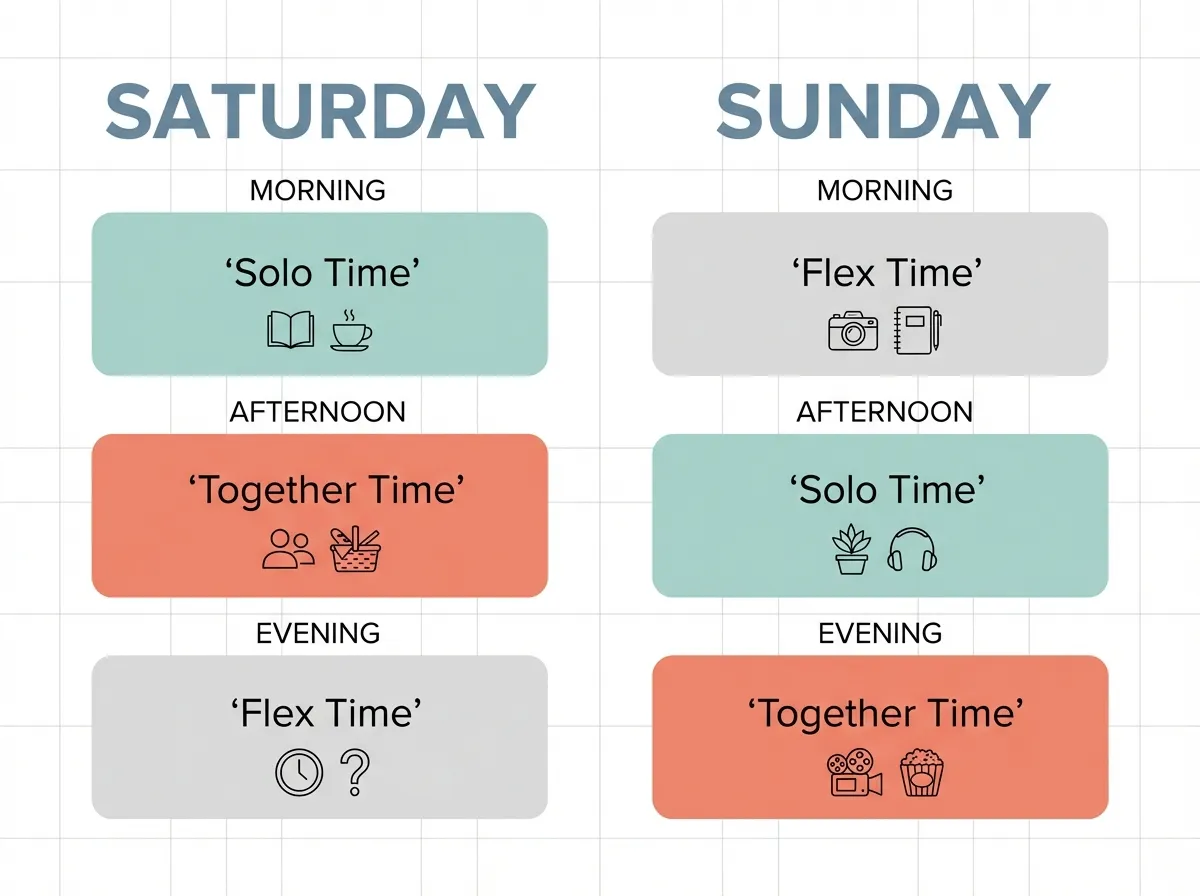
Step 2: Designate "Together" Time, "Solo" Time, and "Flex" Time
Split your weekend hours into three buckets:
- Together time: Activities you do as a couple, whether social or quiet. Non-negotiable connection.
- Solo time: Hours where each person does exactly what they need without guilt or explanation.
- Flex time: Unstructured hours that can go either way depending on mood and energy.
A sample weekend might look like this:
| Time Block | Saturday | Sunday |
|---|---|---|
| Morning | Solo time (introvert reads, extrovert calls a friend) | Together time (farmers market or coffee run) |
| Afternoon | Flex time | Solo time |
| Evening | Together time (dinner party with one other couple) | Together time (cook dinner, watch a show) |
The specific activities don't matter as much as the structure. When both partners can see that their needs are accounted for on paper, the anxiety drops. The introvert stops bracing for a wall-to-wall social marathon. The extrovert stops fearing a weekend of silent isolation.
Step 3: Use the "One Social, One Quiet" Rule
For couples who are just starting to build this muscle, a simple default helps: one social event and one quiet activity per weekend, minimum.
This doesn't mean perfectly equal time. It means both energetic needs get addressed at least once. Some weekends will skew more social, some more quiet — and that's fine, as long as it balances over the month.
Examples of how real couples apply this:
- Priya and Tom: Saturday evening is a group dinner (Tom's social need). Sunday is a long hike — just the two of them, no phones (Priya's quiet need). Both feel seen.
- Marcus and David: Friday night they host one friend for a low-key board game evening (social but contained). Saturday afternoon, David goes to a coffee shop alone while Marcus goes to a friend's barbecue. Sunday they cook together.
- Lin and Jordan: They alternate who "leads" the weekend. On Lin's weekends, plans are quieter. On Jordan's weekends, plans are more social. Neither fights the other's lead.
Notice what all of these have in common: nobody is being dragged into something, and nobody is being left behind. The structure creates room for both.
Step 4: Build Escape Hatches Into Social Plans
One of the most corrosive patterns in introvert-extrovert couples is the unspoken hostage situation: the introvert goes to the party but seethes quietly, counting the minutes, while the extrovert senses the resentment and can't relax.
The fix is simple and surprisingly effective: agree on exit logistics before you arrive.
- Drive separately, or agree on a departure time in advance.
- Create a low-key signal (a specific phrase, a hand on the shoulder) that means "I'm hitting my wall — I need to leave in 20 minutes."
- The extrovert gets permission to stay longer solo if the introvert leaves first. No guilt. No scorekeeping.
This one change transforms social events from endurance tests into genuine choices. The introvert shows up more willingly because they know they can leave. The extrovert relaxes because they're not watching their partner for signs of misery.
Step 5: Protect the Transition Zone
The most volatile moment in an introvert-extrovert weekend isn't during the party or during the quiet time. It's the transition between the two.
The extrovert comes home buzzing from a night out, wants to debrief, wants connection. The introvert has been recharging in silence for three hours and isn't ready to match that energy. Collision.
Or: the introvert has been reading alone all morning, feeling centered. The extrovert bursts in with a spontaneous plan. The introvert's peace shatters. Resentment.
Protect these transitions with a simple buffer:
- After social events, allow 30 minutes of parallel decompression — same room, low stimulation, no pressure to talk.
- Before shifting from solo time to together time, give a 15-minute heads-up: "Hey, I'd love to start making dinner together in about 15 minutes."
These buffers prevent enormous fights.

What to Do When the Plan Breaks Down
No framework survives contact with real life every single weekend. Sometimes the extrovert gets a last-minute invite that feels unmissable. Sometimes the introvert has a brutal work week and can't handle even the agreed-upon social event. Life happens.
When the plan breaks down, avoid two traps:
- The Scorekeeping Trap: "I went to YOUR friend's birthday last weekend, so you owe me." Transactional framing poisons goodwill. Instead, name the need: "I'm running on empty. I need this Saturday to be quieter than we planned."
- The Martyrdom Trap: "Fine, I'll just go alone. Again." Passive resentment isn't flexibility. If you're genuinely okay going solo, say that cleanly. If you're not, say what you actually need.
A useful repair phrase when plans shift: "This isn't what we planned. What would make this weekend work for both of us given where we are right now?"
It's not magic. It's a reset that keeps you on the same team instead of retreating to opposite corners.
For couples who find these negotiations keep spiraling, tools like Servanda can help you formalize your weekend agreements into a written plan — not as a contract, but as a shared reference point you can return to when emotions make it hard to remember what you actually decided together.
The Deeper Win: Respecting Different Wiring
The weekend battle plan isn't really about Saturday. It's about whether two people with different nervous systems can build a life that respects both of their wiring without one person perpetually adapting to the other.
When this works, something subtle shifts. The introvert stops seeing social plans as an imposition and starts seeing them as a gift to their partner — because their own recovery time is protected. The extrovert stops seeing quiet weekends as rejection and starts seeing them as their partner's way of showing up fully recharged for the time they do spend together.
That shift — from "you're limiting me" to "you're fueling yourself so you can be present with me" — is the difference between a couple that fights every Friday and a couple that actually looks forward to the weekend.
Conclusion
The introvert-extrovert weekend conflict isn't a sign that you're incompatible. It's a sign that you haven't built the structure to hold both of your needs at the same time. Map your energy on Wednesdays. Designate together, solo, and flex time. Use the one-social-one-quiet rule. Build escape hatches. Protect the transitions.
None of this requires one partner to fundamentally change who they are. It requires both partners to get specific about what they need and creative about how to deliver it. Start this Wednesday. One five-minute conversation. See what shifts by Sunday night.
Frequently Asked Questions
How do introvert-extrovert couples stop fighting about weekend plans?
The most effective approach is to stop negotiating in the moment and instead create a recurring structure — a midweek check-in where both partners share their energy levels and needs, followed by a weekend plan that includes dedicated solo time, together time, and flex time. This removes the Friday-night standoff because both people already know their needs are built into the schedule.
Is it okay for an introvert to skip social events their partner wants to attend?
Yes, as long as it's handled with clear communication rather than passive withdrawal. Agree ahead of time that the introvert can leave early or stay home while the extrovert goes solo — no guilt, no scorekeeping — and balance it over the month so the extrovert's social needs are also supported.
Why do introverts and extroverts need different things on weekends?
It comes down to how each person's brain processes stimulation and dopamine. Extroverts recharge through social connection and novelty, while introverts recharge through solitude and low-stimulation environments — these are physiological needs, not mere preferences, which is why the conflict feels so intense and repetitive.
What's the best approach for introvert-extrovert couples on weekends?
Rather than traditional compromise where both people get less, aim for rotation and intentional design — alternate who leads the weekend's tone, use the one-social-one-quiet rule, and build in escape hatches so no one feels trapped. Over the course of a month, both partners' needs should be met roughly equally even if individual weekends skew one direction.
How do you stop keeping score in a relationship with different social needs?
Replace transactional language like "you owe me" with need-based language like "I'm running on empty and need this weekend to be quieter than planned." Having a shared written plan — even a simple one you revisit each Wednesday — gives both partners a reference point so disagreements stay collaborative rather than accusatory.