Is Fighting Normal? What Healthy Conflict Looks Like
It's 9:47 p.m. on a Tuesday. You just had a twenty-minute argument about whose turn it is to deal with the overflowing recycling bin. Now you're lying in bed, staring at the ceiling, running a quiet calculation in your head: How many times have we fought this month? Is this too much? Are we broken?
No. Fighting doesn't mean your relationship is failing. In fact, the total absence of conflict is often a bigger red flag than the presence of it. But not all fighting is created equal. There is a specific pattern of conflict that relationship researchers have identified as destructive, and it has nothing to do with how often you argue or how loud your voice gets. What matters far more is how you fight, and what happens between you after the dust settles.
Why Couples Fight: The Most Common Triggers
Research consistently surfaces the same handful of topics as the most common relationship arguments:
- Household responsibilities — who does what, and whether it's fair
- Money — spending habits, saving priorities, financial stress
- Intimacy and affection — mismatched needs or expectations
- Parenting differences — discipline styles, screen time, routines
- Time and attention — feeling neglected, phone use, work-life balance
- Extended family — in-law boundaries, holiday logistics
- Communication itself — feeling unheard, stonewalled, or dismissed
These aren't exotic, relationship-ending crises. They're the mundane, everyday friction points that come from sharing a life with another human being who has a different brain, different history, and different instincts than you.
The fact that you argue about the dishes or the budget doesn't mean something is wrong with your relationship. It means you're in one.
So Is Fighting Normal in a Relationship?
Yes.
Dr. John Gottman, whose Love Lab at the University of Washington has studied thousands of couples over four decades, found that the presence of conflict is not what distinguishes happy couples from unhappy ones. Both groups argue. Both groups get frustrated. Both groups sometimes raise their voices.
The difference? Happy couples maintain a ratio of roughly 5:1 — five positive interactions for every negative one, even during disagreements. They fight, but the relationship's emotional bank account stays in the black.
Meanwhile, couples who never fight often aren't peaceful — they're avoidant. They've learned that bringing up issues leads to pain, so they stop bringing them up entirely. The resentment doesn't disappear; it goes underground, where it quietly corrodes trust, intimacy, and emotional connection.
Avoiding conflict isn't harmony. It's silence masquerading as safety.
The One Fight Pattern That Actually Destroys Relationships
If frequency of fighting isn't the danger signal, what is?
Gottman's research points to four specific behaviors so reliably destructive that he calls them the Four Horsemen of the Apocalypse:
1. Criticism
Attacking your partner's character rather than addressing a specific behavior.
- Destructive: "You never think about anyone but yourself."
- Healthier: "I felt hurt when you made plans without checking with me first."
2. Defensiveness
Meeting a complaint with a counter-complaint or excuse, refusing to take any ownership.
- Destructive: "Well, if you didn't nag me about it every five seconds, I'd help more."
- Healthier: "You're right, I dropped the ball on that. I'm sorry."
3. Stonewalling
Shutting down, withdrawing, or going emotionally blank during a conversation.
- What it looks like: Walking away mid-sentence, giving the silent treatment, scrolling your phone while your partner is talking.
- What to do instead: "I'm flooded right now. I need 20 minutes to calm down, and then I want to come back to this."
4. Contempt
Contempt — sarcasm, mockery, eye-rolling, sneering, name-calling, hostile humor — is the single strongest predictor of divorce in Gottman's research. It communicates something worse than anger: disgust. It says, "I don't just disagree with you. I'm above you."
- Destructive: "Oh, you're going to lecture me about budgeting? That's hilarious."
- What contempt-free disagreement sounds like: "I see this differently than you, and I want to explain why."
It's not that you fight. It's whether contempt has taken root in the way you fight. A couple who argues loudly about the dishes but ends the night laughing together is in far better shape than a couple who rarely raises their voice but communicates through eye-rolls and quiet disdain.
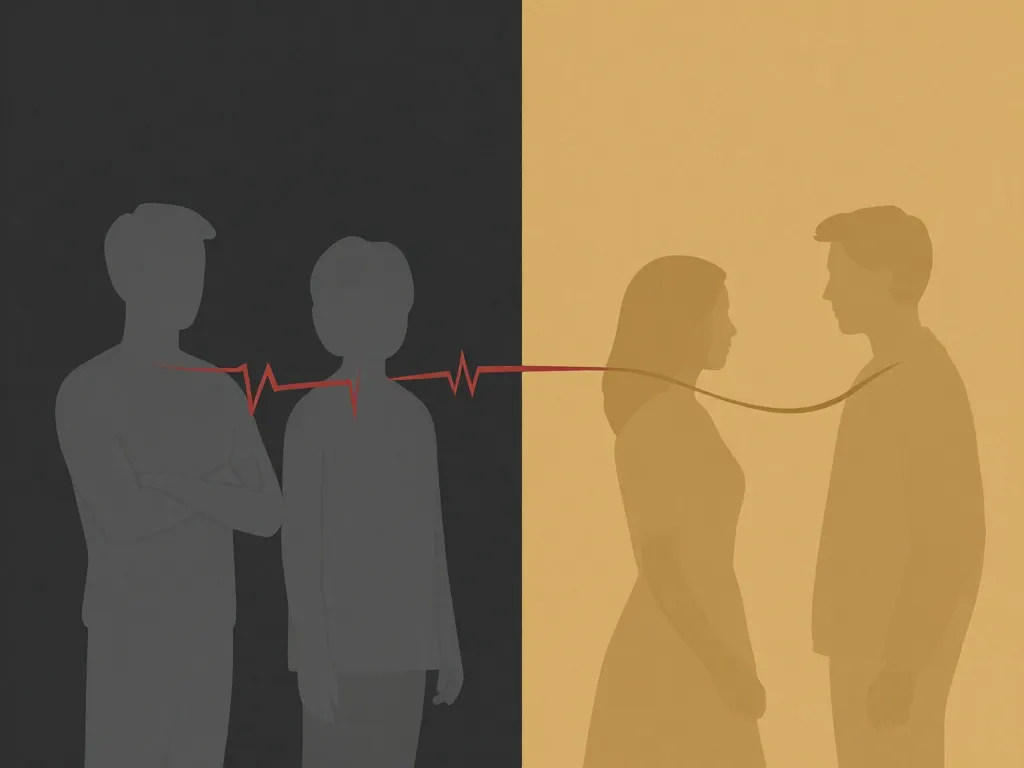
What Healthy Conflict Actually Looks Like
Healthy conflict in relationships isn't pretty. It's not the serene, soft-voiced conversation you see in therapy montages on TV. It's messy, uncomfortable, and sometimes loud. But it has a few defining characteristics that separate it from the destructive kind:
It stays specific
Healthy arguments are about this specific thing that happened, not about your partner's entire personality. "You forgot to pick up the prescription" is specific. "You always forget everything because you don't care" is a character indictment.
It allows influence
In productive disagreements, both partners remain open to being changed by the conversation. If you've already decided you're right before the argument starts, you're not arguing — you're prosecuting.
It includes repair attempts
Repair attempts are anything that de-escalates tension during or after a fight: a joke, an apology, a touch, a concession, saying "I hear you." Gottman's research found that the success or failure of repair attempts is one of the primary factors that predicts whether a relationship will last.
It ends (even if the issue doesn't)
Healthy arguments have a conclusion — not necessarily a resolution, but a point where both partners agree to stop, reconnect, and return to the issue later if needed. Fights that stretch for hours, bleed into the next day, or cycle endlessly without any pause are a sign the conflict has become more about emotional flooding than about the actual issue.
It doesn't threaten the relationship itself
In healthy conflict, the relationship is never on the table. Statements like "maybe we should just break up" or "I don't even know why I'm with you" weaponize the relationship itself, turning every disagreement into an existential threat.
How to Argue Better: Practical Shifts You Can Make Today
1. Start softly
Gottman's research shows that the first three minutes of a conversation predict how it will end 96% of the time. If you open with an accusation, the conversation will almost certainly become adversarial. Instead:
- Lead with "I" instead of "you"
- Describe what you observed, then how it made you feel
- State what you need, not what your partner did wrong
Example: "I noticed the kitchen was still messy when I got home, and I felt overwhelmed because I'd had a long day. Could we figure out a system that works for both of us?"
2. Call a tactical timeout
When your heart rate goes above roughly 100 bpm — what researchers call "physiological flooding" — your ability to listen, empathize, and think clearly plummets. You shift into fight-or-flight, and productive conversation becomes nearly impossible.
Agree on a timeout protocol before you need it:
- Either partner can call a timeout at any time.
- The timeout lasts at least 20 minutes (that's how long it takes for your nervous system to calm down).
- The person who calls it is responsible for coming back to the conversation.
3. Separate the topic from the person
You're arguing about money, but what you're actually feeling is anxiety about security. Your partner is arguing about your phone use, but what they're actually feeling is loneliness. Try to identify the emotion underneath the topic, and speak to that.
4. Build agreements, not just truces
Many couples end arguments by simply getting tired and moving on. The problem? Nothing changes, so the same fight resurfaces weeks later. Instead, end significant disagreements with a specific, mutual agreement — even a small one.
Example: "Okay, so we're going to try alternating who cooks on weeknights, and we'll revisit in two weeks to see if it's working."
When stakes are higher — finances, parenting approaches, living arrangements — consider using a tool like Servanda to formalize those agreements into something both partners can reference later, reducing the chance that misunderstandings reignite the same argument.
5. Practice the 5:1 ratio outside of fights
You can't deposit into the emotional bank account only when you're withdrawing from it. The 5:1 ratio is built during ordinary moments: a genuine compliment at breakfast, a text in the middle of the day, laughing together at something dumb on TV, saying "thank you" for small things.
When the ratio is healthy, fights are less threatening because both partners trust the underlying foundation.

The 69% Rule: Why Most Arguments Never Get "Solved"
Approximately 69% of relationship conflicts are perpetual. They never get resolved. They're rooted in fundamental personality differences — one partner is a planner, the other is spontaneous; one needs more social time, the other needs more solitude; one is a spender, the other is a saver.
These differences don't go away. And that's not a failure. The goal with perpetual problems isn't resolution — it's dialogue. Can you talk about this difference with humor, affection, and mutual respect? Can you make accommodations without keeping score? Can you accept that this is part of who your partner is, not a flaw to be fixed?
The couples who struggle most are the ones who treat every perpetual problem like it has a solution — and interpret their partner's inability to change as a lack of love.
When Should You Actually Worry?
Healthy conflict is normal. But there are clear warning signs that conflict has crossed into unhealthy or dangerous territory:
- Physical intimidation or violence of any kind — this is never acceptable, period.
- Persistent contempt — if mocking, belittling, or eye-rolling has become the default tone of your relationship.
- Emotional withdrawal — if one or both partners have stopped trying to repair after fights.
- Controlling behavior — if one partner uses arguments to restrict the other's autonomy, finances, or social connections.
- You feel afraid — of your partner's reaction, of bringing up issues, of being yourself.
If any of these are present, the issue isn't your fighting style — it's your safety. Reach out to a therapist, a trusted person in your life, or the National Domestic Violence Hotline (1-800-799-7233).
Frequently Asked Questions
How often is it normal for couples to fight?
There's no magic number. Some happy couples argue several times a week; others argue a few times a month. Frequency alone isn't a reliable indicator of relationship health. What matters is the quality of those arguments — whether they include respect, repair, and a willingness to understand each other's perspective.
Is it a red flag if my partner and I never fight?
It can be. While some couples have low-conflict temperaments, a complete absence of disagreement often signals avoidance rather than harmony. If one or both partners are suppressing needs, swallowing frustrations, or walking on eggshells to keep the peace, the lack of visible conflict may hide deeper problems.
What's the difference between a healthy argument and a toxic one?
A healthy argument stays focused on a specific issue, involves both partners listening and being willing to compromise, and includes repair efforts during or after the disagreement. A toxic argument attacks the person rather than the problem, involves contempt or emotional abuse, threatens the relationship itself, or leaves one partner feeling afraid or diminished.
How do I stop having the same fight over and over?
Recognize that many recurring arguments are about perpetual differences that won't be "solved." The goal is to move from gridlock to dialogue. Try to identify the deeper need or value underneath the surface topic (security, respect, autonomy, connection), name it out loud, and work together to find compromises that honor both partners' needs — even imperfectly.
Can fighting actually make a relationship stronger?
Yes, when handled well. Working through a disagreement and emerging on the other side — still connected, still respectful — builds trust and resilience. It teaches both partners that the relationship can hold difficult emotions without breaking. Over time, couples who navigate conflict constructively often report feeling closer and more secure than those who avoid it.
Moving Forward Together
The real question isn't "Is fighting normal?" — it's: Are we fighting in a way that brings us closer or pushes us apart?
Healthy conflict isn't the absence of tension. It's the presence of respect during tension. It's the willingness to say "I'm sorry" before you've fully cooled down. It's the choice to see your partner as someone you're working with, not against — even when you're frustrated enough to forget that.
You won't get this right every time. Nobody does. But if you can catch yourself before contempt creeps in, if you can pause when you're flooded, if you can end a fight with a repair instead of a retreat — you're already doing better than you think.
The next argument isn't a threat to your relationship. It's a chance to practice being better at it.