
How Old Relationship Patterns Sabotage Co-Parenting
Key Takeaways
- Your conflict style from the marriage doesn't disappear after separation. Research from MSU Extension shows that former couple dynamics "bleed over" into co-parenting, keeping you stuck in loops you thought you'd left behind.
- Three patterns cause the most damage: stonewalling (shutting down), score-keeping (tracking who owes what), and passive aggression (indirect hostility disguised as cooperation). Identifying yours is the first step.
- Co-parenting requires a fundamentally different communication mode — think business partnership, not intimate relationship. The emotional shortcuts you once relied on no longer apply.
- Pattern interruption works better than willpower. Specific, structured responses (like the BIFF method) can replace reactive habits over time.
- Your children are absorbing your conflict style right now. Breaking these patterns isn't just about reducing your stress — it's about what your kids learn relationships look like.
Introduction
It's Tuesday night. Your co-parent texts about switching weekends — again. Before you even finish reading, your jaw tightens. You recognize the tone. It's the same tone from a hundred arguments in the kitchen. You type a sharp reply, delete it, type another one, and eventually send something clipped and cold. They respond with silence. Two days pass. The weekend swap never gets resolved, and your twelve-year-old is the one asking, "So where am I sleeping Friday?"
Here's what nobody tells you after a separation: ending the relationship doesn't end the relationship's habits. The ways you fought, avoided, and scored points against each other — those patterns followed you straight into co-parenting. And they're quietly making everything harder than it needs to be.
This article will help you name the specific old relationship patterns that are sabotaging your co-parenting, understand why they persist, and — most importantly — replace them with responses that actually work.

Why Old Relationship Patterns Follow You Into Co-Parenting
Research from Michigan State University Extension highlights a critical insight: conflict styles developed during a romantic relationship don't reset after separation. They "bleed over" into the co-parenting dynamic because they're deeply practiced neurological habits, not conscious choices.
Think of it this way. If you spent seven years in a relationship where raising your voice was the only way to be heard, your nervous system learned that escalation equals survival. If your partner withdrew every time conflict arose, your nervous system learned that silence means danger. These aren't personality flaws. They're adaptations. And they activate automatically — especially when you're communicating with the exact person they were built around.
The problem is that co-parenting demands a completely different operating system. You're no longer intimate partners working through emotional needs. You're something closer to business colleagues managing a shared, long-term project: raising a human being. The emotional reflexes that might have been understandable (if unhealthy) inside a marriage become genuinely destructive when applied to scheduling, medical decisions, and holiday logistics.
Here's what makes this so tricky: most co-parents don't realize they're running the old software. They think the problem is their co-parent's behavior. In reality, both people are often locked in a pattern that neither can see clearly because they're both inside it.
The Three Patterns That Do the Most Damage
Not every old habit causes equal harm. In co-parenting conflicts, three patterns show up more than any others — and they tend to feed each other in vicious cycles.
1. Stonewalling: The Shutdown
What it looks like: Ignoring texts for days. Giving one-word answers. Refusing to discuss schedule changes. Walking away from conversations mid-sentence during pickup.
Where it comes from: Stonewalling usually develops as a self-protection strategy. During the relationship, one partner may have felt overwhelmed, flooded, or unable to "win" arguments. Shutting down became the only way to survive emotionally.
Why it's devastating in co-parenting: When one co-parent stonewalls, decisions don't get made. The other parent is left carrying the entire mental load — or forced to make unilateral choices that then become ammunition. Children experience this as instability: plans change last minute, nobody seems to be in charge, and they learn that problems get ignored rather than solved.
A real example: Marcus and Delia separated after eight years. During their marriage, Marcus would go quiet during fights — sometimes for days. Now, when Delia sends logistics texts about their daughter's soccer schedule, Marcus takes 48–72 hours to respond. Delia, running on her old pattern of escalation, sends follow-up after follow-up. By Friday, there are fourteen unanswered messages, and their daughter doesn't know if Dad is coming to the game.
2. Score-Keeping: The Ledger
What it looks like: "I took her to three doctor's appointments last month — when's the last time you did anything?" Tracking every dollar, every extra hour, every sacrifice — and deploying the tally during disagreements.
Where it comes from: Score-keeping usually grows out of a relationship where one or both partners felt their contributions were invisible or undervalued. It was an attempt to prove worth, secure fairness, or build a case.
Why it's devastating in co-parenting: Co-parenting will never be perfectly symmetrical. One parent may live closer to the school. One may have a more flexible job. Score-keeping turns every logistical reality into evidence of injustice, making it impossible to problem-solve. Worse, children start to feel like a burden — something being tallied rather than someone being raised.
A real example: Jen and Tom split custody roughly evenly, but Jen works from home and handles most midweek appointments. When Tom asks to swap a Saturday, Jen's immediate response is, "I already do everything during the week — and now you want my Saturday too?" Tom hears this as an attack and shuts down (there's the stonewalling). The actual question — whether Saturday can be swapped — never gets answered.
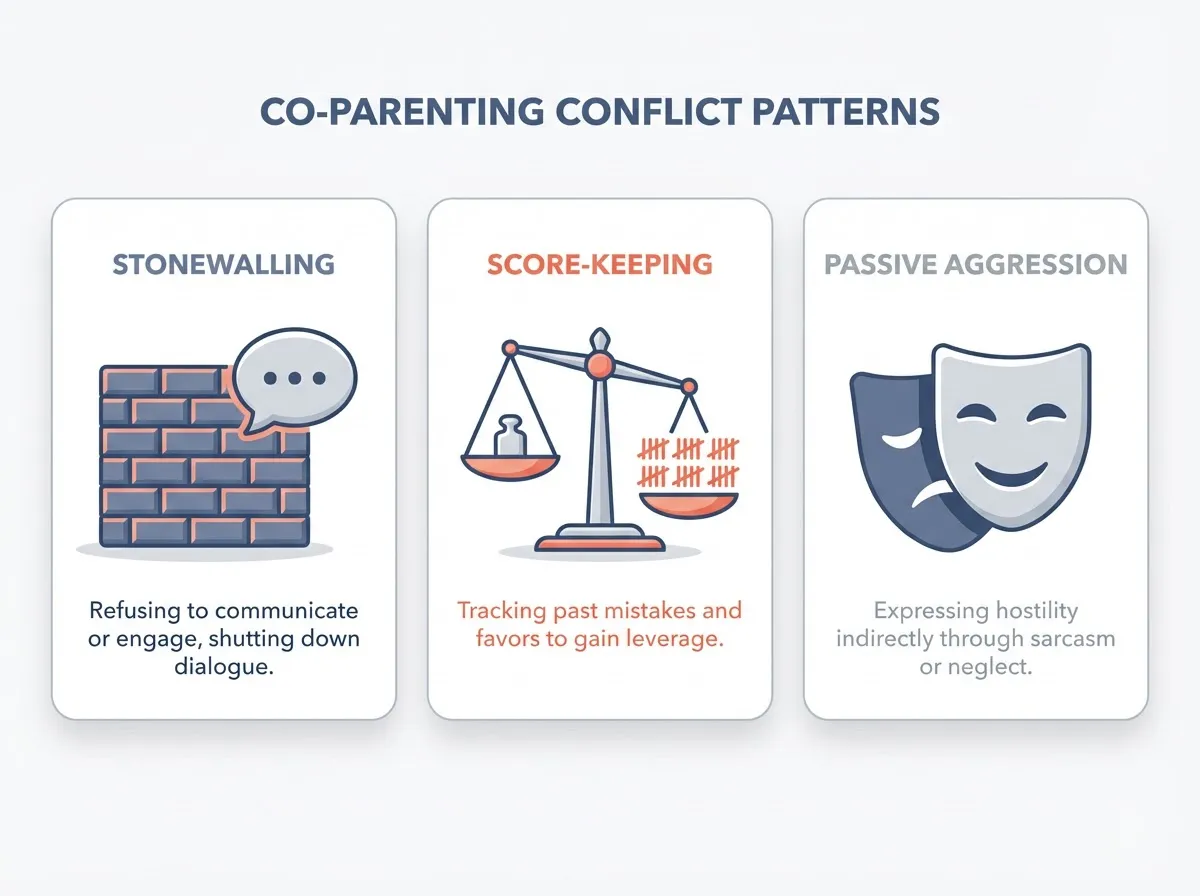
3. Passive Aggression: The Disguised Attack
What it looks like: "Sure, whatever you think is best" (said in a tone that clearly means the opposite). Agreeing to plans and then "forgetting." Signing kids up for activities during the other parent's time without discussing it. Complimenting the other parent's new partner in front of the kids in a way that's clearly barbed.
Where it comes from: Passive aggression develops in relationships where direct conflict felt unsafe — either because of power imbalances, because direct requests were met with rage, or because one partner learned early in life that expressing anger was unacceptable.
Why it's devastating in co-parenting: Passive aggression is almost impossible to address directly because the aggressor maintains plausible deniability. ("What? I said it was fine!") This creates a crazymaking dynamic where one parent constantly feels undermined but can't point to a specific offense. Children, who are remarkably perceptive, pick up on the subtext and often feel caught between two realities — what's being said and what's actually happening.
How to Tell Which Pattern Is Yours
Most people can quickly identify their co-parent's destructive pattern. The harder — and more important — work is identifying your own.
Ask yourself these questions honestly:
-
When I receive a difficult text from my co-parent, what's my first impulse? If it's to not respond, you may default to stonewalling. If it's to reference something from last month, you may lean toward score-keeping. If it's to agree outwardly while seething inwardly, passive aggression may be your go-to.
-
What did I do during arguments in the relationship? Your co-parenting conflict style is almost certainly a carryover. The situation has changed; the nervous system response hasn't.
-
What would my co-parent say my pattern is? You don't have to ask them. But if you're honest with yourself, you probably already know what they'd say.
-
What did I learn about conflict growing up? Many of these patterns predate the relationship entirely. They were modeled by your own parents and simply reinforced during your marriage.
Naming your pattern isn't about blame. It's about agency. You can't change a habit you haven't identified.
Replacing Old Patterns With Co-Parent-Appropriate Responses
Knowing your pattern matters, but knowledge alone doesn't change behavior. You need replacement strategies — specific, concrete actions that give your nervous system something new to do when the old triggers fire.
For Stonewalling: The 24-Hour Commitment
You don't have to respond immediately. But commit to a maximum response window — 24 hours for non-urgent matters, same-day for anything involving the children's immediate needs.
When you feel the urge to shut down:
- Acknowledge the message, even if you're not ready to decide. "Got this. I need to check my schedule and will respond by tomorrow evening." This takes fifteen seconds and prevents the cascade of follow-up messages that makes everything worse.
- Separate the person from the logistics. You're not responding to your ex. You're responding to a scheduling question about your child. Mentally reframe every text as a work email.
- Set a phone alarm for your response deadline. Don't rely on motivation. Stonewalling feels good in the moment — it's a relief. You need an external prompt to override it.
For Score-Keeping: The "This Conversation Only" Rule
The single most effective intervention for score-keepers is a rigid boundary: respond only to what's being discussed right now.
When you feel the urge to bring up the ledger:
- Notice the mental shift. Score-keeping often begins with the word "but" or the phrase "what about when you..." Catch it before it leaves your mouth or your thumbs.
- Ask yourself: does the historical record solve the current problem? Almost never. It feels righteous, but it derails the conversation every time.
- If fairness is a genuine concern, address it separately. Send a distinct message: "I'd like to talk about how we're dividing appointment responsibilities. Can we set a time?" This keeps the ledger out of Tuesday's soccer text.

For Passive Aggression: Say the Actual Thing
Passive aggression dissolves when you learn to express disagreement directly and without hostility. This is harder than it sounds, because it requires tolerating the discomfort of open conflict.
- Replace "fine" with specifics. Instead of "Sure, whatever works for you," try: "I have a concern about that plan. Can we discuss it?" The first response hides your objection. The second one names it.
- Stop agreeing to things you don't agree with. Every time you say yes when you mean no, you're planting a seed of resentment that will surface later in sabotaging ways.
- Use the BIFF method for written communication: keep messages Brief, Informative, Friendly, and Firm. This framework, developed by high-conflict communication expert Bill Eddy, gives you a structure that's direct without being aggressive. For instance: "I'm not available to swap Saturday this week. I can do the following Saturday instead. Let me know if that works."
For All Patterns: Build Structural Guardrails
Individual effort matters, but structure helps more. When co-parents rely solely on goodwill and self-awareness, old patterns inevitably resurface during stressful moments — a child's illness, a financial change, a new partner entering the picture.
Consider these structural supports:
- Written parenting plans that cover not just custody schedules but decision-making protocols for medical, educational, and extracurricular choices
- Communication limited to one platform (text, email, or a co-parenting app) so conversations don't scatter and get lost
- A 48-hour rule for non-emergency decisions, giving both parents time to respond thoughtfully rather than reactively
- Formalizing agreements in writing before conflicts escalate — tools like Servanda can help co-parents create clear, documented agreements with built-in structure, reducing the ambiguity that old patterns thrive on
What Your Children Actually See
This is the part most articles skip, and it's the part that matters most.
Your children don't see "co-parenting conflict." They see their parents. They see Mom's face tighten when Dad's name appears on her phone. They see Dad go quiet for three days after a disagreement. They see the gap between what's said and what's meant.
And they're learning. They're learning what conflict looks like, what relationships require, and whether problems are things you solve or things you endure.
Breaking old relationship patterns isn't just about making co-parenting smoother — though it will. It's about interrupting a generational cycle. The conflict style you inherited from your parents, refined in your marriage, and are now carrying into co-parenting is the same one your child is absorbing right now.
That's not said to add guilt. It's said to add urgency. Every single time you catch a pattern, name it, and choose a different response, your child sees that too.
Frequently Asked Questions
How long does it take to break old co-parenting communication patterns?
Research on habit change suggests that replacing an automatic response with a new one takes anywhere from 18 to 254 days, depending on the complexity of the behavior. Co-parenting patterns are deeply embedded, so expect months rather than weeks. The key is consistency — not perfection. Every time you catch yourself and choose a different response, you're strengthening the new neural pathway, even if you still slip up regularly.
What if my co-parent is the one with toxic patterns and won't change?
You can't control your co-parent's behavior, but you can change the dynamic by changing your half of it. When you stop playing your part in the pattern — stop escalating in response to stonewalling, stop engaging with score-keeping, stop pretending passive aggression is fine — the pattern loses its rhythm. This doesn't guarantee they'll change, but it does guarantee that you stop feeding the cycle. In cases of persistent high-conflict behavior, a family mediator or parallel parenting arrangement may be necessary.
Can co-parenting counseling help with these patterns?
Yes, and it's specifically designed for this. Unlike couples therapy, co-parenting counseling focuses exclusively on the parenting partnership — not on processing the relationship. A good co-parenting counselor will help both parents identify their conflict patterns, develop communication protocols, and practice new responses in a structured environment. Many families find that even four to six sessions create a noticeable shift.
Is parallel parenting better than co-parenting when old patterns are severe?
Parallel parenting — where each parent operates independently with minimal direct communication — can be a healthy interim step when old patterns are deeply entrenched or when one parent is consistently high-conflict. It's not a failure; it's a strategy. Many families start with parallel parenting and gradually move toward more cooperative co-parenting as both parents develop new communication skills and the emotional charge of the separation decreases.
How do I stop reacting emotionally to my co-parent's messages?
The most practical technique is to build in a buffer. When you receive a triggering message, don't respond immediately. Close the app. Take a walk. Wait at least an hour for non-urgent matters. When you return, read the message as if a colleague wrote it. Ask: what's the actual logistical question here? Answer that question and nothing else. Over time, this pause becomes automatic, and the emotional charge fades.
Conclusion
The patterns that defined your former relationship — the stonewalling, the score-keeping, the passive aggression — didn't end when the relationship did. They followed you into co-parenting because they're wired into your nervous system, activated by the one person they were built around.
But here's what's worth remembering: these patterns were learned, which means they can be unlearned. Not overnight. Not perfectly. But steadily, one caught reaction at a time.
Start by naming your pattern — honestly, without judgment. Then pick one replacement strategy from this article and practice it for the next two weeks. Not all three. Just one. Build the new habit before adding the next.
Your co-parenting relationship doesn't have to be a replay of your marriage. It can be something entirely different — structured, clear, and focused on the one thing you and your co-parent will always have in common: your children.