The One Fight That Can Actually End Your Marriage
It's 9:47 PM on a Tuesday. You're arguing about the dishes again. Or maybe it's the thermostat. Or how your partner never replaces the toilet paper roll. You've had this exact fight seventeen times, and a quiet dread creeps in: Is this the thing that's going to destroy us?
Here's the truth that most couples never hear: the topic of your fight almost certainly won't end your marriage. Dishes don't cause divorce. Neither do fights about money, in-laws, or parenting styles—at least, not directly. What does end marriages is something far less obvious and far more dangerous: how you fight. Relationship researchers have spent decades tracking which couples stay together and which fall apart, and the findings are remarkably consistent. The one fight that can actually end your marriage isn't about any single subject. It's the meta-fight—the recurring breakdown in how you and your partner handle disagreement itself.
Why Most Couple Fights Are Completely Normal
If you and your partner argue about the same things over and over, you're not broken. You're typical.
Dr. John Gottman's research at the University of Washington followed couples over multiple decades and found that 69% of all relationship conflicts are perpetual problems—disagreements rooted in fundamental personality differences or lifestyle preferences that never fully disappear. You're a spender; they're a saver. You want spontaneity; they want a plan. You run hot; they run cold (literally, with the thermostat).
Here's a short list of the most common recurring arguments couples report:
- Household chores: Who does what, how often, and to what standard
- Money: Spending habits, savings goals, financial priorities
- Intimacy and affection: Frequency, initiation, emotional connection
- Parenting approaches: Discipline, screen time, values
- In-laws and extended family: Boundaries, holidays, loyalty
- Quality time vs. personal space: How much togetherness is enough
- Career and work-life balance: Long hours, ambition, shared goals
These fights, in and of themselves, are not red flags. They're signs that two distinct human beings are trying to build a shared life. The couples who thrive aren't the ones who eliminate conflict. They're the ones who learn to navigate it without damaging each other.
The Real Relationship Killer: How You Fight
So if arguments about money and chores don't end marriages, what does?
The answer has been validated across decades of clinical research: it's the pattern of conflict itself. When your process for handling disagreements becomes toxic, every topic—no matter how trivial—becomes a threat to the relationship.
Gottman identified four specific behaviors so destructive that he called them the "Four Horsemen of the Apocalypse" for relationships. When these show up consistently, they predict divorce with over 90% accuracy.
1. Criticism
This goes beyond a specific complaint. It's an attack on your partner's character.
- Complaint (healthy): "I was upset that you didn't call when you were running late. I worry when I don't hear from you."
- Criticism (destructive): "You never think about anyone but yourself. You're so selfish."
The difference is surgical but enormous. One addresses a behavior; the other dismantles a person.
2. Contempt
This is the single strongest predictor of divorce. Contempt communicates disgust and superiority—eye-rolling, mockery, name-calling, sarcasm designed to wound.
A couple we'll call Priya and James came to this realization after a particularly brutal argument about vacation planning. James suggested camping. Priya's response: "Oh, of course you want to sleep in dirt. Why would I expect anything better?" The topic was vacations. The damage was contempt.
3. Defensiveness
When one partner raises an issue, the other immediately counter-attacks or plays the victim instead of listening.
- Partner A: "I felt hurt that you made plans without checking with me first."
- Defensive response: "Well, maybe if you weren't always controlling everything, I wouldn't have to."
Defensiveness blocks all repair. It says, Your feelings are not my problem, and I refuse to take any responsibility.
4. Stonewalling
This is the shutdown—physically present but emotionally gone. Walking away mid-sentence. The silent treatment. Scrolling through a phone while your partner is trying to talk through something important.
Stonewalling often happens when a person is physiologically flooded (heart rate elevated, stress hormones surging). It may feel like self-protection, but to the other partner, it reads as abandonment.
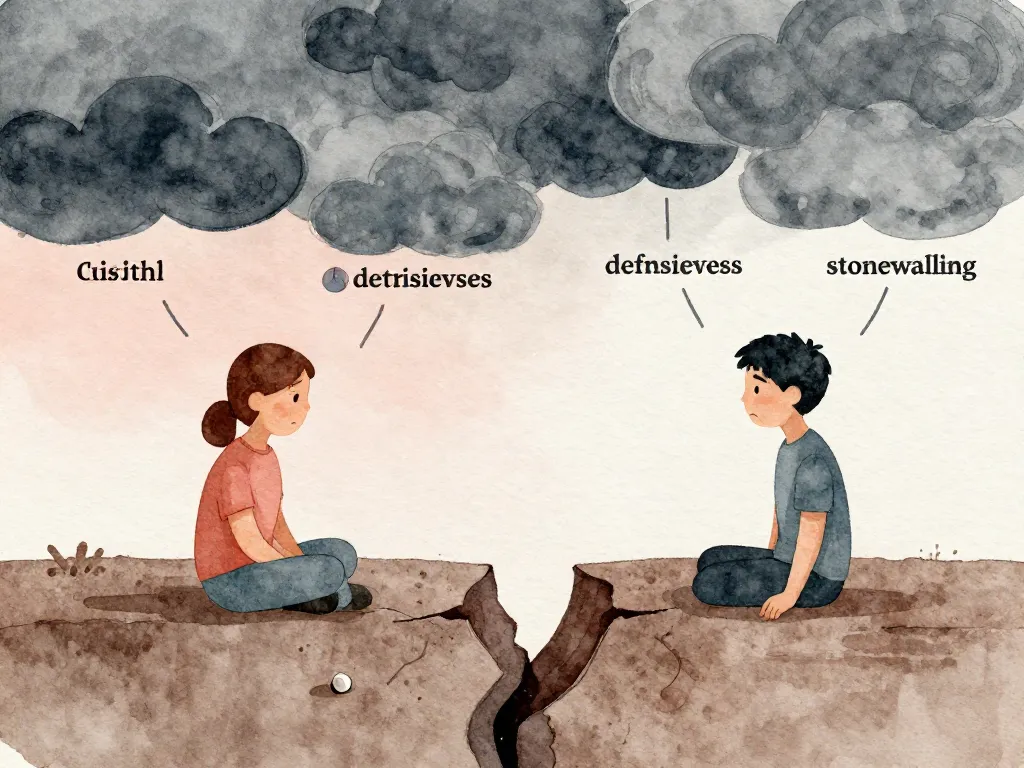
How a Normal Fight Becomes a Dangerous One
Any ordinary argument can become the fight that ends your marriage—if it's handled with these patterns.
Consider this escalation pathway:
- The trigger is mundane. One partner leaves clothes on the floor.
- Criticism enters. "You're such a slob. You have no respect for our home."
- Defensiveness fires back. "Maybe if you weren't so obsessive about everything being perfect, we'd actually enjoy living here."
- Contempt surfaces. Eye roll. Sarcastic laugh. "Right. Like you know anything about making a home enjoyable."
- Stonewalling finishes it. One partner walks out. No resolution. No reconnection. The other is left talking to an empty room.
Now multiply that sequence by hundreds of instances over months and years. The topic changes—sometimes it's dishes, sometimes finances, sometimes sex—but the process is identical every time. Not because of the clothes on the floor, but because the floor is lava and neither of you knows how to cross it safely.
What Healthy Conflict Actually Looks Like
The goal is not to stop fighting. Conflict avoidance creates its own slow-burning damage. The goal is to fight in a way that doesn't erode the foundation of your relationship.
Start Softly
The first three minutes of a conflict conversation predict its outcome with remarkable accuracy. If you open with blame, the conversation is almost certainly going to end badly.
Instead of "You always..." or "You never...", try starting with your own experience:
- "I've been feeling overwhelmed with the evening routine, and I need help figuring it out."
- "I'm anxious about our spending this month. Can we look at it together?"
This frames the problem as something you're both facing, not something one of you is causing.
Accept Influence
Research consistently shows that couples who accept each other's perspective—who say, "That's a fair point" or "I can see why you'd feel that way"—are dramatically more likely to stay together. This doesn't mean capitulating. It means treating your partner as someone whose viewpoint has legitimacy, even when you disagree.
Make and Receive Repair Attempts
A repair attempt is any effort to de-escalate during a fight. It can be humor, a touch, a direct statement like "I think we're getting off track" or even "Can we start over? I didn't say that well."
The key finding from Gottman's research: it's not whether you make repair attempts that matters most—it's whether your partner accepts them. In struggling relationships, repair attempts get swatted away or ignored. In healthy ones, they're received, even imperfectly.
Take Breaks Without Abandoning
If you or your partner is flooded—heart racing, voice rising, thoughts spinning—it's okay to pause. But how you pause matters:
- Destructive: Storming out. Slamming doors. Going silent for hours.
- Constructive: "I'm getting too heated to think clearly. I need 20 minutes, and then I want to come back to this. I'm not leaving the conversation."
The second version communicates the same need for space but includes a critical piece: I'm coming back.

A Practical Framework for Your Next Argument
Here's a step-by-step approach you can use the next time conflict arises:
- Pause before responding. Take one breath. Ask yourself: Am I about to address the issue or attack the person?
- State the specific problem, not a character judgment. "When X happened, I felt Y" beats "You're always Z."
- Listen for the need underneath the complaint. Your partner's frustration about the messy kitchen might be about feeling unsupported. Your annoyance about spending might be about security.
- Acknowledge before problem-solving. Before jumping to solutions, say back what you heard. "It sounds like you're feeling stretched thin and need me to step up more in the evenings." This alone can defuse 80% of the tension.
- Agree on one small next step. Not a grand overhaul. One concrete action. "I'll handle dinner cleanup on weeknights this week. Let's check in Sunday and see how it's going."
- Write it down if it helps. Formalizing agreements—even small ones—creates accountability and prevents the "we never agreed to that" argument next week. Tools like Servanda can help couples create written agreements that keep things clear when emotions have cooled.
When to Worry: Signs Your Conflict Pattern Needs Intervention
Not every couple can untangle destructive patterns alone, and there's no shame in that. Consider seeking professional support if:
- Every argument ends the same way, regardless of the topic, with one or both of you feeling unheard, resentful, or hopeless
- Contempt has become the default tone—sarcasm, eye-rolling, and mockery are more common than kindness
- You've stopped fighting altogether, not because things are good, but because you've both given up on being understood
- Repair attempts are consistently rejected—when one partner tries to de-escalate, the other won't allow it
- You're keeping score, cataloguing offenses to use as ammunition later
A skilled couples therapist doesn't just mediate arguments. They help you see the underlying pattern, understand the emotional injuries driving it, and build a new way of engaging when things get hard.
The Fight Beneath the Fight
At the bottom of every recurring argument, if you dig past the logistics and the frustrations and the I-told-you-so's, you'll usually find one of two fundamental questions:
- "Do you care about me?"
- "Can I trust you to be there?"
When your partner is furious about you being on your phone during dinner, they're not fighting about the phone. They're asking, Am I important enough for your attention? When you're upset about a financial decision made without you, you're asking, Are we actually a team?
See the deeper question, and the fight transforms. You stop defending your screen time and start addressing the disconnection. You stop arguing about the purchase and start talking about the partnership.
This shift doesn't require you to become a therapist. It just requires a willingness to ask yourself, in the heat of the moment: What is my partner really saying right now?
FAQ
Is it normal to have the same fight over and over again?
Yes. Research shows that the majority of relationship conflicts are perpetual, meaning they resurface throughout the relationship. The key isn't eliminating the topic but developing a healthier way of discussing it each time it comes up.
How do I know if our fighting style is actually damaging our relationship?
Look for the Four Horsemen: criticism (attacking character), contempt (disgust or superiority), defensiveness (counter-attacking instead of listening), and stonewalling (shutting down completely). If these patterns appear regularly in your disagreements—especially contempt—they're actively eroding your relationship, regardless of what you're arguing about.
Can a couple recover from years of poor conflict habits?
Absolutely. Destructive conflict patterns are learned behaviors, which means they can be unlearned. Many couples see significant improvement within months of intentionally changing how they approach disagreements, particularly with support. The willingness to change matters far more than the length of time you've been stuck.
What should I do when my partner shuts down during an argument?
Recognize that stonewalling often happens because your partner is physiologically overwhelmed. Agree on a protocol in advance: either of you can call a break, with a specific time to return to the conversation ("Let's pick this up in 30 minutes"). During the break, do something calming—walk, breathe, read—rather than rehearsing your argument.
How do you fight fairly when you're really angry?
The most effective tool is also the simplest: slow down. Anger narrows your focus and makes you more likely to say something you'll regret. Before responding, take one full breath and ask yourself whether you're about to address the problem or punish the person. If it's the latter, it's time for a brief pause—not a withdrawal, but a stated pause with a commitment to return.
Conclusion
The fight that can end your marriage isn't about dishes, money, or in-laws. It's the one where criticism, contempt, defensiveness, and stonewalling have replaced curiosity, respect, and genuine effort to understand each other. The reassuring truth is that most of what you argue about is completely normal—and most of how you argue can be changed.
You don't need to become a perfect communicator overnight. You need to make one shift: start paying attention to how you fight, not just what you fight about. The next time tension rises, try opening softly. Try hearing the question beneath the complaint. Try making one small repair attempt—and receiving the one your partner offers.
The couples who last are the ones who fight and find their way back to each other, every time.