
One Partner Feels Smothered, the Other Ignored
It's 9 PM on a Tuesday. Maya puts her phone down and turns to her partner, Jordan. "You've barely said ten words to me tonight. Do you even want to be in this relationship?" Jordan stiffens. "I literally just sat next to you for two hours. I don't know what more you want from me." Maya feels a familiar sting of rejection. Jordan feels a familiar wave of suffocation. Both walk away believing the other person is the problem.
If this sounds like your relationship—or even a shadow of it—you're not alone. When one partner feels smothered and the other feels ignored, therapists say you're likely caught in the most common conflict cycle in romantic relationships: the pursue-withdraw pattern. The good news? It's not a sign of incompatibility. It's a fixable cycle, and once you see it clearly, you can start dismantling it together.
Key Takeaways
- The pursue-withdraw cycle is a pattern, not a personality flaw. One partner reaches for connection (pursuing), and the other retreats to self-regulate (withdrawing). Neither response is wrong—but together, they create a painful loop.
- Both partners are experiencing the same core emotion: fear. The pursuer fears abandonment or disconnection; the withdrawer fears inadequacy or engulfment. Recognizing this shared vulnerability is the turning point.
- Breaking the cycle requires action from both sides. The pursuer learns to make softer bids for connection; the withdrawer learns to stay engaged even when uncomfortable.
- Scheduled check-ins and structured conversations can replace reactive arguments. Predictable connection reduces the pursuer's anxiety and the withdrawer's sense of being ambushed.
- This pattern is well-researched and highly treatable. Emotionally Focused Therapy (EFT) has a 70-75% success rate in moving couples from distress to recovery.
What Is the Pursue-Withdraw Cycle?
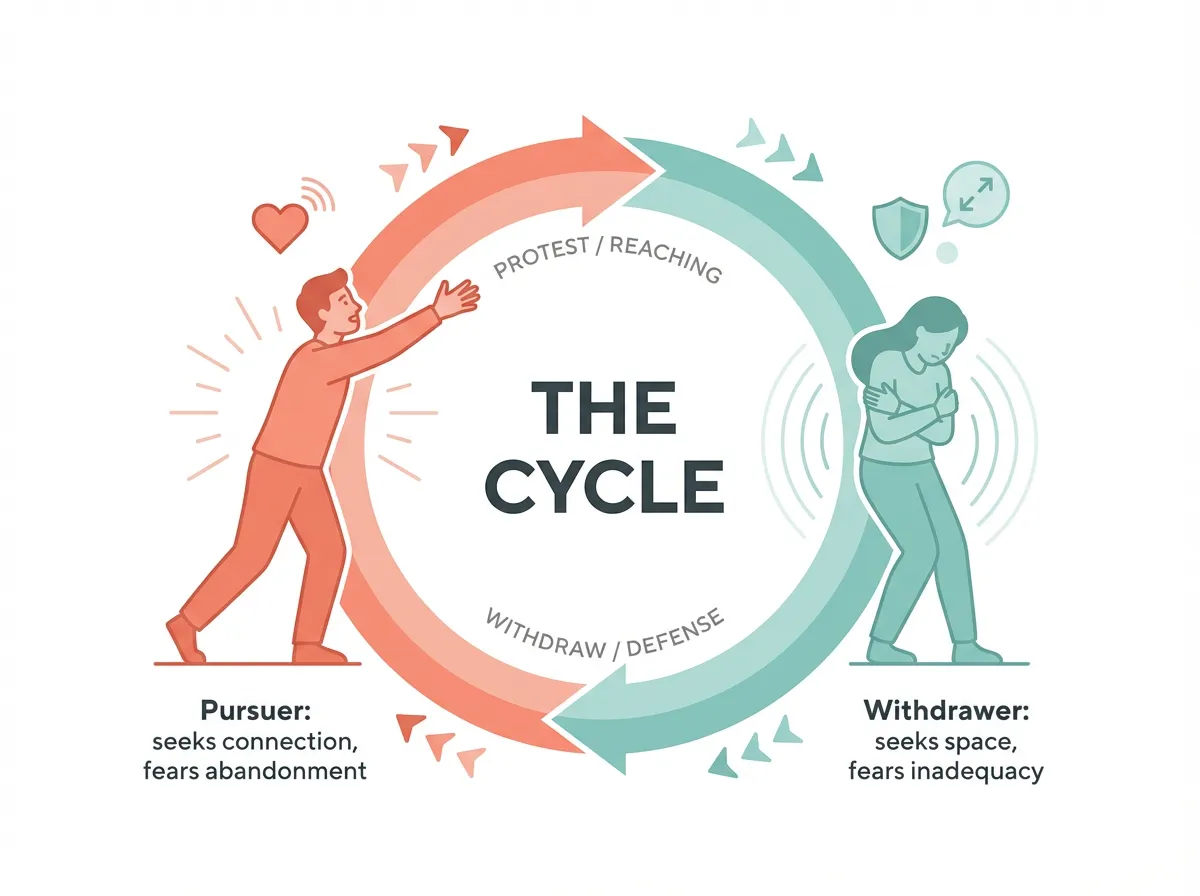
The pursue-withdraw cycle (sometimes called the demand-withdraw pattern) is a relationship dynamic where one partner consistently seeks more closeness, conversation, or reassurance, while the other consistently pulls back, shuts down, or creates distance.
It looks like this in practice:
- The pursuer texts more often, asks probing questions about the relationship, brings up issues frequently, and may express frustration through criticism or emotional intensity.
- The withdrawer gives shorter answers, avoids difficult conversations, retreats into work or hobbies, and may physically leave the room during conflict.
Research by Dr. John Gottman and Dr. Sue Johnson has shown that this dynamic is present in roughly 80% of distressed couples. It crosses gender lines, cultural backgrounds, and relationship structures. And critically, it tends to escalate over time: the more one partner pursues, the more the other withdraws, which triggers more pursuing, and so on.
Why It Feels Like a Personality Problem (But Isn't)
When you're inside this cycle, it's almost impossible not to make it personal. The pursuer thinks: They're emotionally unavailable. They don't care. The withdrawer thinks: They're too needy. Nothing I do is ever enough.
But here's what decades of couples research consistently reveals: pursue-withdraw is a relational pattern, not a character trait. The same person who withdraws in one relationship may pursue in another. The same person who pursues around emotional topics may withdraw around financial ones. The pattern lives between you, not inside either of you.
This reframe matters enormously. When you stop seeing your partner as the enemy and start seeing the cycle as the enemy, everything changes.
Why One Partner Feels Smothered and the Other Feels Ignored
To break this cycle, you first need to understand what's driving each side. And under the surface frustration, both partners are usually experiencing the same thing: fear.
The Pursuer's Inner World
The partner who pursues more connection is typically driven by attachment anxiety—a deep, often preverbal fear that their partner is slipping away. When they don't receive signals of closeness (eye contact, engaged conversation, physical touch, responsiveness to texts), their nervous system sounds an alarm.
Their pursuing behaviors—the repeated check-ins, the "we need to talk" conversations, the emotional intensity—are actually bids for reassurance. They're saying, in the only way they know how: Are you still here? Do you still choose me?
The tragedy is that the way they express this need often pushes their partner further away.
The Withdrawer's Inner World
The partner who pulls back is typically driven by a fear of inadequacy or emotional overwhelm. When they sense conflict approaching or feel the weight of their partner's disappointment, their nervous system goes into a protective shutdown.
Withdrawing isn't laziness or apathy. It's often a flood response—research shows that withdrawers frequently experience higher physiological arousal (elevated heart rate, cortisol spikes) during conflict than pursuers do. They retreat not because they don't care, but because they care so much that the intensity becomes unbearable.
They're saying: I can't be what you need right now. I'm afraid of making this worse.

The Escalation Trap
Here's how the cycle feeds itself:
- The pursuer feels a gap in connection and reaches out (sometimes urgently, sometimes critically).
- The withdrawer feels pressure and pulls back to self-regulate.
- The pursuer interprets the withdrawal as rejection and pursues harder.
- The withdrawer feels more overwhelmed and retreats further.
- Repeat until one partner explodes or both go silent for days.
Over months and years, this cycle erodes trust, affection, and goodwill. The pursuer begins to feel chronically unwanted. The withdrawer begins to feel chronically inadequate. Both partners feel profoundly alone—even when sitting on the same couch.
How to Break the Pursue-Withdraw Cycle
Breaking this pattern isn't about one person changing while the other stays the same. It requires both partners to make deliberate, concurrent shifts. Here's how.
Step 1: Name the Cycle Out Loud
The single most powerful intervention is also the simplest: learn to identify the cycle in real time and name it together.
Instead of: "You always shut me out!" Try: "I think we're doing our thing again. I'm pursuing and you're pulling away, and it's making both of us miserable."
This shifts the conversation from blame to observation. You're standing side by side, looking at the pattern, rather than standing across from each other in opposition.
Practice this language: - "The cycle is happening again." - "I can feel myself starting to [pursue/withdraw]. Can we pause?" - "I don't want to fight you. I want to fight this pattern with you."
Step 2: Pursuers—Soften Your Approach
If you tend to pursue, your work is to slow down and soften without going silent. This doesn't mean suppressing your needs. It means expressing them in a way your partner can actually receive.
Concrete shifts to practice:
- Lead with vulnerability, not criticism. Instead of "You never initiate anything," try "I've been feeling disconnected this week, and it scares me a little."
- Make specific, doable requests. Instead of "I need more effort from you," try "Could we spend 20 minutes after dinner just talking? No phones?"
- Tolerate brief pauses. If your partner needs 30 minutes to decompress after work before engaging, practice letting that happen without interpreting it as rejection.
- Acknowledge their efforts. Withdrawers often feel like nothing they do registers. When they make even small bids for connection, notice them and say so.
Step 3: Withdrawers—Stay in the Room
If you tend to withdraw, your work is to increase your tolerance for emotional engagement, even when it's uncomfortable. This doesn't mean absorbing criticism without boundaries. It means staying present rather than disappearing.
Concrete shifts to practice:
- Signal before you step away. Instead of going silent or leaving the room without explanation, try "I'm feeling overwhelmed and I need 20 minutes, but I'm coming back. This matters to me."
- Initiate small moments of connection. Send an unprompted text during the day. Ask about something specific your partner mentioned. These micro-gestures have outsized impact.
- Share your internal experience. Withdrawers often feel plenty of emotion but struggle to verbalize it. Practice saying things like "I don't know what to say right now, but I want you to know I'm trying" or "I shut down because I'm afraid of disappointing you."
- Set boundaries without walls. There's a difference between saying "I need space" (boundary) and going cold for three days with no explanation (wall).
Step 4: Create Structured Connection Rituals
One of the most effective ways to defuse the pursue-withdraw cycle is to build predictable connection into your routine. When the pursuer knows connection is coming, they feel less compelled to chase it. When the withdrawer knows there's a container for emotional conversation, they feel less ambushed.
Ideas to try:
- A daily 10-minute check-in. Share one thing from your day and one thing you appreciated about each other. Keep it short and positive.
- A weekly "state of us" conversation. Set aside 30 minutes to discuss how the relationship feels. Use a timer. Take turns. No interrupting.
- A repair ritual after conflict. Agree on what repair looks like for both of you—maybe it's a hug, maybe it's a written note, maybe it's revisiting the conversation 24 hours later with calmer heads.
Tools like Servanda can help couples formalize these rituals into written agreements—especially around topics like how to handle conflict pauses, communication expectations, or check-in schedules—so that good intentions don't dissolve in the heat of the moment.

Step 5: Understand Your Attachment Styles
The pursue-withdraw cycle often maps onto attachment theory:
- Anxious attachment → more likely to pursue
- Avoidant attachment → more likely to withdraw
- Secure attachment → able to flex between needing closeness and tolerating distance
Understanding your attachment style isn't about labeling yourself or your partner. It's about gaining compassion for the survival strategies you both developed long before you met each other. The pursuer learned early that love requires vigilance. The withdrawer learned early that emotions are dangerous. Neither lesson was wrong at the time—but both need updating for an adult partnership.
Recommended resources for self-assessment: - Attached by Amir Levine and Rachel Heller - Hold Me Tight by Dr. Sue Johnson - The Experiences in Close Relationships (ECR) questionnaire (free online)
What Happens When Only One Partner Is Willing to Change
This is the question that keeps people up at night. And the honest answer is: one person changing does shift the dynamic, even if it doesn't fully resolve it.
If you're the pursuer and you begin making softer bids, your partner may gradually feel safer and start engaging more. If you're the withdrawer and you start staying present, your partner may gradually relax their grip.
But there are limits. If one partner is genuinely unwilling to examine their role in the cycle—if they refuse to see it as a shared pattern and insist the other person is entirely the problem—individual therapy can help you clarify your needs and boundaries.
Change doesn't require perfection. It requires willingness. Two people who are both willing to try, even clumsily, will almost always outpace one person doing everything right alone.
A Real-World Example: How One Couple Broke the Cycle
Rachel and Dev (names changed) came to therapy after three years of escalating arguments. Rachel described feeling "invisible"—Dev would come home, retreat to his computer, and give one-word answers when she tried to connect. Dev described feeling "suffocated"—Rachel would follow him from room to room, interpreting every quiet moment as evidence he didn't love her.
In therapy, they learned to see the cycle instead of each other as the problem. Rachel practiced saying "I'm feeling disconnected and I'd love to spend some time together tonight—what works for you?" instead of "You clearly don't care about this marriage." Dev practiced saying "I need an hour to decompress, and then I want to hear about your day" instead of silently disappearing into his office.
The shift wasn't instantaneous. But within two months, Rachel reported feeling less panicked about connection gaps, and Dev reported feeling less defensive about needing downtime. They stopped having the same fight and started having actual conversations.
FAQ
Is the pursue-withdraw pattern the same as being needy or emotionally unavailable?
No. These labels are oversimplifications that assign blame to one person. The pursue-withdraw pattern is a relational dynamic—it exists between two people, not inside one of them. The same person can be a pursuer in one context and a withdrawer in another. Calling someone "needy" or "emotionally unavailable" keeps you stuck in blame; naming the cycle opens the door to change.
Can the pursue-withdraw cycle actually end a relationship?
Yes, if left unaddressed over time. Research by Dr. John Gottman identifies this pattern as one of the strongest predictors of divorce. The pursuer eventually exhausts themselves and emotionally disengages (a phenomenon therapists call "pursuer burnout"), and the withdrawer loses the motivation to re-engage once the pursuing stops. The good news is that early intervention—whether through self-help, structured conversations, or therapy—has a very high success rate.
What if I'm the one who feels both smothered AND ignored at different times?
This is more common than people realize. Many individuals oscillate between pursuing and withdrawing depending on the topic, their stress level, or the phase of the relationship. You might pursue around emotional intimacy but withdraw around financial discussions. Recognizing this flexibility actually gives you a strategic advantage: you already know what both positions feel like, which makes it easier to empathize with your partner's experience.
Should we try couples therapy for this, or can we fix it on our own?
Many couples make significant progress on their own by reading about the pattern, practicing softer communication, and building structured check-ins. However, if the cycle has been entrenched for years, if there's significant resentment buildup, or if conversations consistently escalate despite your best efforts, Emotionally Focused Therapy (EFT) is specifically designed to treat this dynamic and has strong clinical evidence behind it. There's no weakness in seeking professional guidance—it's often the fastest route to change.
How long does it take to break the pursue-withdraw cycle?
There's no universal timeline, but most couples in therapy report noticeable shifts within 8-12 sessions. On your own, you might start seeing small improvements within a few weeks of consistent practice. The key word is "consistent." Old patterns reassert themselves under stress, so expect setbacks. What changes first is your ability to recognize the cycle in real time—and that awareness alone begins to weaken it.
Conclusion
When one partner feels smothered and the other feels ignored, it's easy to believe you're fundamentally mismatched. But the pursue-withdraw cycle isn't evidence of incompatibility—it's evidence that two people with different attachment strategies are caught in a loop that neither created on purpose.
The way out isn't for the pursuer to stop wanting connection or for the withdrawer to force themselves into constant emotional availability. The way out is to see the pattern together, name it without blame, and make small, deliberate changes from both sides. Softer bids. Staying present. Structured rituals. Shared language.
You didn't choose this cycle. But you can choose to break it. And in doing so, you might discover that the partner you've been fighting with has been fighting for the same thing you have all along: to feel safe, wanted, and close.