
Why You Really Fight About Dishes (It's Not the Dishes)
It's 9:47 PM. You walk into the kitchen and there they are again — three plates crusted with dried pasta sauce, two mugs with coffee rings, a pan "soaking" for the second day in a row. Something tightens in your chest. By the time your partner walks in five minutes later, your tone is sharp. They get defensive. Fifteen minutes later, you're both silent on opposite ends of the couch, furious — and neither of you is actually thinking about dishes anymore.
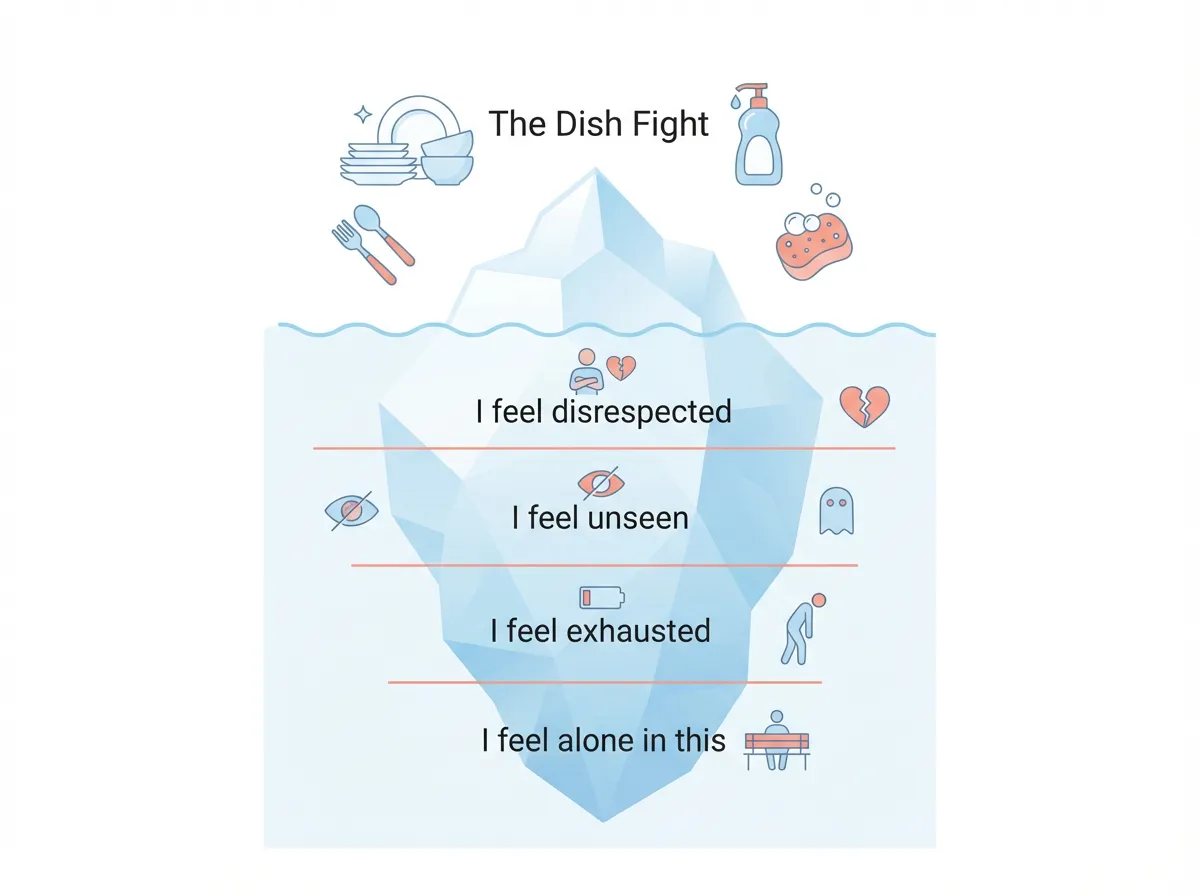
If this sounds familiar, you're far from alone. Research consistently shows that 39% of couple arguments stem from disagreements about cleaning and household chores — making it the single most common trigger for relationship conflict. But here's the thing most couples miss: the dish fight is almost never about the dishes. It's about feeling unseen. Undervalued. Like you're carrying something your partner doesn't even notice.
This article unpacks what's really happening beneath those kitchen-sink blowups — and gives you concrete strategies to stop having the same argument on repeat.
Key Takeaways
- The dishes are a symbol, not the problem. Recurring chore arguments almost always point to unmet emotional needs like feeling respected, valued, or equitable in the partnership.
- "I already do so much" vs. "Nothing I do is enough" — most dish fights are two people feeling underappreciated at the same time, not one person being lazy.
- Invisible labor is real and measurable. The partner who tracks, plans, and remembers household tasks carries a cognitive load that's easy to overlook — and that imbalance fuels resentment.
- Agreements beat expectations. Unspoken standards cause more conflict than dirty dishes ever will. Making your expectations explicit — and writing them down — is the single most effective way to end the cycle.
- Repair matters more than prevention. You will fight about dishes again. What matters is whether you can quickly get to what's actually bothering you underneath.

The Real Reason Couples Fight About Dishes
Let's start with a scenario that plays out in millions of homes every week.
Maya and Jordan have been together for four years. Maya works from home; Jordan commutes. By the time Jordan gets home at 6:30, Maya has usually tidied the living room, started dinner, and unloaded the dishwasher. She doesn't ask Jordan to do these things — she just does them because they need doing.
But when Jordan leaves a cereal bowl in the sink the next morning without rinsing it, Maya feels a flash of anger that's wildly disproportionate to the offense. It's one bowl. She knows that. But what she feels is: "I handle everything around here, and you can't even rinse a single bowl."
Jordan, meanwhile, is thinking: "I just walked in the door and I'm already being criticized. Nothing I do is ever good enough."
Same dirty bowl. Two completely different emotional experiences. Neither of them is wrong — and that's exactly why the fight never resolves when you only talk about the bowl.
What the Research Tells Us
Studies on relationship conflict consistently find that surface-level arguments are proxies for deeper attachment needs. Dr. John Gottman's research at the University of Washington identified that 69% of relationship conflicts are "perpetual" — meaning they never fully resolve because they're rooted in fundamental differences in personality, values, or emotional needs.
When the Gottman Institute analyzed what triggers these recurring conflicts, household responsibilities topped the list. But when researchers dug deeper, the actual complaints weren't about cleaning standards. They clustered around three core emotional themes:
- Respect — "Do you value my time and effort?"
- Equity — "Are we truly in this together?"
- Recognition — "Do you even see what I contribute?"
The dishes aren't the disease. They're the symptom.
The Invisible Labor Problem
One of the biggest drivers behind why couples fight about dishes and chores is something researchers call cognitive labor — the mental work of noticing what needs to be done, planning how to do it, tracking whether it got done, and remembering to do it again next time.
Consider everything that goes into "keeping the kitchen clean":
- Noticing the dish soap is running low
- Adding it to a shopping list (mental or physical)
- Remembering to buy it
- Tracking what's in the fridge before it expires
- Knowing which containers are clean enough for leftovers
- Wiping the counters after someone else cooked but didn't wipe
- Unloading the dishwasher before it needs to be run again
None of these tasks is difficult. But the person who holds this running inventory in their head is doing work that's genuinely invisible to the partner who doesn't. And when that invisible work goes unacknowledged — for weeks, months, years — a single dirty dish becomes the straw that breaks a camel's back.
This isn't a gendered issue by definition, though research from the Pew Research Center shows women in heterosexual relationships still report shouldering a disproportionate share of household management. But the dynamic plays out in every type of partnership: one person becomes the "household project manager," and the other becomes the "helper" who waits to be told what to do — then feels micromanaged when they are.
Both roles breed resentment.
The Four Hidden Arguments Disguised as Dish Fights
If you're caught in a cycle of bickering about household chores, chances are the real argument is one of these four:
1. "I Don't Feel Like Your Partner — I Feel Like Your Parent"
When one person constantly has to remind, delegate, and follow up on household tasks, the relationship starts to feel like a manager-employee dynamic. The "managing" partner loses romantic attraction. The "managed" partner feels infantilized. Both lose.
What it sounds like on the surface: "Why do I always have to ask you to take out the trash?"
What it means underneath: "I want you to notice and care about our shared space without me having to be the one who keeps track."
2. "My Standards Don't Matter to You"
Couples almost always have different thresholds for mess. One person sees a cluttered counter and feels anxious; the other genuinely doesn't register it. When the higher-standard partner repeatedly cleans up — or asks the other to — it can feel like their comfort doesn't matter.
What it sounds like on the surface: "You never clean the pan properly. There's still grease on it."
What it means underneath: "When you do something halfway, it feels like my comfort in our home isn't worth your effort."
3. "I'm Exhausted and I Need You to Step Up"
This one is about capacity, not character. During high-stress periods — new jobs, new babies, health issues — the chore balance that worked before can suddenly feel crushing. The exhausted partner isn't angry about dishes. They're drowning and using the dishes to signal an SOS.
What it sounds like on the surface: "I can't believe you're watching TV while the sink is full."
What it means underneath: "I am running on empty and I need you to see that without me having to spell it out."
4. "Do You Respect Me?"
This is the deepest layer. When someone repeatedly leaves messes for their partner to deal with — especially after conversations about it — the message received isn't carelessness. It's "Your time is less valuable than mine." Whether or not that's the intent, it's the impact.
What it sounds like on the surface: "You said you'd load the dishwasher before bed."
What it means underneath: "When you don't follow through on what you promised, I feel like I can't rely on you — and that scares me."

How to Stop Fighting About Dishes (For Real)
Knowing the problem is deeper than dishes is a great start. But insight without action is just a more sophisticated way of staying stuck. Here's what actually works:
Step 1: Name the Real Need — Out Loud
The next time you feel a dish-related argument brewing, pause and ask yourself: What am I actually feeling right now? Then try to express that instead of the complaint.
| Instead of this... | Try this... |
|---|---|
| "You never clean up after yourself." | "When I come home to a messy kitchen, I feel like I'm carrying this alone. I need to feel like we're a team." |
| "You're always nagging me about the house." | "When I hear criticism right when I walk in, I shut down. I need a few minutes before we talk logistics." |
| "I just did the dishes yesterday!" | "I'm feeling like my contributions aren't being seen. Can we talk about what's working and what's not?" |
This isn't about scripting your relationship. It's about giving your partner access to the actual problem — because they can't fix something they can't see.
Step 2: Make the Invisible Visible
Sit down together — outside of a conflict — and list every household task you can think of. Not just physical chores, but the cognitive labor: Who notices when the bathroom needs cleaning? Who books the vet appointments? Who remembers to buy toilet paper before it runs out?
This exercise isn't about scorekeeping. It's about building shared awareness. Many couples are genuinely shocked to see how unevenly the mental load is distributed — and that awareness alone can shift behavior.
Step 3: Create Explicit Agreements (Not Assumptions)
Most household conflict isn't caused by laziness. It's caused by unspoken expectations meeting different defaults. You grew up in a house where dishes were done immediately after dinner. Your partner grew up in a house where they piled up until the weekend. Neither is wrong — but if you never name these differences, you'll fight about them forever.
Concrete agreements look like:
- "We'll run the dishwasher every night before bed."
- "Whoever cooks doesn't have to clean up."
- "Saturday mornings are joint cleaning time — 90 minutes, then we're done."
- "If something is bothering one of us about the house, we bring it up during our Sunday check-in, not in the moment."
The key is writing these down. Verbal agreements are subject to selective memory, especially when emotions flare. Tools like Servanda can help couples formalize household agreements and track commitments, giving you a neutral reference point instead of a "you said / I said" spiral.
Step 4: Solve the System, Not the Symptom
If you've had the same dish fight more than three times, the problem isn't the dishes — it's that your household system doesn't work. Approach it like you'd approach any logistical problem:
- Identify the bottleneck. Is it that you don't have enough counter space? That the dishwasher is annoying to load? That neither of you has energy to clean after 8 PM?
- Experiment with solutions. Try paper plates on weeknights (seriously). Try a "clean as you go" rule for cooking. Try hiring a cleaning service for the tasks that trigger the most conflict.
- Evaluate together. Give any new system two weeks, then check in. What worked? What didn't? Adjust and repeat.
This takes the moral weight out of chores. It's no longer "you're a bad partner for leaving dishes out." It's "our current system isn't catching this — let's tweak it."
Step 5: Get Good at Repair
You will fight about dishes again. That's not a failure — it's being human. What matters is how quickly you can move from the surface complaint to the real conversation.
After a blowup, try this repair script:
- Acknowledge the trigger: "I know I snapped about the pan in the sink."
- Name what was underneath: "The truth is I've been feeling overwhelmed all week and I wasn't just mad about the pan."
- Make a specific request: "Can we look at the chore split this weekend? I think it needs adjusting."
This process takes two minutes. It prevents two hours of cold-shoulder silence. And over time, it rewires how you both handle friction — you start skipping the dish fight entirely and going straight to the need.
What If Your Partner Won't Engage?
Sometimes one partner is ready to dig into the deeper issues and the other isn't. If you've tried naming your real needs and your partner dismisses, deflects, or stonewalls, here are a few approaches:
- Lower the stakes. Instead of "We need to talk about our emotional dynamics," try: "Hey, I want to try something different when we argue about the house. Can I show you this article?" (Yes, this one.)
- Lead by example. Start naming your own feelings in low-conflict moments. "I felt really good when you took care of dinner tonight — it made me feel like we're on the same page." Positive reinforcement builds safety.
- Seek outside support. If the pattern is deeply entrenched, a couples therapist or a structured conflict resolution process can provide the neutral ground that makes vulnerable conversation possible.
Frequently Asked Questions
Is it normal for couples to fight about chores?
Absolutely. Survey data consistently shows that household chores are the most common source of day-to-day couple conflict, with roughly 39% of arguments linked to cleaning disagreements. The issue isn't that you argue about chores — it's whether those arguments ever lead to meaningful change or just repeat endlessly.
How do I bring up the chore imbalance without starting a fight?
Timing and framing are everything. Bring it up during a calm, neutral moment — not while staring at a sink full of dishes. Frame it as a shared problem ("I think our system isn't working") rather than a personal accusation ("You don't do enough"). Suggest a specific, low-pressure next step, like listing all household tasks together over coffee this weekend.
What if we have very different cleanliness standards?
Different standards are one of the most common — and most solvable — sources of chore conflict. The fix is making those standards explicit rather than assuming yours are "correct" and your partner's are "wrong." Find a middle ground you can both commit to in writing, and focus your energy on the areas that matter most to each of you rather than trying to align on everything.
Can a chore chart actually help an adult relationship?
It sounds unsexy, but yes — structured systems dramatically reduce friction. The key is framing it as a partnership tool, not a parenting tool. Think of it less as a "chore chart" and more as a shared operating agreement for your household. The format matters less than the fact that expectations are visible, specific, and mutually agreed upon.
When should we get professional help for recurring arguments?
If the same argument has been cycling for months without progress, if one or both of you regularly shut down or escalate during conflict, or if you feel more like adversaries than partners — it's worth talking to a professional. Couples therapy isn't a last resort. It's maintenance for your most important relationship.
The Dish Fight You'll Never Need to Have Again
The dirty dishes in your sink aren't destroying your relationship. But the unspoken needs beneath them might be.
Every recurring argument is an invitation — a signal that something important isn't being said, seen, or addressed. When you learn to hear what the dish fight is really about — respect, recognition, equity, exhaustion — you gain the ability to solve the actual problem instead of replaying the same frustrating script.
You don't need a spotless kitchen to have a great relationship. You need a partner who's willing to look past the plate in the sink and ask, "What do you really need from me right now?"
Start there. The dishes can wait.