
Parallel Parenting When Communication Fails
You've tried. You've sent calm, measured texts. You've suggested compromises. You've bitten your tongue more times than you can count. But every exchange with your co-parent still spirals into accusations, manipulation, or silence. Every pickup feels like walking through a minefield. Every schedule change becomes a three-day battle.
If this sounds familiar, you're not failing at co-parenting. You may simply need a different model — one that doesn't require cooperation, goodwill, or even basic communication to work. That model is called parallel parenting, and for thousands of families dealing with high-conflict dynamics, it's not a consolation prize. It's a lifeline.
Parallel parenting when communication fails isn't about giving up on your child's well-being. It's about protecting it by removing the one variable that keeps causing harm: forced interaction between two people who can't communicate without conflict.
This guide walks you through exactly how to set it up, what boundaries to draw, and how to make it work long-term.
Key Takeaways
- Parallel parenting is not co-parenting's failure — it's an alternative designed specifically for high-conflict situations where direct communication causes more harm than good.
- The foundation is a highly detailed parenting plan that eliminates the need for ongoing negotiation about schedules, holidays, pickups, and decisions.
- Communication should be limited to written, business-like channels — no phone calls, no face-to-face conversations, no open-ended texts.
- Each parent has full autonomy during their parenting time, which means accepting that your ex will do things differently — and that's okay.
- Children benefit most when shielded from parental conflict, even if the parenting styles in each home aren't identical.
What Is Parallel Parenting (and How Is It Different From Co-Parenting)?
Co-parenting assumes two adults can communicate respectfully, make joint decisions, and occasionally be flexible. For many separated families, that works beautifully.
But for others — those dealing with narcissistic behavior, emotional abuse, chronic boundary violations, or simply a relationship so damaged that every interaction causes harm — traditional co-parenting is not just difficult. It's destructive.
Parallel parenting is a structured arrangement where both parents remain actively involved in their child's life but disengage from each other almost entirely. Think of it as two parallel lines: both moving in the same direction (raising the child), but never intersecting.
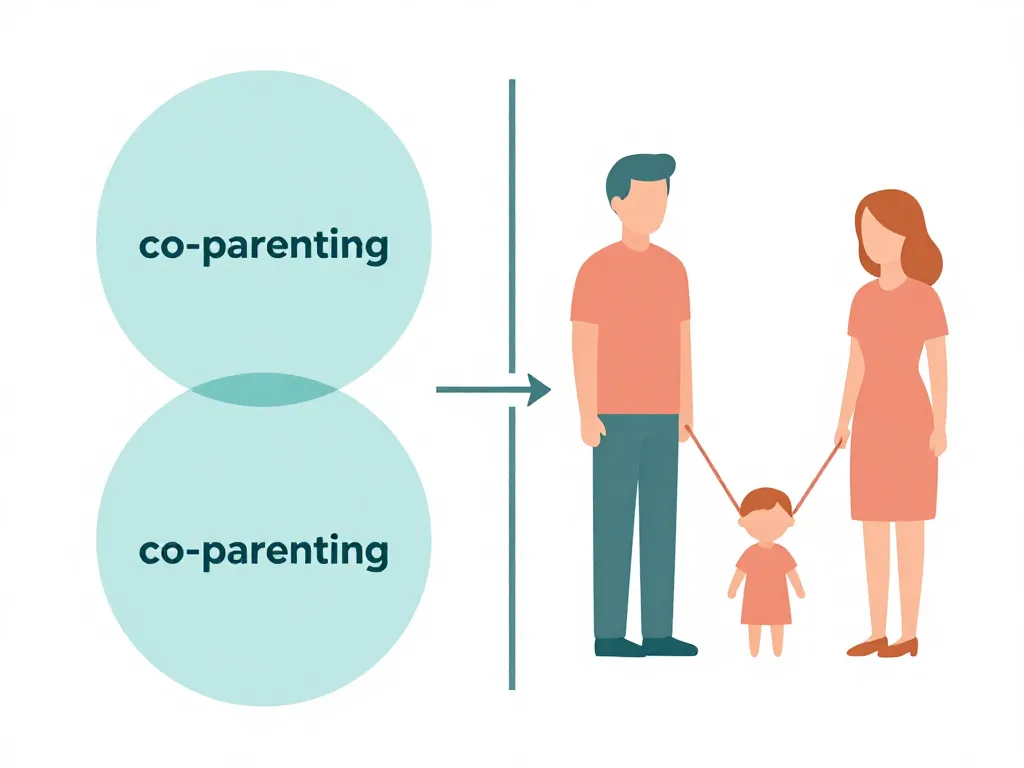
Here's how the two models compare:
| Co-Parenting | Parallel Parenting | |
|---|---|---|
| Communication | Open, flexible | Limited, written only |
| Decision-making | Joint on most issues | Divided by category or domain |
| Scheduling | Collaborative, adjustable | Rigid, predetermined |
| Pickups/drop-offs | Direct, face-to-face | Neutral location, no direct contact |
| Flexibility | High | Minimal by design |
| Conflict level | Low to moderate | High (that's why you need this) |
Neither model is inherently better. The right one depends on the reality of your relationship with your co-parent — not what you wish it were.
Why Parallel Parenting Works When Communication Fails
The central insight behind parallel parenting is simple: you cannot control another person's behavior, but you can control your exposure to it.
When every interaction with your co-parent triggers a cycle of conflict — whether that's gaslighting, stonewalling, explosive anger, or passive-aggressive sabotage — the most protective thing you can do for your child is reduce the number of interactions that can go wrong.
Parallel parenting works because it:
- Removes ambiguity. A detailed plan means there's nothing to negotiate. Tuesday at 6 PM means Tuesday at 6 PM. No discussion needed.
- Eliminates emotional triggers. Written, limited communication removes tone of voice, facial expressions, and real-time escalation from the equation.
- Gives each parent autonomy. When you're not constantly battling over bedtimes and screen rules, you can actually focus on parenting.
- Protects children from the crossfire. Kids are remarkably perceptive. They feel the tension in a parking lot exchange. They hear the edge in your voice after reading a text. Less conflict between parents means less stress absorbed by children.
How to Set Up a Parallel Parenting Plan: Step by Step
Transitioning to parallel parenting isn't something you announce to your ex over text. It's a structural change that works best when it's formalized — ideally through a mediator, attorney, or court order.
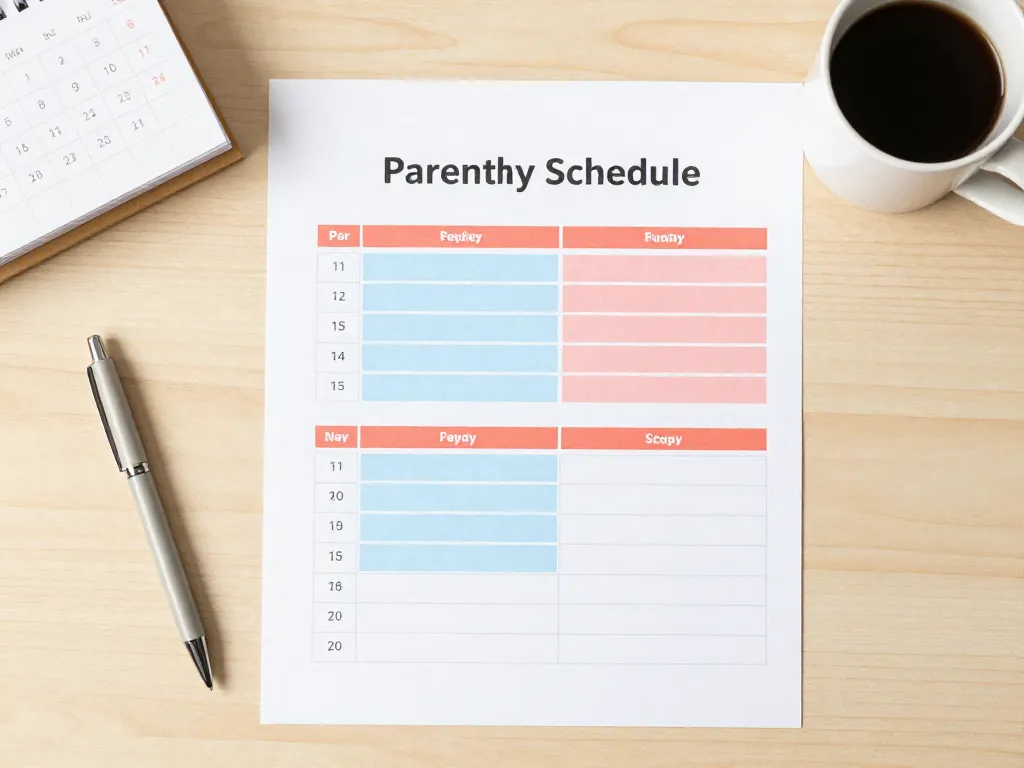
Step 1: Create a Bulletproof Parenting Schedule
The schedule is the backbone of parallel parenting. It should be so detailed that it requires zero discussion to execute.
Your plan should explicitly address:
- Regular weekly/biweekly custody schedule with specific days and times
- Holiday rotation spelled out for every major and minor holiday, including exact pickup and drop-off times
- Summer and school break schedules for at least two years ahead
- Birthday arrangements (who has the child, when, for how long)
- Transportation logistics — who drives, where exchanges happen, what happens if someone is late
- Right of first refusal — if one parent can't be with the child during their time, does the other parent get first option?
The more specific you are now, the fewer arguments you'll have later.
Example: Instead of writing "Parents will alternate Thanksgiving," write: "Parent A has Thanksgiving in even-numbered years from Wednesday at 5:00 PM to Friday at 10:00 AM. Parent B has Thanksgiving in odd-numbered years during the same window. The non-custodial parent handles drop-off at [specific location]."
Step 2: Define Decision-Making Domains
In parallel parenting, you don't make decisions together — you divide decision-making authority by category.
For example:
- Parent A has final say on medical and dental decisions
- Parent B has final say on education and extracurricular activities
- Both parents must agree on decisions involving relocation, elective surgery, or changes to the parenting plan
This eliminates the endless back-and-forth that high-conflict co-parents often weaponize. Each parent knows their lane and stays in it.
Step 3: Establish a Communication Protocol
This is where many parallel parenting arrangements either succeed or fail.
Rules that work:
- Written communication only. Email or a dedicated co-parenting app. No phone calls. No texts (unless there's a genuine emergency involving the child's immediate safety).
- Business-like tone. Imagine you're emailing a colleague you don't particularly like. Keep it factual, brief, and neutral.
- 48-hour response window. Neither parent is required to respond immediately unless there's an emergency. This prevents the pressure-and-escalation cycle.
- BIFF method. Keep messages Brief, Informative, Friendly, and Firm. No editorializing, no emotional commentary, no rehashing the past.
- No third-party messaging. Children, grandparents, and new partners should never be used as communication go-betweens.
A good message: "Alex has a dentist appointment on March 12 at 3:00 PM. Since this falls on your time, please confirm you can take him or let me know by Friday so I can reschedule."
A bad message: "Since you never take Alex to the dentist, I scheduled one for March 12. Try to actually show up this time."
The difference between these two messages is the difference between parallel parenting working and not working.
Step 4: Design Conflict-Free Exchanges
Pickup and drop-off are the most common flashpoints in high-conflict custody. Parallel parenting minimizes this with deliberate logistics:
- Use a neutral exchange location — a public parking lot, a library, or the child's school
- Stagger arrivals if needed: one parent drops off, then the other picks up 10 minutes later
- Use school as the exchange point when possible: one parent drops off in the morning, the other picks up in the afternoon
- No lingering, no conversations, no "quick chats" at exchanges
- Bring a support person if you feel unsafe, and document any incidents

Step 5: Formalize Everything in Writing
A parallel parenting plan only works if it's documented and, ideally, legally enforceable. Verbal agreements with a high-conflict co-parent are worth nothing.
Consider formalizing your agreements with a tool like Servanda before conflicts escalate — having a clear written record of what was agreed upon, and when, can be invaluable if disputes arise later.
Work with your attorney or mediator to get the plan filed with the court. A court-ordered plan gives you recourse if your co-parent violates the terms.
Living With Parallel Parenting: What to Expect
You Will Have to Let Go of Some Control
This is the hardest part for most parents, and it deserves honest acknowledgment.
When your child is at your co-parent's house, they might eat fast food for dinner, stay up too late, or watch shows you wouldn't allow. Unless the child is being abused or neglected, this is not your battle to fight.
Parallel parenting requires accepting that two homes will operate differently. Your child will adapt. Children are remarkably capable of understanding that "Mom's house rules" and "Dad's house rules" are different — as long as both homes feel safe and stable.
The Urge to Engage Will Be Strong
Your co-parent may bait you. They may send inflammatory messages, violate minor parts of the agreement, or use the children to get a reaction. Parallel parenting means choosing non-engagement as your default response.
This doesn't mean you ignore genuine violations. It means you document them calmly, share them with your attorney if needed, and don't give your co-parent the emotional reaction they're looking for.
Your Children May Have Questions
Kids might ask why Mom and Dad don't talk anymore, or why exchanges feel so formal. Age-appropriate honesty works best:
- "Mom and Dad work better when we each handle things on our own."
- "We both love you so much, and we figured out a way to make things calmer for everyone."
- "You don't need to worry about the grown-up stuff. That's our job."
Never blame the other parent. Never explain the conflict. Never make the child feel responsible for managing the situation.
Common Mistakes That Undermine Parallel Parenting
Even well-intentioned parents can sabotage their own parallel parenting arrangement. Watch out for:
- Over-communicating. If your message isn't about the child's health, safety, schedule, or education, don't send it. The "friendly update" is a trap in high-conflict dynamics.
- Bending the schedule for goodwill. Flexibility is a gift you give to reasonable co-parents. With a high-conflict ex, every exception becomes a new expectation — or a new argument.
- Checking up on the other household. Asking your child what happened at Dad's house, what he said about you, or whether his new partner was there puts your child in an impossible position.
- Failing to document. Keep a log of every exchange, every late pickup, every violated term. Not to weaponize it — but to protect yourself if the situation escalates to court.
- Expecting it to feel good. Parallel parenting is a harm-reduction strategy. It won't feel warm or collaborative. That's not the goal. The goal is peace — and peace often looks like distance.
When Parallel Parenting Might Not Be Enough
Parallel parenting is a powerful tool, but it's not a solution for every situation.
If your co-parent is:
- Physically abusing or neglecting the child
- Actively violating court orders
- Engaging in parental alienation
- Struggling with untreated addiction that endangers the child
…then parallel parenting alone won't protect your child. These situations require legal intervention, and possibly a modification of custody. Work with your attorney and, if needed, involve child protective services.
FAQ
Is parallel parenting legal?
Yes. Parallel parenting is a recognized arrangement that family courts frequently support, especially in high-conflict cases. Many judges and mediators actually prefer parallel parenting plans because their specificity reduces the need for repeated court appearances. You can have your parallel parenting plan formalized as part of a court order.
Can parallel parenting eventually become co-parenting?
It can, though it shouldn't be the expectation. Some families find that after months or years of reduced contact, tensions decrease enough to allow more flexibility and direct communication. Others maintain parallel parenting throughout their children's upbringing. Both outcomes are perfectly acceptable — let the situation evolve naturally rather than forcing a timeline.
How do I start parallel parenting if my ex won't agree to it?
You can begin implementing many parallel parenting principles unilaterally — switching to written-only communication, stopping unnecessary conversations at exchanges, and disengaging from conflicts about the other household. For the formal plan, work with your attorney to request a detailed parenting order through the court. You don't need your ex's enthusiastic cooperation; you need a clear court order.
What age children does parallel parenting work best for?
Parallel parenting can work for children of any age, though the plan details will look different. Younger children need more frequent, shorter exchanges and very specific routines. Teenagers may need provisions for their own social schedules and increasing autonomy. The core principle — reducing parental conflict by reducing parental interaction — benefits children at every developmental stage.
How do I handle emergencies in a parallel parenting arrangement?
Most parallel parenting plans include an emergency exception that allows direct phone contact when a child's health or safety is at immediate risk. Define "emergency" clearly in your plan — a trip to the ER qualifies; a lost lunchbox does not. For non-urgent but time-sensitive issues, a same-day email response expectation can be written into the agreement.
Moving Forward
Parallel parenting when communication fails isn't a sign that you've failed as a parent. It's a sign that you've recognized a hard truth and chosen to act on it: your child benefits more from two disengaged, peaceful parents than from two engaged, warring ones.
The transition won't be seamless. There will be moments when you want to fire off an angry response, when you'll grieve the co-parenting relationship you thought you'd have, when your ex will test every boundary you've set. But with a detailed plan, firm boundaries, and a commitment to disengagement, you can create the stability your child needs — even if your co-parent never changes.
Your child doesn't need their parents to be a team. They need their parents to stop being opponents. Parallel parenting makes that possible.