His Mom Hates Me: Surviving In-Law Rejection
You noticed it the first time she set the table — place settings for everyone except you got the nice china. Or maybe it was subtler: the way she addresses every question to your partner as if you're not in the room, or the offhand comments about their ex that seem to land right when you're within earshot.
When your partner's mother doesn't like you, the sting is unique. It's not just social discomfort — it's a slow-drip threat to the relationship you've built. You start dreading holidays. You rehearse conversations in the car. You bite your tongue so often it's practically a reflex. And the worst part? Your partner is caught in the middle, sometimes unable — or unwilling — to see what's happening.
In-law rejection is one of the most common sources of recurring arguments between couples.

Why Your Partner's Mother Might Not Like You
Before you can respond effectively, it helps to understand the machinery behind the rejection. This isn't about excusing bad behavior — it's about seeing the full picture so your responses are strategic rather than reactive.
She's Losing Her Role
For many mothers, a child's serious partnership triggers a genuine identity crisis. If her sense of purpose has been organized around caregiving, your presence signals that she's being replaced — even if that's not remotely true. The hostility you experience may actually be grief wearing a mask.
You Don't Match the Blueprint
Some mothers carry a detailed, often unspoken, image of who their child "should" end up with — someone from a specific background, career path, religion, or temperament. When reality departs from that image, they interpret the mismatch as a threat to their child's wellbeing rather than examining whether the blueprint was reasonable in the first place.
Family Dynamics Were Already Strained
Sometimes the tension has almost nothing to do with you personally. If your partner has a complicated history with their mother — unresolved conflicts, enmeshment, old loyalty tests — you've walked into a minefield that existed long before you arrived. You just happen to be the new variable she can focus on.
She Feels Shut Out
This one is worth considering honestly. In some cases, a mother's coldness is a clumsy response to feeling excluded. If your partner has pulled away since your relationship began, or if important news consistently reaches her secondhand, her behavior might be a distorted attempt to reclaim connection.
What In-Law Rejection Actually Does to Your Relationship
The damage from in-law conflict rarely stays contained to holiday dinners. Left unaddressed, it infiltrates your daily life in patterns that are hard to trace back to their source.
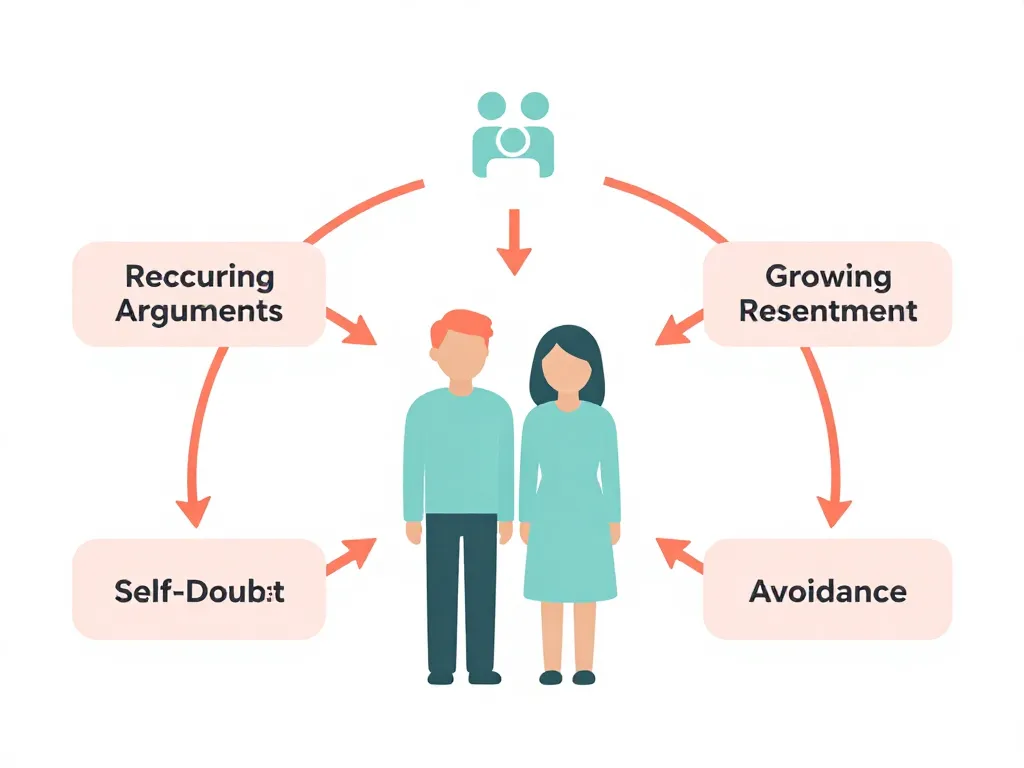
Recurring arguments with no resolution. You've had the same fight about his mother twelve times. Each time ends with frustration because the underlying dynamic never shifts.
Resentment toward your partner. When you feel unsupported, the hurt doesn't stay directed at his mother — it migrates toward him. You start keeping a mental ledger of every time he didn't speak up.
Self-doubt. Prolonged rejection from a parental figure can erode your confidence, even when you intellectually know the problem isn't you. You start second-guessing your behavior at family events, wondering if you're too loud, too quiet, too much, not enough.
Avoidance patterns. You stop attending family gatherings. Your partner goes alone. The physical distance creates emotional distance, both from the family and from each other.
Recognizing these patterns is the first step toward interrupting them.
How to Respond When Your Partner's Mother Doesn't Like You
There's no script that fixes a hostile mother-in-law overnight. But there are concrete strategies that protect your wellbeing and give the relationship room to evolve — or at least stop the bleeding.
1. Stop Trying to Win Her Over
This is counterintuitive, but it's essential. When you're in "approval-seeking mode," you hand over your emotional stability to someone who hasn't earned that power. Every unreturned gesture becomes a wound.
This doesn't mean being rude or withdrawn. It means shifting your goal from "make her like me" to "be respectful and authentic, regardless of her response." The difference is subtle but transformative.
Example: Priya spent two years bringing handmade gifts to every family dinner, volunteering to help in the kitchen, and sending birthday cards with personal notes. Her mother-in-law's coldness never thawed. When Priya finally stopped performing and simply showed up as herself — warm but not desperate — the dynamic shifted. Not because her mother-in-law changed, but because Priya stopped being devastated by each interaction.
2. Have the Hard Conversation With Your Partner
This is where most couples get stuck. The conversation about in-law rejection tends to go sideways because both people feel attacked — you feel unsupported, and your partner feels caught between the two people they love most.
Some principles for this conversation:
- Lead with the specific, not the general. Instead of "Your mom hates me," try: "When your mom made that comment about my cooking last Sunday, and you laughed along, I felt really alone."
- Acknowledge the bind they're in. Your partner didn't choose this conflict. Saying "I know this puts you in a hard position" creates the safety they need to actually hear you.
- Define what support looks like. Don't assume your partner knows what you need. Be explicit: "I need you to say something in the moment when she makes comments about our parenting, even if it's just redirecting the conversation."
- Make agreements you can both reference later. Vague promises like "I'll talk to her" evaporate under pressure. Decide together on specific boundaries and responses you'll both commit to. Tools like Servanda can help couples formalize these kinds of agreements in writing, so they don't dissolve the moment emotions spike again.
3. Set Boundaries Without Declaring War
Boundaries aren't ultimatums. They're decisions about what you will and won't participate in, communicated calmly and enforced consistently.
Some boundaries that couples navigating in-law rejection have found helpful:
- Time limits on visits. "We'll stay for three hours" is a boundary. "We're never going back" is a reaction.
- Topics that are off-limits. If she repeatedly criticizes your career, your weight, or your family, your partner can say: "We're not going to discuss that, Mom. How's your garden doing?"
- A signal system between you and your partner. Agree on a discreet sign — a word, a gesture — that means "I need us to leave" or "please step in."
- Post-visit debriefs. Set aside time after family gatherings to check in with each other honestly. This prevents resentment from compounding silently.
4. Don't Badmouth Her (Even When It's Tempting)
Venting about his mother to friends can feel cathartic, but constantly trashing her to your partner creates a loyalty trap that will eventually backfire. Your partner may start defending her — not because they agree with her behavior, but because the relentless negativity triggers a protective instinct.
There's a difference between processing your feelings and building a case. Process with a therapist, a trusted friend, or in a journal. When talking to your partner, stay focused on specific incidents and how they made you feel, not character indictments.

5. Examine Your Own Contribution (Without Self-Blame)
This isn't about accepting fault for someone else's hostility. It's about making sure you're not unconsciously escalating the dynamic.
Ask yourself honestly:
- Do I shut down or become visibly cold around her, which she might read as disdain?
- Have I made dismissive comments about her traditions or values?
- Am I keeping my partner from spending time with her because of my own discomfort?
- Do I bring up her behavior so frequently that it dominates our relationship?
If the answer to any of these is yes, that's not proof that you're the problem. It's information you can use to make adjustments that serve your peace of mind.
6. Accept What You Cannot Change
Some mothers-in-law come around. Some don't. The timeline isn't in your control, and neither is the outcome.
What you can control:
- How much emotional energy you invest in seeking her approval
- How you and your partner function as a team
- What behavior you'll tolerate in your home
- How you model healthy boundaries for your children, if you have them
Acceptance isn't resignation. It's a decision to build your life on the foundation of your partnership rather than on the shifting sand of someone else's opinion of you.
When It's More Than Dislike: Recognizing Toxic Behavior
There's a meaningful difference between a mother-in-law who's cold or critical and one who's actively destructive. Watch for these escalation signs:
- Deliberate sabotage — spreading lies, trying to break you up, contacting your employer or friends
- Emotional abuse directed at you or your children — name-calling, gaslighting, threatening
- Demanding your partner choose — explicit ultimatums that pit the relationship against the family
- Boundary violations after clear conversations — showing up unannounced after being asked not to, sharing private information you asked to keep confidential
If the behavior crosses into these territories, the conversation with your partner shifts from "how do we manage this" to "how do we protect ourselves." That may mean significantly reduced contact, supervised visits only, or in extreme cases, no contact at all. This isn't a failure — it's a recognition that you cannot maintain a relationship with someone who refuses to treat you with basic dignity.
What to Do When Your Partner Won't Stand Up for You
This is the hardest version of this problem. You've explained how you feel, you've been specific, you've been patient — and your partner still won't address their mother's behavior.
A few things to consider:
- Understand the fear. Your partner may have spent decades managing their mother's emotions. Standing up to her may feel existentially terrifying, not just uncomfortable. This doesn't excuse inaction, but it explains it.
- Suggest couples therapy. Sometimes a neutral third party can help your partner see the pattern they've been too close to recognize. A therapist can also help you both develop scripts and strategies together.
- Evaluate the pattern. If your partner consistently prioritizes their mother's feelings over yours across many situations, this is a relationship issue, not just an in-law issue. It points to a deeper question about where you stand in the partnership.
- Decide what you can live with. This is deeply personal. Some people can compartmentalize a difficult mother-in-law if the rest of the relationship is strong. Others find that the lack of support erodes everything. Neither response is wrong.
A Long Game, Not a Quick Fix
Surviving in-law rejection is about building sustainable patterns — between you and your partner, and between your partnership and the outside world.
The couples who navigate this well tend to share a few traits: they talk about the problem without letting it consume every conversation. They set boundaries they actually enforce. They take breaks from the situation when they need to. And they remember, regularly, that they chose each other — and that choice matters more than anyone else's opinion of it.
Your partner's mother may never become your biggest fan. But if you and your partner can face this challenge as allies rather than adversaries, the relationship you build won't just survive the rejection — it'll be stronger for having weathered it together.
Frequently Asked Questions
What do I do if my boyfriend's mom doesn't like me for no reason?
The rejection often has less to do with you personally and more to do with her own fears — losing her role, grieving her child's independence, or projecting an idealized image of who her son should be with. Focus on being respectful and authentic rather than performing for her approval, and work with your partner to set clear boundaries around how you're treated.
How do I talk to my partner about his mom being rude to me?
Lead with specific examples rather than generalizations — say "When your mom said X and you didn't respond, I felt alone" instead of "Your mom hates me." Acknowledge that your partner is in a difficult position, then be explicit about what support you need, whether that's them speaking up in the moment or setting a boundary together.
Should I stop going to family events if my mother-in-law is hostile?
Avoiding family gatherings entirely can create emotional distance between you and your partner, so it's usually better to set time limits and boundaries around visits rather than cutting them off completely. However, if her behavior crosses into emotional abuse or deliberate sabotage, reducing or eliminating contact may be necessary to protect your wellbeing.
How do I set boundaries with my mother-in-law without causing more drama?
Boundaries work best when they're calm decisions about what you will and won't participate in, not emotional ultimatums delivered in the heat of the moment. Agree on specific limits with your partner — like redirecting off-limits topics or leaving after a set time — and enforce them consistently so they become the new normal rather than a one-time confrontation.
What if my partner refuses to stand up to his mother?
Your partner may have spent years managing their mother's emotions and may find confronting her genuinely terrifying, not just inconvenient. Couples therapy can help them see the pattern from the outside and develop concrete strategies, but if they consistently prioritize their mother's feelings over yours across many situations, it's worth evaluating whether this reflects a deeper imbalance in the partnership.