The Real Reason You Fight About Chores
It's 9:47 PM on a Tuesday. The kitchen counter is cluttered with dishes from dinner, the trash bag is bulging over the rim of the can, and someone's shoes are blocking the hallway again. You've asked — twice — if your partner could take care of it. They said they would. That was three hours ago.
So you do it yourself, slamming cabinet doors just loud enough to send a message. Or maybe you say something sharp. Maybe they snap back. And suddenly you're in the same argument you had last week, last month, last year — except now it's not really about the dishes at all.
Studies consistently rank household task division among the top sources of conflict for couples. The fight was never really about the trash. It's about something much deeper — and until you name it, no chore chart in the world will fix it.
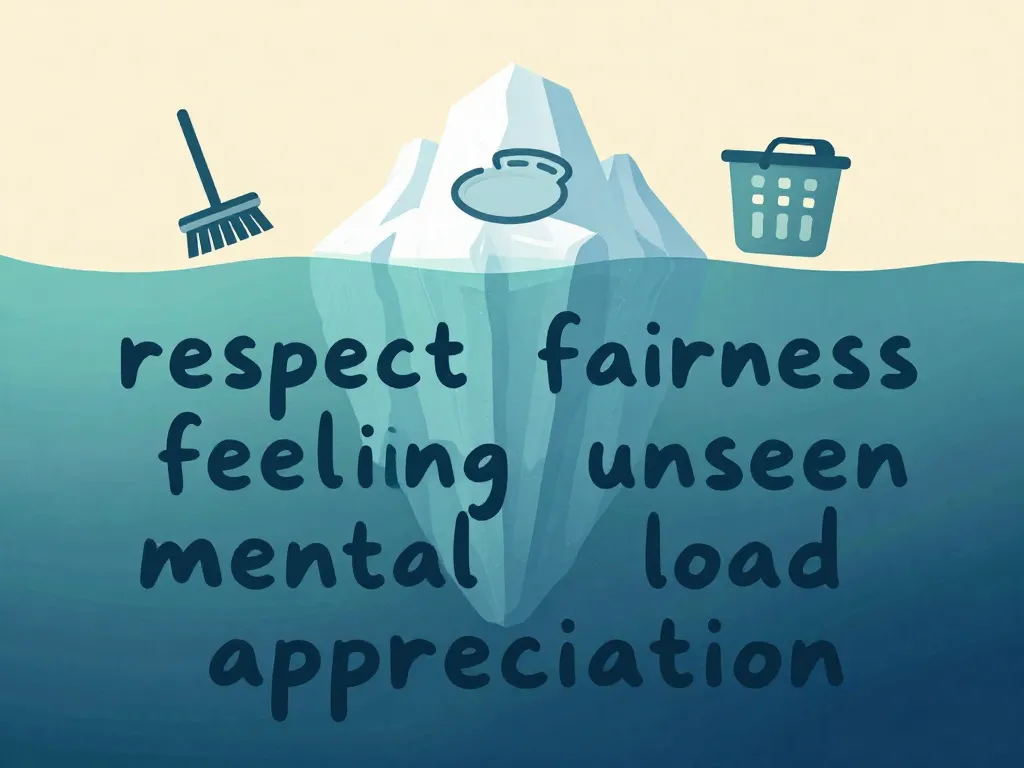
Why Couples Really Fight About Chores
It's Not About the Dishes — It's About What the Dishes Represent
When you walk past a full sink for the third day in a row, you're not just seeing unwashed plates. You're seeing evidence. Evidence that your effort isn't being matched. Evidence that your partner doesn't notice what you notice. Evidence that — maybe — you matter less in this partnership than you thought.
Relationship researchers have found that chore-related arguments almost always map to one of three deeper concerns:
- Fairness — "I'm doing more than my share, and that's not okay."
- Respect — "If you valued me, you wouldn't leave this for me to deal with."
- Recognition — "I do so much that nobody sees or acknowledges."
A couple could theoretically split every chore perfectly down the middle and still fight — because one partner feels their contributions are invisible, or because "splitting evenly" doesn't account for the vast difference between taking out the trash once a week and managing the entire household calendar in your head.
The Mental Load: The Fight Beneath the Fight
The "mental load" (sometimes called "cognitive labor") explains why so many chore fights feel impossible to resolve.
The mental load is the invisible, ongoing work of managing a household: remembering when the pediatrician appointment is, noticing that the soap dispenser is empty, knowing that the dog's flea medication needs to be reordered before the weekend, keeping track of whose turn it is to pick up the kids.
This labor is exhausting, constant, and largely thankless — because it's invisible. If one partner carries the bulk of it (and research suggests this burden falls disproportionately on women in heterosexual relationships, though it can affect any partner in any relationship), they may feel like a project manager who also has to do half the tasks themselves.
The partner who doesn't carry the mental load often genuinely doesn't realize it exists. They're not being malicious. They simply don't see the work because someone else is doing it for them.
This mismatch in awareness is fertile ground for resentment.
"I asked him to help more, and he said, 'Just tell me what to do.' He didn't understand that having to tell him is the problem." — A sentiment echoed by countless partners in relationship forums and therapy offices alike.

What the Research Actually Says
A widely cited study from the Pew Research Center found that sharing household chores ranked third — behind faithfulness and a good sexual relationship — among factors associated with a successful marriage.
The nuance that matters: it's not the division of chores that predicts satisfaction — it's the perceived fairness of the division. Couples where both partners feel the arrangement is fair report significantly higher relationship satisfaction, even when the split isn't mathematically equal.
Fairness is subjective. It's shaped by each person's upbringing, cultural expectations, work schedule, energy levels, and — critically — whether they feel their partner appreciates what they contribute.
Recognizing the Pattern in Your Own Relationship
The Scorecard Trap
Many couples fall into what therapists call "scorekeeping" — a running mental tally of who did what and when. Scorekeeping poisons relationships for several reasons:
- Each person remembers their own contributions more vividly than their partner's. You remember scrubbing the bathroom because you were there. You don't remember your partner spending 45 minutes on the phone with the insurance company because you were in the other room.
- Not all tasks feel equal. Mowing the lawn once a week and cooking dinner every night are not equivalent in frequency or mental effort, even if both partners consider them "their" jobs.
- Scorekeeping frames your partnership as a competition. And in a competition, someone always loses.
The "Ask Me and I'll Do It" Problem
One partner says they're happy to help — they just need to be told what to do. This feels generous to the person saying it. To the person hearing it, though, it communicates: I don't pay attention to what needs doing unless you point it out, and I'm comfortable with that arrangement.
The issue isn't willingness. It's initiative. When one person always has to delegate, they're still carrying the mental load — they've just added "manager" to their list of unpaid household roles.
The Shutdown
Sometimes one partner simply withdraws. They stop asking for help. They stop expressing frustration. They absorb the extra work in silence.
This accumulated resentment tends to surface eventually — often explosively, and often about something that seems wildly disproportionate. ("You forgot to buy milk" becomes a two-hour argument because it's not about the milk. It was never about the milk.)

How to Actually Fix It (Not Just the Chore Chart)
If chore fights are really about fairness, respect, and recognition, then the solution has to address those things. Here's how.
Step 1: Name What You're Actually Feeling
The next time you feel a chore-related argument building, pause and ask yourself: What am I really upset about right now?
Are you angry that the laundry isn't folded? Or are you hurt because you feel like your effort goes unnoticed? There's a significant difference between "You never fold the laundry" and "I feel invisible when I handle everything and it seems like nobody notices."
The first statement invites defensiveness. The second invites empathy.
Step 2: Make the Invisible Visible
Sit down together — not during a fight, but during a calm moment — and list everything that goes into running your household. Not just the physical tasks, but the planning, scheduling, remembering, and anticipating.
Most couples find this exercise revelatory. The list is always longer than either person expected, and the distribution is rarely as balanced as the less-burdened partner assumed.
| Category |
Physical Tasks |
Mental/Planning Tasks |
| Kitchen |
Cooking, dishes, cleaning surfaces |
Meal planning, grocery lists, checking what's expired |
| Kids |
Driving, bedtime routine, packing lunches |
Scheduling appointments, tracking school events, arranging playdates |
| Home maintenance |
Repairs, yard work, cleaning |
Noticing what needs fixing, hiring contractors, seasonal prep |
| Admin |
Filing paperwork |
Paying bills, managing subscriptions, insurance, taxes |
| Social/Family |
Attending events |
Remembering birthdays, buying gifts, maintaining relationships with extended family |
This exercise isn't about assigning blame. It's about creating a shared, honest picture of what "running a household" actually requires.
Step 3: Negotiate Based on Capacity, Not Just Equality
A rigid 50/50 split sounds fair in theory but often collapses in practice because life isn't static. One partner might work longer hours during certain seasons, deal with a health issue, or simply find certain tasks more draining than others.
Instead of aiming for mathematical equality, aim for mutual satisfaction: an arrangement where both partners feel the division is fair given their current circumstances, and where adjustments happen proactively rather than after a blowup.
Some questions to guide the conversation:
- Which tasks do each of us genuinely not mind doing?
- Which tasks do we both hate? (These are the ones to alternate or outsource if possible.)
- What does each of us need to feel appreciated for the work we do?
- How often should we check in to see if the arrangement is still working?
Step 4: Write It Down
Verbal agreements made during emotional conversations are notoriously unreliable. Not because anyone is lying, but because people remember different things — especially when stress is involved.
Writing down your agreements — who handles what, how often you'll revisit the arrangement, what each of you needs to feel respected in the process — creates a reference point you can return to without re-litigating the entire argument. Tools like Servanda can help couples formalize these kinds of agreements so they don't slip through the cracks when life gets hectic.
Step 5: Build in Appreciation
This is the step most couples skip, and it might be the most important one.
When your partner does something — especially something routine and unglamorous — notice it. Say something. Not a lavish production, just genuine acknowledgment:
- "Thanks for handling dinner tonight. I know you were tired."
- "I noticed you restocked everything in the bathroom. I appreciate that."
- "You've been managing all the kids' schedules this month, and I want you to know I see that."
Appreciation isn't a reward for doing chores. It's recognition that your partner is contributing to a shared life — and that you don't take it for granted.
Over time, consistent appreciation changes the emotional climate of the relationship. It becomes harder to resent someone who clearly sees and values what you do.
When Chore Fights Signal Something Bigger
Sometimes, fights about chores are a symptom of a more fundamental imbalance in the relationship — one that goes beyond household tasks.
If you notice any of the following patterns, it may be worth exploring with a couples therapist:
- One partner consistently dismisses the other's concerns ("You're overreacting; it's just dishes.")
- The same argument happens repeatedly with no change in behavior, despite multiple conversations.
- One partner feels like a parent managing the other, rather than an equal.
- Resentment has calcified into contempt — eye-rolling, sarcasm, or a general sense that your partner is incompetent or uncaring.
These patterns don't mean your relationship is doomed. They mean the underlying issues — respect, equity, emotional responsiveness — need more focused attention than a chore chart can provide.
FAQ
How do you stop fighting about chores with your partner?
Stop focusing on the tasks themselves and start addressing what's underneath: feelings of unfairness, being unappreciated, or carrying a disproportionate mental load. Have a calm conversation (outside of an argument) where you both list all household responsibilities — including invisible planning work — and negotiate a division that feels fair to both of you. Revisit the arrangement regularly.
Is it normal for couples to fight about housework?
Housework is one of the most common sources of conflict for couples across all demographics. Recurring, unresolved fights about chores often signal deeper issues around respect and fairness that are worth addressing directly.
What is the mental load in a relationship?
The mental load refers to the invisible cognitive work of managing a household — planning meals, remembering appointments, tracking what needs to be bought or repaired, anticipating needs before they become problems. It's exhausting precisely because it's constant and largely unrecognized. When one partner carries most of this load, they often feel more like a household manager than an equal partner.
How do you split chores fairly when both partners work?
Fairness doesn't have to mean a perfect 50/50 split. Consider each person's work schedule, energy levels, and preferences. Divide tasks based on who genuinely doesn't mind doing what, alternate the jobs nobody likes, and — crucially — account for planning and coordination work, not just physical tasks. Check in monthly to adjust as life changes.
Why does my partner not see the mess?
Different people have genuinely different thresholds for noticing clutter and mess — shaped by upbringing, personality, and habit. Your partner likely isn't ignoring the mess to spite you. However, "I just don't see it" doesn't absolve someone of responsibility. The solution is building shared standards together and creating systems (like a visible task list) that don't rely on one person's awareness.
Conclusion
The next time you find yourself fuming about an overflowing trash can or an unmade bed, pause before you say anything. Ask yourself what you're really feeling. Chances are it's not about the trash. It's about feeling unseen, unappreciated, or unfairly burdened — and those are legitimate, important concerns that deserve a real conversation.
Addressing chore conflict at the root level takes more effort than just divvying up tasks, but it pays off in ways a chore chart never could: less resentment, more mutual respect, and the quiet confidence that comes from knowing your partner truly sees what you do — and values it.
You don't need a perfect system. You need an honest one. Start there.