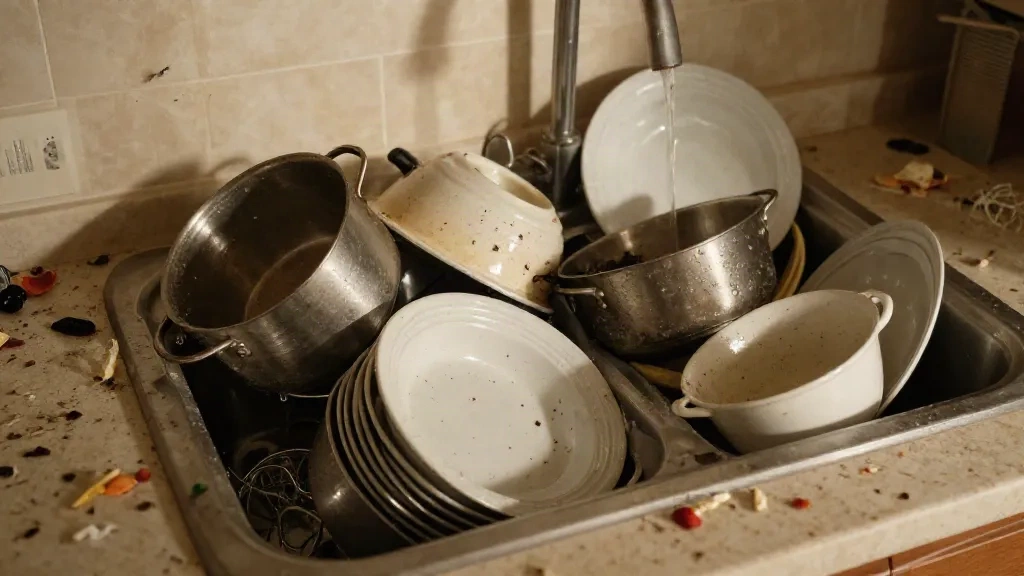
The third conversation about the dishes is a different animal from the first two. By then you're not negotiating, you're litigating. Who said what in the kitchen in March. Who did the bins twice in a row. Whether "I'll get to it" meant tonight or meant Sunday.
Verbal agreements between roommates fail for one boring reason: nobody wrote them down, so the argument is always about the past instead of the next seven days. What fixes it is an artifact. A roommate agreement template covering chores and quiet hours, filled in with your actual names, your actual bedtimes, and your actual bin day, stuck somewhere you both see it.
There are two ways to build that document, and households pick the wrong one all the time. Call them the Rota and the Standard. This piece runs them against each other, then gives you the template and the part everyone skips: what happens when someone breaks it.
What's the difference between a chore rota and a chore standard?
A rota assigns a named person to a named task on a named day. A standard defines the condition the flat has to be in by a deadline and stays silent on who gets it there.
A rota line looks like this: Bathroom, deep clean, Sam on the first and third Sunday of the month. Bins out Tuesday night, Alex on odd weeks, Sam on even.
A standard line looks like this: No dish sits in the sink overnight. The kitchen counter is clear of food, packaging, and dishes by 10 p.m. every night. Whoever sees it does it.
Both are written. Both are specific. They fail in completely different ways, which is why the choice matters more than the formatting.
Where a chore rota holds up, and where it breaks
A rota holds up brilliantly for tasks with a fixed frequency that nobody wants to do: bathrooms, bins, floors, the fridge purge. It is dispute-proof. On Tuesday there is no conversation about whose turn it is, because the paper says whose turn it is, and the paper was agreed to in a calm moment by both of you.
It also protects the person who cares less about mess. Under a rota, the roommate with a higher tolerance for a grimy shower does the shower on the 15th anyway, because it's on the sheet. Without one, they will simply never see the problem, and the other person cleans it while getting quietly furious.
Where it breaks:
Travel and shift work. Say one of you is away four nights every other week for work. A strict Tuesday-bins rota means the bins don't go out roughly twice a month and the other person eats it. Fix: every rota needs a swap clause. If you can't do your slot, you name a replacement slot within 72 hours, in writing, before your slot passes. Not after.
The letter-of-the-law problem. "I did the dishes yesterday." "Yeah. Your dishes." A rota gives people a defensible boundary, and defensible boundaries get abused. The person who cooked a four-pan dinner on someone else's dish night has technically done nothing wrong and has absolutely done something wrong.
Scorekeeping. Rotas invite ledgers. Once someone is counting, they're not managing a household, they're building a case.
Where a chore standard holds up, and where it breaks
A standard holds up for anything that is a condition rather than a task: the state of the counters, the noise level at midnight, whether the living room is usable when someone gets home. Nobody can be rostered onto "the flat feels livable," so a rota has nothing to say about it.
Standards also survive uneven schedules without amendment. If one of you works 7 a.m. to 4 p.m. and the other works 2 p.m. to 11 p.m., "the sink is empty by the time the last person goes to bed" works for both of you in a way that "Wednesdays, Priya" never will.
Where it breaks:
"Clean" is not a shared word. One person means no visible crumbs. One person means no dish actively growing something. If your standard says "keep the kitchen clean," you have written nothing. Write the test instead: counters wiped, sink empty, hob free of pans, bin not overflowing. Four checkable facts beat one adjective.
Diffusion. "Whoever sees it does it" reliably means the person with the lower tolerance sees it first, every time, forever. Within about six weeks they are doing 80% of the cleaning and feeling like a nag for mentioning it. This is the single most common way a standards-only agreement collapses.
No trigger for the conversation. A missed rota slot is a fact with a date on it. A drifting standard is a mood, and moods are easy to deny.
How do you write quiet hours that actually mean something?
Quiet hours need three things: a clock, a definition of quiet, and a carve-out for the nights you both know are coming. "Be respectful after 11" is not a quiet hours policy, it's a feeling.
Start with the clock, and steal it from your city if you can. Most municipal noise ordinances mark overnight quiet somewhere between 10 and 11 p.m. through 7 a.m.; look up your own city's code and use those hours as your default, because then neither of you invented them. The World Health Organization's 2018 Environmental Noise Guidelines for the European Region recommends night-time noise below 40 decibels for sleep, which is roughly the level of a quiet library. That's the target, not silence.
Then define quiet in terms someone can check at 12:40 a.m. without a decibel meter:
- No bass audible through a closed bedroom door.
- No vacuum, blender, washing machine, or drill.
- Voices in common areas at a level that doesn't carry into a bedroom with the door shut.
- Headphones after the hour, no exceptions, including for TV.
Then the carve-out, because a rule with no exceptions gets broken and then ignored entirely. Something like: Each of us gets two late nights per month past quiet hours, flagged at least 48 hours ahead in the group chat. Two, not five. Naming a number kills the argument about whether this is a pattern.
One more line worth adding: If noise wakes you, you're allowed to knock that night. Otherwise the resentment gets banked and shows up three weeks later attached to something about the recycling.
How many guest nights should a roommate agreement allow?
Set a number, in nights per month, and set a separate rule for the partner who is functionally living there. Vagueness here produces the nastiest roommate fights there are, because the person hosting genuinely does not perceive the difference between a guest and a resident.
A workable default for a shared flat: six guest nights per person per month, no more than three consecutive. Above that, a conversation, not a fait accompli. Check your lease too, since many of them define anyone staying past 14 consecutive days as an occupant, which is a landlord problem rather than a flatmate problem.
Write in the mechanical stuff people are too embarrassed to say out loud, because that's where the friction actually lives:
- Guests use the bathroom in the morning after both tenants, not before.
- A guest staying more than two nights in a week contributes to shared supplies (or the host does, doubled).
- Overnight guests are announced in the chat by 6 p.m., not discovered at breakfast.
- Guests fall under quiet hours the same as residents. The host is responsible for that, not the guest.
What happens when someone breaks the roommate agreement?
This is the section everyone leaves out, and it's the reason the agreement on your fridge stopped working in week three. An agreement with no stated response to a breach is a wish list. Write the ladder before anyone is angry.
A ladder that holds up:
- The flag. One message, factual, no adjectives. "Sink had pans in it this morning, that was your night." No reply needed beyond an acknowledgment.
- The make-good, within 48 hours. The missed job gets done, or a swap gets named on the sheet. Not an apology. An action with a date.
- The price, on the third miss in a month. Pick something real and small: the misser pays for the next round of shared supplies, or takes the other's bathroom slot, or covers a one-off cleaner. A price nobody would actually pay is decoration.
- The review, on the fourth. Sit down for 20 minutes and change the agreement, because four misses in a month means the rota is wrong, not that your roommate is a bad person. Someone's schedule changed and the paper didn't.
Write the ladder into the document itself and both sign it. If getting to a signed version is the part that keeps stalling, a structured tool like Servanda walks both of you through the specific clauses and produces something you've each actually agreed to, which is worth more than the best-worded agreement one person drafted alone and taped up.
A roommate agreement template for chores and quiet hours
Copy this, fill in every blank, delete nothing. Blanks left empty are the exact clauses you'll fight about in April.
Household agreement between __ and _, effective , reviewed ___ (pick a date 90 days out).
Rota tasks (named person, named day)
| Task |
Who |
When |
| Bins / recycling out |
______ |
______ |
| Bathroom clean |
______ |
______ |
| Floors (vacuum + mop) |
______ |
______ |
| Fridge clear-out |
______ |
______ |
| Restock: loo roll, bin bags, soap |
______ |
______ |
Swap rule: if you can't do your slot, name a replacement slot in writing before the slot passes.
Standards (condition + deadline, whoever's home)
- Sink: empty by ______ p.m. daily.
- Counters and hob: clear of pans, packaging, and food by ______ p.m.
- Cooked, so didn't wash up? You still clear your own pans by ______.
- Common-area personal items (shoes, laptops, laundry) returned to your room by ______.
Quiet hours
- Weeknights: __ to _. Weekends: to ___.
- Quiet means: no audible bass through a closed door, no appliances, headphones for TV and music.
- Late-night exceptions: __ per person per month, flagged ____ hours ahead.
- If noise wakes you, you may knock that night.
Guests
- __ overnight guest nights per person per month, maximum ____ consecutive.
- Announced by ______ p.m. the same day.
- Guests follow quiet hours. Host is responsible.
- A partner staying more than ______ nights a month triggers a conversation about supplies and rent.
When it's broken: flag, make-good within 48 hours, price on the third miss (______), review on the fourth.
Signed __ / ____
Which one would we pick, and when would we switch?
Use a rota for every task with a frequency, and a standard for every condition. That split is not a compromise, it's what each tool is good at: bins and bathrooms need an owner, and counters and noise need a threshold. A household running both usually needs five rota lines and four standards, and that's the whole document.
Switch a rota line to a standard when the schedules stop matching the calendar. Shift work, a new commute, three weeks of travel a month: at that point a fixed Tuesday is just a scheduled failure, and "bins out before collection, either of you" works better.
Switch a standard to a rota the moment one of you is doing more than about 60% of it. You'll know, because you'll have started counting. Counting is the signal. When the shared thing has quietly become one person's job, put a name and a day next to it and get it back onto paper.