Roommate Agreements: Do They Actually Prevent Fights?
It's 11:47 PM on a Tuesday. You have a 7 AM alarm set, a presentation tomorrow, and your roommate just invited six friends over to watch a movie at full volume. You're lying in bed, staring at the ceiling, heart pounding — not because of the noise, but because you're rehearsing the confrontation in your head. Should I say something? Will they think I'm uptight? We never actually talked about this...
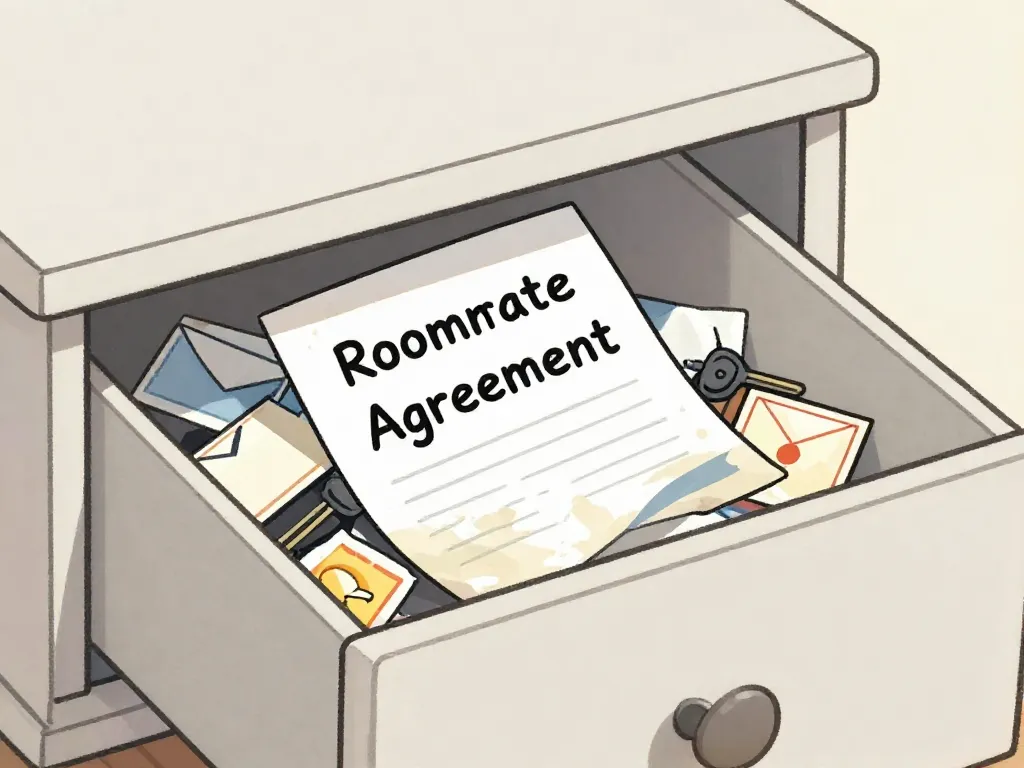
This is the moment most roommates wish they had set expectations earlier. But here's the real question: would a roommate agreement have actually prevented this? Or would it just be a piece of paper collecting dust in a kitchen drawer?
Roommate agreements can be powerful tools — but only if they're built the right way. A bad one creates false confidence. A good one creates a shared language for navigating the messy, unavoidable friction of sharing a living space.
Why Most Roommate Agreements Fail
Most roommate agreements don't work, not because the concept is flawed, but because most people approach them wrong.
The "Template Trap"
You Google "roommate agreement template," download a PDF, fill in the blanks, and both sign it during move-in weekend while you're still in the honeymoon phase. Three months later, the agreement is buried under a pile of mail. Nobody references it. When conflict arises, pulling it out feels adversarial — like presenting evidence in a court case against someone you share a bathroom with.
The agreement becomes a checkbox rather than a living document.
The Vagueness Problem
Here's an example pulled from a popular roommate agreement template:
"Both roommates agree to keep common areas reasonably clean."
What does "reasonably" mean? To one person, it means no dishes left in the sink overnight. To another, it means nothing is growing mold. That single word contains an entire conflict waiting to happen.
Vague roommate agreements don't prevent fights. They postpone them.
The Enforcement Gap
Even specific agreements fail if there's no plan for what happens when someone doesn't follow through. Most people write rules but skip the most important part: what do we do when a rule gets broken?
Without an enforcement mechanism — even an informal one — the agreement has no teeth. The person who brings up a violation feels like a nag, while the person being called out feels attacked.
What the Research and Real Experience Tell Us
A study from the Journal of American College Health found that students who discussed and agreed on expectations before moving in together reported significantly fewer conflicts over the semester. But the critical finding: it wasn't the written document that mattered most — it was the conversation itself.
The act of sitting down together and saying "What bothers you? What do you need? What are your non-negotiables?" creates mutual understanding. The paper is just a record of that understanding.
Consider two scenarios:
Scenario A — No Agreement:
Mia and Jordan move in together as friends from college, so they assume they're on the same page. Within a month, Mia is frustrated that Jordan's partner is essentially living with them rent-free. Jordan is annoyed that Mia passive-aggressively cleans the kitchen at 6 AM on weekends. Neither says anything directly. By month four, they can barely stand each other.
Scenario B — Thoughtful Agreement:
Alex and Sam sit down before move-in and have an honest conversation. They agree that overnight guests are fine up to three nights per week, and anything more triggers a conversation about contributing to utilities. They decide on a cleaning rotation that alternates weekly. When Sam's schedule changes and they fall behind on their cleaning week, they text Alex proactively: "Hey, I know it's my week — work has been brutal. Can we swap?" Alex agrees without resentment because there's a system to reference.
The agreement didn't eliminate friction in Scenario B, but it gave Alex and Sam a framework to address friction before it became personal.

The Five Topics Your Roommate Agreement Must Cover
These five areas are responsible for the vast majority of roommate conflicts:
1. Cleaning Standards and Responsibilities
This is the number one source of roommate conflict, almost always rooted in different definitions of "clean."
Don't write: "We'll both keep the apartment clean."
Do write:
- Kitchen dishes must be washed or loaded into the dishwasher within 12 hours of use
- Bathroom cleaning alternates weekly (Person A: odd weeks, Person B: even weeks)
- Common areas get a 15-minute tidy every Sunday evening
- Personal messes in shared spaces get cleaned up same-day
2. Guest Policies
Guests involve another person's social life and relationships — deeply personal territory. Undefined guest policies lead to explosive roommate conflicts.
Address these specifics:
- How many nights per week can a guest stay over?
- At what point does a frequent guest need to contribute to utilities or rent?
- Are there any advance-notice expectations?
- What about parties or gatherings? How many people, how late, how often?
3. Noise and Quiet Hours
People have wildly different sensitivity to noise and wildly different schedules.
Consider agreeing on:
- Quiet hours (e.g., 10 PM – 7 AM on weeknights, midnight – 9 AM on weekends)
- Headphone rules for music, gaming, and video calls
- How to handle exceptions ("I have an early flight tomorrow — can we push quiet hours up tonight?")
4. Shared Expenses and Supplies
- Who buys shared supplies (toilet paper, dish soap, trash bags)? Do you split costs or alternate purchases?
- How do you handle utility bills? Even split, or proportional to room size?
- What happens if someone can't pay on time?
Use a shared spreadsheet or expense-splitting app to track costs transparently.
5. Personal Space and Boundaries
- Is borrowing each other's stuff okay? With or without asking?
- Are bedrooms strictly private?
- How do you handle temperature preferences for heating and cooling?
- What about food — is anything shared, or is the fridge divided?
How to Create a Roommate Agreement That Actually Works
Step 1: Have the Conversation Before You Write Anything
Don't start with a template. Start with a conversation. Sit down — ideally with food — and talk openly about your living habits, pet peeves, and non-negotiables.
Useful prompts:
- "What's the worst roommate experience you've ever had, and what caused it?"
- "What's something small that really gets under your skin in a shared space?"
- "What does your ideal weeknight look like at home?"
Step 2: Be Uncomfortably Specific
Every vague statement is a future argument. Push yourselves to define terms.
Instead of "clean up after yourself," specify: "Wipe kitchen counters after cooking. Sweep visible crumbs from the floor. Take out trash when the bin is full — don't compress it down and leave it."
The awkwardness of spelling things out lasts five minutes. The alternative conflict lasts months.
Step 3: Build in a Review Schedule
People change. Schedules change. Relationships start and end. A new job might shift someone's sleep schedule by three hours.
Set a recurring calendar reminder — monthly for the first three months, then quarterly — to revisit the agreement. During these check-ins, ask:
- "Is anything in our agreement not working for you?"
- "Is there something we didn't cover that's been bugging you?"
- "Do we need to adjust anything?"
This normalizes renegotiation and makes updating the rules feel collaborative rather than confrontational.

Step 4: Define What Happens When Rules Get Broken
You don't need a punishment system. You need a communication protocol. For example:
- First time: A casual, no-blame mention. "Hey, just a reminder about the dishes thing we agreed on."
- Pattern emerges: A direct sit-down conversation. "I've noticed this has come up a few times. Can we talk about whether the current agreement still works?"
- Ongoing issue: Bring in a neutral perspective. This could be a mutual friend, an RA, or a structured mediation tool. Platforms like Servanda can help you work through recurring disagreements by providing a neutral framework when direct conversations feel stuck.
Having this protocol agreed on in advance means neither person has to invent a confrontation strategy in the heat of the moment.
Step 5: Sign It, But Keep It Accessible
Both of you should sign the agreement — not because it's legally binding (in most cases, it's not), but because signing creates psychological commitment. It transforms a casual chat into an intentional decision.
Keep it somewhere you can both access it. A shared Google Doc works better than a piece of paper because it's easy to update and impossible to lose.
Common Mistakes That Undermine Roommate Agreements
- Making it one-sided. If one person drafted the entire agreement and the other just signed, it doesn't represent genuine buy-in. Both voices need to shape the document.
- Being too rigid. Rules should have flexibility built in. Life isn't perfectly predictable, and an agreement that doesn't bend will break.
- Using it as a weapon. The agreement exists to facilitate conversation, not to "win" arguments. The moment someone pulls out "section 3B clearly states..." you've lost the plot.
- Ignoring power dynamics. If one roommate is on the lease and the other is a subletter, or if there's a significant income difference, the agreement should acknowledge and account for that imbalance.
- Forgetting to celebrate what works. If your agreement has been running smoothly for three months, acknowledge it. "Hey, I really appreciate how well our cleaning rotation has been going" goes a long way.
The Honest Answer: Do Roommate Agreements Prevent Fights?
No piece of paper prevents fights. People prevent fights — by choosing to have hard conversations early, by being specific about their needs, and by treating their living arrangement with the same intentionality they'd bring to any other important relationship.
A roommate agreement is a tool. Like any tool, it works when used properly and collects dust when it's not. The difference between an agreement that prevents fights and one that provides false security comes down to three things:
- The quality of the conversation that created it
- The specificity of its terms
- The willingness of both parties to revisit and enforce it with kindness
If you and your roommate are willing to do those three things, then a roommate agreement can be one of the most effective conflict prevention tools you'll ever use.
Frequently Asked Questions
Is a roommate agreement legally binding?
In most cases, no. A roommate agreement between co-tenants is generally a social contract, not a legal one. However, if it covers financial obligations like rent splits and is signed by both parties, it could carry weight in small claims court. For anything involving money, it's worth having clear written terms regardless of legal enforceability.
When should you create a roommate agreement?
Ideally, before you move in together — or during the first week of living together. The earlier you set expectations, the less likely you are to develop resentment over unspoken rules. That said, it's never too late. If you're three months in and already clashing, sitting down to formalize expectations can still reset the dynamic.
What if my roommate refuses to make a roommate agreement?
Don't force it. Instead, try framing it casually: "I've had bad roommate experiences before, and I've found that talking through a few things upfront makes everything easier. Can we just chat about expectations over dinner?" The conversation matters more than the document.
Can a roommate agreement help if we're already fighting?
It can, but it works differently at this stage. Rather than preventing conflict, the agreement becomes a tool for resolution — a way to say "Let's stop arguing about what the rules should be and decide together what they will be going forward." It reframes the conflict as a problem to solve together rather than a battle to win.
Should friends who become roommates still make an agreement?
Absolutely — arguably more so than strangers. Friendships create assumptions ("We know each other so well, we don't need to talk about this"), and those assumptions are exactly where roommate conflict hides. A brief, honest conversation about expectations can protect both your living situation and your friendship.