
5 Roommate Conflict Myths That Keep You Stuck
It's 11 PM on a Tuesday. Your roommate's friends are laughing loudly in the living room — again. You're lying in bed, jaw clenched, mentally composing the most scathing text message of your life. You've been here before. You've rehearsed the argument in the shower. You've vented to three separate group chats. And yet nothing changes.
Here's the uncomfortable truth: the conflict with your roommate might be real, but the story you're telling yourself about it could be making everything worse. Certain roommate conflict myths act like invisible walls — they feel like facts, but they actually block you from resolving anything. They keep you stuck in a loop of resentment, avoidance, or explosive blowups that never lead anywhere productive.
Let's dismantle five of the most common ones. Not to make you feel bad, but to give you something more useful: a way out.
Key Takeaways
- Blaming one person entirely is almost never accurate — roommate conflicts usually involve contributions from both sides, even small ones.
- Avoiding conflict doesn't keep the peace — it builds invisible pressure that eventually explodes or erodes the relationship.
- "Obvious" expectations aren't obvious to everyone — unspoken standards about cleanliness, noise, and shared spaces vary wildly between people.
- One big conversation won't fix everything — real resolution requires follow-through, written agreements, and ongoing adjustment.
- Feeling angry doesn't mean you're right — strong emotions are valid, but they aren't reliable evidence that your interpretation is the only correct one.

Myth 1: "This Is 100% My Roommate's Fault"
Why We Believe It
When you're frustrated, your brain does something sneaky: it casts you as the reasonable protagonist and your roommate as the villain. Psychologists call this the fundamental attribution error — the tendency to explain other people's behavior as a character flaw ("they're inconsiderate") while explaining your own behavior as situational ("I only snapped because I was stressed").
It feels righteous. It feels clean. And it's almost never the full picture.
What's Actually Happening
Roommate conflicts are rarely one-directional. That doesn't mean both people are equally at fault — sometimes one person really is being more disruptive. But there's usually a secondary dynamic at play:
- You never actually told them the noise bothers you, so they assumed it was fine.
- You've been passively withdrawing for weeks, and they have no idea why you seem cold.
- You established a cleaning "standard" in your head that you never communicated out loud.
None of that excuses genuinely disrespectful behavior. But asking "What's my 10% in this?" isn't about self-blame — it's about finding the piece of the problem you can actually control.
Try This Instead
Before your next confrontation, write down your version of events. Then try writing your roommate's version — genuinely, as if you were defending their perspective to a friend. You don't have to agree with it. But if you can't even articulate their side, you're not ready for a productive conversation yet.
Myth 2: "If I Ignore It, It'll Work Itself Out"
Why We Believe It
Conflict avoidance feels like peacekeeping. You tell yourself you're being the bigger person, that it's not worth the drama, that maybe the problem will just naturally dissolve. This myth is especially common among people who grew up in households where conflict was explosive or punishing — avoiding feels like the safe option.
What's Actually Happening
Unaddressed roommate conflicts don't disappear. They metastasize. That small annoyance about dishes in the sink becomes a symbol of deeper disrespect. The resentment compounds silently until one day you explode over something trivial — and your roommate is blindsided because, from their perspective, everything was fine.
Research on interpersonal conflict consistently shows that avoidance is one of the least effective conflict styles for long-term relationship satisfaction. A 2023 survey from ApartmentList found that over 30% of renters who experienced roommate conflicts said they let issues build up until the relationship was unsalvageable.
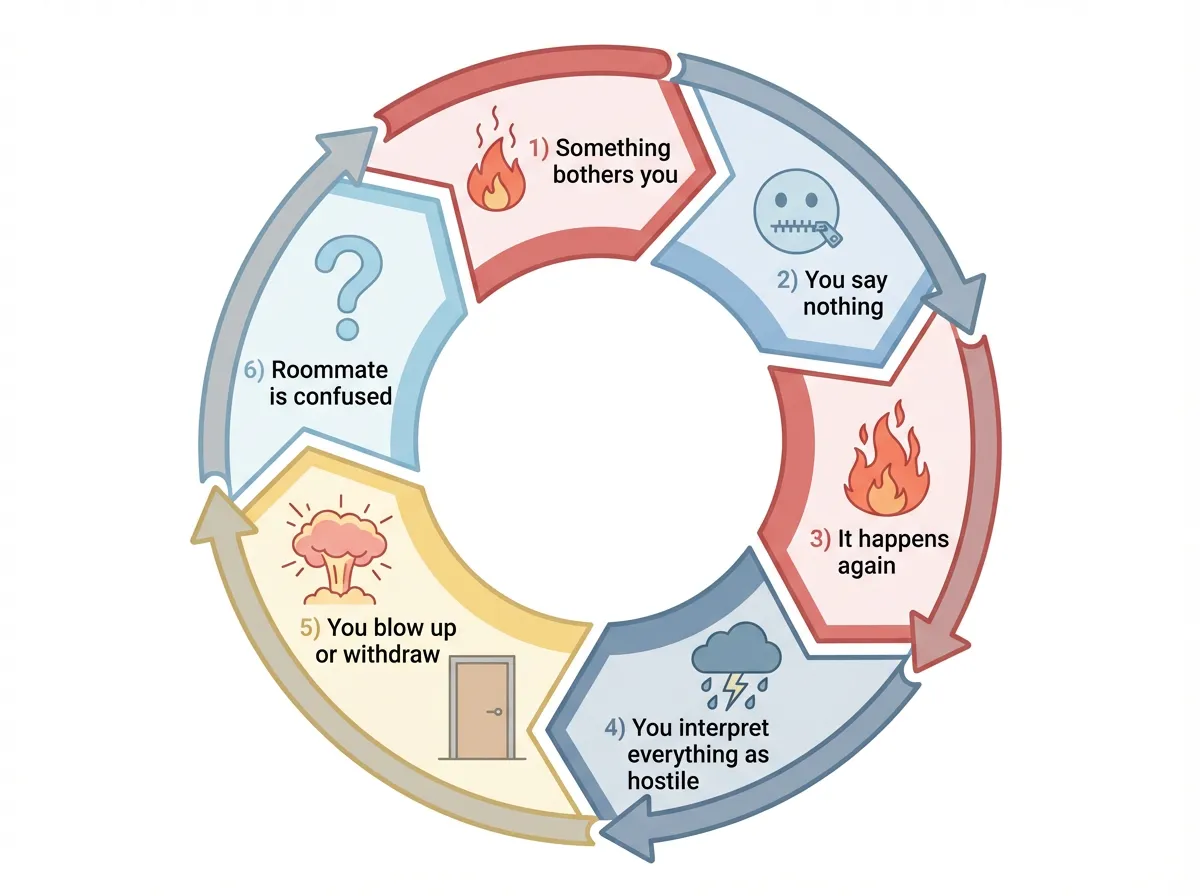
Here's what the avoidance cycle actually looks like:
- Something bothers you.
- You say nothing because you don't want to be "difficult."
- It happens again. The annoyance grows.
- You start interpreting neutral behavior as hostile.
- You either blow up or silently start planning your exit.
- Your roommate is confused and hurt.
Try This Instead
Set a 48-hour rule: if something bothers you and you're still thinking about it two days later, it's worth a conversation. Not a confrontation — a conversation. A simple script: "Hey, I want to bring something up while it's still small. Can we talk about [specific thing] for a few minutes?"
Timeliness is kindness. Addressing something early, when the emotional stakes are low, is far gentler than waiting until you're furious.
Myth 3: "They Should Just Know — It's Common Sense"
Why We Believe It
This might be the most pervasive of all roommate conflict myths. You grew up cleaning the kitchen after every meal. You were taught that quiet hours start at 10 PM. You consider it basic decency to ask before borrowing something. So when your roommate violates these norms, it doesn't feel like a difference of opinion — it feels like a moral failure.
What's Actually Happening
There is no universal "common sense" for shared living. People are raised in wildly different households with wildly different norms. What feels like obvious courtesy to you might be something your roommate has genuinely never encountered.
Consider the range:
- Cleanliness: Some people were raised to clean as they go; others did one big weekly clean. Neither is wrong — they're just different systems.
- Noise: In some families, the house was always lively and loud. In others, you could hear a pin drop after 9 PM.
- Shared items: Some roommates come from cultures or families where food, toiletries, and supplies were communal by default. Others consider the fridge a series of individual territories.
- Guests: "Having someone over" could mean anything from a quiet dinner to an overnight stay to a week-long visit.
The phrase "they should just know" is almost always code for "I haven't actually told them, and I'm frustrated that they can't read my mind."
Try This Instead
Replace assumptions with explicit agreements. Sit down early in the living arrangement — or right now, even if you're mid-conflict — and get specific. Tools like Servanda can help roommates create clear written agreements covering chores, guests, quiet hours, and shared expenses, which prevents the "I assumed you knew" trap from forming in the first place.
Write it down. Anything unwritten is just a wish.
Myth 4: "One Big Talk Will Fix Everything"
Why We Believe It
Movies and TV have conditioned us to believe in the cathartic confrontation — that one raw, honest conversation where everyone says what they really feel, maybe someone cries, and then everything is magically repaired. So you psych yourself up for The Big Talk. You plan your points. You might even rehearse.
What's Actually Happening
One conversation can absolutely start the process of resolution. But a single talk rarely finishes it, for a few reasons:
- People need time to process. Your roommate might agree to changes in the moment but need days to genuinely absorb the feedback.
- Behavior change is gradual. Even with the best intentions, habits don't shift overnight. If your roommate has been leaving dishes out for six months, one talk isn't going to rewire that pattern by tomorrow.
- New issues surface. Resolving one conflict often reveals adjacent ones you hadn't noticed. That's not failure — it's progress.
The myth of the one big talk can actually make things worse. When you invest enormous emotional energy into a single conversation and then your roommate slips back into old habits two weeks later, it feels like betrayal. In reality, it's just human.

Try This Instead
Think of conflict resolution as an ongoing system, not a single event. After your initial conversation:
- Agree on a check-in schedule. Even something casual like "Let's revisit this in two weeks and see how it's going" removes the pressure of perfection.
- Define success concretely. Instead of "be cleaner," try "wipe down kitchen counters after cooking." Specificity makes follow-through measurable.
- Expect imperfection. Build in grace for slip-ups. The goal isn't flawless compliance — it's a shared commitment to trying.
Myth 5: "If I Feel Strongly, I Must Be Right"
Why We Believe It
Emotions are powerful, and our culture often equates emotional intensity with moral clarity. If you feel deeply hurt, it seems logical that someone must have done something deeply wrong. Your anger feels like proof.
What's Actually Happening
Your feelings are always valid — meaning they're real, they matter, and they deserve attention. But valid doesn't mean accurate as evidence. Emotions are shaped by your history, your stress level, your sleep, your past relationships, and a hundred other factors that have nothing to do with your roommate eating your leftover Thai food.
Here are some common ways emotions distort roommate conflicts:
- Catastrophizing: "They left the door unlocked — they clearly don't care about my safety." (More likely: they forgot.)
- Mind-reading: "They're being quiet because they're angry at me." (More likely: they're tired, or scrolling their phone, or just existing quietly.)
- Personalizing: "They didn't invite me to hang out with their friends — they must not like me." (More likely: they assumed you were busy, or they wanted time with just those friends, which is healthy.)
The intensity of your reaction is information about you — your needs, your boundaries, your triggers. That's valuable. But it's not a verdict on the other person's character.
Try This Instead
Before acting on a strong feeling, run it through a quick reality check:
- What happened? (Just the facts — what a security camera would show.)
- What story am I telling myself about it? (The interpretation, the meaning I've assigned.)
- Is there another plausible explanation? (Even one I don't love.)
- What do I actually need right now? (Not what I want to say — what I need.)
This isn't about suppressing your emotions. It's about separating the signal from the noise so you can advocate for yourself clearly.
How to Actually Move Forward
Debunking these myths isn't about proving you wrong or letting your roommate off the hook. It's about removing the mental barriers that keep you cycling through the same arguments without resolution.
Here's a quick reference for putting this into practice:
| Myth | Reality | Action |
|---|---|---|
| It's 100% their fault | Conflicts are usually co-created | Ask: "What's my 10%?" |
| Ignoring it will fix it | Avoidance compounds resentment | Use the 48-hour rule |
| They should just know | "Common sense" is not universal | Make expectations explicit and written |
| One big talk fixes everything | Resolution is a process | Schedule check-ins |
| Strong feelings = being right | Emotions are valid but not verdicts | Use the reality check framework |
Frequently Asked Questions
How do I bring up a roommate conflict without starting a fight?
Start with timing and framing. Choose a calm, neutral moment — not right after the frustrating incident. Open with something specific and non-accusatory, like "I want to talk about how we handle dishes — can we figure out a system that works for both of us?" Framing it as a shared problem rather than a personal accusation makes defensiveness far less likely.
Is it normal to have conflicts with roommates?
Absolutely. Conflict is a natural part of sharing space with another person, regardless of how well you get along. Studies consistently show that the majority of roommates experience some form of disagreement. The difference between healthy and unhealthy roommate situations isn't the absence of conflict — it's how conflicts get handled.
What do I do if my roommate refuses to talk about problems?
If direct conversation isn't working, try writing it down. A calm, specific message or letter can feel less confrontational. If they still won't engage, focus on what you can control: your own boundaries, your own space, and whether this living situation is sustainable. In some cases, involving a neutral third party — a mutual friend, an RA, or a mediation service — can help break the stalemate.
Should roommates have a written agreement?
Yes, even if you're living with a close friend. Written agreements remove ambiguity around chores, guests, quiet hours, shared expenses, and other common friction points. They're not a sign of distrust — they're a sign of maturity. The best time to create one is at the start of the living arrangement, but the second-best time is right now.
When should I consider finding a new roommate?
If you've made genuine, repeated efforts to address problems — you've communicated clearly, proposed solutions, followed through on your end — and nothing changes, it's okay to start exploring other options. A living situation that consistently drains your mental health isn't worth preserving out of guilt or convenience. Knowing when to walk away is its own form of resolution.
Moving Forward, One Myth at a Time
Roommate conflicts are frustrating, exhausting, and deeply personal — you can't clock out from the place where you sleep. But so much of what keeps us stuck isn't the conflict itself; it's the false beliefs we layer on top of it. The idea that it's all their fault. The hope that silence equals peace. The assumption that everyone shares your definition of "obvious."
Letting go of these myths doesn't mean your frustrations aren't real. It means you're clearing the fog so you can actually see what's happening — and do something about it. Start with one myth. Challenge it honestly. See what shifts. You might not fix everything overnight, but you'll stop spinning in place. And that's where real resolution begins.