5 Roommate Fights Every Renter Faces (And Fixes)
It's 11:47 p.m. on a Tuesday. You have a presentation at 8 a.m. Your roommate has friends over, and someone just turned up the Bluetooth speaker in the kitchen. You're lying in bed, jaw clenched, composing a furious text message you'll probably regret sending.
Sound familiar? You're not alone — and you're not a bad roommate for feeling this way. A 2023 survey from Apartment List found that nearly 70% of renters who live with roommates report experiencing recurring conflicts. The most common roommate fights — over noise, cleanliness, shared expenses, guests, and temperature — are so predictable that Resident Advisors on college campuses have literal playbooks for them.
The good news: these fights are universal, which means the solutions are well-tested. This article walks through the five most common roommate conflicts, explains why they escalate, and gives you concrete fixes drawn from RA-tested mediation strategies and real-world renter experiences.
Key Takeaways
- The five most common roommate fights are about cleanliness, noise, shared expenses, guests, and thermostat/shared spaces — and every one of them is solvable.
- Most conflicts escalate because of unspoken expectations, not because someone is a terrible person. Writing agreements down — even informally — prevents the majority of blowups.
- Timing matters more than wording. Bringing up an issue when you're calm and rested is more effective than crafting the perfect speech while you're angry.
- Small, specific asks beat big, vague complaints. "Can you wash your pan within an hour of cooking?" works better than "You need to be cleaner."
- You don't have to solve everything in one conversation. A trial period for any new arrangement takes the pressure off both sides.

Fight #1: The Dish Standoff (and Other Cleanliness Wars)
Why It Happens
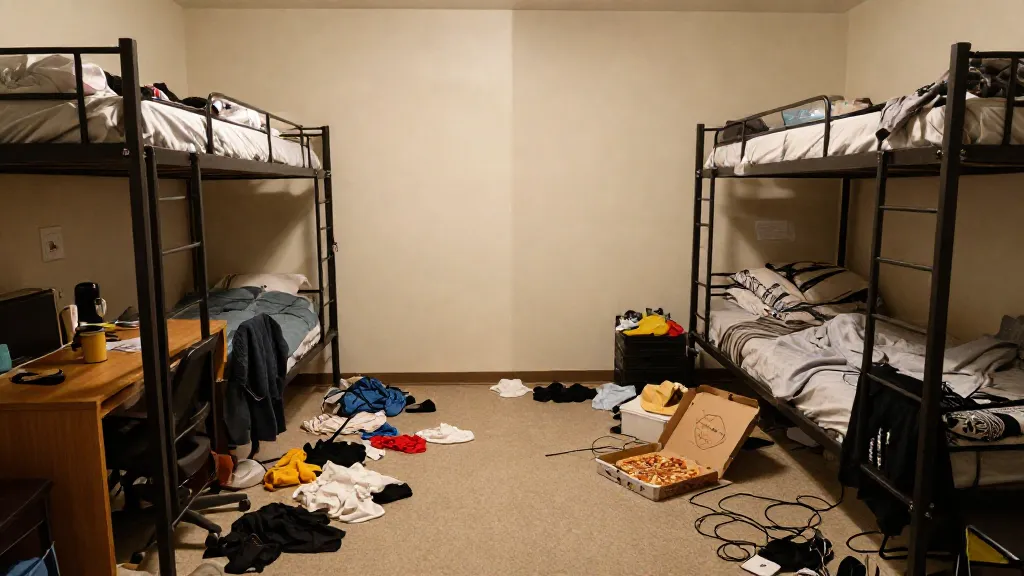
Cleanliness is the number one source of roommate fights, and it's not because one person is a slob and the other is a saint. People genuinely have different thresholds for what counts as "messy." You grew up in a house where dishes were washed immediately after dinner. Your roommate grew up in a house where the sink filled up and someone handled it before bed. Neither standard is wrong — but when they collide in a shared kitchen, resentment builds fast.
The real problem isn't the dishes. It's that most roommates never define what "clean" actually means in their shared space.
The Fix
1. Get specific, not general. Replace "let's keep the kitchen clean" with concrete standards: - Dishes washed (or in the dishwasher) within two hours of use - Counters wiped down after cooking - Trash taken out when it reaches the top of the bag
2. Create a rotation that's actually visible. A shared note on the fridge or a free app like Sweepy or OurHome removes the mental load of remembering whose turn it is. When chores are visible, no one has to be the nagging roommate.
3. Try a two-week pilot. Propose the new arrangement as an experiment. "Let's try this for two weeks and see if it works" feels collaborative, not bossy. It also gives both of you permission to adjust.
Real example: Marcus and Dev had a three-month cold war over a cast iron skillet. Marcus felt Dev never cleaned it properly. Dev felt Marcus was being controlling. When they finally talked, they realized Marcus didn't know cast iron isn't supposed to be scrubbed with soap. They agreed Dev would wipe and oil the pan after use, and Marcus would stop re-washing it. The fight was never about effort — it was about different definitions of "clean."
Fight #2: The Noise Battle
Why It Happens
Noise conflicts are deceptive because they feel personal. When your roommate plays music at a volume that disrupts your focus, it's hard not to interpret it as disrespect. But noise tolerance is deeply individual — shaped by how you grew up, your work schedule, your stress levels, and even your neurological wiring. Someone who works from home has radically different noise needs than someone who's out all day and wants to unwind at night.
The Fix
1. Establish "quiet hours" — and be honest about what you need. Many leases already include quiet hours (typically 10 p.m. to 8 a.m.), but your personal needs might differ. If you work early mornings, say so. If you study late, say so. Frame it as information sharing, not a demand: "I'm usually asleep by 10:30 on weeknights — could we keep common areas quieter after 10?"
2. Invest in physical buffers. This isn't about letting bad behavior slide; it's about not making a roommate relationship dependent on perfection. White noise machines ($20–$40), good earplugs, and a door draft stopper can make a meaningful difference while you work on the social solution.
3. Use a signal system. Some roommates use a simple visual cue — a closed door means "please don't knock unless it's urgent," headphones on means "I'm focused." This removes the awkwardness of asking for quiet in the moment.

Real example: Priya and Angela shared a one-bedroom apartment where Priya's "bedroom" was a partitioned living room. Angela's boyfriend would call every night at 11 p.m., and Angela would talk in the kitchen — ten feet from Priya's bed. Priya stewed for weeks before finally saying, "I can hear conversations in the kitchen after 10. Could you take late calls in your room with the door closed?" Angela had no idea how much sound carried. She moved her calls immediately. The conversation took 90 seconds.
Fight #3: The Money Mess
Why It Happens
Shared expenses create roommate fights not because people are cheap, but because people make different assumptions about fairness. Should utilities be split 50/50 even if one person works from home and runs the AC all day? Should groceries be shared or separate? What about household supplies — who replaces the dish soap?
Money conflicts also carry extra emotional weight because they touch on values, class, and financial stress that most people don't want to discuss openly.
The Fix
1. Separate what you can, and agree on what you share. The cleanest arrangement for most roommates: - Split evenly: Rent, internet, renter's insurance, shared household supplies - Keep separate: Groceries, personal toiletries, subscriptions - Discuss case by case: Utilities (especially if usage is clearly uneven)
2. Use a shared expense tracker. Splitwise, Venmo's group feature, or even a shared spreadsheet eliminates the "I think you owe me" conversations. When the math is visible, the emotion drains out.
3. Set a payment deadline — and automate what you can. "Rent and utilities Venmo'd by the 28th" is a clearer agreement than "we'll figure it out each month." Autopay removes willpower from the equation.
4. Address income differences directly if they exist. If one roommate earns significantly more, it's worth a one-time honest conversation about whether a proportional split makes sense. This isn't charity — it's practical. A roommate who's financially stressed and resentful is worse for everyone than a slightly uneven rent split that both people feel good about.
Fight #4: The Guest Problem
Why It Happens
Guest conflicts are really boundary conflicts wearing a social mask. The issue is rarely "I don't like your friends." It's usually: - "I didn't sign up to live with a fourth person" (a partner who's over five nights a week) - "I can't relax in my own home when strangers are here" - "Your guests used my food / left a mess / were loud at 2 a.m."
These fights are especially hard to raise because they feel controlling. Nobody wants to be the roommate who "doesn't allow guests."
The Fix
1. Distinguish between guests and semi-residents. Most roommate agreements that work draw a clear line: overnight guests are fine a certain number of nights per week (two or three is a common number). Beyond that, the guest is functionally a roommate and should be contributing to utilities and shared costs.
2. Set a heads-up norm, not a permission system. "Let me know if someone's staying over" is different from "ask me if someone can stay over." The first is courtesy. The second breeds resentment. A simple text — "Jake's crashing here tonight" — is usually all it takes.
3. Address the impact, not the person. If a roommate's partner is over constantly, don't say "Your girlfriend is here too much." Say "I've noticed our water bill went up, and I'm feeling like I don't have much alone time in the common areas. Can we talk about a guest schedule that works for both of us?"

Real example: Jordan's roommate Tyler started dating someone new and had them over six nights a week for a month. Jordan didn't say anything until they exploded during an argument about an unrelated utility bill. A resident advisor helped them separate the issues. They agreed on a four-night-per-week maximum, with Tyler's partner chipping in $50/month for utilities when staying over frequently. The key was that the RA helped Jordan raise the guest issue without it becoming a referendum on Tyler's relationship.
Fight #5: The Thermostat Tug-of-War
Why It Happens
This one sounds trivial until you're living it. One person runs cold, the other runs hot. One watches the electric bill like a hawk, the other thinks 68°F in winter is a basic human right. Thermostat conflicts are so common that a 2022 survey by Rent.com found temperature disagreements ranked in the top five sources of roommate tension.
The deeper issue is that temperature is constant. A dirty dish can be cleaned. Noise can stop. But the thermostat affects every hour you're home, which means the irritation never fully resets.
The Fix
1. Agree on a range, not a number. A set range (say, 68–72°F) gives both people room to adjust without it feeling like a violation. Program the thermostat to a shared schedule if possible.
2. Split the difference with personal solutions. The person who runs cold gets a space heater for their room (and pays the marginal electricity). The person who runs hot gets a fan. This keeps the common areas at a compromise temperature while letting each person customize their own space.
3. Make the cost transparent. Sometimes the fight isn't really about comfort — it's about money. If your utility bill swings $40 between summer and winter, knowing that number makes the trade-off concrete. "Is 72° instead of 70° worth an extra $15/month to you? If so, would you cover the difference?" That's a solvable negotiation.
How to Bring Up a Roommate Fight Without Making It Worse
Knowing the fix is one thing. Actually raising the issue is another. Here's a framework that RAs and mediators use:
Pick the Right Moment
- Not when you're angry
- Not when they're stressed, rushing, or just walked in the door
- Ideally, during a calm, neutral moment — "Hey, do you have ten minutes to talk about something small?"
Use the Observation → Impact → Request Format
This is a stripped-down, non-corny version of what therapists call an "I-statement":
- Observation (what you've noticed, no judgment): "I've noticed the dishes have been sitting in the sink overnight a few times this week."
- Impact (how it affects you): "It makes the kitchen feel cluttered when I'm trying to cook in the morning."
- Request (what you'd like to try): "Could we try a same-day dishes rule and see how it goes?"
This format works because it removes blame. You're describing a situation and proposing a solution, not prosecuting a case.
Write It Down
The single biggest predictor of whether a roommate agreement sticks is whether it's written somewhere. It doesn't need to be a legal document. A shared Google Doc, a note on the fridge, or even a text thread works. Tools like Servanda can help you formalize these agreements with clear terms so nothing gets lost in memory or misinterpreted later. The point is the same: when expectations are documented, people follow through at dramatically higher rates — and when something goes wrong, you have a reference point that isn't "I thought we agreed."
FAQ
How do I talk to my roommate about a problem without starting a fight?
Timing and framing are everything. Choose a neutral moment when neither of you is stressed, and lead with what you've observed rather than what they've done wrong. A request for a small experiment ("Can we try this for two weeks?") feels much less threatening than a permanent demand.
What should a roommate agreement include?
A useful roommate agreement covers at minimum: cleaning responsibilities and standards, quiet hours, guest policies (including overnight limits), how shared expenses are split and when they're due, and thermostat or shared space norms. It doesn't have to be formal — a shared doc with bullet points works.
Is it normal to fight with your roommate?
Absolutely. Roughly 70% of people who live with roommates report recurring conflicts. Having friction doesn't mean your living situation is broken — it means two different people with different habits are sharing a space. What matters is whether you have a way to address issues before they calcify into resentment.
When should I involve a mediator or third party in a roommate conflict?
If you've tried to raise an issue directly more than twice and nothing has changed, or if conversations consistently escalate into arguments, a neutral third party can help. This could be a mutual friend, an RA, a landlord, or a mediation service. The goal isn't to "win" — it's to have a structured conversation where both people feel heard.
Can a roommate agreement be legally binding?
In most cases, a written roommate agreement is not a formal lease and may not be enforceable in court the same way. However, it serves as strong documentation of what was agreed upon, which can be helpful if disputes escalate to a landlord or small claims situation. The real value is preventive — having the conversation and writing it down solves most problems before they become legal ones.
Moving Forward
Every roommate fight on this list — the dishes, the noise, the money, the guests, the thermostat — shares a root cause: unspoken expectations meeting someone else's unspoken expectations. The fix is almost always the same pattern: get specific about what you need, propose a trial run, and write it down.
None of this requires you to be a perfect communicator or to never feel annoyed. It just requires a willingness to treat your roommate like a reasonable person who probably doesn't know they're bothering you. Because most of the time, they don't.
The fact that you read this far means you're already doing the hard part — taking your living situation seriously enough to look for solutions instead of just venting. That alone puts you ahead of most. Now pick the one fight on this list that's been nagging at you, use the observation-impact-request format, and start the conversation. Two weeks from now, you'll be glad you did.