80% of Roommate Fights Are Fixable With One Talk
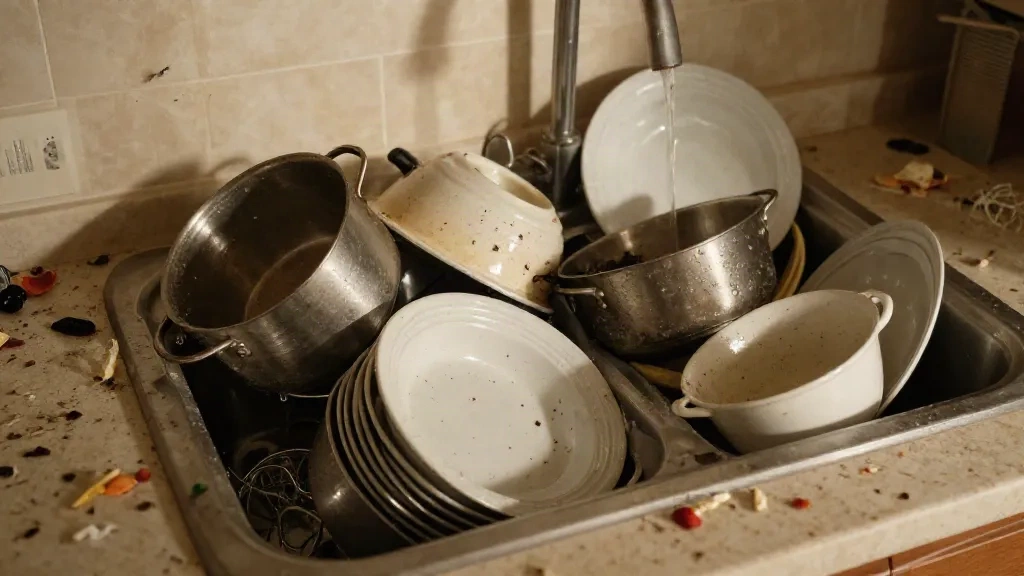
It starts small. A crusty pan in the sink. Music bleeding through the wall at midnight. Your milk disappearing from the fridge for the third week straight. You tell yourself it's not worth bringing up. You're not going to be that roommate. So you swallow the irritation, close your bedroom door a little harder than necessary, and open a group chat with your friends to vent instead.
Weeks pass. The small thing metastasizes into a big thing, and now every interaction with your roommate feels loaded. You've mentally drafted a speech, scrapped it, rewritten it, and scrapped it again. The idea of actually sitting down and saying something feels almost physically impossible.
Here's the thing that housing professionals and university mediation centers keep repeating: roughly 80% of roommate fights are fixable with a single honest conversation. Not a series of negotiations. Not couples therapy. One talk. The problem isn't that your conflicts are unsolvable — it's that the conversation never happens.
This article gives you the exact script, the timing, and the mindset to have that one talk. Let's make it happen.
Key Takeaways
- Most roommate conflicts are rooted in unspoken expectations, not genuine incompatibility. One direct conversation resolves the vast majority of them.
- Timing and setting matter as much as the words you use. Catching your roommate off-guard or cornering them when they're stressed will backfire every time.
- A simple three-part script — Observe, Feel, Request — gives you a repeatable framework so you never have to wing a difficult conversation again.
- Written follow-ups prevent the same fight from recycling. Even a quick text summary of what you agreed on creates accountability.
- The longer you wait, the harder the conversation gets. Small annoyances that sit for weeks become resentments that take months to unpack.

Why Most Roommate Fights Never Get Resolved
Before we get to the script, it helps to understand why you haven't had this conversation yet. You're not weak or avoidant — you're running into a set of very predictable psychological barriers.
The "It's Not a Big Deal" Trap
When a conflict is fresh, it genuinely doesn't feel like a big deal. Your roommate left hair in the shower drain. Annoying? Sure. Worth a whole conversation? Seems like overkill.
But annoyances accumulate. Behavioral researchers call this "stacking" — each small incident gets mentally filed on top of the last, and eventually the stack topples. By the time you're ready to say something, you're not reacting to one dirty dish; you're reacting to six weeks of dirty dishes, and the emotional charge behind your words is disproportionate to the incident that finally broke you.
The fix is counterintuitive: bring it up when it's still small. A small conversation about a small problem is infinitely easier than a big conversation about a big one.
Fear of Making It Awkward
You live with this person. You share a bathroom, a kitchen, maybe a wall. The fear of creating tension in a space you can't escape is real and rational. But here's what the data shows: the awkwardness of an honest conversation lasts hours. The awkwardness of an unresolved conflict lasts months.
Residence life coordinators at major universities report that roommate pairs who have at least one structured conversation in the first month of living together are significantly less likely to request room transfers. The short-term discomfort pays off.
The Mind-Reading Assumption
Most people assume their roommate already knows what they're doing wrong. They don't. Your roommate probably has a completely different internal model of how the shared space should work, shaped by their family, their last living situation, and their own priorities. What feels obvious to you — "of course you wipe down the counter after cooking" — may genuinely not be on their radar.
This is frustrating, but it's also liberating. It means your roommate probably isn't disrespecting you on purpose. They just don't have the information yet.
The One-Talk Framework: A Step-by-Step Script for Roommate Fights
Here's the practical core of this article. This framework is adapted from conflict resolution models used by housing professionals, university mediation offices, and workplace mediators. It's designed to be simple enough to memorize and flexible enough to fit almost any roommate conflict.
Step 1: Choose Your Moment (Not Your Moment of Anger)
Do not have this conversation: - Right after the annoying thing happens (you're reactive) - When either of you is rushing out the door - Over text (tone is impossible to control) - After drinking - In front of other people
Do have this conversation: - On a low-key evening when you're both home - After a neutral or positive interaction (you just watched a show together, cooked at the same time, etc.) - When you've had at least 24 hours to cool down from the last incident
A good opening: "Hey, do you have 10 minutes sometime tonight? There's something small I want to run by you about the apartment."
This does three critical things: it signals the conversation is coming (no ambush), it frames the issue as "small" (lowers defenses), and it asks for consent (respects their time).
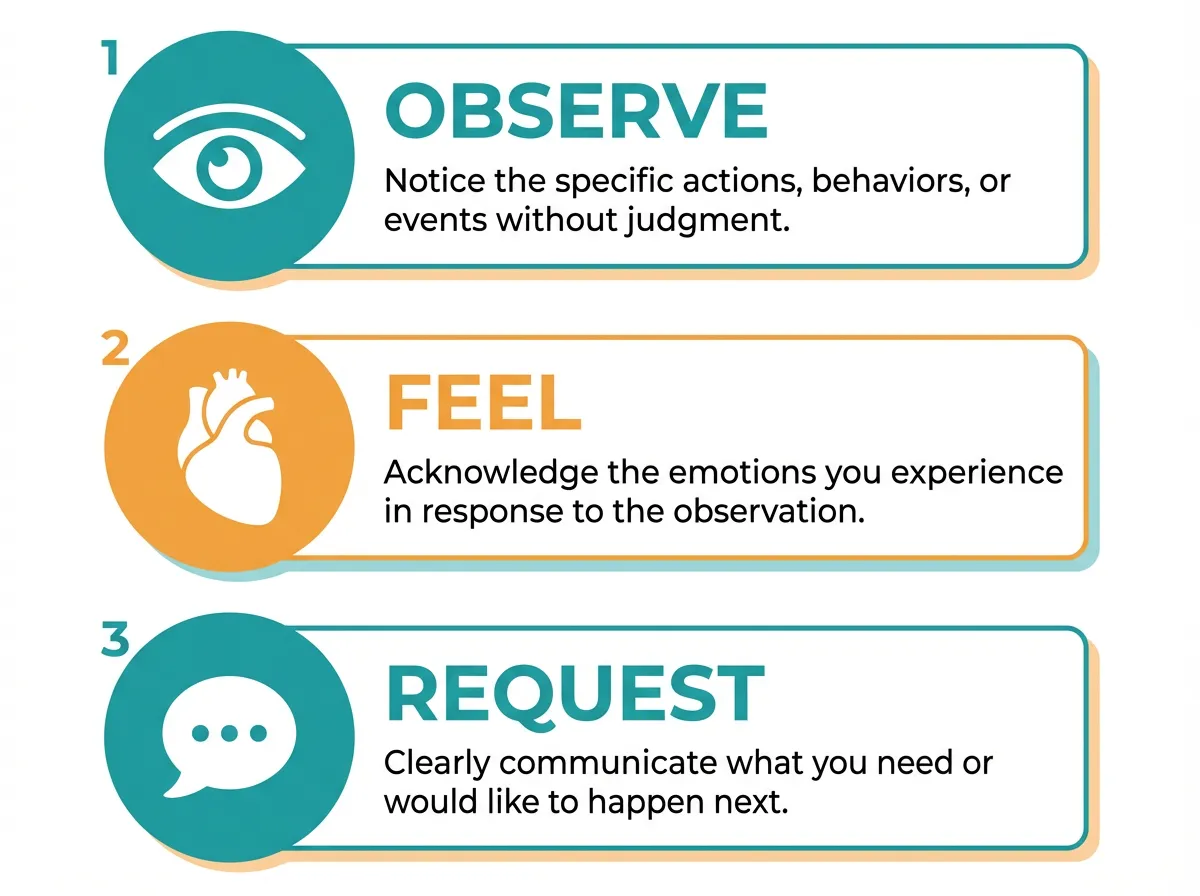
Step 2: Use the Observe-Feel-Request Script
This is the backbone. Three sentences. That's it.
Observe — State the specific behavior you've noticed, without judgment or interpretation.
"I've noticed the dishes from dinner tend to sit in the sink until the next day."
Not: "You always leave your gross dishes everywhere." The word "always" is a conversation killer. So is any adjective that assigns a character trait to a behavior.
Feel — Name the impact on you. Use "I" language, not "you" language.
"It stresses me out because I like to start the morning with a clean kitchen, and when the sink is full I feel like I either have to clean it or just be uncomfortable."
Not: "You're being inconsiderate." The goal is to describe your experience, not diagnose their character.
Request — Propose a specific, actionable change. Make it concrete and reasonable.
"Would you be open to a rule where we both rinse and load our dishes before bed? Doesn't have to be spotless — just out of the sink."
Not: "Can you just be cleaner?" Vague requests lead to vague compliance, which leads to the same fight two weeks later.
Step 3: Listen — Actually Listen
After your three sentences, stop talking. This is the hardest part. Your roommate needs space to respond, and their response might not be what you want to hear. They might:
- Agree immediately. Great. Move to Step 4.
- Push back or offer context. Maybe they've been working late shifts and they're exhausted. Maybe they didn't realize it bothered you. This is useful information — listen to it without getting defensive.
- Get defensive. If this happens, don't escalate. A simple redirect: "I'm not trying to criticize you — I just want us to figure out something that works for both of us."
The goal of this conversation is not to win. It's to surface information that was previously invisible to both of you and build a shared agreement from it.
Step 4: Agree on Something Specific and Write It Down
This is where most roommate conversations fail — not in the talking, but in the follow-through. You have a good talk, you both nod, and then within a week the old pattern returns because nobody pinned down what was actually agreed upon.
After the conversation, send a quick text or shared note:
"Hey, just to recap what we talked about — we're going to try the dishes-before-bed rule starting tonight. If it's not working for either of us we'll revisit in two weeks. Sound right?"
This isn't legalistic. It's a safety net. It gives both of you a reference point so that if the behavior recurs, you can say, "Hey, remember what we agreed on?" instead of starting the whole conversation over from scratch.
For bigger issues — guests, quiet hours, shared expenses — tools like Servanda can help you turn verbal agreements into structured written ones, which is especially useful if you want to avoid the "I don't remember agreeing to that" problem down the road.
Applying the Script to the Five Most Common Roommate Fights
Let's walk through real scenarios so you can see how this framework adapts.

1. Cleanliness Standards
Observe: "I've noticed the bathroom doesn't get cleaned between our uses, and things like toothpaste in the sink and hair on the floor tend to build up."
Feel: "I get kind of anxious using a shared bathroom that feels dirty, and I don't want to just silently clean up after both of us because that'll build resentment."
Request: "Can we set up a simple rotation — you clean the bathroom one week, I clean it the next? We can even make a shared checklist so we're on the same page about what 'clean' means."
2. Noise and Quiet Hours
Observe: "A few nights this week I've heard your music or calls pretty clearly through the wall after midnight."
Feel: "I have to be up at 6:30 for work, and when I can't fall asleep it throws off my whole next day."
Request: "Could we agree on a quiet hours window — maybe 11 PM to 7 AM on weeknights? Headphones after that? I'm flexible on weekends."
3. Guests and Overnight Visitors
Observe: "Your partner has stayed over four or five nights this month, and I've come out to the living room a couple of mornings and they're using the kitchen and shower."
Feel: "I don't mind them being here sometimes, but when it's frequent I start to feel like I have a third roommate I didn't agree to — and it changes the vibe of the shared spaces for me."
Request: "Can we set a limit — like two or three overnights a week max? And maybe a heads-up text when they're coming over so I'm not surprised?"
4. Shared Expenses and Groceries
Observe: "I've bought the last three rounds of paper towels and dish soap, and I've noticed some of my groceries getting used."
Feel: "It makes me feel like I'm subsidizing shared costs on my own, and I don't want money stuff to become a bigger issue between us."
Request: "What if we start a shared supplies fund — we each throw $20 a month into a Venmo pool and buy household stuff from that? And for personal groceries, we keep separate shelves?"
5. Temperature and Thermostat Wars
Observe: "I've noticed the thermostat getting set to 68 a few times when I had it at 72."
Feel: "I get really cold at that temperature and I end up layering blankets, which isn't great for sleeping."
Request: "Can we meet in the middle at 70 and both adjust with personal stuff — fan for you, extra blanket for me? And agree not to change the thermostat without a quick text?"
What If One Talk Isn't Enough?
The 80% statistic is encouraging, but it also means 20% of conflicts won't resolve in a single conversation. Here's how to know when you're in that 20%:
- You've had the conversation clearly and kindly, and the behavior hasn't changed after two weeks. At this point, a second conversation is warranted — firmer in tone, referencing the previous agreement.
- Your roommate refused to engage at all. If someone stonewalls, dismisses your concerns, or turns the conversation into an attack on you, that's a compatibility issue, not a communication issue.
- The conflict involves a lease violation, safety concern, or harassment. These are not one-talk problems. Involve your landlord, RA, or an appropriate authority.
For the stubborn-but-fixable conflicts, a second conversation might sound like:
"Hey, I want to circle back on what we talked about two weeks ago. The dishes-before-bed thing hasn't really stuck, and I want to figure out why. Is the system not working for you? Do we need to adjust it?"
Notice the tone: curious, not accusatory. You're giving your roommate the benefit of the doubt while also making clear that the issue isn't going away.
The Cost of Waiting
Let's close the strategy portion with a reality check. Here's what happens when you don't have the conversation:
- Week 1-2: You notice the issue. Mildly annoyed. Easily fixable.
- Week 3-4: The annoyance compounds. You start attributing motive — they must not respect me. Internal narrative builds.
- Month 2: You're venting to friends, avoiding your roommate, and dreading coming home. The issue has expanded in your mind from a specific behavior to a general character flaw.
- Month 3+: The conflict erupts — often triggered by something unrelated. The resulting fight is messy, emotional, and confusing to your roommate, who may genuinely not understand the intensity of your reaction.
Every week you wait, the conversation gets harder and less likely to succeed. The best time to have the talk was the first week. The second best time is today.
Frequently Asked Questions
How do I bring up a problem with my roommate without starting a fight?
Start by asking if they have a few minutes to talk, so you're not ambushing them. Use specific observations instead of generalizations — "I noticed X" rather than "You always do X." Frame your concern around how it affects you, then propose a concrete solution. Most people respond well when they feel respected rather than accused.
What if my roommate gets defensive when I try to talk?
Defensiveness is a stress response, not a rejection of you. If it happens, resist the urge to match their energy. Instead, try: "I'm not attacking you — I just want to find something that works for both of us." If they're too heated to talk, it's okay to say, "Let's come back to this tomorrow" and revisit when emotions have cooled.
Should I text my roommate about a problem or talk in person?
In person is almost always better for the initial conversation. Text strips out tone, facial expressions, and the ability to course-correct in real time. It's very easy for a well-meaning message to read as passive-aggressive on a screen. Use text after the conversation to summarize what you agreed on — that's where written communication actually helps.
How do I know if my roommate conflict is worth bringing up?
Ask yourself: Has this bothered me more than twice? If yes, it's worth a conversation. The "it's too small to mention" instinct is usually the voice of conflict avoidance, not wisdom. Bringing up small issues early is vastly easier than bringing up big resentments late.
What should I do if my roommate and I just can't get along no matter what?
If you've had honest, good-faith conversations and nothing has changed — or if the conflict involves disrespect, boundary violations, or safety — it may be a compatibility issue rather than a communication issue. At that point, involving a neutral third party (RA, landlord, mediator) or exploring a room change is a reasonable and healthy step, not a failure.
One Talk. That's All It Takes.
The biggest takeaway from housing professionals who mediate roommate fights day in and day out is that most conflicts aren't caused by bad people — they're caused by missing conversations. Different backgrounds, different habits, different assumptions about shared living, and no structured moment to align them.
The Observe-Feel-Request script gives you a way to start that conversation without spiraling into blame or shutting down entirely. Pick the one issue that's been sitting heaviest, choose a calm moment this week, and try the three-sentence framework. You don't have to be perfect. You just have to be honest and specific.
Eighty percent odds are in your favor. That one talk you've been avoiding? It's probably the only thing standing between you and a living situation that actually feels good to come home to.