Secret Spending: Signs and How to Recover Trust
You notice a charge on the credit card statement you don't recognize. When you ask about it, your partner gets defensive—maybe dismissive, maybe irritated. "It was nothing. Just something for work." But the number doesn't add up, and neither does the explanation. You let it go. A week later, a package arrives that you never hear about. Then another unfamiliar charge. Slowly, a quiet dread settles in: What else don't I know about?
Secret spending—sometimes called financial infidelity—is one of the most common yet least discussed sources of conflict in relationships. A 2023 Bankrate survey found that 42% of U.S. adults in relationships admitted to hiding a financial account, debt, or spending habit from their partner. Unlike a dramatic betrayal, secret spending often builds gradually, eroding trust in small, cumulative ways that can feel just as devastating. Most couples can recover, but recovery requires honesty about what happened, why it happened, and what needs to change.
What Counts as Secret Spending?
Secret spending isn't the same as buying a surprise birthday gift. It becomes a problem when one partner deliberately hides purchases, debts, or financial decisions that affect the household—especially when doing so involves deception.
Examples include:
- Hidden purchases: Buying clothing, electronics, or personal items and concealing them from a partner
- Secret accounts: Maintaining a credit card, savings account, or investment account a partner doesn't know about
- Concealed debt: Accumulating credit card balances, personal loans, or buy-now-pay-later obligations without disclosing them
- Understating costs: Telling a partner something cost $50 when it cost $200
- Covert subscriptions or memberships: Signing up for services—gambling apps, shopping platforms, paid content—and hiding the recurring charges
- Cash withdrawals: Regularly pulling out cash so spending can't be tracked
The common thread isn't the dollar amount—it's the secrecy. A $15 monthly subscription hidden for two years can damage trust just as deeply as a single $5,000 purchase, because the issue is the pattern of deception, not the price tag.
Warning Signs Your Partner May Be Hiding Spending
Secret spending rarely announces itself. It tends to surface through small behavioral shifts that are easy to rationalize away. Here are some patterns to pay attention to:
1. Defensiveness Around Money Conversations
When a simple question like "What was that charge?" consistently triggers irritation, deflection, or an argument, something deeper may be going on. A partner who has nothing to hide doesn't usually treat financial questions as personal attacks.
2. Unexplained Packages or Possessions
New items appear—clothes with tags still on, gadgets, products tucked in a closet—without any mention of a purchase. If asked, the explanation is vague: "Oh, I've had that for a while" or "It was on sale."
3. Guarded Devices and Accounts
Changing passwords, angling screens away, or deleting notifications from banking apps can signal that someone is managing a financial life they don't want scrutinized.
4. Bills That Don't Add Up
You're supposed to have $800 left after expenses, but the checking account shows $400. Credit card balances climb even though you thought you were paying them off. Discrepancies between expected and actual finances are one of the clearest signs of secret spending.
5. Cash Disappears Quickly
Frequent ATM withdrawals without clear explanations can indicate spending that's deliberately kept off the digital paper trail.
6. Emotional Shifts Around Finances
Guilt often manifests in unexpected ways. A partner engaging in secret spending might become unusually generous, unusually avoidant of financial discussions, or anxious when mail arrives.

Why People Spend in Secret
It's tempting to frame secret spending as straightforward dishonesty, but the motivations are usually more layered than that. Understanding the "why" isn't about excusing the behavior—it's about addressing the root cause so the pattern doesn't repeat.
Fear of Judgment or Control
Some people hide spending because they feel their partner scrutinizes every purchase. If one person controls the household budget tightly, the other may resort to secrecy just to feel some financial autonomy. This doesn't make the hiding okay, but it suggests the couple needs to revisit how financial decisions are shared.
Shame About a Habit or Addiction
Compulsive shopping, gambling, or spending on substances often comes wrapped in shame. The person knows their behavior is problematic but feels unable to stop—and terrified of their partner's reaction. In these cases, the secret spending is a symptom of a deeper issue that may require professional support.
Avoiding Conflict
Some people hide purchases because they dread the argument. Maybe past conversations about money turned into fights. Maybe they grew up in a household where money was always a source of tension. Rather than face the discomfort, they take the path of least resistance—which ironically creates far greater conflict down the road.
Different Financial Values
One partner is a saver; the other is a spender. When this difference goes unaddressed, the spender may start hiding purchases to avoid lectures, while the saver grows increasingly suspicious. Neither is wrong for having their financial disposition, but the absence of a shared framework turns a difference into a deception.
Maintaining an Identity
A partner may spend secretly on hobbies, appearance, or gifts for others because those purchases feel tied to their sense of self—and they worry their partner wouldn't "approve." The spending isn't reckless; it's personal. But the hiding introduces a wedge.
The Damage Secret Spending Does to a Relationship
Financial infidelity may not involve another person, but the emotional fallout often mirrors a traditional betrayal. Research published in the Journal of Financial Therapy found that financial deception was associated with lower relationship satisfaction and higher levels of anxiety and depression in the partner who was deceived.
Here's what couples typically experience:
- Broken trust that extends beyond money: If they lied about this, what else have they lied about?
- Hypervigilance: The deceived partner starts monitoring every transaction, which creates a surveillance dynamic that's exhausting for both people.
- Power imbalances: The partner who was kept in the dark may feel stripped of agency in their own financial life.
- Resentment: Particularly if the secret spending created real financial consequences—debt, missed savings goals, or an inability to cover shared expenses.
- Shame spirals: The partner who spent secretly often feels terrible, which can lead to withdrawal rather than the openness needed for repair.
None of this is irreversible. But it does require intentional, structured effort to heal.
How to Recover Trust After Secret Spending
Recovery isn't a single conversation—it's a process. Here's a step-by-step framework that gives both partners a role in rebuilding.
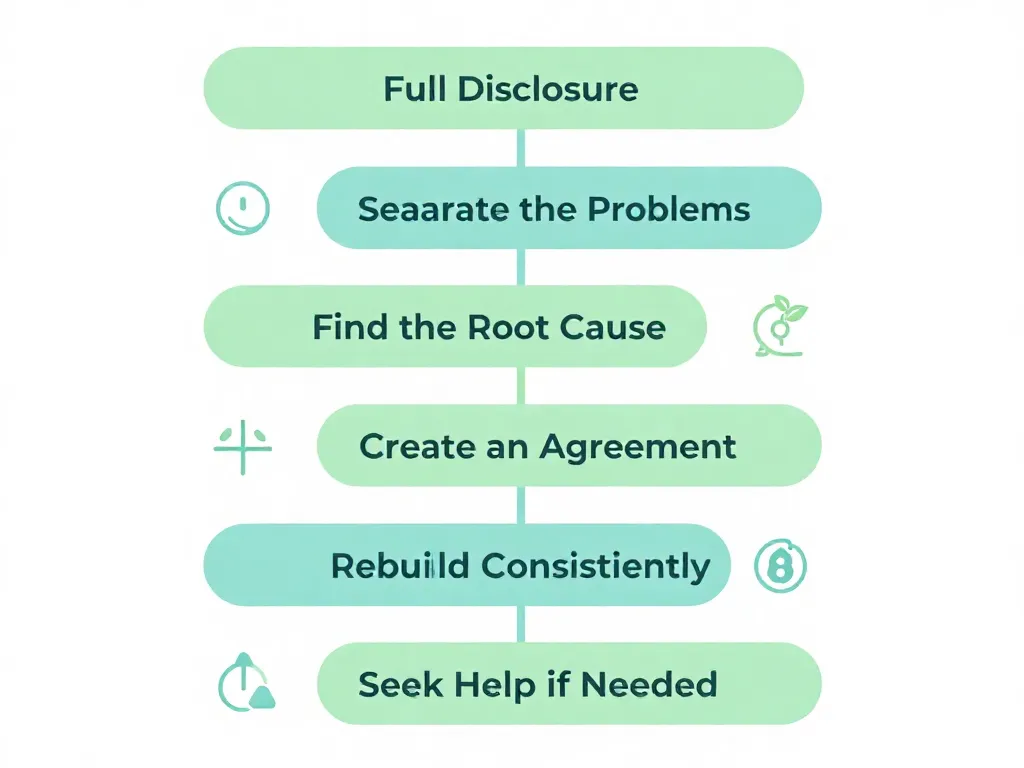
Step 1: Have the Full Disclosure Conversation
This is the hardest part, but partial truth does more harm than continued silence. The partner who hid spending needs to lay everything on the table: what was spent, how much, over what period, and whether there's outstanding debt.
Practical tips for this conversation:
- Choose a calm, private moment—not during an argument
- The disclosing partner should lead with accountability, not excuses: "I spent $3,200 on a credit card you didn't know about. I should have told you sooner."
- The other partner should try to listen fully before responding, even though the urge to react will be strong
- If emotions escalate, it's okay to take a 30-minute break and return
Step 2: Separate the Financial Problem from the Trust Problem
These are two distinct issues and trying to solve them simultaneously usually means neither gets resolved well.
The financial problem might be: "We have $4,000 in undisclosed debt that we need a plan to pay off."
The trust problem is: "I feel deceived by the person I'm supposed to be building a life with."
Address the financial logistics first—it's more concrete and gives both partners a sense of forward momentum. Then turn to the emotional repair, which takes longer.
Step 3: Understand the Root Cause Together
Have an honest and compassionate conversation about what drove the secrecy.
Some questions to explore together:
- "Did you feel you couldn't tell me? If so, what was I doing that made it feel unsafe?"
- "Is there something about how we handle money that feels unfair to you?"
- "Is this connected to something bigger—stress, a habit you're struggling with, something from your past?"
This isn't about the deceived partner taking blame. It's about both people understanding the system they've created together, so they can build a better one.
Step 4: Create a New Financial Agreement
Vague promises to "be more open" rarely stick. What works is a concrete, written agreement that both partners help design. This might include:
- A spending threshold: Any purchase over $150 gets discussed first
- Monthly financial check-ins: A 30-minute sit-down to review accounts, upcoming expenses, and goals
- Personal spending allowances: Each partner gets a set amount per month to spend however they want, no questions asked. This preserves autonomy while maintaining transparency on shared finances.
- Shared access to all accounts: Not as surveillance, but as a mutual commitment to openness
- A plan for existing debt: Specific monthly payments, timeline, and who's responsible for what
Tools like Servanda can help couples formalize these agreements in writing, making them concrete and revisitable rather than relying on memory of a late-night conversation.
Step 5: Rebuild Trust Through Consistent Behavior
Trust isn't restored by a single apology—it's rebuilt through repeated, small demonstrations of honesty over time. For the partner who hid spending, this means:
- Proactively sharing financial information, even when it's uncomfortable
- Following through on every element of the agreement you made together
- Being patient with your partner's need for reassurance, even months later
- Flagging temptation honestly: "I almost bought something I didn't need today. I didn't, but I want you to know I'm aware of the pattern."
For the partner who was deceived, rebuilding trust means:
- Resisting the urge to monitor obsessively—trust the system you built together
- Acknowledging progress when you see it
- Being honest about lingering feelings without weaponizing them
- Recognizing that your partner's willingness to change is itself a form of respect
Step 6: Know When to Get Professional Help
If the secret spending was tied to compulsive behavior, addiction, or if the trust breach feels too large to navigate alone, a financial therapist or couples counselor who specializes in money issues can be invaluable.
Preventing Secret Spending Before It Starts
If you're reading this proactively—before secret spending has become an issue—here are habits that make financial deception far less likely:
- Normalize money conversations early: Talk about finances regularly enough that it stops feeling like a big deal
- Build in personal financial freedom: Autonomy reduces the incentive to hide
- Agree on values, not just numbers: Discuss what money means to each of you—security? freedom? generosity?—and find the overlap
- Check in, don't check up: There's a difference between "Let's review our finances together" and "Let me see your credit card statement"
- Address small tensions before they calcify: The first time a spending difference creates friction, talk about it. The tenth time, it's a pattern.
Moving Forward Together
Secret spending is painful, but it doesn't have to be the defining chapter of your relationship. Most couples who navigate financial infidelity successfully report that the process—while difficult—actually deepened their understanding of each other and strengthened how they work as a team.
The path forward isn't about perfection. It's about building a shared financial life where both people feel respected, informed, and free enough to be honest.
Frequently Asked Questions
What is financial infidelity and how common is it?
Financial infidelity is when one partner deliberately hides purchases, debts, accounts, or financial decisions that affect the household from the other partner. A 2023 Bankrate survey found that 42% of U.S. adults in relationships admitted to hiding a financial account, debt, or spending habit, making it one of the most common yet least discussed sources of relationship conflict.
How do I bring up secret spending with my partner without starting a fight?
Choose a calm, private moment outside of an argument and lead with specific observations rather than accusations—for example, mention a charge you noticed and express curiosity rather than blame. If emotions escalate, agree to take a 30-minute break and return to the conversation, and focus on understanding what happened before jumping to solutions.
Can a relationship survive financial infidelity?
Yes, most couples can recover from secret spending, and many report that working through financial infidelity actually deepened their communication and strengthened their partnership. Recovery requires full disclosure of the hidden spending, understanding the root cause together, creating a concrete written financial agreement, and consistently following through on new commitments over time.
What are the signs my partner is hiding money or spending?
Common warning signs include defensiveness when asked about charges, unexplained packages or new possessions, guarded devices with changed passwords, bank balances that don't match expected amounts, and frequent cash withdrawals without clear explanations. Emotional shifts like sudden over-generosity, avoidance of financial discussions, or anxiety around mail can also indicate hidden spending.
When should we see a professional about secret spending in our relationship?
You should consider a financial therapist or couples counselor if the secret spending is tied to compulsive behavior or addiction, if the hidden debt is substantial enough to threaten your financial stability, or if the trust breach feels too overwhelming to navigate on your own.