
Signs Your Cofounder Breakup Is Inevitable
You used to finish each other's sentences in pitch meetings. Now you can barely finish a conversation without one of you shutting down or walking away. The Slack messages that once pinged with excitement—"What if we tried this?"—have gone quiet, replaced by terse updates and passive-aggressive reactions.
If this sounds familiar, you're not alone. Cofounder breakups are one of the leading causes of startup failure, and nearly every founder who's been through one says the same thing afterward: "The signs were there for months. I just didn't want to see them."
This article catalogs the recurring red flags that founders consistently report before a split—drawn from real breakup stories shared on Reddit, Hacker News, and startup postmortems. The goal isn't to scare you. It's to give you the clarity to act before the damage becomes irreparable.
Key Takeaways
- Diverging visions that go unaddressed are the single most common precursor to a cofounder breakup—not personality clashes, not money disputes.
- Unequal effort and resentment operate on a feedback loop: the harder one founder works, the more the other withdraws, and neither addresses it directly.
- The absence of conflict is often more dangerous than conflict itself—silence means someone has already checked out.
- Most cofounder splits could have been prevented—or at least made less destructive—with written agreements created early in the relationship.
- If you recognize three or more of these signs, don't wait. Have the hard conversation this week, not next quarter.

The Anatomy of a Cofounder Breakup
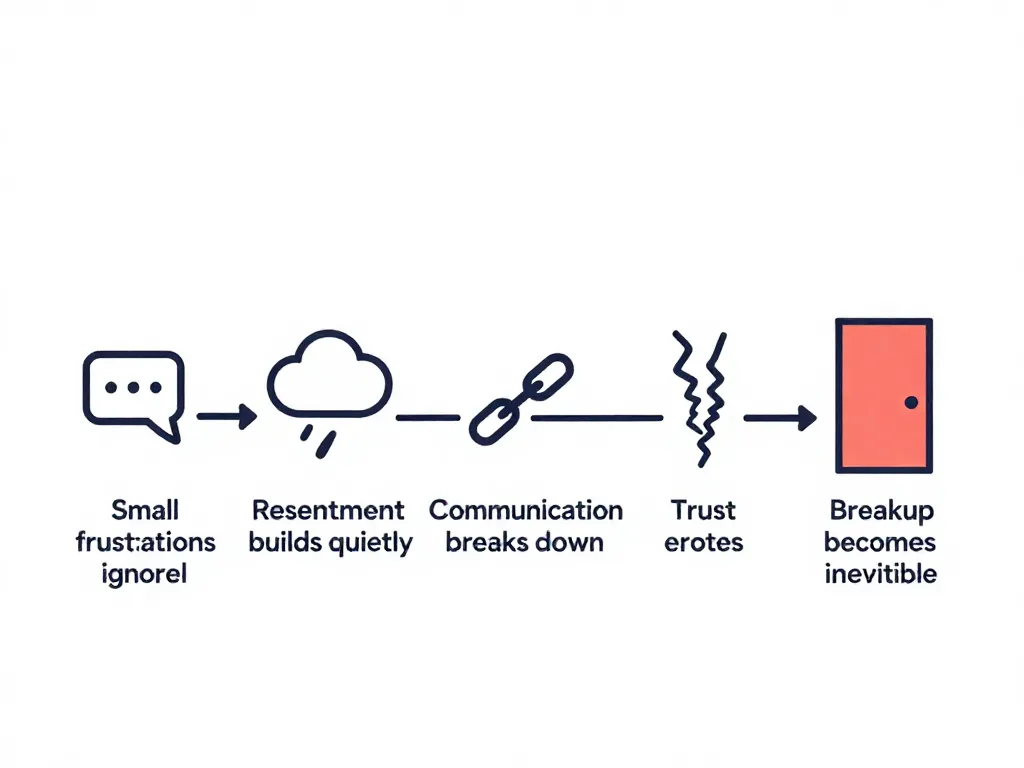
Cofounder relationships follow a pattern that, in hindsight, looks almost predictable. The early days are fueled by shared excitement and complementary strengths. Then reality sets in—fundraising pressure, product-market fit struggles, money running low—and the cracks that were always there begin to widen.
What makes cofounder breakups so painful is that they don't happen in a single moment. They happen slowly, over weeks and months, through a series of small disappointments that compound until someone finally says, "I'm done."
Here are the signs that founders report again and again.
Sign 1: You've Stopped Sharing the Same Vision
This is the one that shows up in virtually every cofounder breakup story. Not a disagreement about tactics—those are healthy—but a fundamental misalignment about what you're building and why.
One founder wants to build a venture-scale company; the other wants a profitable lifestyle business. One wants to pivot to enterprise; the other is emotionally attached to the consumer product. One is optimizing for a fast exit; the other wants to build for decades.
A founder on Hacker News described it this way: "We started the company to solve the same problem. Two years later, we couldn't even agree on what the problem was."
What this looks like day-to-day:
- You avoid strategic conversations because they always end in a stalemate
- You present different visions to different investors or advisors
- You make major decisions unilaterally because consensus feels impossible
- One of you has mentally moved on to "the next thing"
Why it's fatal:
Tactical disagreements can be resolved with data. Vision disagreements are about identity and values—they don't resolve with a spreadsheet.
Sign 2: Effort Has Become Visibly Unequal
This is the red flag that generates the most raw emotion in founder communities. One cofounder is working 70-hour weeks, handling customer calls, writing code, and managing investors. The other is coasting—showing up late, disappearing for days, or doing work that doesn't move the needle.

The resentment that builds from unequal effort is corrosive. It doesn't stay contained to work—it bleeds into every interaction, every equity conversation, every board meeting.
A Reddit user in r/startups shared: "I'd be debugging production issues at 2 a.m. and my cofounder would text me at 10 a.m. asking what happened. Not offering to help. Just asking. That's when I knew."
The effort gap often starts small:
- One founder consistently misses self-imposed deadlines
- "I'll get to it this weekend" becomes a recurring phrase
- One person stops attending meetings they used to care about
- The workload split that was once 50/50 quietly drifts to 80/20
Why it compounds:
The founder doing more work starts making more decisions. The founder doing less work feels excluded from decisions. Both feel justified. Neither talks about it directly. The gap widens.
Sign 3: Commitments Are Made and Broken Without Acknowledgment
Every healthy working relationship runs on kept promises. When a cofounder starts breaking commitments—not once, but as a pattern—and doesn't acknowledge it, trust erodes fast.
This goes beyond missing a deadline. It's about a pattern of saying one thing and doing another:
- "I'll close that candidate by Friday"—Friday comes and goes, no update.
- "I'll put in my share of the capital next month"—next month, the conversation is avoided.
- "I'll handle the investor update"—you end up writing it yourself at midnight.
The most damaging part isn't the broken commitment itself. It's the absence of accountability. When someone doesn't even acknowledge that they dropped the ball, it sends a clear message: this isn't as important to me as it is to you.
Sign 4: You've Stopped Fighting (and That's Not a Good Thing)
Most people assume that fighting is the sign of a cofounder breakup. But experienced founders and startup advisors will tell you the opposite: silence is far more dangerous than conflict.
Healthy cofounders argue. They push back on each other's ideas. They have uncomfortable conversations about money, equity, and direction. When that friction disappears, it usually means one of two things:
- One founder has mentally checked out and no longer cares enough to disagree.
- Both founders are avoiding conflict because they're afraid the conversation will end the company.
Either way, the absence of productive disagreement means critical issues are going unaddressed. Decisions get made by default rather than by design. The company drifts.
A founder writing on the Initialized Capital blog described this phase as "the quiet before the quit." By the time one cofounder finally speaks up, the other has already been interviewing for jobs.
Sign 5: Financial Transparency Has Broken Down
Money is where implicit resentments become explicit crises. When cofounders stop being transparent about finances—personal or company—it's a signal that trust has fundamentally broken down.
Watch for these patterns:
- One founder starts making financial decisions (large expenses, new hires, personal draws) without discussing them
- Equity conversations are treated as taboo or "something we'll figure out later"
- One founder has a financial runway of years; the other is three months from broke—and they've never talked about it
- Expense reports become a source of tension or suspicion
Financial misalignment often reveals deeper value misalignment. How you spend money reflects what you prioritize, and when cofounders discover they have radically different financial values, it rarely ends well.
Sign 6: You're Venting to Everyone Except Your Cofounder
Pay attention to who you're talking to about your frustrations. If you're sharing your concerns with your spouse, your advisor, your YC batchmates, your therapist—everyone except the person who actually needs to hear them—you've already lost confidence that a direct conversation will help.
This is a defense mechanism, and it's understandable. But it creates a toxic dynamic:
- Your cofounder has no idea how serious the problems are
- The people you're venting to only hear your side and reinforce your frustrations
- Your resentment grows in private while the relationship appears stable on the surface
- By the time you finally confront your cofounder, you've already made your decision
Sign 7: Life Changes Have Shifted Priorities—and Nobody Said So
Startups don't exist in a vacuum. Cofounders get married, have kids, face health issues, deal with family emergencies, burn out, or simply realize they want a different life than they did two years ago.
None of these are failures. But when a major life change shifts a cofounder's priorities and they don't communicate it, the other cofounder is left guessing—interpreting reduced effort as laziness, changed availability as disrespect, or shifted goals as betrayal.
Some of the most painful cofounder breakup stories online involve founders who genuinely cared about each other but never had an honest conversation about how their lives had changed. By the time they did, the resentment was already baked in.
What to Do If You See These Signs
Recognizing these red flags doesn't mean your cofounder relationship is doomed. But it does mean you need to act—and act with more structure than a casual "let's grab coffee and talk."
Step 1: Name the problem specifically
Don't say "things aren't working." Say "I've been handling all investor communications for the last three months, and I need us to rebalance that." Specificity makes the conversation actionable.
Step 2: Separate the person from the pattern
Your cofounder probably isn't a bad person. They may be burned out, scared, or dealing with something you don't know about. Approach the conversation with genuine curiosity about their experience, not just your grievances.
Step 3: Put agreements in writing
Verbal agreements between cofounders are the source of an enormous number of disputes. If you agree on a new division of responsibilities, equity adjustments, or commitment levels—write it down. Tools like Servanda can help cofounders formalize these agreements with clarity and structure, so both parties have a shared reference point instead of competing memories.
Step 4: Set a check-in cadence
Don't let another six months pass in silence. Agree to monthly cofounder check-ins where you explicitly discuss the health of the relationship, not just business metrics.
Step 5: Know your BATNA
If the relationship can't be repaired, know your options. What does a clean separation look like? What happens to equity, IP, and existing commitments? Having thought through this in advance makes you less likely to stay in a bad situation out of fear.
FAQ
How common are cofounder breakups in startups?
Extremely common. Research from Noam Wasserman at Harvard found that 65% of startups fail due to cofounder conflict. It's one of the most predictable risks in the startup lifecycle, yet most founders spend more time on their pitch deck than on their cofounder relationship.
Can a cofounder breakup actually be good for the company?
Yes—sometimes it's the healthiest possible outcome. If two cofounders are genuinely misaligned on vision or effort, a clean, well-structured separation can unlock both the company and the departing founder. The key word is structured: messy breakups destroy companies, but planned ones can save them.
How do I bring up cofounder problems without making things worse?
Start with observation, not accusation. Instead of "You're not pulling your weight," try "I've noticed our workload has shifted significantly over the past few months, and I want to understand what's going on for you." Frame it as a problem to solve together, not a verdict you've already reached.
Should cofounders have a prenup-style agreement?
Absolutely. A cofounder agreement that covers equity vesting, roles, decision-making authority, and separation terms is the single most protective thing you can do for your startup. It's not a sign of distrust—it's a sign of maturity.
When is it too late to fix a cofounder relationship?
When one or both founders have completely lost respect for the other. Disagreements, frustrations, and even anger can be worked through. But once respect is gone—once you no longer believe your cofounder is competent, honest, or committed—there's very little to build on.
Moving Forward
A cofounder breakup doesn't have to be a catastrophe. But an unacknowledged cofounder breakup—one that drags on for months while both people pretend everything is fine—almost always is.
If you've read this article and recognized your own situation in three or more of these signs, the worst thing you can do is nothing. The second worst thing is to have a vague conversation that ends with "let's try harder."
Instead, get specific. Get honest. Get things in writing. And if the relationship truly can't be saved, get a clean separation in place before the company becomes collateral damage.
The founders who navigate this well aren't the ones who avoid conflict. They're the ones who face it early, with clarity and structure, while there's still something worth saving.