
Signs Your Cofounder Relationship Is Falling Apart
You used to finish each other's sentences in pitch meetings. Now you can barely finish a conversation without one of you checking out. The shift didn't happen overnight — it never does. One week, you notice your cofounder stopped pushing back on your ideas (and not because they suddenly agree). The next, you realize you've been making decisions without looping them in, and you didn't even feel guilty about it.
When a cofounder relationship is falling apart, the earliest signs are almost always things you rationalize away. You tell yourself it's just stress, just a rough quarter, just the natural growing pains of building something from nothing. But research from Harvard Business School suggests that cofounder conflict is a leading cause of early-stage startup failure — and the founders who survive it are the ones who recognized the cracks before they became canyons.
This article will walk you through the real warning signs, not the obvious ones, but the subtle patterns that most founders only recognize in hindsight.
Key Takeaways
- Performing alignment isn't the same as having it. Many cofounders act like everything is fine in front of investors and employees while harboring deep, unspoken disagreements about vision, roles, or equity.
- Avoidance is more dangerous than arguing. The cofounder pairs most at risk aren't the ones who fight — they're the ones who've stopped bringing things up.
- Unwritten expectations are ticking time bombs. If you haven't formalized who owns what, who does what, and what happens if someone leaves, you're building on sand.
- The "performing" trap is real. Initialized Capital's research highlights how founders often perform a good relationship rather than build one — and the difference becomes obvious under pressure.
- Early intervention changes outcomes. Addressing red flags at the discomfort stage — before they become resentment — is the single highest-leverage thing you can do for your company.
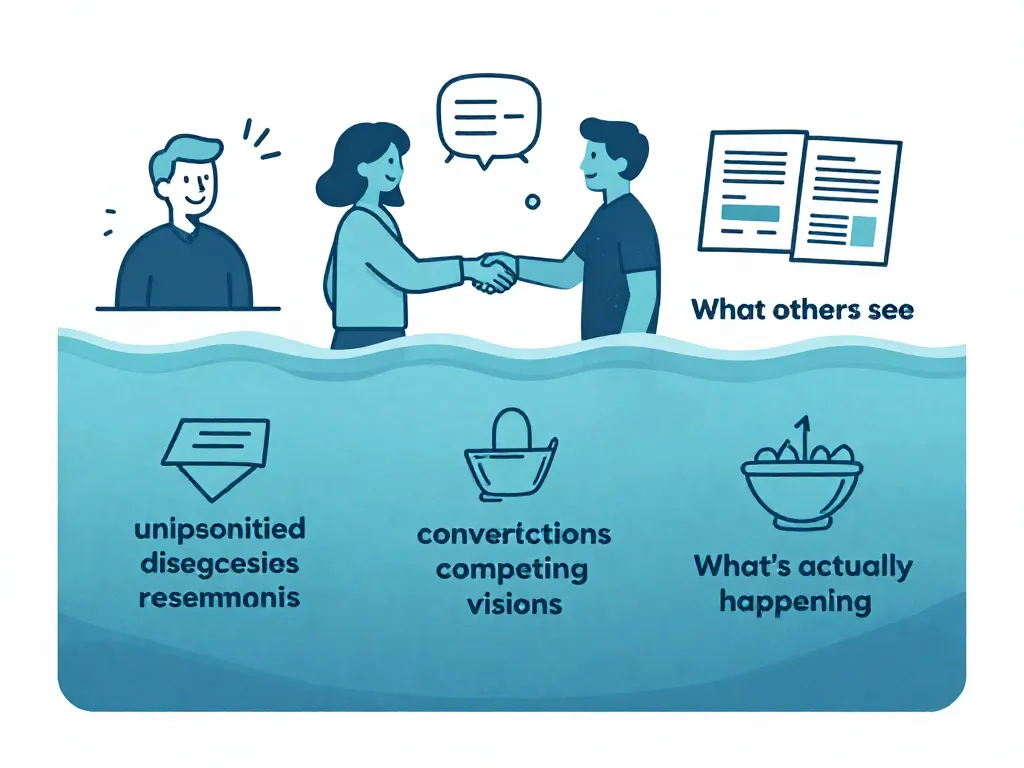
The Difference Between a Good Cofounder Relationship and the Performance of One
There's a concept from an Initialized Capital blog post that deserves more attention: many cofounder relationships are performed rather than built. On the surface, everything looks great. You present a united front at board meetings. You tell your startup friends how lucky you are. You post about your amazing cofounder on LinkedIn.
But underneath, neither of you has said what you actually think about the company's direction in months.
Performing a cofounder relationship means optimizing for the appearance of harmony. Building one means doing the uncomfortable work of surfacing disagreements early, negotiating expectations explicitly, and being honest when something isn't working — even when it's awkward.
The founders who only perform eventually hit a moment where the gap between the performance and reality becomes impossible to sustain. That moment usually arrives during a crisis: a failed fundraise, a key employee quitting, a product launch that flops. And by then, the relationship has been hollowed out from the inside.
7 Warning Signs Your Cofounder Relationship Is Deteriorating
1. You've Stopped Having the Hard Conversations
This is the most common and most dangerous sign. Early in your partnership, you probably debated everything — product direction, hiring priorities, pricing strategy. That friction was productive. It made your decisions better.
Now, one or both of you has started letting things slide. Not because you agree, but because bringing it up feels like it's not worth the emotional cost.
What this looks like in practice: - You disagree with a decision but say nothing in the meeting, then complain to someone else afterward - You've developed "territories" where you don't question each other — not out of trust, but out of avoidance - Important strategic conversations keep getting "tabled" and never come back
What to do: Pick one avoided topic this week. Bring it up with a framing like: "I've been sitting on something and I think we need to talk through it, even if we don't resolve it today."
2. You're Building Separate Companies Under One Roof
You handle product. They handle sales. You've divided and conquered so effectively that you no longer have a shared understanding of what the company is doing or why.
Some division of labor is healthy. But when cofounders operate in complete silos, it creates two separate narratives about the company's priorities. One of you thinks you're a product-led growth company. The other is out promising enterprise features to close deals. Neither of you realizes you're working toward different goals until those goals collide.
The test: Can each of you articulate the other's top three priorities this quarter — without asking? If not, you've drifted further than you think.

3. Resentment Has Replaced Respect
Resentment in a cofounder relationship rarely announces itself. It accumulates. Maybe you feel like you're working harder. Maybe you think they got too much equity for what they actually contribute. Maybe you're tired of being the one who handles the unglamorous work while they get to be the face of the company.
How resentment shows up: - You keep a mental scoreboard of who's contributing more - You feel a flash of irritation when they get credit for something - You've started describing the workload split to friends using words like "unfair" or "unbalanced"
Resentment is a signal, not a character flaw. It means something in the relationship needs to be renegotiated — a role, an expectation, a resource allocation — and it hasn't been.
4. Decision-Making Has Become a Power Struggle
Healthy cofounder dynamics have a clear (even if informal) framework for how decisions get made. Deteriorating ones turn every choice into a referendum on who has more authority.
Watch for these patterns: - Decisions that used to take a quick conversation now require multiple tense meetings - One cofounder starts making unilateral decisions, then frames them as "too urgent to discuss" - You find yourselves relitigating past decisions during new disagreements - Third parties (investors, advisors, senior employees) are being pulled in to break ties
When decision-making becomes adversarial rather than collaborative, it erodes trust faster than almost anything else.
5. You're Venting to Everyone Except Each Other
This is one of the clearest signs your cofounder relationship is falling apart, and one of the most rationalized. You tell yourself you're "just processing" when you vent to your partner, your advisor, your investors, or your founding engineer.
But what you're actually doing is building a coalition — even if you don't intend to. The people around you start forming opinions about your cofounder based on your worst-case framing. And your cofounder, who probably senses something is off, starts doing the same thing in the other direction.
By the time you finally confront the issue directly, you've both created echo chambers that make compromise feel like losing.
6. Trust Has Eroded on the Small Things
Cofounder trust doesn't usually break on one big betrayal. It erodes through a hundred small moments:
- They said they'd have the financial model done by Friday. It's Tuesday and there's no mention of it.
- You agreed to a hiring plan together, then discover they've been interviewing candidates for a role you didn't discuss.
- They told the board something slightly different from what you discussed privately.
None of these are fireable offenses on their own. But each one deposits a tiny grain of doubt. Over time, you stop giving them the benefit of the doubt on anything. And once that's gone, every interaction gets filtered through suspicion.
What to do: Name the pattern, not the incident. Instead of "You didn't send the model on Friday," try "I've noticed we keep dropping commitments we make to each other, and it's starting to affect how I work with you."
7. You've Started Imagining the Company Without Them
This is the one founders almost never say out loud, but it's the most telling sign of all. You've caught yourself thinking: What would this company look like if I were doing it alone? What if they left?
Sometimes this is a fleeting thought during a frustrating week. But if it's become a recurring daydream — if you've started quietly exploring what a buyout would look like, or wondering whether the investors would back you solo — the relationship has already crossed a critical threshold.
This doesn't necessarily mean the partnership is over. But it does mean something fundamental needs to change, and it needs to change soon.

What to Do When You Recognize These Signs
Recognizing the warning signs is only useful if you act on them. Here's a practical framework:
Step 1: Get Honest With Yourself First
Before you have any conversation with your cofounder, spend an hour writing down — honestly — what's bothering you. Separate the situational frustrations ("They were late to three meetings this month") from the structural ones ("We fundamentally disagree about whether to raise another round"). The structural issues are the ones that matter.
Step 2: Have a State-of-the-Union Conversation
Schedule a dedicated conversation — not a five-minute check-in between other meetings. Frame it as a partnership review, not a confrontation. Some useful prompts:
- "What's working in how we operate together? What isn't?"
- "Are there decisions we've been avoiding?"
- "Do we still agree on where this company should be in two years?"
Step 3: Formalize What You've Been Leaving Informal
Many cofounder conflicts escalate because there's no written agreement to anchor the conversation. Roles, equity vesting, decision-making authority, exit terms — if these live only in your heads, they're going to diverge. Consider formalizing your agreements with a tool like Servanda before conflicts escalate, so that when tensions rise, you have a shared document to return to rather than competing memories.
Step 4: Bring in a Neutral Third Party if Needed
If you've tried direct conversation and you're stuck, an outside perspective can break the deadlock. This could be an executive coach who works with founding teams, a trusted mutual advisor, or a structured mediation process. The key is that the third party has no stake in the outcome.
When It's Time to Part Ways
Not every cofounder relationship can or should be saved. If you've had honest conversations, tried structural changes, and the fundamental trust or alignment isn't there, a clean separation is better than a slow, toxic decline.
The best cofounder breakups happen when both parties can still be professional, when there's a clear operating agreement to guide the terms, and when the split is treated as a business decision rather than a personal failure. The worst ones happen when founders wait until they hate each other.
Frequently Asked Questions
How do you know when cofounder conflict is normal vs. a real problem?
Normal cofounder conflict is productive — you disagree, you work through it, and the decision is better for it. The conflict becomes a problem when disagreements go unresolved, when you start avoiding topics to keep the peace, or when the pattern of tension is steady rather than situational. If the bad dynamics have persisted for more than a few weeks, take it seriously.
Can a cofounder relationship recover after trust is broken?
Yes, but only if both cofounders genuinely want to repair it and are willing to change specific behaviors — not just promise to "do better." Recovery requires naming the exact trust violations, agreeing on concrete changes, and building in accountability. It's hard work, and it's slower than most founders want it to be, but it is possible.
What should be in a cofounder agreement to prevent conflict?
At minimum: roles and responsibilities, equity split and vesting schedule, decision-making authority (who has final say on what), what happens if a cofounder wants to leave or is asked to leave, and how disputes will be resolved. The more specific you are, the fewer gaps there are for resentment to grow.
When should cofounders consider mediation?
Consider mediation when direct conversations keep going in circles, when you've tried to resolve the same issue more than twice without progress, or when the emotional temperature is so high that productive dialogue feels impossible. You don't need to be at the breaking point — in fact, mediation works best when you're not.
How do cofounder breakups affect startup fundraising?
Investors generally see a cofounder departure as a risk signal, but how you handle it matters more than the fact that it happened. A clean, well-documented separation with a clear narrative about why it happened and how the remaining team is positioned shows maturity. A messy, public, or legally contentious split can be a dealbreaker for future funding.
Conclusion
A cofounder relationship falling apart rarely looks like a dramatic blowup. It looks like slowly choosing avoidance over honesty, letting small resentments pile up, and performing harmony instead of building it. The founders who navigate this successfully aren't the ones who never have problems — they're the ones who catch the problems early and do something about them.
If you recognized your situation in any of the signs above, that awareness itself is valuable. The question is what you do next. Start with one honest conversation. Put one unwritten expectation into writing. Address one avoided topic. The cost of acting early is discomfort. The cost of waiting is almost always higher.
Your company deserves cofounders who build a real partnership, not just the appearance of one.