
When to Quit Your Own Startup: A Cofounder's Guide
You cofounded this company. You gave it a name, argued over the logo, pitched it to investors on four hours of sleep. And now, on a Tuesday afternoon, sitting in a meeting where your cofounder talks past you for the third time this week, you feel something you haven't admitted to anyone: you want out.
You're not alone. A candid Hacker News thread on founder breakups drew hundreds of replies from people describing the exact same moment—the quiet realization that the startup they built has become something they dread. An Initialized Capital blog post laid it bare: sometimes the bravest, most strategic thing a founder can do is leave.
But leaving your own startup feels impossible. There's money on the table, reputation at stake, and a nagging voice that says quitting equals failure. This guide exists to challenge that voice. We'll walk through the real signals that it's time to go, how to separate emotion from strategy, and how to exit in a way that protects you, your cofounder, and the company you built together.
Key Takeaways
- Quitting your own startup is a strategic decision, not a character flaw. Many successful founders left one venture before building the next.
- There are concrete, recognizable signals that distinguish a rough patch from a fundamentally broken cofounding relationship.
- Your exit process matters as much as the decision itself. How you leave determines your financial outcome, your reputation, and your legal exposure.
- Vesting cliffs, equity agreements, and investor obligations create real constraints—but they're navigable with preparation.
- Formalizing your exit in writing protects both sides and prevents the kind of messy, years-long disputes that destroy friendships and future opportunities.

Why Founders Stay Too Long
Before we talk about when to quit your startup, we need to understand why founders don't.
Sunk Cost Isn't Just a Textbook Concept
You've invested years. You've told your parents, your friends, your LinkedIn network. You've burned savings. The psychological weight of all that investment creates a gravitational pull that has nothing to do with whether staying is rational.
Research in behavioral economics calls this the sunk cost fallacy—continuing a behavior because of previously invested resources rather than future expected returns. Founders are especially vulnerable because the investment isn't just financial. It's identity.
The "Failure" Narrative Is a Trap
Startup culture celebrates perseverance to an almost dangerous degree. "Grit" and "resilience" are the highest compliments. In that context, walking away feels like announcing you weren't tough enough.
But here's what the Hacker News thread revealed over and over: founders who stayed in broken partnerships out of fear of looking weak ended up in far worse positions—burnout, litigation, destroyed friendships, mental health crises—than those who left early with a clear head.
VC Money Raises the Stakes
If you've raised funding, leaving feels like betraying your investors. There are board seats, fiduciary duties, and the social pressure of a tight-knit funding ecosystem. One anonymous founder in the thread described feeling "handcuffed to a company I no longer believed in" because walking away might blacklist them from future raises.
These pressures are real. But they're manageable—if you approach your exit strategically rather than impulsively.
5 Signals It's Time to Quit Your Startup
Every startup has hard days. The question is whether you're experiencing a rough quarter or a fundamental breakdown. Here are five signals that point to the latter.
1. You and Your Cofounder Have Irreconcilable Visions
Disagreements about product features are normal. Disagreements about what the company is—its mission, its market, its values—are existential.
If you want to build a bootstrapped lifestyle business and your cofounder wants to chase a billion-dollar exit, that's not a communication problem. That's a structural incompatibility. No amount of offsites or mediator sessions will merge two fundamentally different visions into one.
The test: Can you write a single paragraph describing the company's purpose that both of you would sign without caveats? If not, this signal is lit.
2. Trust Has Eroded Beyond Repair
Trust in a cofounding relationship isn't abstract. It shows up in specific behaviors:
- Do you check their work because you don't believe they'll do it right?
- Have they made financial or strategic decisions without telling you?
- Do you find out about important conversations after they've happened?
- Have you caught them misrepresenting things to investors, customers, or employees?
One founder described discovering their cofounder had been having side conversations with their lead investor about restructuring equity—without mentioning it. That's not a rough patch. That's a broken relationship.
3. Your Mental or Physical Health Is Deteriorating
Startup stress is expected. But there's a line between "I'm tired" and "I can't sleep, I'm drinking more than I used to, and I dread Monday mornings."
If you're experiencing persistent anxiety, depression, insomnia, or physical symptoms that correlate with work, your body is telling you something your pride won't. No startup is worth a health crisis—and you'll be useless to the company in that state anyway.
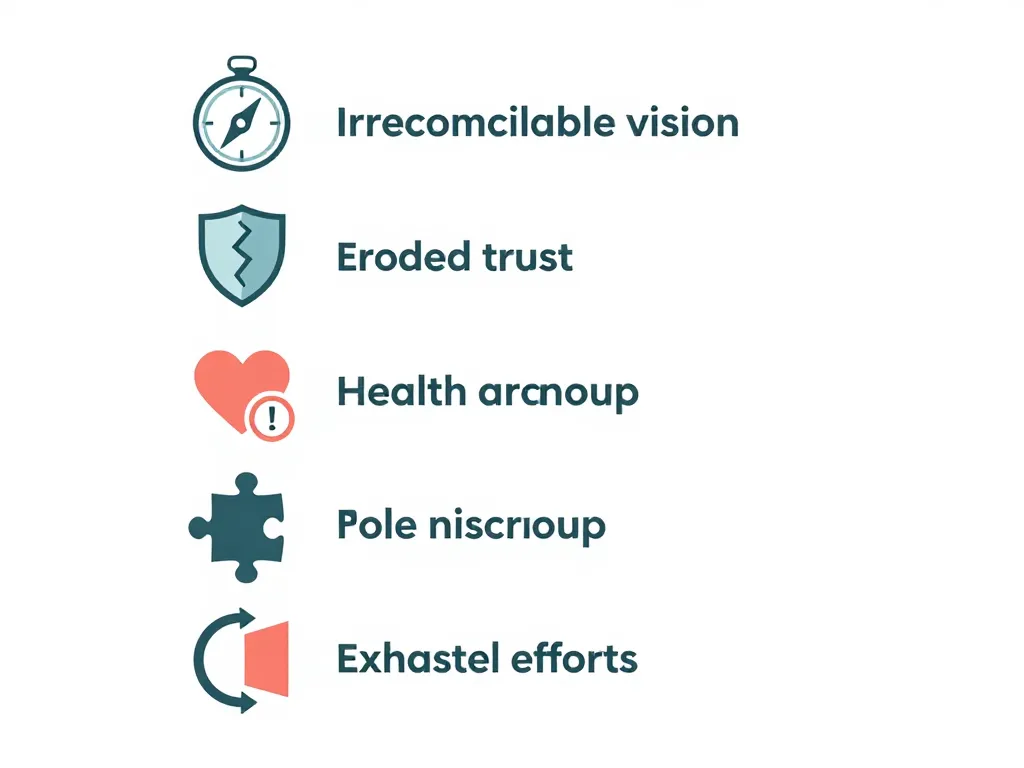
4. You're No Longer the Right Person for the Role
This one takes humility to recognize. Sometimes the company evolves past your skill set. The scrappy zero-to-one founder isn't always the right person to manage a 50-person engineering org. The technical cofounder may not be the right CTO for a company entering enterprise sales.
If you're honest with yourself and realize the company needs someone with different capabilities in your seat, leaving isn't quitting—it's leadership.
5. You've Tried Everything and Nothing Has Changed
Have you had the hard conversations? Have you proposed restructuring roles? Have you brought in a third-party mediator? Have you tried formal conflict resolution?
If you've exhausted good-faith efforts to fix the relationship and the dynamics remain toxic, staying becomes an exercise in self-harm disguised as dedication.
How to Quit Your Startup Without Burning Everything Down
Deciding to leave is step one. Executing the exit well is where most founders stumble.
Step 1: Get Legal Advice Before You Say Anything
Before you tell your cofounder, your investors, or anyone else, talk to a startup attorney. You need to understand:
- What your operating agreement or shareholder agreement says about departures
- Where you stand on your vesting schedule
- Whether there are non-compete or IP assignment clauses that affect you
- What your board obligations are if you've taken VC funding
This isn't adversarial. It's basic self-protection. You wouldn't leave a job without understanding your severance terms. Leaving a company you cofounded deserves at least the same diligence.
Step 2: Separate Your Identity from the Company
This is the emotional work, and it's harder than the legal work.
You named this thing. You told people it was yours. Now you need to internalize a truth that experienced founders know: you are not your startup. Your next chapter—whether it's another company, a role at someone else's company, or a year off—is not a downgrade. It's a pivot.
Talk to a therapist, a coach, or a trusted mentor outside the startup ecosystem. Someone who won't default to "just push through."
Step 3: Have the Conversation with Your Cofounder
When you're ready, approach this as a business conversation, not a breakup fight. Focus on:
- What you want: A clean exit with fair equity treatment
- What you're offering: A reasonable transition period, knowledge transfer, and discretion
- What you're not willing to do: Sacrifice vested equity, sign unreasonable non-competes, or be erased from the company's history
Keep it professional. Keep it documented. Send a follow-up email summarizing what you discussed.
Step 4: Negotiate Your Exit Terms in Writing

This is where most cofounder breakups go sideways. In the heat of the moment, people make verbal agreements: "Yeah, you can keep your shares." "We'll figure out the IP stuff later." "Don't worry about a formal separation agreement."
Six months later, those verbal agreements evaporate. The remaining cofounder's new attorney sends a letter. Things get ugly.
Get everything in writing. Your exit agreement should cover:
- Equity: What you keep, what you forfeit, any acceleration clauses
- Intellectual property: Clear assignment of what belongs to the company
- Non-compete and non-solicit terms: Duration, geography, scope
- Transition responsibilities: What you'll do and for how long
- Confidentiality: What both sides agree not to disclose
- Mutual non-disparagement: Protecting both reputations
Tools like Servanda can help cofounders formalize exit agreements with clear, structured terms—especially useful when emotions are running high and both sides need a neutral framework to work from.
Step 5: Communicate Thoughtfully to Stakeholders
Once terms are agreed upon, you need a communication plan for:
- Investors: Be honest but professional. Most experienced VCs have seen cofounder departures. They care about the company's continuity, not your personal drama.
- Employees: They'll be anxious. A unified message from both cofounders goes a long way.
- Customers and partners: Usually, less is more. A brief, confident statement about leadership transition.
Coordinate messaging with your cofounder. Whatever your private feelings, a messy public narrative hurts both of you.
What Happens After You Leave
The first few weeks will feel strange. You'll refresh the company's website. You'll check Slack out of habit. You might feel relief, grief, anger, and freedom all in the same afternoon.
This is normal.
Here's what founders who've been through it recommend:
- Take a real break. Not "I'll just consult for a few weeks" but an actual pause. Your nervous system needs to recalibrate.
- Resist the urge to start something new immediately. The rebound startup is as risky as the rebound relationship.
- Talk to other founders who've left companies. You'll be surprised how many have. The Hacker News thread proved that this experience is common—it's just not discussed openly.
- Protect the narrative. When people ask what happened, have a concise, non-bitter answer ready: "We had different visions for the company's future, and I decided to step away so it could move in the direction [cofounder] believes in."
A Note on Timing
There's rarely a "perfect" time to leave a startup. There's always a fundraise coming, a product launch approaching, or a key hire in progress.
Waiting for the perfect window is another form of avoidance. The best time to leave is when you've made the decision, prepared properly, and negotiated your terms. Not when it's convenient—because it never will be.
Frequently Asked Questions
Will quitting my startup ruin my reputation with investors?
Most experienced investors have seen cofounder departures many times. What damages your reputation isn't leaving—it's leaving badly. A messy, public blowup with your cofounder, badmouthing the company on social media, or disappearing without a transition plan will raise red flags. A professional, well-communicated exit actually demonstrates maturity that investors respect.
What happens to my equity if I leave before my shares fully vest?
This depends entirely on your vesting agreement and any acceleration clauses you negotiated at the start. Typically, you keep whatever has vested and forfeit unvested shares. Some agreements include single-trigger or double-trigger acceleration provisions that may apply. Review your shareholder agreement with an attorney before announcing your departure—your negotiating leverage changes the moment people know you're leaving.
Can my cofounder force me out instead of letting me leave on my terms?
Yes, depending on your corporate structure and agreements. If you're a minority shareholder or if the board has removal provisions, your cofounder may have legal mechanisms to push you out. This is exactly why proactive, voluntary departure is often strategically smarter than waiting for a forced exit. You have more negotiating power when you're choosing to leave than when you're being shown the door.
How do I know if I should try to fix things or just leave?
Ask yourself three questions: Have I clearly communicated what's wrong? Have I proposed specific, structural changes (not just "we need to communicate better")? Has enough time passed to evaluate whether those changes are sticking? If you've done all three honestly and the situation hasn't improved, you have your answer. Gut feelings matter here—if something feels irreparably broken, it probably is.
Should I tell employees the real reason I'm leaving?
Keep it honest but bounded. You don't owe anyone the full emotional story, and airing dirty laundry will make employees anxious and erode trust in the remaining leadership. A truthful, high-level message—"I've decided to move on to pursue other opportunities, and I'm confident the team is in good hands"—is enough. Save the detailed debrief for your therapist, your attorney, and your closest confidants.
Conclusion
Quitting your own startup isn't failure. It's a decision—and often, it's the most rational, self-aware decision you'll make in your career. The founders who thrive long-term aren't the ones who white-knuckle through every bad situation. They're the ones who know when a chapter is over and move forward with intention.
If you're reading this article because you're already thinking about leaving, trust that instinct enough to take the next step: talk to a lawyer, talk to a therapist, and start mapping your exit. The startup will survive. Your cofounder will adapt. And you'll be free to build whatever comes next—this time, with the hard-won wisdom of knowing what a cofounding relationship actually requires.
You built something real. Leaving it doesn't undo that. It just means the story is longer than one company.