Stepparent Boundaries: What's Your Role Really?
It's a Tuesday evening. Dinner's almost ready. Your partner's 9-year-old drops a backpack in the middle of the hallway, ignores the homework rule, and starts playing a video game. You feel the frustration rising. You know what the household rule is — but do you say something? Do you enforce it? Or do you bite your tongue and wait for your partner, who's still stuck on a work call?
You say something. The kid pushes back. Your partner walks in, sides with the child, and suddenly the homework debate has become a full-blown argument between the two of you — again.
Disagreements about stepparent boundaries are among the most common and most corrosive sources of conflict in blended families. Not because anyone is doing something wrong, but because the role itself is genuinely undefined. Nobody handed you a job description. And the one you've been improvising? It might be clashing with the one your partner imagined.
This article is about naming that gap and closing it — together.

Why Stepparent Boundaries Are So Hard to Define
Biological parenthood comes with an assumed authority. It isn't questioned at the grocery store, at school pickup, or at the dinner table. Stepparenthood comes with none of that. Instead, it comes with a long list of unspoken expectations, many of which contradict each other.
Consider the double bind most stepparents face:
- "Treat my kids like your own" — but don't discipline them.
- "Be involved" — but don't overstep.
- "Support me as a co-parent" — but defer to me on every decision.
These aren't instructions. They're contradictions. And when couples haven't explicitly discussed what the stepparent's role looks like in their specific household, those contradictions become landmines.
The Real Source of the Conflict
Most couples assume they're fighting about discipline — whether the stepparent was too harsh, too lenient, or out of line. But underneath the discipline debate, the actual conflict is almost always about role clarity and respect.
The stepparent feels unsupported: "I'm expected to do all the work of a parent with none of the authority."
The biological parent feels protective: "Nobody understands my child the way I do, and I need to be the one making calls."
Both of these feelings are valid. The problem isn't the feelings — it's the absence of a shared framework for navigating them.
The Five Stepparent Roles (And How to Choose Yours)
There is no single correct way to be a stepparent. But there are identifiable models, and naming the one that fits your family can prevent dozens of future arguments.
1. The Supportive Partner
You back up your partner's parenting decisions but don't initiate discipline. You build a warm relationship with the child, but the biological parent is always the authority figure.
Best for: Early-stage blended families, families with older children or teenagers, situations where the child has a strong relationship with both biological parents.
2. The Co-Parent
You share parenting authority. You can set rules, enforce consequences, and make day-to-day decisions about the child. You and your partner operate as a unified team.
Best for: Long-established blended families, households where the child's other biological parent is absent or minimally involved, situations where the child has openly embraced the stepparent relationship.
You offer guidance and emotional support, but you don't function as a parent. You're a trusted adult, not an authority figure.
Best for: Families with teenagers, situations where the child is resistant, or families where both biological parents are actively co-parenting.
4. The Household Manager
You enforce house rules ("no shoes inside," "dishes in the sink") because they apply to everyone in the home, but you leave child-specific parenting decisions — screen time limits, curfews, consequences for behavior — to the biological parent.
Best for: Couples who want the stepparent to have legitimate authority in shared spaces without crossing into parenting territory.
5. The Evolving Role
You start in one position and intentionally move toward another over time, based on the child's comfort and the couple's ongoing conversations.
Best for: Almost everyone. Roles that evolve tend to fit better than roles that are forced.
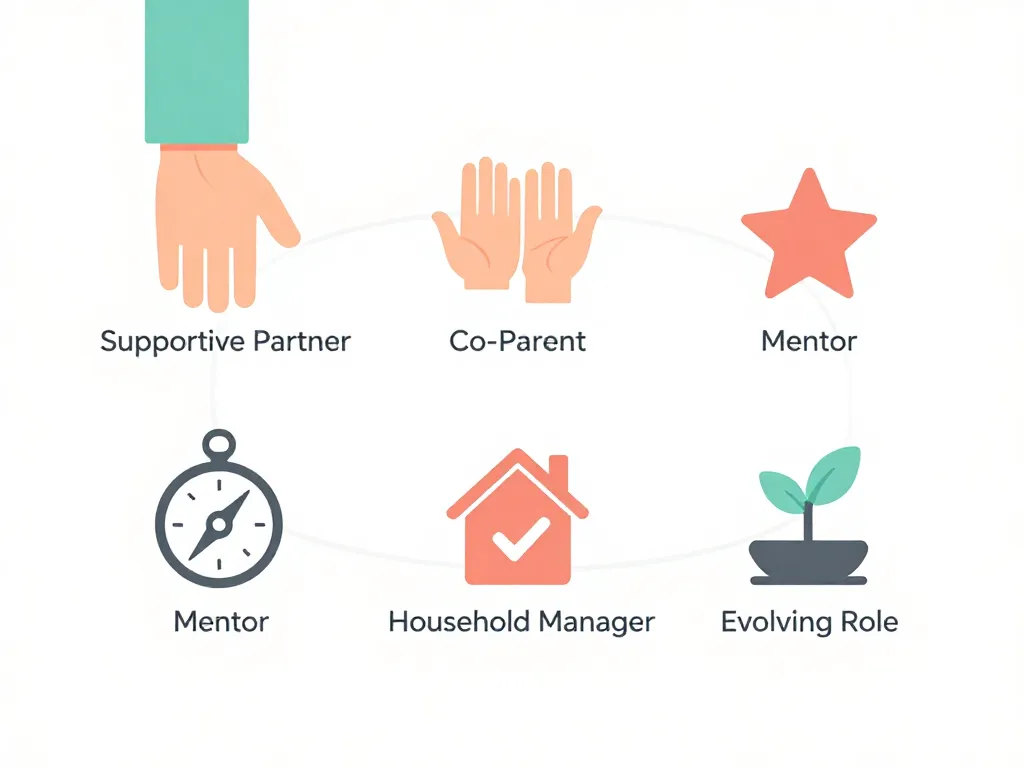
The point isn't to pick the "right" role from a list. It's to pick one together — and to revisit it regularly.
How to Have the Conversation Without It Becoming a Fight
Knowing you need to define stepparent boundaries is one thing. Actually sitting down with your partner and doing it? That's where it gets hard. Here's a framework that works.
Step 1: Start With What's Working
Before you address friction points, acknowledge what your partner is doing well — and ask them to do the same for you.
Examples:
- "I appreciate how patient you are with Liam at bedtime. He clearly trusts you."
- "I notice you always back me up in front of the kids, even when you disagree. That means a lot."
Step 2: Name the Specific Friction Points
Avoid generalizations like "you always undermine me." Instead, describe specific moments:
- "Last Thursday, when I asked Maya to turn off her tablet and she refused, I didn't know if I should follow through or wait for you. I froze, and then I felt embarrassed."
- "When you corrected me in front of Jayden about his bedtime, I felt like my authority in this house doesn't count."
Specificity reduces defensiveness. It turns a vague grievance into a solvable problem.
Step 3: Negotiate the Boundaries Explicitly
Walk through real scenarios and decide together how each one should be handled:
| Scenario |
Who Handles It? |
How? |
| Child ignores household chore |
Stepparent can remind |
Biological parent handles refusal |
| Child is disrespectful to stepparent |
Both address it |
Biological parent takes the lead, validates stepparent |
| Homework battles |
Biological parent sets the rules |
Stepparent can help enforce if child is receptive |
| Bedtime routine |
Depends on child's comfort |
Gradually shift as trust builds |
| Major discipline (grounding, loss of privileges) |
Biological parent decides |
Stepparent is consulted privately first |
You don't need to cover every possible scenario. Start with the three situations that cause the most recurring arguments and build from there.
Step 4: Create a "What to Do When We Disagree" Protocol
No agreement covers every situation. What matters more than the plan is what you do when the plan breaks down.
Some couples agree to:
- Never contradict each other in front of the children
- Use a code word that means "we need to talk about this privately, right now"
- Revisit the agreement monthly over dinner, without the kids
Tools like Servanda can help couples formalize these agreements in writing so that when emotions run high, there's a calm reference point to return to — something you both created together when you were thinking clearly.

Common Mistakes That Erode Stepparent Boundaries
Even well-intentioned couples fall into patterns that slowly damage the stepparent role. Watch for these:
Undermining in Front of the Children
When a biological parent corrects or overrides the stepparent in front of the child, it teaches the child that the stepparent has no real authority. This doesn't mean the biological parent has to agree with every call. It means disagreements happen in private, and the unified front stays intact.
The "You're Not My Real Parent" Trap
Every stepparent hears this eventually. The mistake isn't that the child says it — it's how the couple responds. If the biological parent doesn't address it, the stepparent internalizes the message. A simple, calm response from the biological parent — "You're right, they're not your biological parent, but they're an adult in this home and they deserve respect" — changes the entire dynamic.
Moving Too Fast
New stepparents sometimes try to establish authority quickly, either because they genuinely care or because they want to prove their commitment. But trust with a child builds slowly. Pushing for a co-parent role before the child is ready almost always backfires — and often creates resentment in the biological parent too.
Keeping Score
Blended family life is inherently unequal. The biological parent will always have a different relationship with the child than the stepparent does. When couples start tracking who does more, who sacrifices more, or who gets more respect from the kids, the partnership erodes. The goal isn't equality — it's alignment.
What the Research Actually Shows
Studies on blended family dynamics consistently point to a few findings worth noting:
- Stepparent-child relationships take an average of 4 to 7 years to fully develop. Expecting a close bond in the first year sets everyone up for disappointment.
- The strongest predictor of blended family success isn't the stepparent-child relationship — it's the strength of the couple's relationship. When the couple is aligned, the children adjust more effectively.
- Authoritative stepparenting (warm but firm) works, but only when the biological parent has explicitly supported that authority. Without that backing, firmness reads as overreach.
This means that the work of defining stepparent boundaries isn't just about the kids. It's about protecting the relationship between the two of you.
A Realistic Example: How One Couple Redefined the Role
Marcos and Jennifer had been together for three years. Jennifer's two daughters, ages 8 and 11, lived with them full-time. Marcos loved the girls, but every attempt to set a boundary — asking them to clean up, enforcing screen-time limits, saying no to a sleepover — ended with the older daughter saying, "You can't tell me what to do," and Jennifer stepping in to smooth things over.
Marcos felt invisible. Jennifer felt caught in the middle.
After one particularly bad weekend, they sat down and walked through the role models. They agreed that Marcos would operate as a Household Manager for now — he could enforce shared household expectations, but child-specific decisions would go through Jennifer. Crucially, Jennifer agreed to back Marcos publicly every time, even if she privately disagreed, and they'd debrief after the kids were in bed.
Three months later, the arguments hadn't disappeared. But they'd changed. Instead of fighting about whether Marcos had the right to say something, they were discussing how to handle specific situations. The meta-conflict — the fight about the fight — was gone.
That shift made all the difference.
Conclusion
The stepparent role is one of the hardest in family life because it's one of the least defined. No legal framework, no cultural consensus, and no automatic authority tells you where you stand. Every couple has to navigate it deliberately.
The couples who do it well aren't the ones who get it right on the first try. They're the ones who keep having the conversation — who name the friction, choose a role together, and adjust it when it stops working.
Start with one question tonight: "What do you actually need from me when it comes to the kids?" Listen to the answer. Say what you need in return. Build from there.
Your family doesn't need a perfect structure. It needs an honest one.
Frequently Asked Questions
Should a stepparent discipline their stepchild?
It depends on the role you and your partner have explicitly agreed upon. In most cases, especially early on, the biological parent should lead on discipline while the stepparent enforces shared household rules. The key is that any authority the stepparent exercises must be openly backed by the biological parent, or it will be perceived as overreach.
How do you deal with a stepchild saying "you're not my real parent"?
Every stepparent hears this at some point, and the biological parent's response is what matters most. A calm, clear statement like "They're not your biological parent, but they're an adult in this home and deserve respect" resets the dynamic and validates the stepparent's role. If the biological parent stays silent, the stepchild learns the stepparent has no real standing.
How long does it take for a stepparent to bond with stepchildren?
Research shows stepparent-child relationships take an average of 4 to 7 years to fully develop. Rushing that timeline — by pushing for closeness or parental authority too quickly — often backfires and creates resentment in both the child and the biological parent. Patience and gradual trust-building produce far stronger long-term bonds.
How can couples stop fighting about stepparenting roles?
Most arguments about stepparenting are actually about undefined roles and feeling unsupported, not about the specific discipline incident. Sitting down together to negotiate explicit boundaries — who handles what in specific recurring scenarios — replaces the recurring meta-conflict with solvable, situation-specific discussions. Tools like written agreements and monthly check-ins help keep both partners aligned as circumstances change.
What is the best role for a new stepparent?
For most new blended families, starting as a Supportive Partner or Household Manager works best — you build warmth and trust with the child without claiming parental authority too soon. Over time, as the child's comfort grows and the couple continues to communicate, the role can intentionally evolve toward more shared responsibility.