
Stop Being Defensive When Co-Parenting
Your co-parent texts: "You forgot to pack Emma's inhaler again."
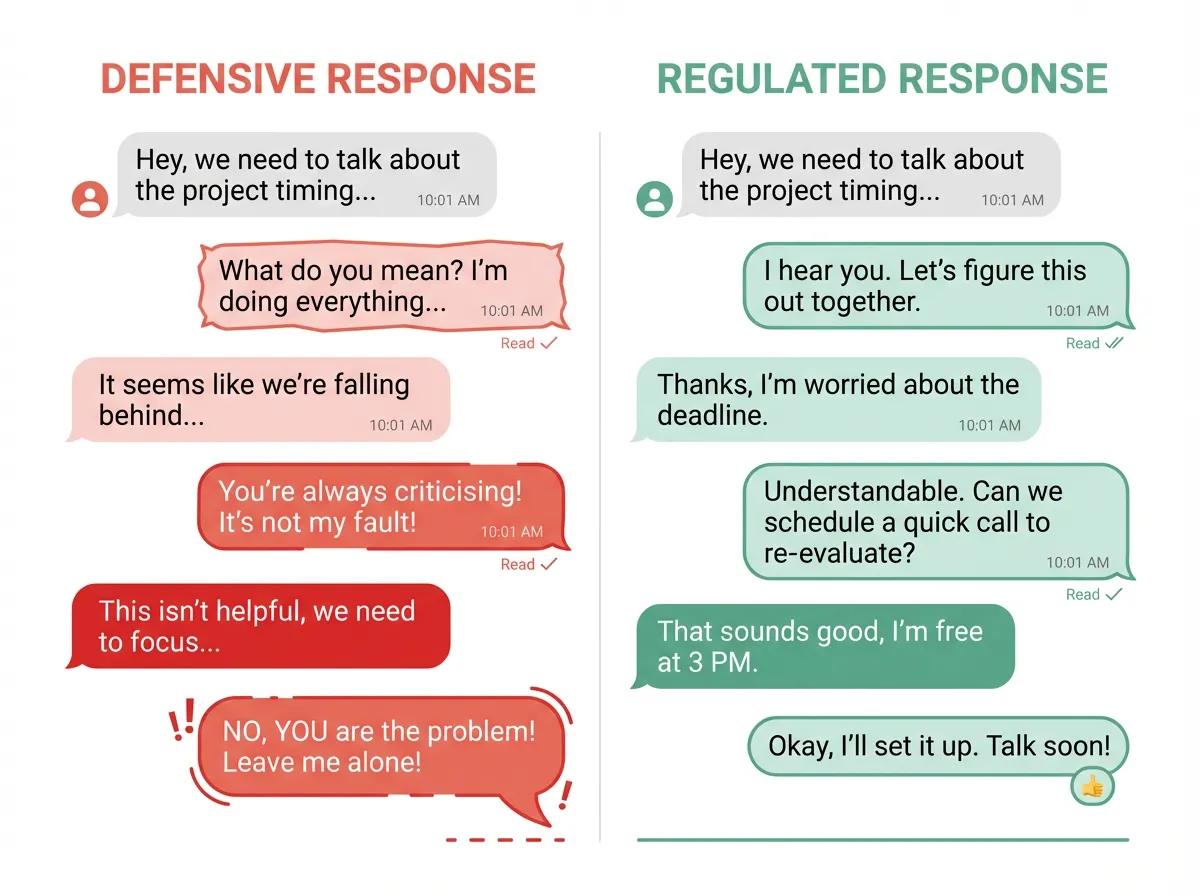
Before you've even finished reading, your chest tightens. Your thumbs are already moving: "I didn't forget—YOU moved it from where it's supposed to be. Maybe if you actually kept things organized…"
You haven't solved the inhaler problem. You haven't even addressed it. What you've done is launch a volley that will bounce back and forth for the next three hours while Emma's inhaler sits forgotten.
This pattern—the instant flinch, the counter-accusation, the spiral—is defensiveness, and it is one of the most common and destructive habits in co-parenting communication. Therapists increasingly identify emotional regulation as the single most important co-parenting skill, and defensiveness is where emotional regulation goes to die.
The good news: defensiveness is a habit, not a personality trait. You can interrupt it. This article gives you specific techniques to recognize your defensive triggers, concrete scripts for responding without escalation, and a framework for building a calmer co-parenting dynamic over time.
Key Takeaways
- Defensiveness is a stress response, not a character flaw. Understanding why your body reacts helps you catch it before you hit "send."
- The 90-second pause is your most powerful tool. Neurochemically, the initial flood of cortisol and adrenaline subsides within 90 seconds if you don't feed it.
- Replace "You" volleys with "The issue" statements. Shifting from personal attack/defense to problem-focused language changes the entire trajectory of a conversation.
- Scripts work better than willpower. Having pre-written response templates for high-friction moments removes the need to think clearly when you're emotionally flooded.
- Reducing defensiveness doesn't mean accepting blame. You can decline to be a doormat and still refuse to escalate.

Why You Get Defensive When Co-Parenting
Defensiveness isn't a choice you consciously make. It's your nervous system doing what it was designed to do: protect you from a perceived threat.
When your co-parent criticizes you—or when you interpret a neutral message as criticism—your brain activates the same fight-or-flight circuitry it would use if you were physically threatened. Cortisol and adrenaline surge. Your prefrontal cortex (the part responsible for rational thought, perspective-taking, and impulse control) goes partially offline. You become, temporarily, a worse communicator than you actually are.
This response is amplified in co-parenting because of several factors unique to the relationship:
The Layers That Make It Worse
- Shared history of conflict. Your nervous system has been "trained" by months or years of difficult interactions to interpret this person's messages as threats.
- Identity threat. Criticism of your parenting feels like criticism of who you are. Parenting is deeply tied to self-worth.
- Loss of control. Co-parenting requires depending on someone you may no longer trust, which creates a baseline of anxiety that makes any feedback feel like an attack.
- Audience effect. Your children are the silent audience. Every co-parenting exchange carries the weight of "Am I the good parent or the bad parent?"
Understanding these layers isn't about excusing defensive behavior. It's about seeing the machinery clearly so you can intervene at the right point in the chain.
The Real Cost of Defensiveness in Co-Parenting
Defensiveness feels protective in the moment but causes real damage over time:
- Minor logistics become multi-day conflicts. A question about a pickup time turns into a referendum on who is more reliable.
- Your children absorb the tension. Research consistently shows that inter-parental conflict—not divorce itself—is what harms children. They don't need to hear the argument; they sense the aftermath.
- Cooperative co-parenting becomes impossible. When every exchange is a minefield, both parents stop bringing up legitimate concerns. Important information about the children stops flowing.
- You exhaust yourself. Living in a constant state of defensive vigilance is physically and emotionally draining.
The goal isn't to become passive. It's to stop spending energy defending your ego so you can spend it on solving actual problems for your kids.
How to Catch Defensiveness Before It Takes Over
The intervention point is the gap between stimulus (their message) and response (your reply). Your job is to widen that gap. Here's how:
1. Learn Your Physical Signals
Defensiveness starts in your body before it reaches your conscious mind. Start paying attention to your personal early-warning system:
- Jaw clenching
- Chest tightening or shallow breathing
- Heat in your face or neck
- An immediate urge to type or speak
- A mental "highlight reel" of their past wrongs
When you notice any of these, name it silently: "I'm getting defensive." This simple act of labeling activates your prefrontal cortex and begins to downregulate the amygdala. Neuroscientists call this "affect labeling," and it works remarkably well.
2. The 90-Second Rule
Neuroanatomist Jill Bolte Taylor's research shows that the chemical process of an emotional reaction runs its course in roughly 90 seconds. After that, any continued emotional arousal is being fed by your thoughts about the situation, not the situation itself.
Practical application:
- Put your phone down for 90 seconds. Physically set it on a surface, face down.
- Do something with your body. Walk to another room. Fill a glass of water. Take five slow breaths where your exhale is longer than your inhale (this directly activates your parasympathetic nervous system).
- Re-read the message after the 90 seconds. You'll often find it's less inflammatory than your nervous system told you it was.
3. Separate the Content from the Delivery
Ask yourself: "If a neutral third party sent me this exact information, would I be upset?"
If your co-parent texts, "You forgot the inhaler again," the content is: the inhaler was not packed. That's a logistics issue. The word "again" and the implied criticism are delivery issues. Respond to the content. Ignore the delivery.
This is not easy, but it is learnable.
Scripts for Responding Without Being Defensive
When you're emotionally flooded, you cannot think of the right words. That's why having pre-built responses is essential. Here are templates for the most common co-parenting friction points:
When You're Accused of Forgetting Something
❌ "I didn't forget—you never told me!"
✅ "Thanks for flagging that. I'll make sure it's packed next time. Can we keep the inhaler in a specific spot in her bag so we both know where it is?"
Why it works: It acknowledges the issue, commits to a solution, and proposes a system—all without admitting fault or assigning blame.
When You Feel Micromanaged
❌ "Stop trying to control everything I do with MY kids."
✅ "I hear your concern about bedtime. I handle evenings a bit differently, and the kids are adjusting fine. If there's a specific issue—like them being tired at school—let me know and we can figure it out."
Why it works: It validates without surrendering autonomy, and redirects to evidence rather than opinion.
When a Schedule Change Is Requested Last-Minute
❌ "Absolutely not. You always do this. The world doesn't revolve around you."
✅ "That doesn't work for this weekend because I already have plans with the kids. I can do [alternative date]. Let's try to give each other more notice going forward."
Why it works: Clear boundary + alternative + forward-looking standard, with zero personal attacks.
When Your Parenting Is Directly Criticized
❌ "You're one to talk. At least I actually show up."
✅ "I'm not going to engage with personal comments, but if there's a specific concern about [child's name], I'm willing to discuss it."
Why it works: It draws a firm line without reciprocating the attack, and it keeps the child at the center.

Building a Less Defensive Co-Parenting Dynamic Long-Term
Scripts are a short-term tool. The deeper work involves reshaping how you relate to your co-parent's communication over time.
Rewrite Your Internal Narrative
Many co-parents operate with an internal story that sounds something like: "They're always trying to make me look bad" or "Nothing I do is ever enough for them."
These narratives prime you for defensiveness before a single word is exchanged. Try replacing them with a more neutral working assumption: "They're stressed about the kids, just like I am. Their delivery might be bad, but their goal is probably the same as mine."
You don't have to believe this fully. You just have to use it as a working hypothesis that keeps your nervous system calmer long enough for your rational brain to engage.
Create Communication Guardrails
Structure prevents escalation better than willpower does. Consider:
- Restricting communication to writing (text or email) so you always have the 90-second buffer. Phone calls and face-to-face exchanges are higher-risk for defensive reactions.
- Using a shared parenting app or platform to keep discussions organized around specific topics rather than open-ended threads that drift into personal territory. AI-powered mediation platforms like Servanda can provide structure when emotions run high, helping co-parents keep exchanges focused and productive.
- Agreeing on response windows. For example, non-emergency messages get a response within 24 hours. This eliminates the pressure to reply immediately while emotional.
Practice Self-Compassion (Seriously)
This isn't a soft suggestion—it's a strategic one. Research by Kristin Neff and others shows that self-compassion reduces defensiveness because people who can tolerate their own imperfections don't need to defend against every criticism.
When you catch yourself being defensive, don't add a layer of self-criticism on top: "I'm so bad at this." Instead: "That was a defensive reaction. It makes sense given everything I've been through. I'll try a different approach next time."
Know When Defensiveness Is Actually Appropriate
This article is about reducing unnecessary defensiveness—the kind that turns logistics into warfare. But some situations warrant firm boundaries:
- If your co-parent is genuinely verbally abusive, you don't need to respond calmly to abuse. You need to set a boundary and potentially involve a mediator or legal professional.
- If false accusations are being made that could affect custody, document everything and consult your attorney.
- Healthy boundaries are not defensiveness. Saying "I won't discuss this right now" is a boundary. Saying "You're just as bad as your mother" is defensiveness.
A Realistic Timeline for Change
You will not eliminate defensiveness overnight. Here's a realistic progression:
- Week 1-2: You notice your defensive reactions after they happen. That's progress—awareness is the first step.
- Week 3-4: You start catching yourself during the reaction. You might still send the defensive text, but you catch it faster.
- Month 2-3: You begin pausing before reacting. The 90-second rule becomes more natural. You use scripts.
- Month 4+: Your baseline shifts. Messages that used to trigger you barely register. You respond to content, not delivery, as a default.
This is a skill, and like any skill, it develops with consistent practice, not perfection.
Frequently Asked Questions
How do I stop being defensive with my co-parent when they're being unreasonable?
Start by separating their tone from their actual request. Even if the delivery is hostile, respond only to the factual content. Use the 90-second rule before replying, and lean on a script if needed. You can't control their behavior, but you can break the cycle by refusing to match their energy.
Is being defensive during co-parenting normal?
Absolutely. Defensiveness is a natural stress response, and co-parenting with someone you've had conflict with is inherently stressful. The fact that you react defensively doesn't make you a bad co-parent—it makes you a human being. What matters is building the skills to manage that reaction over time.
What's the difference between setting boundaries and being defensive in co-parenting?
A boundary is calm, clear, and focused on what you will or won't do: "I'm not available to discuss this over the phone; please text me." Defensiveness is reactive and focused on the other person's faults: "You always call at the worst time because you don't respect my schedule." Boundaries protect your peace. Defensiveness escalates conflict.
Can co-parenting apps actually help reduce defensive communication?
Yes, because they add structure and a written record, which naturally slows communication down and encourages more measured responses. Many co-parents find that the formality of a dedicated platform keeps conversations focused on logistics and reduces the personal attacks that trigger defensiveness.
Should I tell my co-parent I'm working on being less defensive?
It depends on your relationship. If you have a reasonably cooperative dynamic, sharing this can build trust: "I'm trying to respond more calmly—bear with me if I take longer to reply." If your relationship is highly contentious, it's usually better to simply change your behavior without narrating it. Actions speak more clearly than announcements in high-conflict situations.
Moving Forward
Defensiveness in co-parenting isn't a moral failing—it's a deeply human response to a genuinely difficult situation. But it's also a habit that keeps you stuck in cycles of conflict that drain your energy and affect your children.
The most powerful shift you can make is a small one: the next time your co-parent sends a message that makes your chest tighten, put your phone down for 90 seconds. Breathe. Re-read it. Respond to the logistics, not the tone.
You won't do it perfectly every time. You don't need to. You just need to do it more often than you did before. Over weeks and months, those small moments of choosing regulation over reaction will reshape your co-parenting dynamic in ways that benefit everyone—especially your kids.
Start today. Start with the next message.