Why Tone Starts More Fights Than the Topic Itself
You're standing in the kitchen. Your partner says, "So… you didn't take out the trash again." The words themselves? Pretty neutral. A factual observation about a forgotten chore. But something in the drawn-out so, the rising pitch on again, the half-exhale that came before—something makes your chest tighten. Within ninety seconds, you're not talking about the trash anymore. You're defending your entire character.
A growing body of research—including findings highlighted by Psychology Today in 2025—confirms that tone, not the actual topic, is the number-one trigger for arguments between couples. That means the thing igniting most of your fights isn't the dishes, the budget, or the in-laws. It's how the sentence lands.
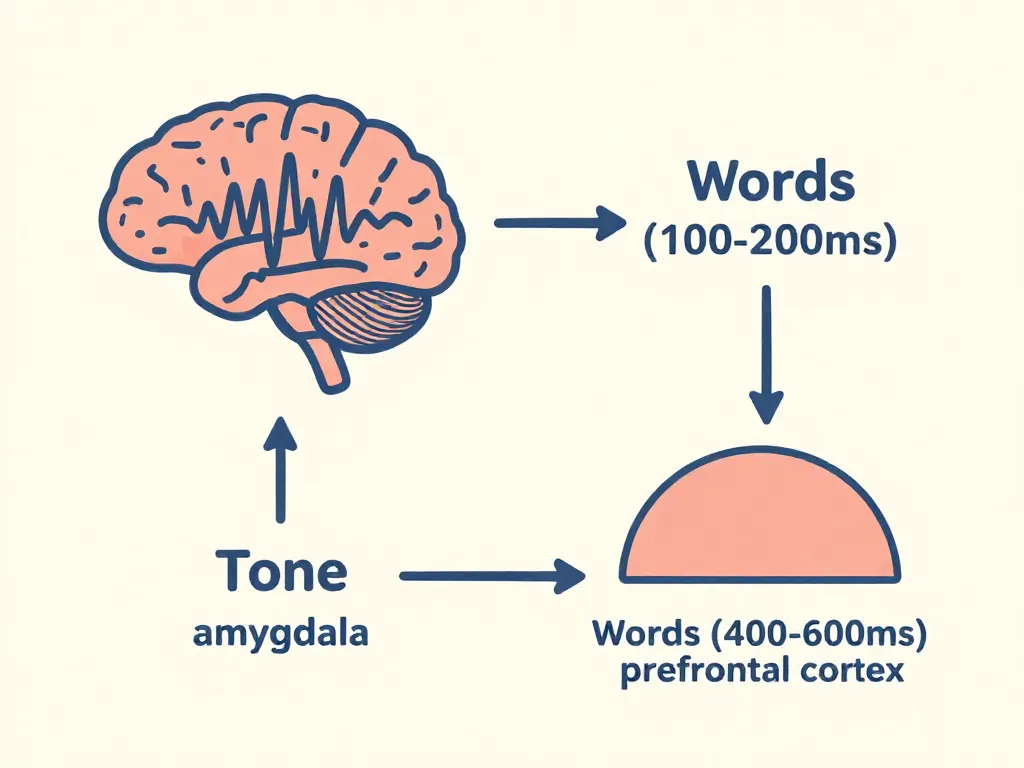
The Science: Why Tone Hits Before Words Do
When your partner speaks, your brain doesn't process what they say and how they say it at the same speed. Not even close.
Your Limbic System Is Faster Than Your Logic
The amygdala—your brain's threat-detection center—evaluates vocal tone in roughly 100 to 200 milliseconds. That's before the prefrontal cortex has finished decoding the semantic meaning of the sentence. In practical terms, your emotional alarm system has already decided whether you're being attacked before you've consciously understood the words.
This is an evolutionary advantage when someone screams "Run!" in a forest. It's a relationship liability when someone sighs "Fine" after you suggest takeout for dinner.
What the Research Actually Found
Psychology Today's 2025 reporting synthesized multiple studies showing that among couples who argue frequently, the vocal tone at the start of a conversation predicted the outcome more reliably than the subject matter. Researchers found:
- Conversations that began with a harsh, critical, or contemptuous tone escalated to full arguments 96% of the time, regardless of the topic.
- The same issue—finances, parenting, household labor—could be discussed productively or destructively based almost entirely on the opening tone.
- Partners consistently misidentified the topic as the source of the fight when asked afterward, rarely mentioning tone at all.
The Content Illusion: Why You Keep Solving the Wrong Problem
Most couples walk away from a fight believing they have a "money problem" or a "sex problem" or a "chores problem." They try to fix the topic. They make spreadsheets, divide the labor chart, set date nights. And then they're blindsided when the next fight erupts over something completely different—but somehow feels exactly the same.
That's the content illusion: the mistaken belief that the subject of the argument is the cause of the argument.
| Sign of the Content Illusion |
What's Actually Happening |
| "We always fight about money" |
You fight whenever either partner uses a dismissive or controlling tone—money is just a frequent backdrop |
| "The fight came out of nowhere" |
The tonal shift happened before the topic was introduced, but you only noticed the words |
| "We resolved this issue last week, so why are we back here?" |
The topic was resolved; the tonal pattern that triggers defensiveness was not |
Recognizing the content illusion is the first step. The next is learning to hear what's actually happening.

What Tone Actually Sounds Like in a Relationship
Tone isn't just "nice" or "mean." It's a complex signal made up of pitch, pace, volume, rhythm, and breath patterns. And it carries emotional metadata that words alone can't convey.
Here are the five tonal patterns that most commonly trigger escalation in couples:
1. The Contemptuous Drop
What it sounds like: The voice lowers and flattens, often with an exhale. "Yeah. Sure you will."
Why it triggers: Contempt signals superiority. John Gottman's research identified contempt as the single most destructive behavior in relationships. When it lives in the tone rather than the words, it's harder to name—but the body still feels it.
2. The Parental Rise
What it sounds like: The pitch goes up at the end, as though speaking to a child. "Did you remember to pay the bill?"
Why it triggers: It implies incompetence. The listener feels talked down to but often can't articulate why, since the words are technically just a question.
3. The Loaded Sigh
What it sounds like: An audible exhale before or during the sentence, communicating exhaustion or exasperation without saying it.
Why it triggers: It broadcasts "I'm already tired of this conversation" before the other person has said a word. The listener starts the exchange feeling like a burden.
4. The Rapid-Fire Clip
What it sounds like: Sentences are short, clipped, and faster than normal. "I did it. It's done. I don't know what you want."
Why it triggers: Speed communicates impatience. The listener perceives "You're not worth my time," whether or not that's the intent.
5. The Faux-Calm Monotone
What it sounds like: An unnaturally steady, emotionless delivery. "I'm not upset. I just find it interesting that you—"
Why it triggers: The mismatch between the controlled surface and the obvious underlying emotion feels dishonest. The listener senses suppressed anger and braces for it.
Notice: none of these are about the words. The content could be about groceries, vacation plans, or whose turn it is to call the plumber. The tone is doing the real communicating.
Why You Don't Hear Your Own Tone
If tone is so powerful, why don't we just fix it?
Because most people genuinely don't hear themselves. There are two reasons for this:
1. The speaker-listener gap. When you speak, your brain is focused on what you're trying to say—the content, the logic, the point. Tone is produced automatically, shaped by your emotional state, not by deliberate choice. Your partner, meanwhile, receives the tone first and the content second. You're broadcasting on a frequency you're not monitoring.
2. Stress narrows self-awareness. When you're already frustrated, your capacity for self-monitoring drops. The cortisol that sharpens your focus on the problem simultaneously dulls your awareness of how you're sounding. This is why the people who most need to watch their tone are the least equipped to do so in the moment.
This isn't a character flaw. It's a design feature of the human nervous system. And it means that relying on willpower alone will fail under stress every time.
You need systems, not intentions.
Practical Strategies to Break the Tone-Trigger Cycle
Strategy 1: The 5-Second Breath Reset
Before responding to something that lands wrong, inhale for three counts and exhale for five. This activates the vagus nerve, which downregulates the sympathetic nervous system. Your body moves out of fight-or-flight before your mouth opens.
When to use it: The instant you feel a flash of heat, chest tightness, or the urge to say "Here we go again."
Strategy 2: Name the Tone, Not the Topic
Instead of engaging with the content of what was said, try addressing the tone directly—without accusation.
- ❌ "Why are you being so passive-aggressive about the dishes?"
- ✅ "Something in how that landed felt sharp. Can we restart?"
The second version acknowledges your perception, avoids diagnosing your partner's intent, and offers a concrete next step.
Strategy 3: Agree on a "Tone Check" Signal
When you're both calm, agree on a neutral phrase or gesture that either person can use when they notice tone escalating. Some couples use:
- "Pause—how are we saying this?"
- A hand placed flat on the table (a non-verbal signal that doesn't interrupt)
- A simple "Volume check"
The key is that the signal must be agreed upon in advance and treated as a request, not a weapon.
Strategy 4: Lead With Your State, Not Your Case
Before launching into the issue, spend one sentence on how you're feeling. This primes your own nervous system to produce a different tone.
- "I'm feeling anxious about our spending this month, and I want to talk about it without it becoming a thing."
- "I'm a little wound up from work, so if I sound tense, it's not about you."
This is called emotional front-loading, and research from couples therapy models like EFT (Emotionally Focused Therapy) shows it significantly reduces defensive responses from the listener.
Strategy 5: Record and Replay (With Consent)
With your partner's agreement, record a conversation about a mildly contentious topic. Play it back together.
Most people are startled by how they sound. The gap between intent and impact becomes audible, not abstract. This isn't about building a case against each other—it's about building shared awareness.
For couples who want to go deeper, AI-powered mediation tools like Servanda can help structure these conversations, providing a neutral framework that keeps discussions focused and productive when emotions start to take over.
What To Do After Tone Has Already Done the Damage
Prevention is ideal. But you will miss the cues sometimes. Here's how to repair after tone has already escalated a conversation.
1. Acknowledge the Tone Specifically
"I just heard myself, and that came out a lot harsher than I meant it." This is more effective than a generic "Sorry" because it names the actual problem.
2. Don't Demand Instant Recovery
Saying "I apologized for my tone, so can we move on?" ignores the fact that your partner's nervous system is still activated. Give them space to come back down. A good follow-up: "Take whatever time you need. I'm here when you're ready."
3. Revisit When You're Both Regulated
The conversation still needs to happen—you just can't have it productively while cortisol levels are elevated. Most couples need 20 to 30 minutes for physiological de-escalation. Trying to resolve the issue before then usually reignites the cycle.
A Note on Chronic Tone Issues
Sometimes, a partner's tone isn't an occasional slip—it's a persistent pattern that feels dismissive, controlling, or belittling. If you've brought it up multiple times and nothing changes, that's worth taking seriously. Chronic contemptuous tone is a recognized risk factor for relationship dissolution, and addressing it often requires professional support beyond self-help strategies.
This article is about the everyday tonal misfires that happen between well-meaning people. It's not a substitute for therapy when patterns feel entrenched or emotionally unsafe.
FAQ
How do I tell my partner their tone is the problem without starting another fight?
Focus on your experience, not their behavior. Try: "When I hear that tone, I shut down and can't engage with what you're actually saying." This frames it as a shared problem to solve, not an accusation. Timing matters too—bring it up during a calm moment, not mid-argument.
Can tone really matter more than what someone says?
Yes. Research consistently shows that nonverbal cues—including tone of voice—account for a significantly larger share of emotional communication than the literal words. Your brain is wired to prioritize how something is said as a survival mechanism, which means tone will override content almost every time in emotionally charged situations.
What if I can't control my tone when I'm upset?
That's normal. The 5-second breath reset and delaying the conversation work better than trying to force a calm tone in the moment. The goal isn't to perform calmness. It's to recognize when your nervous system isn't in a state that allows productive conversation, and to buy yourself time before speaking.
Why do we keep fighting about the same things even after we resolve them?
This is often the content illusion at work. You resolved the topic (who does what chore, how to handle the budget), but you didn't address the tonal pattern that triggered the fight in the first place. Until the tone dynamic shifts, the same emotional conflict will resurface wearing different costumes.
Is this the same as "it's not what you said, it's how you said it"?
It's the research-backed version of that. What was once dismissed as an oversensitive complaint turns out to be neurologically accurate. Your brain genuinely processes the "how" before the "what," and the emotional response to tone is involuntary. Taking it seriously isn't being dramatic—it's being scientifically literate about how human communication actually works.
Conclusion
The most important fights in your relationship aren't about money, chores, sex, or in-laws. They're about the micro-signals packed into a sigh, a vocal drop, or a clipped sentence—signals that trigger your partner's alarm system before a single word registers.
Understanding that tone starts more fights than the topic itself changes how you approach conflict. Instead of endlessly solving for the what, you start paying attention to the how. And the how is something you can change—not through willpower, but through simple, repeatable practices: the breath reset, the tone check, the emotional front-load.
You don't need to become a different person. You just need to notice the six inches between your intention and your delivery. That gap is where most arguments are born—and where most of them can be prevented.