Why Your Tone Starts More Fights Than Your Words
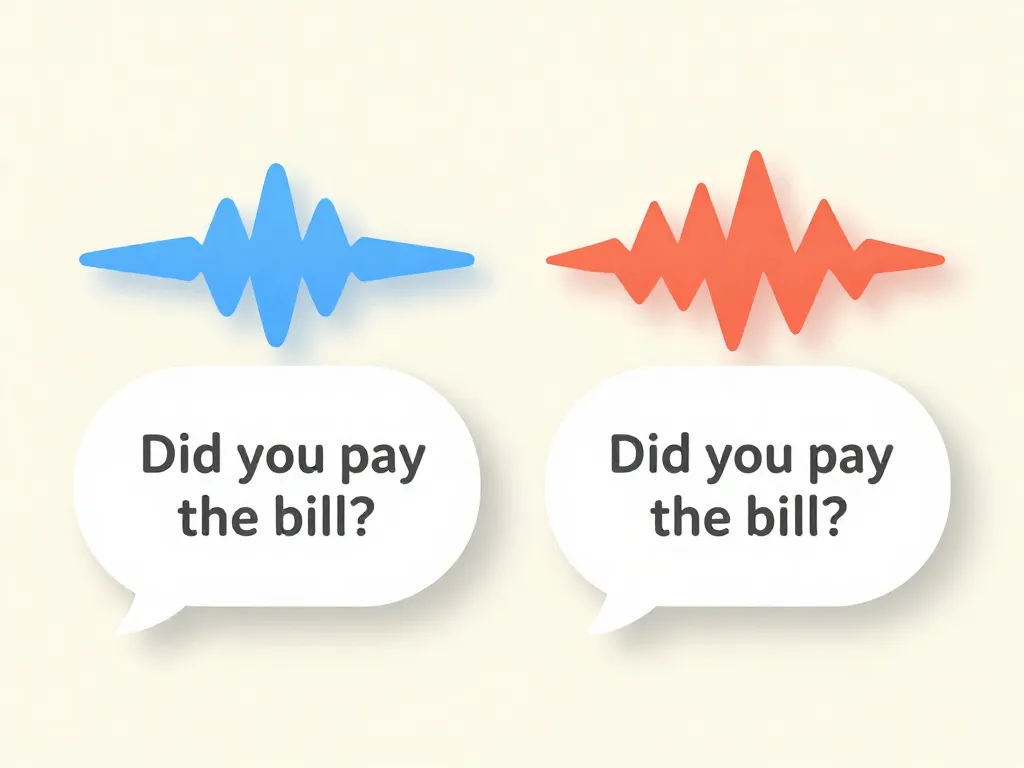
You asked a simple question: "Did you pay the electric bill?"
Five words. No insult. No accusation. But twenty minutes later, you're both in separate rooms, stewing. What happened?
Your partner didn't hear a question. They heard an indictment — a sigh-laced, eyebrow-raised prosecution disguised as five neutral words. And honestly? They might be right. Not because you intended it, but because your tone of voice carried a message your words never said out loud.
Recent coverage from Psychology Today and CNBC highlights that tone — not money, not chores, not parenting disagreements — is the number one fight trigger for American couples. The topic of the argument is almost beside the point. It's the way something is said that lights the fuse. And most couples have no idea this is happening, which means the same fights keep cycling back with no resolution in sight.
This article breaks down the science behind why your tone starts more fights than your words, how to recognize the patterns, and what you can actually do — starting tonight — to change the dynamic.
The Science: Why Tone Hits Harder Than Words
Albert Mehrabian's communication research from UCLA found that when verbal and nonverbal signals conflict, people overwhelmingly trust the nonverbal signal. When your words say one thing and your tone says another, tone wins.
Neuroscience research shows that the brain's auditory cortex begins processing vocal prosody — the rhythm, pitch, and inflection of speech — before the language centers fully decode the words. In practical terms, your partner's threat-detection system has already decided whether they're under attack before their logical brain finishes hearing your sentence.
This is why a partner can say, "I never said it like that," and genuinely believe it. They're tracking their words. You're tracking their delivery. You're both telling the truth about different channels of the same conversation.
What Researchers Mean by "Tone"
Tone isn't just volume. It's a combination of:
- Pitch — higher pitch can signal stress or contempt; a sharp rise at the end of a statement can sound accusatory
- Pace — speaking too fast can feel like steamrolling; too slow can feel patronizing
- Volume — not just yelling; even a conspicuously quiet voice can feel threatening ("icy calm")
- Emphasis — "Did YOU pay the bill?" hits differently than "Did you pay the BILL?"
- Breath patterns — sighs, sharp exhales, and held breath all communicate before a single word is spoken
The Content Trap: Why You Keep Fighting About the Wrong Thing
Here's the pattern most couples recognize but can't name:
- One partner raises a logistical issue (the dishes, the calendar, a purchase).
- The other partner reacts not to the issue but to the way it was raised.
- A defensive response follows — also delivered in a reactive tone.
- Both people now argue about the argument, not the original topic.
- The original issue goes unresolved.
- It comes back in two weeks, carrying the unresolved emotional residue of every previous attempt.
This is the content trap: the belief that if you just solve the surface problem (split the chores more fairly, agree on a budget), the fights will stop. But they don't stop — because the injury was never about the dishes. It was about feeling dismissed, controlled, or unimportant. And that injury was delivered through tone.
A Real-World Example
Mira and James came to couples counseling because they "couldn't agree on finances." But when their therapist recorded a session (with consent) and played it back, something shifted.
Mira heard herself ask, "So are we just not saving anything this month?" — and was startled. She'd remembered saying it as a straightforward question. On the recording, her voice was clipped, with a rising pitch and a tiny, almost inaudible scoff at the end.
James, hearing it back, said: "That. That's the sound that makes me feel like I'm failing."
Mira didn't intend that. She was genuinely worried about their savings. But her worry exited her mouth wearing the costume of judgment, and James's nervous system responded accordingly.
The topic was money. The trigger was tone. They'd been solving the wrong problem for two years.
The Four Tones That Escalate Conflict
Not all tones are equally destructive. Drawing on John Gottman's decades of research at the Love Lab — where he famously predicted divorce with over 90% accuracy — four tonal patterns emerge as especially corrosive:
1. The Contempt Tone
Sarcasm, mockery, eye-roll-energy even without the eye roll. It sounds like superiority. Gottman calls contempt the single greatest predictor of divorce — and it lives in tone more than in word choice.
What it sounds like: "Oh, brilliant idea." (Said with a flat, dismissive cadence.)
2. The Prosecutorial Tone
Rapid-fire questions, emphasis on "you," a courtroom cadence that makes your partner feel cross-examined rather than consulted.
What it sounds like: "Did you call the landlord? Did you even look at the email I forwarded? What have you been doing all day?"
3. The Withdrawal Tone
Flat affect. Monosyllabic. The verbal equivalent of a turned back. This one is sneaky because the words are technically neutral, but the delivery signals: I have checked out and you are not worth my energy.
What it sounds like: "Fine." "Whatever you want." "Sure."
4. The Parental Tone
Over-explaining, speaking slowly as if to a child, using phrases like "I need you to understand..." Regardless of intent, it communicates a power imbalance — and no adult wants to feel managed by their partner.
What it sounds like: "Okay, let me walk you through this one more time..."
Why Tone Is So Hard to Control (And Why That's Not an Excuse)
Tone is partly involuntary. When your stress response activates — heart rate above 100 beats per minute, which Gottman calls "flooding" — your vocal cords tighten, your breathing becomes shallow, and your voice naturally shifts toward sharper, higher, faster patterns. You're not choosing to sound aggressive. Your nervous system is choosing for you.
But here's the important distinction: automatic doesn't mean unchangeable. You can't prevent the initial stress response, but you can build habits that intervene between the trigger and the delivery. That's where the real work lives.

How to Change Your Tone: 6 Practices That Actually Work
1. The Six-Second Pause
When you feel a surge of frustration, pause for six seconds before responding. This is neurological. Six seconds is roughly the time needed for a spike of cortisol to pass its peak intensity. A breath or two in that window can be the difference between a clipped reply and a measured one.
Try this tonight: When your partner says something that triggers a reaction, place your tongue on the roof of your mouth and take two slow breaths through your nose before responding.
2. Lead With Your Actual Emotion, Not Its Bodyguard
Anger is almost always a secondary emotion. Beneath it is usually hurt, fear, loneliness, or feeling overwhelmed. The problem is that vulnerability feels risky, so your voice defaults to anger's tone — which is louder and more armored.
Try this: Before raising an issue, ask yourself: What am I actually feeling beneath the frustration? Then lead with that. "I'm worried we're falling behind on savings" lands entirely differently than a sarcastic quip about spending — even if the underlying concern is identical.
3. Match the Weight of Your Tone to the Weight of the Issue
Not every issue deserves crisis-level vocal intensity. A misplaced TV remote and a betrayal of trust should not sound the same coming out of your mouth. When everything is delivered at the same high-stakes pitch, your partner can't differentiate between minor friction and genuine pain — so they start tuning out or bracing for impact every time you speak.
Try this: Before you bring something up, internally rate it on a 1-10 scale. Then consciously calibrate your voice to match. A level-2 issue gets a level-2 tone.
4. Record a Conversation (With Full Mutual Consent)
This is the fastest way to close the gap between how you think you sound and how you actually sound. Most couples are stunned. Not horrified — just genuinely surprised.
How to do it ethically: Both partners agree in advance. Choose a low-stakes topic. Record five minutes. Listen back together the next day — not immediately, when emotions are still fresh.
5. Use Physical Softening to Soften Vocal Tone
Your voice follows your body. If your jaw is clenched, your shoulders are up, and your arms are crossed, your voice will sound guarded no matter what words you choose. Deliberately releasing physical tension — dropping your shoulders, unclenching your hands, softening your jaw — creates a downstream shift in vocal delivery.
Try this: Before a difficult conversation, shake out your hands for ten seconds. The physical release interrupts the tension pattern your voice would otherwise mirror.
6. Establish a Tone Check-In Signal
Agree on a neutral, non-blaming word or gesture that either partner can use when they notice tone escalating. This isn't a weapon — it's a shared tool.
Some couples use a hand placed on the table, palm up. Others use a single agreed-upon word like "volume" or "reset." The key is that it was chosen together, it carries no judgment, and it's an invitation to recalibrate — not an accusation.
For couples who want to go further, AI-powered mediation tools like Servanda can help structure conversations and create written agreements during calmer moments — so that when tone threatens to derail a discussion, there's already a framework both people trust.
What to Do When You're on the Receiving End of a Harsh Tone
It's one thing to manage your own tone. But what about when your partner's tone hits you like a wall?
- Name the tone, not the character. Say "That felt sharp" instead of "You're being mean." The first describes an experience; the second assigns an identity.
- Ask for a redelivery. "Can you say that again? I want to hear the words, but the way it came out made me defensive." This only works if it's said gently — not as a gotcha.
- Check your own narrative. Sometimes you're hearing tone that isn't there because past experiences have tuned your ears to expect it. Ask yourself: Am I reacting to what they actually said, or to what I expected them to say?
- Disengage before flooding. If your heart rate is climbing and you can feel yourself losing the ability to hear anything except threat, say: "I need twenty minutes. I'm not leaving this conversation — I'm making sure I can actually be in it."
Frequently Asked Questions
Can tone really cause more arguments than actual disagreements about money or chores?
Yes — and it's consistently supported by research. A 2024 survey reported by CNBC found that tone and delivery ranked above finances and household duties as a source of recurring conflict. The reason is that tone carries emotional meaning (contempt, dismissal, control) that cuts deeper than any logistical disagreement.
How do I change my tone if I don't even realize I'm doing it?
Self-awareness is the first step, and it often requires external feedback. Recording a conversation (with mutual consent) is the most effective mirror. You can also ask your partner to gently flag it in real time using an agreed-upon signal. Over time, you'll start catching yourself earlier in the cycle.
What if my partner says my tone is harsh but I genuinely don't hear it?
This is extremely common and doesn't mean anyone is lying. You're monitoring your intentions; they're monitoring your delivery. Instead of debating who's right, try treating their experience as valid data — even if it doesn't match your internal experience. The recording exercise often resolves this gap quickly.
Is it possible that I'm just sensitive to my partner's tone because of past trauma?
Absolutely. If you grew up in an environment where a certain tone preceded conflict or punishment, your nervous system may be calibrated to detect threat at lower thresholds than average. This is real and valid — and it's also something worth exploring, whether through individual therapy, couples work, or self-study. Awareness of your own triggers makes it easier to distinguish between a genuine present-moment problem and an echo of an old one.
Does texting solve the tone problem since there's no vocal delivery?
Not really — it shifts it. Without vocal cues, people project tone onto text, often negatively. A neutral "ok" can read as passive-aggressive. Texting can be useful for sharing information, but for emotionally loaded topics, voice-to-voice (or face-to-face) communication with intentional tone awareness is more reliable.
Moving Forward: The Tone Shift That Changes Everything
The central truth is deceptively simple: your partner is not reacting to what you said — they're reacting to how it sounded. And you're doing the same thing to them.
This isn't a reason for despair. It's actually a reason for hope. Because tone, unlike deeply rooted personality differences or fundamental value conflicts, is a behavior. Behaviors can be observed, practiced, and changed — often faster than you'd expect.
Start with one practice from this article. Try the six-second pause tonight. Try the physical softening before tomorrow's hard conversation. Try recording one five-minute exchange this weekend.
The fights you keep having about dishes, money, and schedules may not be about dishes, money, and schedules at all. Change the tone, and you may find the topic was never really the problem.