
Valentine's Day Expectations That Ruin Couples
It's February 13th. Marcus has booked a restaurant, bought a card, and ordered flowers. He feels good — he's planned ahead this year. Meanwhile, his partner Dina has been quietly hoping that this Valentine's Day will be different. Not just dinner and flowers. She wants him to plan something that shows he really gets her — maybe tickets to that exhibit she mentioned in November, or a handwritten letter about what she means to him. She hasn't said any of this out loud. She doesn't want to have to ask.
By February 15th, they're barely speaking.
This scene — or some version of it — plays out in millions of relationships every year. Not because anyone did something wrong, but because Valentine's Day expectations have a way of becoming invisible tests that partners don't even know they're taking. The holiday becomes less about connection and more about mind-reading, scorekeeping, and unspoken demands. And when those demands go unmet, the fallout can linger far past February.

Let's break down exactly which expectations cause the most damage — and what to do instead.

Key Takeaways
- Share what you want from Valentine's Day before February 14th — not as a demand, but as an honest signal so your partner has something real to work with.
- Recognize that expecting your partner to "just know" what you want is testing telepathy, not love, and almost always leads to disappointment.
- Stop using social media as a benchmark for your relationship — you're comparing your real life to a curated performance, and it erodes satisfaction even when you were happy moments before.
- Co-create your Valentine's Day plan together so that success is defined by both of you, not by one person's unspoken fantasy.
- If the same Valentine's Day fight happens every year, treat it as a signal that a deeper relationship pattern — not just the holiday — needs honest attention.
The Real Reason Valentine's Day Starts Fights
Here's what most couples don't realize: the argument on February 14th is almost never about February 14th.
Valentine's Day acts as a pressure point — a single date on the calendar onto which people project months (or years) of accumulated feelings about whether they're valued, prioritized, and understood. The holiday becomes a referendum on the entire relationship.
When someone says, "You didn't even try," they're rarely talking about the restaurant choice. They're saying, I don't feel like I matter to you, and today proved it.
When someone says, "Nothing I do is ever enough," they're not being dismissive. They're saying, I feel like I'm set up to fail, and I don't know what the rules are.
Both people are hurting. Neither is wrong. But the Valentine's Day expectations sitting between them — unspoken, unexamined, and often contradictory — are doing real damage.
Five Valentine's Day Expectations That Destroy Connection
1. "If You Loved Me, You'd Just Know"
This is the most common and most destructive expectation of all: the belief that a loving partner should instinctively know what you want without being told.
It sounds romantic in theory. In practice, it's an impossible standard that guarantees disappointment.
- You imagine a specific scenario (a surprise trip, a heartfelt speech, a very particular gift).
- You don't share that vision because you feel like asking would "ruin it."
- Your partner, having no access to your internal fantasy, does something different.
- You interpret the mismatch as evidence that they don't care enough.
The painful irony is that this expectation punishes partners for being human. Nobody — no matter how devoted — can consistently guess another person's unspoken desires. Treating Valentine's Day like a mind-reading exam doesn't test love. It tests telepathy.
What to do instead: Share what matters to you. Not a demand, not a script — just an honest signal. "It would mean a lot to me if we did something a little different this year" gives your partner something real to work with.
2. "This Day Should Make Up for What's Been Missing"
Some couples treat Valentine's Day as emotional repair — a single evening that should compensate for weeks or months of disconnect. If you've been feeling neglected, overlooked, or taken for granted, it's tempting to pin your hopes on February 14th as the day things finally shift.
But one dinner can't fix a pattern. And when you load a holiday with that much redemptive weight, you almost guarantee it will collapse under the pressure.
What to do instead: If something has been missing in your relationship, name it directly — on February 3rd or March 12th or any regular Tuesday. Waiting for a holiday to address a real problem just delays the conversation and raises the emotional stakes.

3. "Effort Should Look Like [Specific Thing]"
This expectation is sneaky because it disguises itself as reasonable. Of course effort matters. But problems arise when one partner has a rigid, private definition of what "real effort" looks like — and anything outside that definition doesn't count.
For example:
- One person defines effort as spending money (an expensive gift, a fancy restaurant).
- The other defines effort as spending time (cooking together at home, a long walk, an uninterrupted evening).
- Both partners put in genuine effort. Neither feels appreciated.
This isn't a values conflict. It's a translation problem. You're both speaking effort — just in different dialects.
What to do instead: Get curious about your own definition. Ask yourself: What would make me feel genuinely celebrated? Then share that, and ask your partner the same question. You might be surprised by how different — and how simple — your answers are.
4. "Social Media Is the Benchmark"
This one has gotten significantly worse in the last decade. The curated Valentine's Day posts — the massive bouquets, the Cartier boxes, the surprise trips to Paris — create a highlight reel that many couples unconsciously measure themselves against.
The comparison trap works like this:
- You scroll through posts showing grand romantic gestures.
- You look at your own evening (takeout, a card from the drugstore, early bedtime).
- A gap opens between what you have and what you think you should have.
- That gap generates resentment, even if you were perfectly happy ten minutes ago.
Research consistently shows that social comparison erodes relationship satisfaction. You aren't comparing your relationship to reality. You're comparing it to a performance.
What to do instead: Consider a simple agreement: no scrolling on Valentine's Day. Or at minimum, acknowledge the comparison trap out loud. "I just saw something online and it made me feel weird" is a far more productive statement than silently stewing.
5. "Valentine's Day Isn't a Big Deal" (When It Actually Is)
This is the expectation in disguise. One partner announces that they "don't care about Valentine's Day" — but they do. They care that you remember. They care that you try. They've just preemptively protected themselves from disappointment by pretending the day doesn't matter.
The reverse version is equally damaging: one partner genuinely doesn't care about the holiday, says so clearly, and the other partner doesn't believe them — planning an elaborate evening that feels more like obligation than joy.
Either way, someone is performing instead of being honest.
What to do instead: Take the radical step of actually believing each other. If your partner says Valentine's Day matters, act accordingly. If they say it doesn't, believe them — and check in gently rather than assuming they're hiding their feelings. "I want to make sure I'm not missing something — does this day really not matter to you, or are you just saying that?" That single question can prevent an entire cycle of resentment.
How to Talk About Valentine's Day Without It Becoming a Fight
Notice that every "what to do instead" above involves some version of the same thing: being honest before the holiday, not after it.
Here's a practical framework for having that conversation:
Step 1: Start with yourself. Before talking to your partner, ask: What am I actually hoping for on Valentine's Day? What would make me feel loved? Write it down if that helps. Be specific.
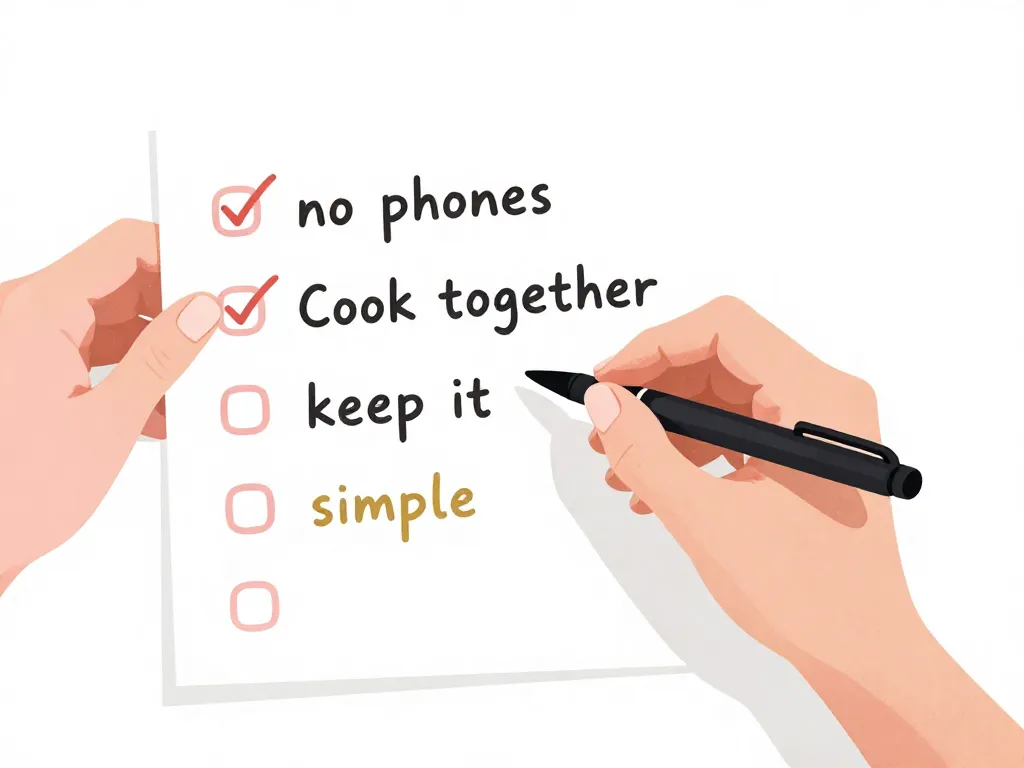
Step 2: Share without scripting. Tell your partner what matters to you in broad terms, not a detailed itinerary. "I'd love it if we could be intentional about the evening — no phones, something a little special" is very different from handing someone a checklist.
Step 3: Ask and actually listen. "What would feel good to you?" — and then take their answer at face value. Don't edit it, interpret it, or argue with it.
Step 4: Agree on a shared version. Maybe you cook together. Maybe you each plan one small surprise. Maybe you skip February 14th entirely and celebrate on a different day when restaurants aren't packed and the pressure is off. The format matters less than the fact that you chose it together.

For couples who find that these kinds of conversations keep going sideways, it can help to put your agreements in writing — even informally. AI-powered tools like Servanda help couples create written agreements that prevent future conflicts by making expectations explicit rather than assumed.
When Valentine's Day Expectations Reveal Deeper Problems
Sometimes the argument about Valentine's Day really is about something bigger. If the same fight happens every year — if one person always feels let down and the other always feels blindsided — that pattern is worth examining.
Ask yourselves:
- Is this a recurring cycle? Do we have some version of this conflict around birthdays, anniversaries, and other holidays too?
- Are we fighting about the event or the relationship? Is the real issue that one person doesn't feel prioritized in daily life, and holidays just make it visible?
- Do we have different attachment needs that we haven't acknowledged? One partner might need grand gestures to feel secure; the other might show love through quiet consistency.
None of these questions have easy answers. But asking them honestly is far more productive than having the same Valentine's Day argument for the fifth year in a row.
What Actually Makes February 14th Good
After all this, you might wonder: is there a version of Valentine's Day that actually works?
Yes. But it tends to look nothing like the cultural fantasy.
Couples who consistently enjoy the holiday share a few traits:
- They talk about it beforehand. No surprises about whether the day matters, how much to spend, or what the evening looks like.
- They define success together. Instead of each person privately deciding what would make the day "good enough," they co-create the plan.
- They keep the stakes proportional. It's one evening. It's not a relationship audit.
- They focus on presence, not performance. The best Valentine's Days aren't the most expensive or the most Instagram-worthy. They're the ones where both people feel seen.
That might mean a five-course dinner. It might mean pizza on the couch with a movie you've both been wanting to watch. The content doesn't matter nearly as much as the intention behind it — and whether that intention was shaped by both of you, not just assumed by one.
Conclusion
Valentine's Day expectations ruin couples not because the holiday itself is toxic, but because it becomes a container for everything we haven't said out loud. The unvoiced hopes, the private scorecards, the Instagram comparisons, the years of accumulated "you should just know" — all of it converges on a single February evening and makes it buckle.
The fix isn't to cancel Valentine's Day or to stop caring about it. The fix is to stop treating it as a test and start treating it as a conversation. Tell your partner what matters to you. Ask what matters to them. Build something together that belongs to both of you, not to a cultural script.
The couples who do this don't just survive Valentine's Day. They come out of it feeling closer — because they chose honesty over performance, and that choice carries far beyond February.
Frequently Asked Questions
Why does Valentine's Day cause so many fights in relationships?
Valentine's Day acts as a pressure point where months or years of unspoken feelings about being valued and understood get projected onto a single evening. The fight is rarely about the dinner or the gift — it's about whether each person feels prioritized in the relationship, and the holiday just makes that question impossible to ignore.
How do I tell my partner what I want for Valentine's Day without ruining the surprise?
You don't need to hand over a detailed checklist — just share what matters to you in broad terms, like "I'd love something that shows you've been listening" or "I'd rather have quality time together than an expensive gift." Giving your partner a genuine signal actually increases the chance you'll feel loved, instead of setting them up to fail a test they didn't know they were taking.
What if my partner says they don't care about Valentine's Day but I think they actually do?
Ask a simple, direct follow-up question like, "I want to make sure — does this day really not matter to you, or are you just saying that?" This one honest check-in can prevent an entire cycle of resentment that builds when one person performs indifference to protect themselves from disappointment.
How do couples stop comparing their Valentine's Day to what they see on social media?
Consider agreeing to skip scrolling on February 14th, or at least name the comparison trap out loud when it hits — saying "I saw something online and it made me feel weird" is far healthier than silently stewing. Research consistently shows that social comparison erodes relationship satisfaction because you're measuring your reality against someone else's curated highlight reel.
Can one good Valentine's Day fix a struggling relationship?
No — one evening can't compensate for weeks or months of feeling neglected or disconnected, and loading a holiday with that much redemptive weight almost guarantees it will collapse under the pressure. If something has been missing in your relationship, address it directly on any ordinary day rather than waiting for a holiday to magically repair a deeper pattern.