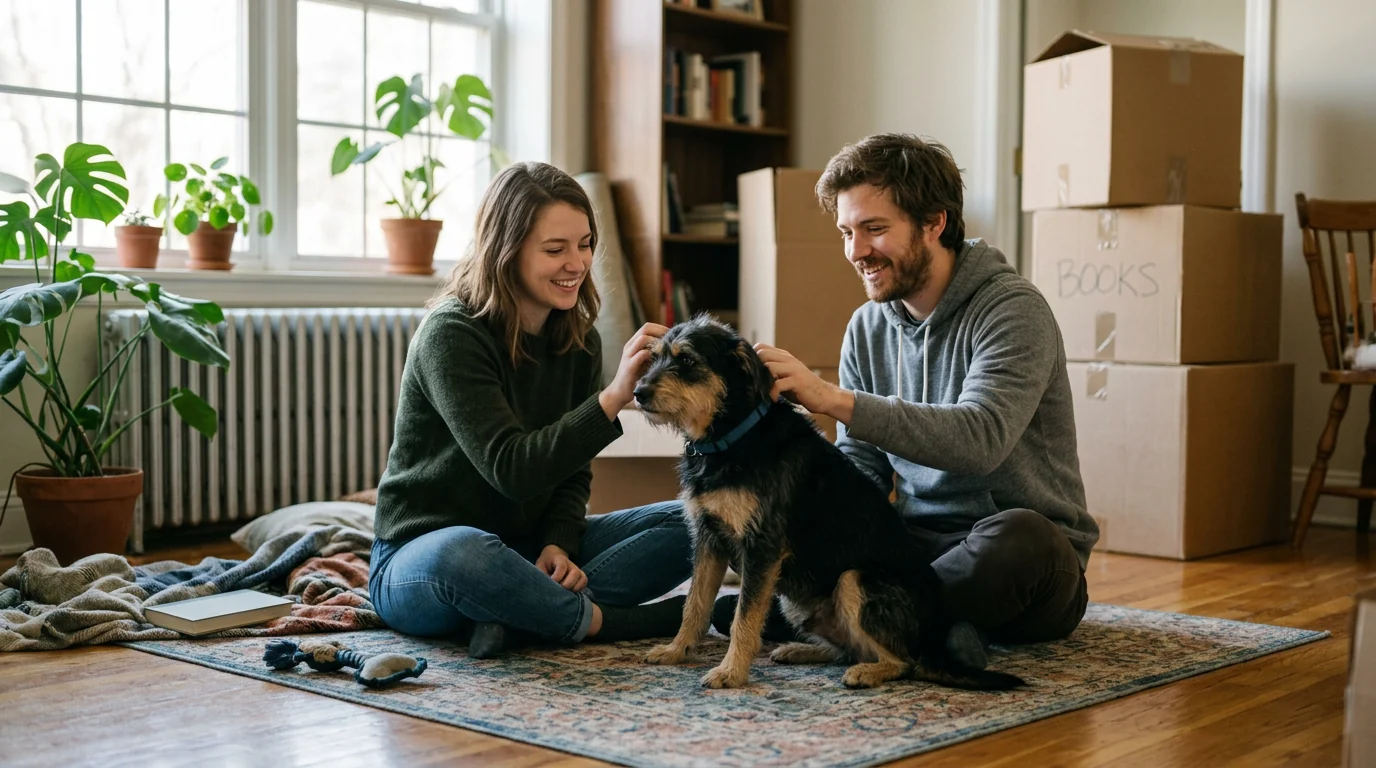
You adopted him together. You split the adoption fee, you both got up at 3am that first week, and neither of you has ever once said out loud who the dog actually belongs to. That worked fine for two years. It stops working the night one of you is packing a car.
The question of who keeps the dog if an unmarried couple breaks up has two honest answers, and they are very different from each other. One is Sole Owner: you name a person now, in writing, and the other person accepts they are not the owner. The other is Shared Custody: you keep co-owning the dog after you split, on a schedule, with costs divided. Most couples avoid picking because picking feels like planning the breakup. So they end up defaulting into Shared Custody by accident, which is the version that goes worst.
Here is where each one holds up, where each one falls apart, and which one is worth the awkward conversation.
Who legally keeps the dog if an unmarried couple breaks up?
Whoever can prove they own him. In nearly every US state, a dog is personal property, and an unmarried couple splitting up has no family court to go to at all: you have a property dispute, and the person with the adoption contract, the vet account, and the microchip registration in their name wins it.
A handful of states have softened this, but only for married people. Alaska led with HB 147 in 2017, requiring courts to consider an animal's well-being in divorce. Illinois followed in 2018 with an amendment to its marriage act allowing sole or joint ownership of a companion animal based on its well-being. California added Family Code section 2605 in 2019, and New York amended Domestic Relations Law section 236 in 2021 to use a "best interest of the companion animal" standard. Every one of those statutes sits inside divorce law. If you never married, none of them do anything for you.
What that leaves is small claims court, or a replevin action to recover specific property. Judges will sometimes order the actual dog returned rather than his cash value, on the theory that an animal is unique property that money can't replace. But you're looking at filing fees, months of waiting, and a judge who will ask a very boring question: whose name is on the paperwork? If your partner signed the rescue's adoption contract because they were the one with the printer, and their address is on the microchip registry, and the vet has their card on file, you are going to lose. Not because you loved the dog less. Because of the printer.
So the paperwork decides it by default. The only question is whether you decide it on purpose instead.

Sole Owner vs. Shared Custody: what each one actually means
Sole Owner names one of you as the dog's owner from day one. That person's name goes on the adoption contract, the microchip registry, the vet file, and the pet insurance policy. If you break up, the dog goes with them, and the other person gets a defined financial exit: a buyout of half the adoption and setup costs, or nothing, depending on what you agree. Visitation, if it happens, is a favor, not a term.
Shared Custody keeps you both owners after the split. You write a schedule (alternating weeks is the most common workable one), you split ongoing costs at a stated ratio, and you agree how veterinary decisions get made when you disagree. It's the arrangement that feels fairest when you're still together and in love with the same dog.
Both are legitimate. They just fail in completely different ways, and the failure modes are what should decide it.
When does naming one owner work best?
Sole Owner works when the two of you are honest that one person is already the primary caretaker, and when a clean financial exit is possible. It's also the only approach that survives one of you moving out of state, which happens after breakups constantly.
Say you and your partner adopted a 60-pound shepherd mix. One of you works from home and does every walk, every vet visit, every nail trim. The other loves him and pays for half the food. That's a Sole Owner situation with a name already attached to it, and writing it down costs you nothing while you're happy.
It holds up in the ugly logistics too. Breed and weight restrictions are the quiet killer here: plenty of rental listings cap dogs at 25 or 35 pounds, and shepherd mixes, pit-type dogs, and huskies get named on restricted lists by landlords and insurers. A person leaving a shared house on four weeks' notice often cannot take a large dog anywhere, and a custody schedule that requires them to have a yard by the 15th of next month is not a plan, it's a wish.
Where Sole Owner breaks: when the named owner is not the real caretaker, and when the money is lopsided. If one of you paid the $2,400 hip dysplasia workup and the $5,800 for the TPLO knee surgery, and the other person's name happens to be on the microchip, "you're not the owner" is going to land as theft. It also breaks when the dog is genuinely bonded to both of you in a way anyone can see, and the excluded person has to absorb that loss on top of the breakup. That grief is real and it turns into a two-year cold war over a dog neither of you can enjoy.
The fix for both is in the terms, not the approach. A buyout number and a written acknowledgment of who paid what removes most of the theft feeling. It won't remove the grief.
When does dog custody sharing actually work?
Shared Custody works under three conditions, all of which have to be true: you both stay in the same metro area, you both have housing that permits the dog, and the dog handles transitions without falling apart. Take away any one of those and the schedule collapses within a year.
When it does work, it works well. Alternating weeks with a Sunday evening handoff, one shared pet insurance policy with the premium split, a single vet clinic that has both of you authorized on the file. Some couples run this for years and the dog is fine. Dogs who have always spent time in two houses tend to adapt faster than people expect.
Now the ways it breaks, in rough order of frequency.
New partners. Twice a month, one of you is standing in the other's driveway. Then someone starts dating, and the handoff becomes a weekly forced encounter with a person you're actively trying to stop thinking about. Couples abandon the schedule over this more than anything else, and the abandonment is usually unilateral and sudden.
A move. One of you takes a job 300 miles away. The alternating-week plan has no version at that distance, and nothing in your agreement says what happens next.
A big vet bill. He tears a cruciate ligament. TPLO surgery runs roughly $4,000 to $7,000 depending on the market and the size of the dog. One of you wants to do it, the other wants the $1,500 conservative management route, and there is no tiebreaker written anywhere. The vet needs an answer today and will only take it from the person on the file.
Enforcement. This is the one nobody thinks about. If your ex keeps the dog past their week and stops replying, you have no family court and no emergency motion. You have a contract claim, in small claims, in eight weeks. That's a real remedy and worth having in writing, but it is not a remedy that gets you your dog on Tuesday.
The deeper problem with Shared Custody is that it keeps you tied to someone you decided to stop being tied to. Every two weeks, a text about pickup times. It's a working arrangement between two people who are supposed to be building separate lives, and it needs both of you to keep being generous long after generosity has stopped being repaid.
What should you actually write down?
Seven things. Write them while you're happy, because every one of them is unresolvable at the moment you need it.
- Primary owner. One name. Whose name goes on the adoption contract, the microchip registry (with the registry updated, not just intended), the insurance policy, and the vet file.
- Cost split for ongoing care. Food, preventatives, grooming, boarding. A percentage, and how it's actually paid, whether that's a shared card or one person invoicing the other monthly. Synchrony's 2022 Lifetime of Care study put the total lifetime cost of a dog somewhere between about $20,000 and $55,000, so this is not a small line item.
- The emergency threshold. Any single vet decision over a stated number, say $1,500, requires both of you. Below it, the person holding the dog decides alone and gets reimbursed at the agreed ratio.
- The buyout. If you split and one person keeps the dog, does the other get anything back? Name a figure or name zero. "We'll work it out" is not a term.
- Visitation, if you want it. Frequency, duration, who travels, and a sunset date. Eighteen months is a sensible outer edge. Open-ended visitation is how people stay entangled for six years.
- The move clause. If either of you relocates more than a stated distance, the arrangement converts to sole ownership by the primary owner. Decide the distance now.
- End of life. Who makes the call, and who's allowed to be in the room.
This is exactly the kind of agreement that's simple to reach in advance and impossible to reach later, and it helps to have something structuring the conversation rather than one of you raising it over dinner. Writing it through a tool like Servanda gets both positions on the record and produces a document you can actually point at, which matters, because the version living in your two memories will not match.
Which approach would we pick?
Sole Owner, with the buyout written and the visitation left informal.
It's the approach that produces one bad conversation now instead of forty small ones later. It survives a job in another city, a landlord with a weight limit, an ex who stops answering texts, and a new relationship that makes handoffs unbearable. And the thing people fear most about it, that the non-owner gets nothing, is fixed by the buyout term and by the fact that most exes who part decently do let the other person see the dog. They just do it as a kindness rather than an obligation, which is a much lighter thing to carry.
We'd switch to Shared Custody under narrow conditions. Both of you in the same city with no plan to leave. Both in housing that takes the dog, verified, not assumed. A dog who already moves between two homes without stress. Genuinely equal caretaking, meaning you'd both struggle to name who does more. And a written 12-month review with an automatic conversion to sole ownership if either of you moves, either of you asks to end it, or the schedule breaks down twice.
If you can't say yes to all five of those today, name an owner. It'll feel cold for about ten minutes.