Smothered vs. Ignored: Breaking the Cycle When One Partner Needs Space and the Other Needs Closeness
It's Thursday night. Maya sends a third text asking what time Jordan will be home. Jordan sees the notification, feels a tightening in their chest, and sets the phone facedown on the desk. When Jordan finally walks through the door an hour later, Maya is quiet—arms crossed, jaw set. Jordan heads straight to the bedroom to change. Maya follows, asking, "Why didn't you just reply?" Jordan sighs. "I was busy. Why do you always need a play-by-play?" And just like that, the loop begins again: Maya reaches, Jordan retreats, and both end the night feeling utterly alone in the same house.
This dynamic—where one partner feels smothered while the other feels ignored—is among the most common patterns therapists see in couples therapy. Once you can name the pattern, you can start to interrupt it.
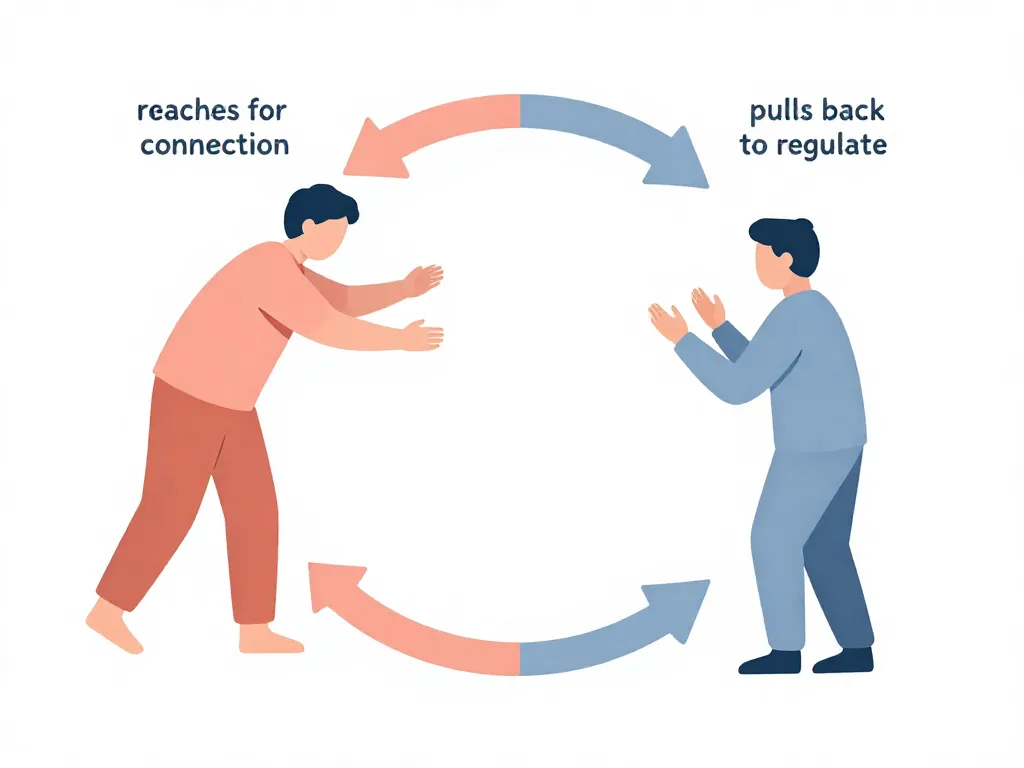
What Therapists Call This: The Pursuer-Withdrawer Dynamic
Relationship researchers, most notably Dr. Sue Johnson (the creator of Emotionally Focused Therapy), have studied this pattern for decades. The clinical name is the pursuer-withdrawer dynamic, and studies suggest it appears in roughly 60–70% of distressed couples.
Here's how it typically works:
| The Pursuer |
The Withdrawer |
| Reaches for connection when anxious |
Pulls back to self-regulate when overwhelmed |
| Interprets silence as rejection |
Interprets pursuit as criticism |
| Escalates volume, frequency, or emotion to get a response |
Shuts down, leaves the room, or goes monosyllabic |
| Feels ignored, unimportant, unloved |
Feels smothered, inadequate, under attack |
| Core fear: "I'm not enough for you to stay" |
Core fear: "Nothing I do is ever enough" |
Underneath the opposing behaviors, both partners share a strikingly similar fear: I am failing at this relationship, and I might lose you.
Why It Escalates So Quickly
The loop is self-reinforcing. Every time the pursuer leans in harder, the withdrawer's nervous system reads it as pressure and pulls back further. Every time the withdrawer goes quiet, the pursuer's nervous system reads it as abandonment and pushes harder. Each person's coping strategy is the other person's trigger.
Recognizing the Pattern in Your Own Relationship
Before you can change anything, you need honest pattern recognition. Below are some everyday situations where the pursuer-withdrawer cycle shows up.
1. The Texting Gap
One partner sends multiple messages during the workday. The other takes hours to reply—or responds with a single word. The first partner reads the brevity as coldness; the second partner reads the volume of messages as neediness.
2. The Weekend Standoff
One partner plans a full weekend of activities together. The other was hoping for quiet downtime alone. The planner feels rejected when the other doesn't show enthusiasm; the other feels suffocated by a packed calendar they never agreed to.
3. The Post-Conflict Freeze
After an argument, one partner wants to talk it out immediately. The other needs hours—or a full night's sleep—before they can process. The first partner keeps circling back; the second partner shuts down or leaves the room.
4. The Emotional Check-In That Feels Like an Interrogation
"How are you feeling about us?" can be a genuine bid for connection—or it can land like a pop quiz when the withdrawer is already running on empty. Context and tone make all the difference.

Why "Just Communicate Better" Doesn't Cut It
Both partners in this dynamic are communicating—just in ways the other can't decode.
The pursuer is communicating: I love you, I miss you, I need to know we're okay.
The withdrawer is communicating: I need a minute to regulate so I can show up for you without snapping.
Neither message is wrong. But when the signals cross, both people hear something entirely different from what was sent. The pursuer hears, "You're too much." The withdrawer hears, "You're not enough."
What follows are specific, tactical moves that address the mechanics of the cycle.
6 Practical Strategies to Break the Smothered-Ignored Loop
Strategy 1: Give the Cycle a Shared Name
Pick a neutral, even playful, name for the pattern. Some couples call it "the loop," "the dance," or "the seesaw." The name doesn't matter—what matters is that it externalizes the problem.
When you say, "I think we're doing the seesaw thing again," you shift from me vs. you to us vs. the pattern. Research from Emotionally Focused Therapy shows that externalizing the cycle reduces blame and defensiveness almost immediately.
Try this tonight: Sit down together and pick a name. Write it on a sticky note and put it somewhere you'll both see it. The next time tension rises, either partner can say the word.
Strategy 2: Use Structured Time-Outs (With a Return Time)
Time-outs work when they're structured, not when they're used as stonewalling in disguise.
A healthy time-out sounds like this:
"I'm starting to flood and I want to handle this well. I need 30 minutes. I'll come find you at 7:15 and we can try again."
Notice the three elements:
1. Ownership ("I'm flooding," not "You're being too much")
2. A specific duration (not "I need space" with no endpoint)
3. A commitment to return (this is what soothes the pursuer's core fear)
The withdrawer gets physiological regulation time. The pursuer gets a concrete promise of reconnection. Both needs are honored.
Strategy 3: Decode the Need Beneath the Behavior
The next time your partner does the thing that triggers you, pause and ask yourself: What are they actually needing right now?
- If your partner is texting you for the fifth time: they likely need reassurance, not a full conversation. A single warm sentence—"Swamped, but thinking of you. Talk tonight."—can short-circuit the entire cycle.
- If your partner has gone quiet after a disagreement: they likely need safety, not distance from you. A gentle "I'm not going anywhere. Take the time you need"—then actually giving them space—can be transformative.
This isn't about suppressing your own needs. It's about learning to respond to the need instead of reacting to the behavior.
Strategy 4: Create Rituals of Connection That Don't Require Negotiation
One of the biggest sources of friction is that every bid for connection becomes a negotiation—and negotiations can feel like pressure.
The fix: pre-agreed rituals. Because they're routine, the withdrawer doesn't feel ambushed, and the pursuer doesn't have to ask (and risk rejection).
Examples:
- A 10-minute coffee together every morning, phones in another room
- A two-minute "highs and lows" exchange before bed
- A weekly 45-minute walk with no agenda
- A shared playlist where either person can add a song as a small gesture of connection
Both partners should design the rituals together so neither feels bulldozed.
Strategy 5: Agree on Texting Norms
This eliminates a huge source of daily friction. Sit down and negotiate explicit texting expectations:
- "During work hours, I may not respond for up to two hours—it doesn't mean anything is wrong."
- "If something is time-sensitive, call instead of texting."
- "A heart emoji counts as a response when you're slammed."
When both partners know the rules, silence stops being a Rorschach test. Tools like Servanda can help couples formalize these kinds of agreements in writing, which reduces the chance of the same argument recurring the next time someone forgets to reply.
Strategy 6: Pursue Curiosity, Not Confirmation
When the cycle kicks up, both partners tend to look for evidence that confirms their worst fear. The pursuer scans for signs of rejection; the withdrawer scans for signs of criticism.
Practice replacing the assumption with a question:
- Instead of "They haven't texted back—they don't care" → "I wonder what their afternoon looks like right now."
- Instead of "Here they go again—nothing is ever enough" → "I wonder what they're actually feeling underneath this."
Curiosity keeps the door open.
What If You're Always the Same Role?
Most couples have a default configuration, but roles can flip depending on the topic. The partner who pursues emotionally might withdraw when it comes to finances. The partner who needs space after conflict might become the pursuer around physical intimacy.
Recognizing that the roles are contextual, not fixed identities prevents labeling. You are not "the needy one" or "the cold one." You are a person whose nervous system responds to perceived disconnection in a particular way in a particular context.
When to Seek Professional Support
Self-help strategies work best when the cycle is still relatively mild—when both partners can still access goodwill toward each other. If any of the following are true, a therapist trained in Emotionally Focused Therapy (EFT) or the Gottman Method can accelerate progress significantly:
- The cycle has become the default mode of nearly every interaction
- One or both partners have started to feel contempt rather than frustration
- Stonewalling lasts days, not hours
- Either partner has begun to emotionally check out of the relationship
- Arguments have escalated to yelling, insults, or threats to leave
Seeking therapy is not a sign that your relationship is failing. It's a sign that you've identified a pattern worth professional-grade tools to dismantle.
Frequently Asked Questions
Is the pursuer-withdrawer dynamic the same as anxious-avoidant attachment?
They overlap significantly but aren't identical. Attachment styles describe a person's general relational wiring, while the pursuer-withdrawer dynamic describes a specific interactional pattern between two people. You can have secure attachment and still fall into the pursuer role under enough stress. The dynamic is about the relationship system, not just individual psychology.
Can the smothered-ignored cycle actually ruin a relationship?
Yes, if it goes unaddressed for years. Research by Dr. John Gottman found that the demand-withdraw pattern is one of the strongest predictors of relationship dissatisfaction and eventual separation. The good news is that recognizing and naming the pattern dramatically improves outcomes, especially when couples intervene early.
What do I do if my partner refuses to acknowledge the pattern?
Start with yourself. You can change your own moves in the dance, and when one partner shifts, the entire dynamic has to adjust. For example, if you're the pursuer, practice offering a warm but brief bid instead of an escalating series of attempts. If you're the withdrawer, practice naming your need for space with a return time instead of silently disappearing. Often, when one partner changes their step, the other naturally follows.
How long does it take to break the pursuer-withdrawer cycle?
There's no universal timeline, but many couples begin to see noticeable shifts within four to eight weeks of consistent, intentional practice. The pattern took months or years to entrench, so patience matters. Celebrate small wins—like catching the loop before it spirals—rather than waiting for the pattern to vanish entirely.
Moving Forward Together
The smothered-ignored cycle is painful precisely because both partners are trying to protect the relationship—just with opposing strategies. The pursuer reaches out of love. The withdrawer steps back out of care. Neither is wrong, and neither is broken.
The work isn't about turning the pursuer into someone who needs less or the withdrawer into someone who gives more. It's about building a shared language for what's happening, honoring both nervous systems, and creating structures that let connection feel safe rather than suffocating.
Name the pattern. Negotiate the texting norms. Build the small rituals. Return after the time-out. These are quiet, daily choices that slowly teach both partners: You are safe here, and you are not too much.
That's where the cycle ends—and something new begins.