Why Couples Fight About Money (And How to Stop)
You're scrolling through the credit card statement when you see it — a $280 charge at a store you don't recognize. Your stomach tightens. You look across the room at your partner, and before you've even said a word, the argument has already started in your head. By 10:15, you're not just talking about that one purchase. You're relitigating last summer's vacation, the car payment, and whether your in-laws really needed that birthday gift.
Research consistently shows that money is the number one topic couples fight about — more than chores, parenting, or even intimacy. A 2022 Ramsey Solutions study found that money is the leading cause of stress in relationships, and financial disagreements are one of the strongest predictors of divorce.
This article offers a real understanding of why money fights happen and concrete strategies to stop the cycle.

Why Couples Really Fight About Money
When you're arguing about the electric bill or the grocery budget, you're almost never actually arguing about dollars and cents. Money is a proxy — a stand-in for deeper emotional currents that most of us never learned to talk about directly.
Money Carries Emotional Baggage
Every person walks into a relationship with a financial origin story. Maybe you grew up in a household where money was scarce and unpredictable, so saving feels like survival. Maybe your partner grew up in a home where money was used to control, so they equate financial independence with freedom.
Dr. Brad Klontz, a financial psychologist and researcher, has identified what he calls "money scripts" — unconscious beliefs about money formed in childhood that drive adult behavior. These scripts fall into four categories:
- Money avoidance: "Money is bad" or "I don't deserve wealth."
- Money worship: "More money will solve all my problems."
- Money status: "My self-worth equals my net worth."
- Money vigilance: "I must always be on guard with money."
When two people with different scripts try to share a bank account, conflict isn't just possible — it's inevitable. The saver sees the spender as reckless. The spender sees the saver as controlling. Neither is wrong. They're just operating from entirely different emotional blueprints.
Power and Control Lurk Beneath the Surface
Money arguments often mask a deeper struggle over power dynamics in a relationship. When one partner earns significantly more, when one partner left a career to raise children, or when one partner brought debt into the relationship, financial decisions can feel loaded with unspoken questions: Who gets to decide? Whose money is this really? Am I an equal partner here?
Consider this scenario: Priya earns roughly twice what her husband, James, makes. She never explicitly says the words, but when they disagree about a purchase, she'll occasionally reference "my paycheck." James doesn't push back in the moment, but the resentment accumulates. Their fights about whether to renovate the kitchen are actually about whether James has an equal voice in their shared life.
Different Risk Tolerances Create Friction
One partner wants to invest aggressively in the stock market. The other wants to keep six months of expenses in a savings account and never touch it. One sees a home purchase as an exciting milestone. The other sees it as terrifying debt.
These aren't right-or-wrong positions. They're expressions of different relationships with risk and uncertainty. But when couples don't name this difference explicitly, every financial decision becomes a tug-of-war.

How to Stop Fighting About Money: A Practical Framework
Step 1: Map Your Money Stories (Separately, Then Together)
Before you discuss a single budget line item, each partner should spend 30 minutes privately answering these questions:
- What's my earliest money memory?
- What did my parents teach me about money — through words and through behavior?
- What does financial security feel like to me? What does financial freedom feel like?
- When I feel anxious about money, what's the fear underneath?
- What financial decision am I most proud of? Most ashamed of?
Then share your answers with each other. The goal isn't to debate or fix — it's simply to understand. When you hear your partner say, "My dad went bankrupt when I was twelve, and I swore I'd never let that happen to me," their insistence on an emergency fund stops looking like rigidity and starts looking like a reasonable response to a real wound.
This exercise has been described by couples therapists as more productive than months of arguing about the budget.
Step 2: Schedule "Money Dates" — and Make Them Non-Negotiable
The biggest mistake couples make with money is only talking about finances when something has gone wrong. That conditions both partners to associate money conversations with conflict.
Schedule a recurring money date — weekly for 20 minutes if you're actively working on financial goals, biweekly or monthly if you're in maintenance mode. Here's how to make it work:
- Set the environment: A coffee shop, a kitchen table with wine, a Saturday morning walk. Not in bed. Not right after work. Not during an argument.
- Use a simple agenda: Review what you spent since the last date. Check progress on one shared goal. Discuss any upcoming expenses. That's it.
- Start with a win: Open each date by naming one financial thing that went well. "We stayed under our dining-out budget" or "We hit $5,000 in the emergency fund."
- Set a timer: Keep it short. You're building a habit, not running an audit.
Couples who hold regular money dates report not only fewer financial arguments but higher relationship satisfaction overall, according to research from Utah State University's Healthy Relationships Initiative.
Step 3: Build a Budget System That Honors Both Partners
Not all budgeting approaches work for every couple. The key is finding a framework that gives both partners autonomy and shared accountability.
| System |
How It Works |
Best For |
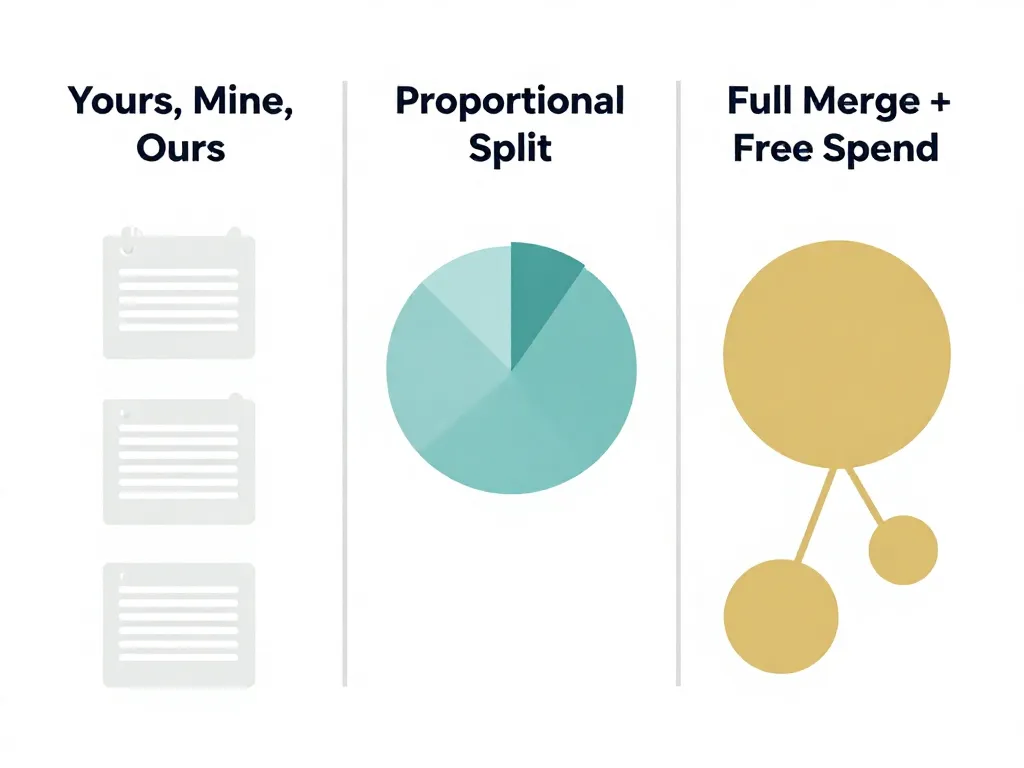
| Yours, Mine, Ours |
Three accounts: one joint account for shared expenses (housing, utilities, groceries, shared savings goals) and two individual accounts for personal spending. Each partner contributes to the joint account either equally or proportionally based on income. |
Couples where financial independence is important to one or both partners, or where there's a significant income gap. |
| Proportional Contribution |
If one partner earns $80,000 and the other earns $40,000, the higher earner covers 67% of shared costs and the lower earner covers 33%. |
Couples with unequal incomes who want to ensure both partners feel the same level of financial ease. |
| Full Merge with Free Spend Allowances |
All money goes into one pot. All bills, savings, and investments come from that pot. Each partner gets an agreed-upon monthly "free spend" amount they can use on anything — no questions asked, no justification needed. |
Couples who view their finances as fully shared and want simplicity, but still need personal autonomy. |
The worst system is no system. When there's no agreed-upon framework, every individual purchase becomes a potential argument.
Step 4: Establish a "No-Questions-Asked" Spending Threshold
This one simple agreement eliminates a staggering number of daily money disagreements. Sit down together and pick a dollar amount — say, $75 or $150. Any purchase under that threshold is each partner's personal call. No permission needed. No explanation required.
Anything above that amount gets a quick conversation — not for approval, but for coordination. "Hey, I'm thinking about buying new running shoes for $180. That work with where we are this month?"
This isn't about control. It's about removing ambiguity. Most couples who fight about purchases are fighting about the absence of a clear agreement, not the purchases themselves.
Step 5: Tackle Debt as a United Front
Debt — whether it's student loans, credit card balances, or medical bills — is one of the most emotionally charged financial topics for couples. If one partner brought significant debt into the relationship, shame and defensiveness can poison every related conversation.
Reframe debt as a shared problem, not a personal failure. Regardless of who incurred it, you're a team now, and the debt affects your shared financial life.
Practical steps:
- Get the full picture on paper: List all debts, interest rates, and minimum payments. Visibility reduces anxiety.
- Pick a payoff strategy together: The avalanche method (highest interest first) or the snowball method (smallest balance first) — either works, but choose one as a team.
- Celebrate milestones: Paid off a credit card? That's worth marking. Progress fuels motivation.
Step 6: Align on Long-Term Goals Before Short-Term Budgets
Couples often dive straight into monthly budget numbers without ever discussing what they're working toward. That's like arguing about the best route before agreeing on the destination.
Set aside one money date per quarter to talk about big-picture goals:
- Where do we want to be in 5 years? 10 years?
- Do we want to own a home? In what area? At what price range?
- When do we want to retire? What does retirement look like?
- Are there experiences or values we want to prioritize — travel, education, charitable giving, early financial independence?
When both partners can see how daily spending decisions connect to a shared vision, the daily decisions become easier and less contentious.
Step 7: Put Your Agreements in Writing
When couples make verbal agreements about money — "Let's try to spend less on dining out" — those agreements are vague, easily forgotten, and open to reinterpretation. Written agreements create clarity and accountability.
Your written financial agreement doesn't need to be legalistic. It can be a shared Google Doc or a note on your fridge that says:
- Joint account contribution: $X each per month
- Free spending threshold: $150
- Monthly dining-out budget: $300
- Next savings goal: $10,000 emergency fund by December
- Money date: First and third Sunday, 10 AM, over coffee
Tools like Servanda can help couples formalize these kinds of agreements in a structured way, creating a clear reference point that both partners helped build — so nobody's left guessing or feeling blindsided when a financial conversation comes up.
When Money Fights Signal Something Bigger
Sometimes, despite your best efforts, money arguments don't improve. If your financial disagreements consistently escalate into personal attacks, if one partner is hiding purchases or accounts, or if money is being used to punish or control, those are signs that the issue extends beyond budgeting.
Financial infidelity — hiding spending, secret accounts, or lying about debt — affects an estimated 40% of couples, according to a National Endowment for Financial Education survey. It's a trust issue that budget spreadsheets alone won't solve.
In these cases, working with a couples therapist who specializes in financial dynamics, or a certified financial therapist, can be transformative.
Frequently Asked Questions
Is it normal for couples to fight about money?
Absolutely. Financial disagreements are the most commonly reported source of conflict among couples, across all income levels. The issue isn't that you disagree about money — it's whether you have a constructive way to work through those disagreements or whether they spiral into recurring, unresolved tension.
Should couples combine finances or keep them separate?
There's no universally right answer. Some couples thrive with fully merged finances, others prefer a "yours, mine, ours" setup, and some keep everything separate. The research suggests that the specific structure matters less than whether both partners actively agreed to it and feel it's fair.
How do you talk to your partner about money without starting a fight?
Timing and framing matter enormously. Don't bring up money when either of you is stressed, hungry, or already upset. Choose a calm, scheduled moment. Start with curiosity rather than accusations — "I'd love to check in on how we're feeling about our savings goal" lands very differently than "Why did you spend $200 at Target?" Lead with shared goals, not individual blame.
What if my partner refuses to talk about money at all?
Money avoidance is a recognized financial behavior pattern, often rooted in shame or anxiety. Pushing harder usually backfires. Instead, start small — a five-minute check-in, a single question, a shared article. Make the first conversations zero-stakes. If avoidance persists and is causing real harm to your shared financial life, a couples therapist can help create a safe space for the conversation.
How often should couples talk about money?
For most couples, a brief check-in every two weeks works well as a baseline — enough to stay aligned without making it feel like a chore. If you're actively paying down debt, saving for a major goal, or going through a financial transition, weekly is better. The format matters more than the frequency: keep it short, structured, and judgment-free.