Why You're Really Fighting (It's Not the Dishes)
It's 9:47 PM on a Tuesday. You walk into the kitchen and see the sink full of dishes — again. Something tightens in your chest. You say something. They say something back. Within three minutes, you're not talking about dishes anymore. You're talking about that time they forgot your birthday plans, or how you "always" criticize them, or why they never seem to prioritize you. An hour later, you're in separate rooms, exhausted, wondering how a few dirty plates turned into a referendum on your entire relationship.
Research consistently shows that the surface-level topics couples argue about — chores, money, screen time — are almost never the real source of conflict. Underneath every fight about the dishes is a deeper, unspoken question: Do you see me? Do I matter to you? Can I count on you?
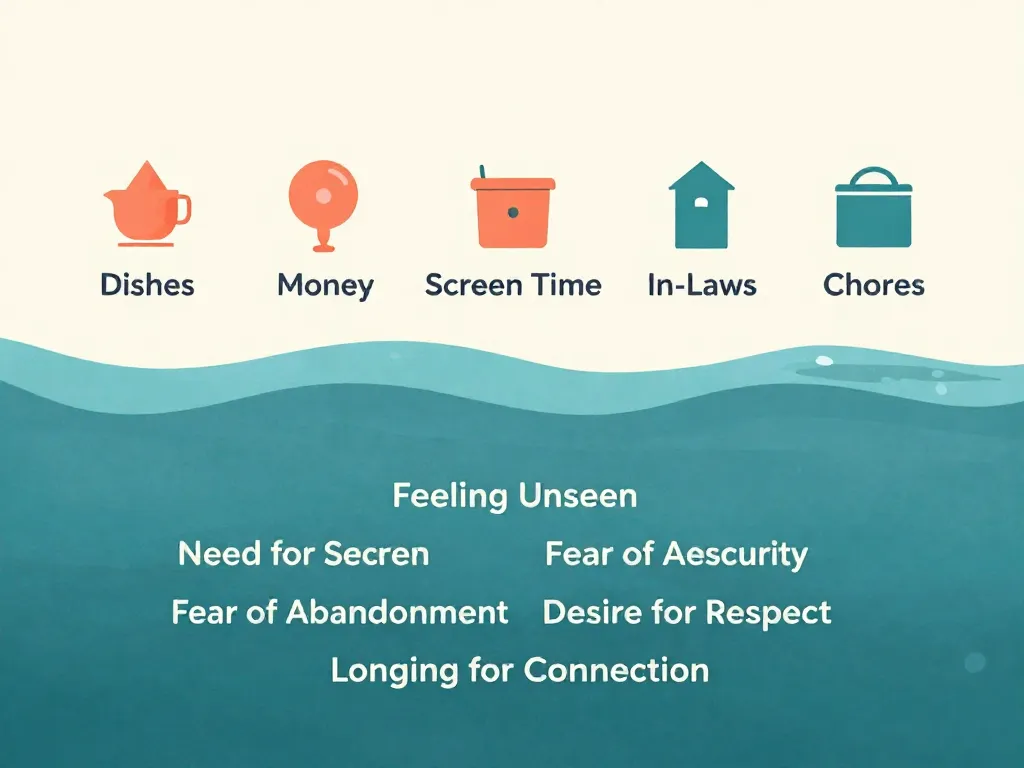
The Real Reason Couples Fight About the Same Things Over and Over
If you've had the same argument fifteen times, it's not because you haven't found the right solution to the logistical problem. It's because the logistical problem isn't the problem.
Dr. John Gottman's decades of research at the University of Washington found that 69% of relationship conflicts are "perpetual" — meaning they never get fully resolved. These aren't problems to be solved. They're ongoing dialogues rooted in fundamental differences in personality, values, or emotional needs.
So why couples really fight isn't about who left the dishes or who spent too much money. It's about what those moments trigger: a feeling of being unseen, undervalued, controlled, or alone in the relationship.
Most of us don't consciously know what's happening beneath the surface. We feel the anger or frustration, and we attach it to the most visible target — the unwashed pan, the forgotten errand, the offhand comment. The real driver stays hidden, which is why the same fight keeps coming back.
Decoding the 5 Most Common Arguments
Let's break down what's actually going on beneath the arguments couples have most frequently.
1. The Chores Fight
What you say: "You never clean up after yourself. I'm not your maid."
What you might mean: "When I'm the only one maintaining our home, I feel like you don't respect my time or effort. I need to feel like we're a team."
The chores argument is almost always about fairness, respect, and feeling like equal partners. When one person consistently handles more of the domestic labor, it can start to feel like a power imbalance — like their time and energy are worth less. The resentment that builds isn't really about dishes. It's about the question: Do you see everything I do for us?
What to try: Instead of listing tasks, share the feeling. "When I come home and the kitchen is messy, I feel overwhelmed and alone in managing our home. I'd love for us to figure this out together."
2. The Money Fight
What you say: "You spent how much on that? We can't afford this."
What you might mean: "Money represents security to me, and when I feel like we're not on the same page, I feel anxious about our future together."
Money conflicts are rarely about the dollar amount. They're about security, control, values, and trust. One partner might have grown up in a household where money was scarce, making them hypervigilant. The other might have learned that spending is a form of self-care or generosity. Neither is wrong — but without understanding the emotional backdrop, every purchase becomes a battleground.
What to try: Talk about what money represents for each of you before you talk about the budget. You might discover that one person needs a savings buffer to feel safe, while the other needs discretionary freedom to feel trusted.

3. The Screen Time / Attention Fight
What you say: "You're always on your phone. You care more about [social media / sports / gaming] than you do about me."
What you might mean: "I'm lonely in this relationship. I miss you, and I need to feel like I'm your priority."
This one has become increasingly common. The frustration with a partner's screen time is almost always a bid for connection and presence. Relationship researcher Dr. Sue Johnson describes these as "attachment cries" — moments when one partner is essentially asking, "Are you there for me?"
The way we express this need (criticism, nagging, sarcasm) often pushes the other person further into their screen.
What to try: Name the need directly. "I'd love 20 minutes tonight where it's just us, no screens. I miss talking to you." This is a request, not an accusation — and it's far more likely to land.
4. The In-Laws / Family Fight
What you say: "Your mother is overstepping again, and you never stand up for me."
What you might mean: "I need to know that you'll choose our family unit. I need to feel like you have my back."
Conflicts about extended family are almost always about loyalty, boundaries, and feeling protected. When one partner feels like the other doesn't advocate for them in front of family, it strikes at a primal need: the need to feel chosen.
What to try: Reframe from "you need to deal with your mother" to "when your mom made that comment at dinner, I felt embarrassed and unsupported. I need to know you're on my team, even when it's uncomfortable."
5. The Sex and Intimacy Fight
What you say: "We never have sex anymore" or "That's all you ever think about."
What you might mean: "I feel disconnected from you and I don't know how to bridge the gap" or "I need to feel emotionally close before I can be physically close."
Sex is one of the most loaded topics in a relationship because it sits at the intersection of vulnerability, desire, self-worth, and emotional safety. The partner who wants more physical intimacy often craves reassurance that they're still desired. The partner who withdraws often needs emotional closeness to feel safe enough to be physically vulnerable.
What to try: Separate the conversation from the bedroom. Talk about connection broadly: "I feel closest to you when ____. What makes you feel close to me?" This depressurizes the topic and opens a door to understanding what intimacy actually means for each of you.
The Hidden Pattern: Pursue-Withdraw
Most couples, regardless of what they're arguing about, fall into one dominant conflict pattern. The most common is the pursue-withdraw cycle:
- Partner A feels something is wrong and raises it — often with intensity, criticism, or urgency.
- Partner B feels overwhelmed, criticized, or attacked, and shuts down, gets defensive, or physically withdraws.
- Partner A interprets the withdrawal as confirmation that Partner B doesn't care, and pursues harder.
- Partner B withdraws further.
- Repeat until exhaustion.
Both partners are usually trying to protect the relationship. The pursuer is fighting for connection (even if it sounds like fighting against the partner). The withdrawer is trying to prevent escalation (even if it looks like indifference).
Neither person is the villain. But unless you name the cycle, it runs the show.
How to Interrupt the Pattern
- Name it out loud. "I think we're doing our thing again — I'm pushing and you're pulling away. Can we pause?" This single sentence externalizes the cycle and puts you both on the same team against the pattern instead of against each other.
- The pursuer's work: Soften the start. Lead with the vulnerable feeling beneath the frustration. "I'm scared we're drifting apart" lands differently than "You never make time for us."
- The withdrawer's work: Stay engaged, even briefly. "I need a few minutes to collect my thoughts, but I'm not leaving this conversation" gives your partner the reassurance they need while honoring your need for space.
The 5-Minute Check-In That Changes Everything
You don't need a three-hour relationship summit. You need a consistent, low-pressure habit. Try this daily or every-other-day check-in:
- Each person shares one appreciation. ("I noticed you packed my lunch today. That meant a lot.")
- Each person shares one thing that's on their mind. Not a complaint — a window into their inner world. ("I've been stressed about the project deadline and I think I've been distant.")
- One question: "Is there anything you need from me right now?"
Total time: five minutes. The goal isn't to solve problems. It's to stay emotionally current with each other so small disconnections don't snowball into major fights.
When disagreements do come up during these check-ins — or outside of them — consider using a structured approach to work through them. AI-powered mediation platforms like Servanda can help couples articulate their real needs and create clear agreements, which is especially useful when emotions make it hard to stay focused on the underlying issue rather than the surface complaint.
What to Do in the Middle of a Fight
Knowing the theory is one thing. Applying it when your heart is racing at 120 bPM is another. Here's a practical in-the-moment protocol:
- Pause. Not forever. Even 10 seconds. Take one slow breath.
- Ask yourself: "What am I really feeling right now?" (Anger is almost always a secondary emotion. Beneath it is usually hurt, fear, or sadness.)
- Ask yourself: "What do I actually need from my partner right now?" Name it simply: reassurance, acknowledgment, help, presence.
- Share the vulnerable layer. "I'm not mad about the dishes. I think I'm feeling unappreciated and I didn't know how to say that."
- Invite your partner in. "Can you help me understand what's going on for you?" Genuine curiosity is the antidote to contempt.
This won't feel natural at first. It might feel awkward, even risky. That's because vulnerability is risky. But it's also the only path to the kind of conversation that actually resolves something.
When the Pattern Is Bigger Than a Blog Article
Sometimes the underlying issues — attachment wounds, childhood experiences, trauma — run deep enough that self-help strategies aren't sufficient. That's not a failure. It's information.
Consider working with a couples therapist trained in Emotionally Focused Therapy (EFT) or the Gottman Method if:
- The same fight has been happening for months or years with no movement
- One or both partners feel emotionally unsafe
- Contempt, stonewalling, or emotional shutdown has become the default
- You've stopped fighting altogether — not because things are good, but because you've given up
Seeking professional help is one of the most proactive, courageous things a couple can do. It means you're choosing the relationship over your ego.
Frequently Asked Questions
Why do my partner and I keep having the same argument?
Recurring arguments usually signal an unmet emotional need that hasn't been identified or addressed. The surface topic (chores, money, time) is a trigger, but the real issue is a deeper need for respect, security, connection, or feeling valued. Until that underlying need is named and responded to, the argument will keep resurfacing in different forms.
Start by asking yourself: "If this issue were magically solved, would I still feel upset?" If the answer is yes, the issue is deeper than the topic at hand. Try completing this sentence: "The story I'm telling myself is _" or "What I'm really afraid of is _." Journaling for even five minutes before a conversation can help you access the feeling beneath the frustration.
Is it normal to fight about small things in a relationship?
Small arguments are not a sign that your relationship is failing — they're a sign that two separate human beings with different needs and histories are trying to build a life together. What matters is not whether you fight about small things, but whether you can use those moments as doorways to deeper understanding rather than dead-end power struggles.
How do I bring up the real issue without starting another fight?
Timing and framing matter enormously. Choose a calm moment (not right after a conflict), and lead with your own feelings rather than your partner's behavior. "I've been thinking about why our kitchen arguments get so intense, and I realized I think it's less about the mess and more about feeling like I'm carrying things alone. Can we talk about that?" This kind of opening signals reflection, not attack.
Can a relationship survive constant arguing?
It depends on the nature of the arguments. Couples who argue but also repair — who circle back, apologize, seek to understand — often have stronger relationships than couples who avoid conflict entirely. The danger isn't in fighting; it's in contempt, defensiveness, and emotional withdrawal without repair. If you're willing to look beneath the surface together, frequent arguments can actually become a catalyst for deeper intimacy.