Housework Wars: Dividing Chores Without Drama
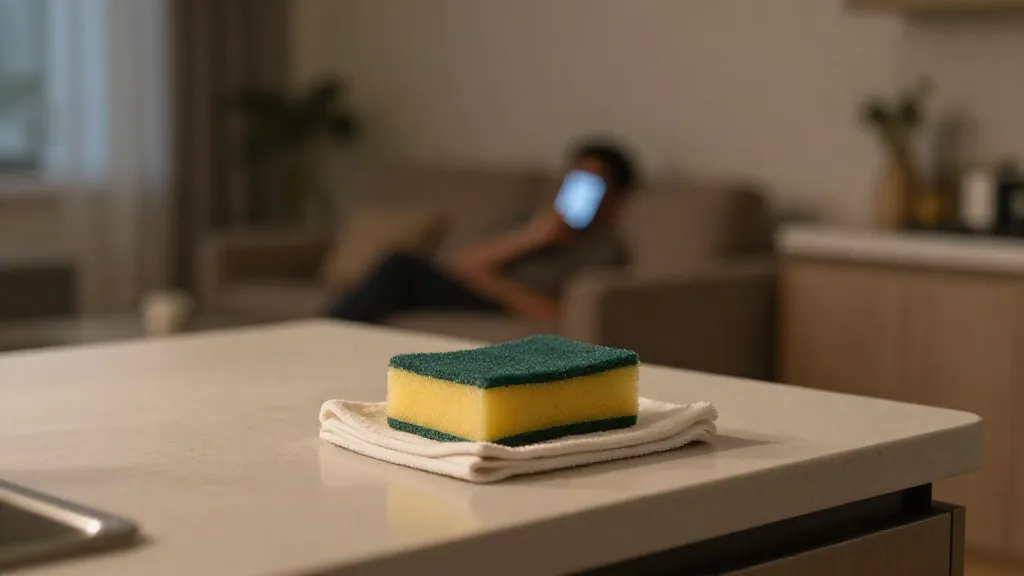
It's 9 PM on a Tuesday. The kitchen counter is cluttered with dishes from dinner. One partner sighs loudly while loading the dishwasher. The other is on the couch, scrolling their phone, genuinely unaware that anything is wrong. The sighing partner doesn't say a word — but inside, a familiar script is playing: I always do this. They never notice. Why do I have to ask?
This scene plays out in millions of homes every night, and it rarely stays quiet for long. Arguments about dividing chores are among the most common — and most corrosive — conflicts in romantic relationships. They're not really about dishes or laundry. They're about feeling unseen, undervalued, and stuck in a pattern that seems impossible to change.
The good news? Dividing chores without drama isn't about finding some mythical 50/50 split. It's about building a system you both understand, agree on, and can adjust over time. This article gives you the concrete frameworks to do exactly that.
Key Takeaways
- A "chore audit" makes invisible work visible. List every household task — including the mental load of planning and managing — so both partners see the full picture.
- Fairness doesn't mean equal — it means agreed upon. A sustainable split accounts for work schedules, preferences, energy levels, and skill sets.
- Weekly 15-minute syncs prevent resentment from building. Brief, structured check-ins let you address imbalances before they become blowups.
- Standards negotiations matter as much as task assignments. Most chore fights are actually about how a task gets done, not who does it.
- Written agreements reduce ambiguity and score-keeping. When expectations are documented, there's less room for the "I thought you were handling that" spiral.

Why Chore Arguments Cut So Deep
On the surface, a fight about who vacuums the living room seems trivial. But research consistently shows that disputes over household labor are one of the top predictors of relationship dissatisfaction. A 2023 Pew Research Center survey found that sharing household chores ranks among the most important factors for a successful marriage — rated just below faithfulness.
The reason these fights sting is because they're rarely about the chore itself. They're proxy battles for deeper issues:
- Respect: "If you valued my time, you'd help without being asked."
- Partnership: "I feel like your parent, not your partner."
- Equity: "My career matters just as much, so why am I doing 70% of the housework?"
- Visibility: "You don't even see the work I do to keep this household running."
And then there's the mental load — the invisible labor of remembering, planning, and managing the household. Noticing the toilet paper is running low, scheduling the vet appointment, knowing which kid needs new shoes. This cognitive work overwhelmingly falls on one partner (often, though not always, women), and it rarely appears on any chore chart.
Until both partners understand what the full workload actually looks like, no division will feel fair.
Step 1: Run a Household Chore Audit
Before you can divide chores without drama, you need to know what you're dividing. A chore audit is the single most effective starting point, and most couples have never done one.
How to Do It
-
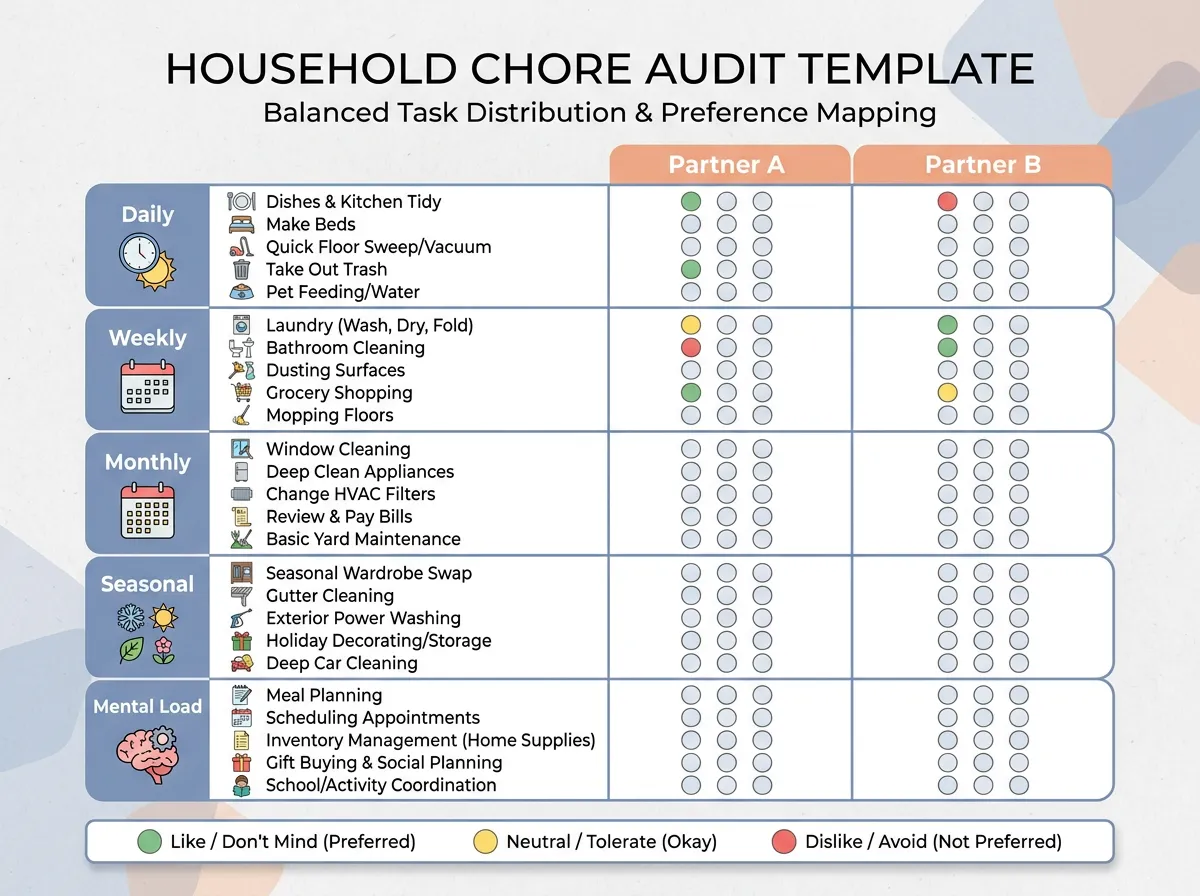
Separately, each partner lists every household task they can think of. Include daily tasks (cooking, dishes, tidying), weekly tasks (laundry, vacuuming, grocery shopping), monthly tasks (deep cleaning, bill review), and seasonal tasks (gutter cleaning, holiday planning).
-
Add the invisible tasks. This is where it gets revealing. Include things like: - Meal planning and recipe decisions - Scheduling appointments (doctor, dentist, vet, car maintenance) - Researching purchases (which stroller? which plumber?) - Monitoring household supplies - Managing social obligations (birthday gifts, RSVPs) - Coordinating childcare logistics
-
Combine both lists into one master list. Inevitably, one partner will have listed tasks the other didn't even realize were being done. That gap is instructive — sit with it without defensiveness.
-
Next to each task, note who currently does it (Partner A, Partner B, or Shared) and roughly how much time it takes per week or month.
The goal of the audit isn't to assign blame. It's to create a shared, accurate map of what it takes to run your household. Many couples report that this step alone dramatically reduces tension, because the invisible finally becomes visible.
Step 2: Negotiate the Split (Fairly, Not Equally)
A perfectly equal 50/50 split sounds fair in theory, but it's often impractical. One partner might work longer hours, have a longer commute, or be managing a health condition. One might genuinely enjoy cooking but loathe yard work. Rigidly counting tasks creates a scorecard mentality that breeds more resentment, not less.
Instead, aim for a split that feels equitable — meaning both partners feel the arrangement is reasonable given their circumstances.
Frameworks That Work
Preference-Based Assignment
Go through your master list and have each person mark tasks as: - 🟢 Don't mind doing this - 🟡 Neutral - 🔴 Strongly dislike doing this
Start by assigning each partner their green-light tasks. For tasks where both partners are neutral or both dislike it, alternate or trade. The "nobody wants to do this" tasks are the most important to explicitly assign — because without a plan, they default to whoever has a lower tolerance for the mess.
Time-Based Balancing
Instead of counting tasks, estimate the total weekly time each partner spends on household labor (including mental load tasks). The goal isn't identical hours but a ratio that reflects your broader life circumstances. If one partner works part-time, they may take on more — but that should be an explicit agreement, not a silent assumption.
Batching and Ownership
Assign whole categories rather than individual tasks. For example: - Partner A owns kitchen (cooking, dishes, groceries, meal planning) - Partner B owns laundry (washing, folding, putting away, dry cleaning drop-off)
Ownership means you handle the full cycle, including the planning and mental load components. This prevents the common trap where one partner "helps" with execution while the other still carries the cognitive burden of managing every step.
Step 3: Negotiate Standards, Not Just Tasks
Here's a truth most chore-division advice ignores: a huge number of chore fights are actually about standards, not assignments.
One partner scrubs the stovetop after every meal. The other wipes it once a week. One folds towels in thirds; the other rolls them. One considers the kitchen "clean" when the counters are wiped; the other means the floor is also mopped and the cabinet faces are spotless.
When you assign a task without agreeing on the standard, you're setting up a cycle of criticism and defensiveness. The partner doing the task feels micromanaged. The partner with higher standards feels like they have to redo the work or silently accept a result that bothers them.
How to Find Middle Ground
- Identify your non-negotiables. Each partner picks 2-3 standards they genuinely can't compromise on (e.g., "the kitchen must be cleaned before bed" or "laundry can't pile up for more than two days"). Honor these.
- Let go of the rest. If your partner owns vacuuming, accept that they might vacuum on Thursday instead of Wednesday. If the outcome is acceptable, the method is theirs to choose.
- Adopt the "owner decides" rule. The partner who owns a task gets to set the process. The other partner doesn't critique the method unless the agreed-upon standard isn't met.
This single shift — separating task ownership from standards negotiation — eliminates a surprising amount of household friction.
Step 4: Institute a Weekly Sync
No system works without maintenance. A short, weekly check-in is the habit that makes everything else stick.

The 15-Minute Household Sync
Pick a consistent day and time (Sunday evening works for many couples). Set a timer. Cover three things:
- What worked this week? Acknowledge what each partner handled. This isn't performative — genuine recognition of effort builds goodwill.
- What fell through the cracks? Discuss without blame. Life happens. The goal is problem-solving, not prosecution.
- What's coming up next week? Flag unusual tasks (hosting guests, car repair appointment, school event) and decide who handles what.
Keep it brief and structured. This is a logistics meeting, not a therapy session. If you notice recurring emotional patterns — one partner consistently feeling overwhelmed, or check-ins turning into arguments — that's valuable data, but it may warrant a deeper conversation (or professional support) outside the sync.
Some couples find it helpful to formalize their chore agreements in writing, especially after the initial audit. Tools like Servanda can help couples create clear, written agreements about household responsibilities, making it easy to reference what was decided rather than relying on memory during heated moments.
Step 5: Build in Flexibility and Renegotiation
Your lives will change. Someone will start a new job, a baby will arrive, a health issue will surface, a parent will need care. The chore system that worked beautifully in March may be completely unsustainable by September.
Build renegotiation into the design:
- Quarterly reviews: Every three months, revisit the full chore audit. Is the distribution still working? Have new tasks crept in? Has one partner silently absorbed extra work?
- Life transition triggers: Agree upfront that major life changes (new job, new baby, relocation, illness) automatically trigger a full renegotiation.
- Permission to call a reset: Either partner can request a reset at any time without it being an accusation. Frame it as: "Our system needs an update" rather than "You're not pulling your weight."
Flexibility is what separates a living agreement from a rigid contract that no one follows.
Common Pitfalls to Avoid
- Weaponized incompetence: Deliberately doing a task poorly so you won't be asked again. This erodes trust faster than almost anything else.
- Gatekeeping: Criticizing or redoing your partner's work until they stop trying. If you've assigned a task, let them own it.
- Score-keeping: Tracking every task to "prove" you do more. The audit process replaces this urge with data; ongoing score-keeping is a sign the system needs adjustment, not more evidence.
- "Just ask me" as a solution: Requiring your partner to ask for help with every task still places the mental load on one person. True division means both partners proactively own their responsibilities.
- Using chores as punishment or leverage: "I did the dishes, so you owe me" turns partnership into a transaction.
A Real-World Example
Jamie and Alex (names changed) came to couples counseling exhausted by nightly arguments about the state of their apartment. Jamie, who worked from home, felt that they were doing "everything" — cooking, cleaning, groceries, managing their toddler's schedule. Alex, who commuted to an office job, felt they were contributing by handling yard work, car maintenance, and all the finances, and was frustrated that Jamie didn't acknowledge that.
Their therapist guided them through a chore audit. The result was revealing: Jamie was spending roughly 22 hours per week on household tasks (including 6 hours of pure mental load). Alex was spending about 8 hours, largely concentrated on weekends.
The imbalance wasn't intentional — Alex genuinely hadn't seen the invisible tasks. Together, they redistributed: Alex took over weeknight dinners three nights a week and all grocery shopping (including meal planning for those nights). Jamie handed off the finances entirely. They set a Sunday evening sync and agreed to revisit the system when Alex's work schedule changed in the fall.
Three months later, the nightly arguments had stopped. Not because the split was perfectly equal — but because it was visible, agreed upon, and adjustable.
Frequently Asked Questions
How do you split chores fairly when one partner works more hours?
Fairness means accounting for each person's total load — paid work, commute time, childcare, and household labor combined. If one partner works significantly more paid hours, it's reasonable for the other to take on more at home, but this should be an explicit conversation, not a silent expectation. Revisit the balance whenever work schedules change.
What do you do when your partner doesn't clean to your standards?
First, recognize that different standards don't mean wrong standards. Have an honest conversation about which standards are genuine non-negotiables versus personal preferences. For the things that truly matter to you, agree on a clear, specific standard ("the kitchen counters are wiped and dishes are put away before bed"). For everything else, practice letting go.
How do you bring up unfair chore division without starting a fight?
Lead with observation and a request, not an accusation. Try: "I've been feeling overwhelmed by how much I'm managing at home. Can we sit down this weekend and map out everything that needs to get done? I want us to figure this out together." Coming with a proposed solution (like a chore audit) shifts the conversation from blame to problem-solving.
Does a chore chart actually work for adults?
A traditional chore chart can feel patronizing, but the underlying principle — clear, visible accountability — absolutely works. The key is co-creating the system rather than one partner assigning tasks to the other. A shared document, whiteboard, or app that both partners build together and can update feels collaborative rather than parental.
How often should couples renegotiate their chore division?
At minimum, quarterly — and immediately after any major life change (new job, baby, health issue, relocation). Regular renegotiation normalizes the idea that your system is a living agreement, not a fixed contract. It also prevents the slow buildup of resentment that happens when one partner absorbs new tasks without discussion.
Moving Forward Together
Dividing chores without drama isn't about achieving some perfect, permanent split. It's about building a shared practice: make the invisible visible, negotiate honestly, check in regularly, and adjust as life changes. The couples who fight least about housework aren't the ones who've found the "right" formula — they're the ones who've built a system for talking about it without blame.
Start small. Run a chore audit this weekend. Have one honest conversation about standards. Schedule your first 15-minute sync. These aren't dramatic gestures, but they're the kind of unglamorous, practical moves that actually shift a relationship's daily texture. The dishes will always need doing. The question is whether you'll face them as teammates or as opponents — and that part is entirely within your control.