
The 4 Hidden Drivers Behind Every Couple's Fight
It's 9:47 PM on a Tuesday. One partner walks into the kitchen and sees the sink full of dishes — again. What starts as a comment about the mess becomes a volley about who does more around the house, which spirals into "you never listen to me," which ends with two people sleeping on opposite edges of the same bed, wondering how a few crusty plates turned into questioning the entire relationship.
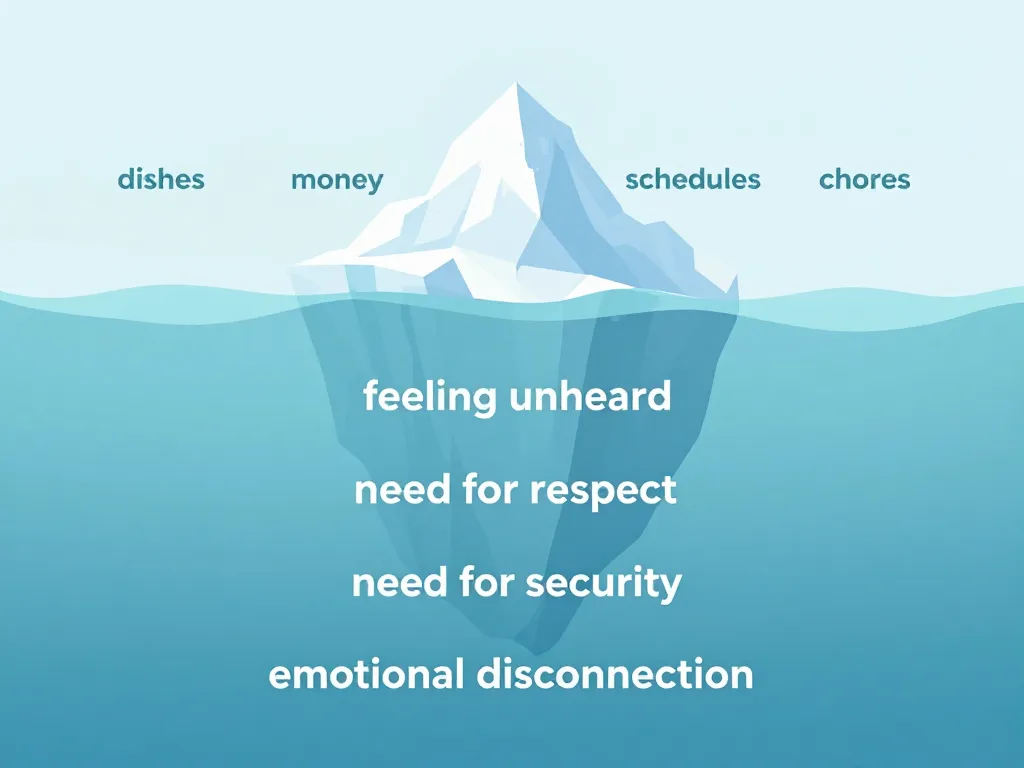
Sound familiar? You're not alone. Research consistently shows that couples argue about a surprisingly narrow set of surface-level topics: household chores, money, time management, and parenting decisions. But here's what most people miss — those topics are almost never the real conflict. Beneath every argument about dishes or budgets, there's a deeper, hidden driver demanding attention. Once you learn to see it, your fights change shape entirely.
This article unpacks the four hidden drivers behind every couple's fight, drawn from relationship psychology research, so you can stop arguing about the sink and start addressing what actually hurts.
Key Takeaways
- Your fights have a subtext. The topic you're arguing about (chores, money, schedules) is rarely the real issue. Underneath, one or both partners feel unheard, disrespected, insecure, or disconnected.
- Four hidden drivers fuel most couple conflicts: the need to feel heard, the need for respect and fairness, the need for security, and the need for emotional closeness.
- Identifying the driver mid-argument can de-escalate it fast. Pausing to ask "what am I really upset about?" shifts the conversation from blame to understanding.
- Recurring arguments are a signal, not a sentence. The same fight on repeat means an underlying need keeps going unmet — not that you're incompatible.
- Small, specific language shifts make an outsized difference. Swapping "you always" for "I've been feeling" targets the real driver instead of the surface complaint.
Why Couples Keep Having the Same Fight
If you've ever thought, "We've had this exact argument a hundred times," you're identifying a pattern that relationship psychologists take very seriously. Dr. John Gottman's research at the University of Washington found that approximately 69% of relationship conflicts are "perpetual" — meaning they never fully resolve. They keep resurfacing because the couple is treating symptoms while the underlying cause goes unaddressed.
Think of it like a dashboard warning light in your car. The light isn't the problem; it's pointing to something under the hood. When you argue about who forgot to pay the electric bill, the dashboard light is on. The engine issue might be that one partner feels they carry an invisible mental load, or that the other partner feels constantly criticized and has started withdrawing.
The framework below identifies the four most common "engine issues" — the hidden drivers behind couple fights — so you can stop trying to fix the dashboard light and start working on what's actually breaking down.
Hidden Driver #1: The Need to Feel Heard
What It Looks Like on the Surface
Arguments about decisions being made without input. Complaints about phone use during conversations. Blow-ups after one partner vents about their day and the other immediately offers solutions.
What's Really Happening
One or both partners feel like their inner world — their thoughts, emotions, preferences — doesn't register with the other person. This isn't about literal hearing. It's about emotional validation: the sense that what I feel matters to you, even when you disagree.
A Realistic Example
Marco and David have been together for six years. David mentions he's been thinking about switching careers. Marco immediately lists all the financial risks. David shuts down. Later that week, David snaps at Marco for choosing a restaurant without asking him. The restaurant is irrelevant. David is carrying a bruise from feeling dismissed about something that mattered deeply to him.
How to Address This Driver
- Before responding, reflect back. Try: "It sounds like this career change is something you've been sitting with for a while." Validation before evaluation.
- Ask what kind of support they need. "Do you want me to help problem-solve, or do you just need me to listen right now?" This one question prevents more arguments than any other single tactic.
- Watch for your own bids to be heard. Sometimes the person who appears to be picking a fight is actually making a clumsy bid for attention. Instead of reacting to the delivery, try to hear the request underneath it.

Hidden Driver #2: The Need for Respect and Fairness
What It Looks Like on the Surface
Fights about the division of chores. Resentment over who earns more or works longer hours. Tension about in-laws, where one partner feels the other "always takes their family's side."
What's Really Happening
One partner feels the relationship's balance of power, effort, or consideration has tilted. They don't feel treated as an equal. This driver is particularly insidious because it often builds silently — resentment compounds like interest on debt, and by the time it surfaces, the emotional balance sheet feels wildly uneven.
A Realistic Example
Preeti handles all the household logistics — scheduling the kids' appointments, restocking groceries, tracking school deadlines. Her husband Arun does the cooking and yard work. On paper, they both contribute. But Preeti also carries the cognitive labor of managing the household: remembering, planning, delegating. When she finally explodes about Arun not replacing the toilet paper roll, it's not about the toilet paper. It's months of feeling like the invisible project manager of their life together.
How to Address This Driver
- Make the invisible visible. Sit down together and list every task required to run your household — including the planning, remembering, and emotional labor. Many couples are stunned by how unbalanced things look once it's all written out.
- Avoid scorekeeping, pursue understanding. The goal isn't a perfectly equal spreadsheet. It's for both people to feel like their contributions are seen and the arrangement is fair to both.
- Check for contempt. Gottman identifies contempt — the sense that your partner is beneath you — as the single most corrosive behavior in relationships. If arguments about fairness carry a tone of "I shouldn't have to explain this to you," that's contempt, and it needs direct attention.
Hidden Driver #3: The Need for Security
What It Looks Like on the Surface
Jealousy or suspicion about friendships. Arguments about spending and saving. Anxiety when a partner comes home late without texting. Conflict about long-term plans — where to live, whether to have children, retirement timelines.
What's Really Happening
One or both partners feel uncertain about the stability of the relationship or their shared future. Security isn't just financial; it's emotional and existential. It answers the question: Can I count on you? Are we building something together, or am I on my own here?
Attachment theory, originally developed by John Bowlby and later applied to adult relationships by researchers like Sue Johnson, explains this driver well. When our attachment bond feels threatened — even by something as minor as an unreturned text — our nervous system can react as though we're in genuine danger. The resulting behavior (clinginess, withdrawal, anger) is a survival response, not a personality flaw.
A Realistic Example
Sarah and James argue about money constantly. Sarah wants to save aggressively; James is more spontaneous with spending. On the surface, it's a budgeting disagreement. But Sarah grew up in a household where financial instability meant chaos — moves, arguments, hunger. For her, a healthy savings account isn't a preference; it's oxygen. When James spends freely, her nervous system reads it as a threat to their safety. James, meanwhile, grew up in a controlling household and experiences Sarah's budgeting as someone restricting his freedom. Neither is wrong. Both are responding to a deep need for security that looks different for each of them.
How to Address This Driver
- Name the fear, not just the complaint. "I'm scared we won't be okay if something goes wrong" lands very differently than "You're irresponsible with money."
- Create shared rituals of reassurance. Weekly check-ins, a shared calendar for plans, a recurring conversation about where you're headed together — these small structures lower the ambient anxiety that feeds security-driven fights.
- Explore your attachment histories together. You don't need a therapist to ask each other: "What did security look like in your family growing up? What makes you feel safe now?" Understanding each other's emotional blueprint changes how you interpret their behavior.

Hidden Driver #4: The Need for Emotional Closeness
What It Looks Like on the Surface
Complaints about not spending enough quality time together. Frustration over mismatched sex drives. Arguments about one partner being "always on their phone" or "married to their job." Fights that erupt after long periods of polite but distant coexistence.
What's Really Happening
One or both partners feel emotionally alone in the relationship. They may share a home, a bed, even a daily routine — but the sense of intimate connection, of being truly known by the other person, has faded. This driver is often the hardest to articulate because it doesn't attach to a specific incident. It's an absence, not an event.
A Realistic Example
Chen and Mia haven't had a real argument in months. Friends comment on how solid they seem. But Chen feels a growing hollowness. Their conversations are logistical — who's picking up the kids, what's for dinner. When Chen tries to share something deeper — a worry about aging parents, a dream about traveling — Mia responds warmly but briefly, then returns to her laptop. One evening, Chen makes a sarcastic comment about Mia "caring more about her email than her marriage." The resulting fight is explosive and confusing to both of them, because it seems to come out of nowhere. But it didn't. It came from months of emotional hunger.
How to Address This Driver
- Prioritize presence over grand gestures. Ten minutes of phones-down, face-to-face conversation daily does more for emotional closeness than an annual vacation.
- Respond to the small moments. Gottman calls these "bids for connection" — a comment about something interesting, a touch on the shoulder, a shared joke. Turning toward these bids (acknowledging them) builds closeness. Turning away (ignoring or dismissing them) erodes it.
- Ask open-ended questions you don't already know the answer to. "What's been on your mind lately that you haven't told anyone?" or "What are you looking forward to this month?" These questions signal genuine curiosity about your partner's inner world.
How to Identify the Hidden Driver in Real Time
Knowing the four drivers intellectually is one thing. Catching them mid-argument is another. Here's a practical process you can use the next time a fight starts heating up:
- Pause and name the surface topic. "We're arguing about the credit card bill."
- Ask yourself: What emotion am I feeling beneath the anger? Anger is almost always a secondary emotion. Underneath it, you'll typically find hurt, fear, loneliness, or shame.
- Match the emotion to a driver: - Hurt → "I don't feel heard." - Resentment → "This doesn't feel fair." - Fear or anxiety → "I don't feel secure." - Loneliness or sadness → "I feel disconnected from you."
- Say the driver out loud. "I think I'm not really upset about the credit card. I think I'm scared about our financial future and I need reassurance that we're on the same page."
- Invite your partner to do the same. "What do you think is really going on for you right now?"
This isn't easy. It requires vulnerability in a moment when your body wants to defend or attack. But every couple who practices this reports the same thing: the fight doesn't just end — it transforms into a conversation that actually brings them closer.
For couples who find that certain conflicts keep resurfacing despite identifying the driver, it can help to formalize what you've agreed on. AI-powered mediation platforms like Servanda can provide structure when emotions run high, helping you document agreements and revisit them before the next cycle begins.
What to Do When You Can't Find the Driver
Sometimes you'll try this framework and draw a blank. You're upset but you can't pinpoint why. That's normal and it's worth naming:
- Say so. "I know I'm upset and I'm not sure what's underneath it yet. Can we come back to this in an hour?"
- Journal for five minutes. Free-writing often surfaces emotions that verbal processing misses.
- Look at patterns, not just incidents. If you can't identify the driver in a single argument, zoom out. What have your last five arguments had in common? The pattern often reveals the driver.
Frequently Asked Questions
Why do my partner and I keep fighting about the same things?
Recurring arguments almost always signal an unmet emotional need beneath the surface topic. Until the underlying driver — feeling unheard, disrespected, insecure, or disconnected — is identified and addressed, the same conflict will keep resurfacing in different forms. It's not a sign of incompatibility; it's a signal pointing you toward what needs attention.
How do I bring up a hidden driver without starting another fight?
Timing and framing matter. Choose a calm moment — not mid-argument — and use "I" statements that focus on your own experience. For example, "I've noticed that when we argue about schedules, I think what I'm really feeling is that I miss spending time with you" is far less likely to trigger defensiveness than "You never make time for us."
Can understanding these hidden drivers actually stop arguments?
It won't eliminate disagreements — and it shouldn't, since some disagreement is healthy. But identifying the real driver tends to de-escalate fights significantly because it shifts the dynamic from adversarial ("you vs. me") to collaborative ("us vs. the problem"). Couples who practice this consistently report shorter, less intense conflicts and faster repair afterward.
What if my partner isn't willing to look at what's beneath our arguments?
You can still make progress unilaterally. When you start responding to the driver instead of the surface topic — even if your partner doesn't — it changes the dynamic. Over time, many partners become more open when they experience the difference between being attacked and being understood. If resistance persists, a couples therapist can help create a safe space for this work.
Are these hidden drivers the same as love languages?
Not exactly, though there's some overlap. Love languages describe how people prefer to give and receive affection. Hidden drivers are about deeper emotional needs — safety, validation, equity, connection — that, when unmet, create conflict. You might know your partner's love language perfectly and still miss the driver beneath a recurring argument.
Moving Forward Together
Every couple fights. That part is universal and, frankly, unavoidable. What separates couples who grow closer from those who grow apart isn't the absence of conflict — it's what they do with it.
The four hidden drivers — the need to feel heard, respected, secure, and emotionally close — aren't weaknesses. They're fundamental human needs. When you learn to recognize them in yourself and in your partner, arguments stop being threats and start becoming doorways into deeper understanding.
You won't get this right every time. You'll still snap about the dishes and say things you regret about the budget. But the next time you feel a fight escalating, try pausing for just five seconds and asking: What am I really asking for right now? That question, asked honestly, changes everything that comes after it.
The fight isn't the problem. The unspoken need is. Name it, and you've already begun to heal it.