The Housework Argument: Why Chores Ruin Love
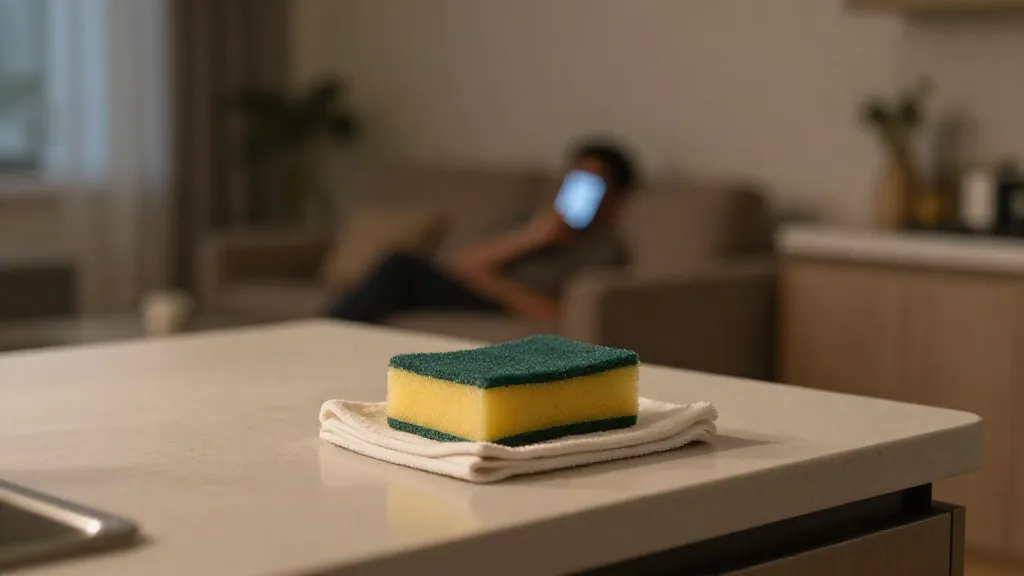
It's 9 p.m. on a Tuesday. You've cooked dinner, wiped the counters, loaded the dishwasher, and folded a basket of laundry. Your partner is on the couch scrolling their phone. You don't say anything—not tonight—but a familiar tightness settles in your chest. It's not really about the dishes in the sink. It's about the fact that you noticed them, and they didn't. Again.
The housework argument is one of the most common conflicts couples face, yet it's also one of the most dismissed. "It's just chores," people say. But research consistently ranks the division of household labor among the top five sources of relationship conflict—right alongside money, sex, and parenting. The reason is simple: a housework argument is never just about housework. It's about feeling seen, respected, and valued by the person you love.
This article breaks down why chore conflicts cut so deep, what's really fueling the resentment, and—most importantly—what you can both do differently starting today.
Key Takeaways
- Housework arguments are really about respect and equity, not who scrubs the toilet. Dismissing them as trivial makes the conflict worse.
- The "mental load"—planning, tracking, and anticipating household needs—is invisible labor that often falls disproportionately on one partner and is a major source of burnout.
- Gratitude without action isn't enough. Saying "thank you" matters, but it doesn't replace actually sharing the workload.
- A concrete, written chore agreement that accounts for both visible and invisible tasks dramatically reduces recurring arguments.
- Resentment builds slowly, then explodes. Addressing the housework divide now protects your relationship's long-term health.

Why the Housework Argument Feels So Personal
When your partner leaves wet towels on the bed for the third time this week, the frustration you feel isn't proportional to the act itself. That's because the towel isn't just a towel. It represents a pattern—a pattern that tells you: My comfort matters more than your effort.
Research from the Gottman Institute shows that recurring housework disputes often trigger what psychologists call negative sentiment override—a state where one partner begins interpreting even neutral actions through a lens of resentment. Once you're in that state, your partner could unload the entire dishwasher and you'd think, Well, it took them long enough.
This is why chore conflicts are so corrosive. They're repetitive, they're daily, and they accumulate. Unlike a one-time argument about a major purchase, the housework argument happens in micro-doses—hundreds of small moments where one person feels unsupported and the other feels blindsided by their partner's frustration.
The Respect Equation
At its core, an unequal division of household labor sends an unspoken message: Your time is less valuable than mine. Whether or not that's the intention, it's often the impact. And in relationships, impact always outweighs intent.
Consider this common scenario:
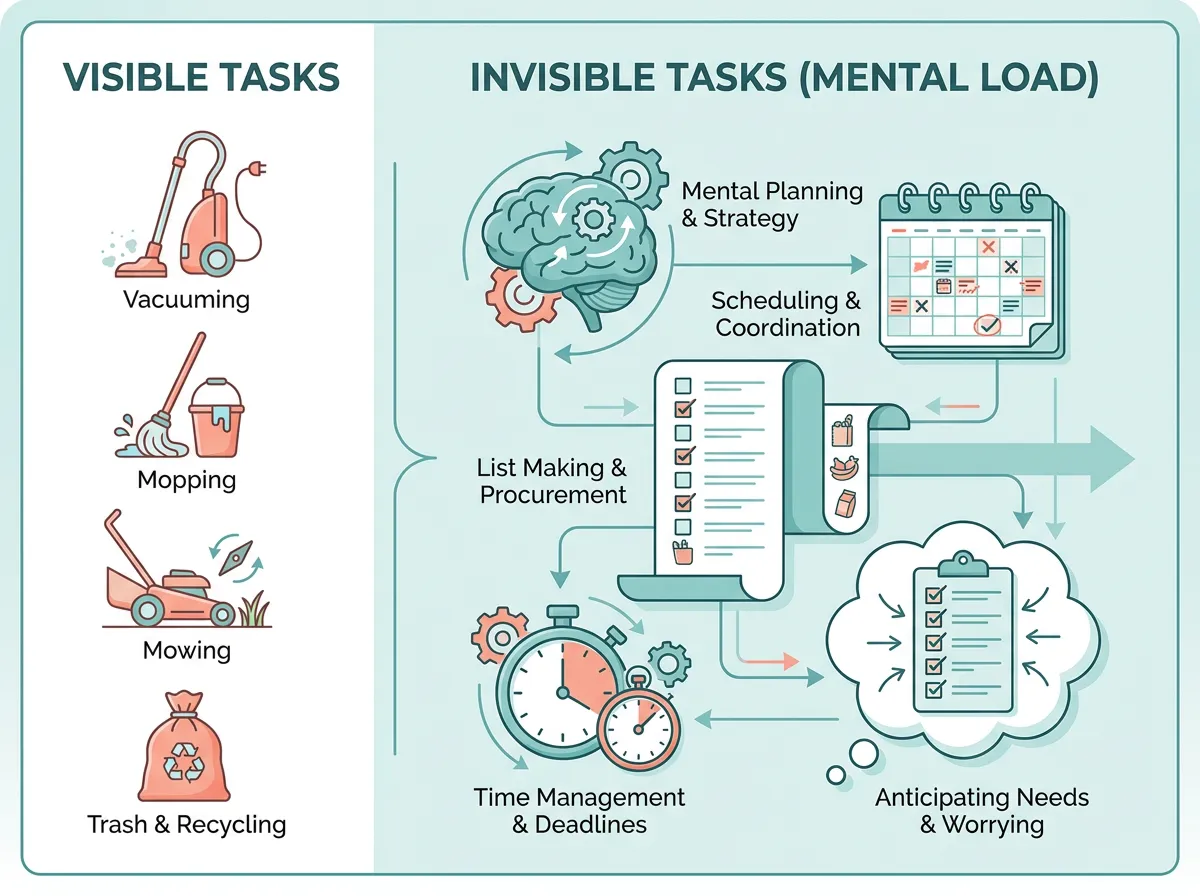
Priya and James have been together for six years. Both work full-time. Priya handles groceries, meal planning, laundry, and most of the cleaning. James mows the lawn, takes out the trash, and handles car maintenance. On paper, James believes things are "pretty even." But Priya's tasks are daily and ongoing, while James's are weekly or seasonal. Priya feels like she's drowning; James genuinely doesn't understand why she's upset.
Neither of them is wrong. But they're operating with completely different definitions of "fair."
The Mental Load: The Invisible Half of Housework
If you've ever heard someone say, "Just tell me what to do and I'll do it," you've witnessed the mental load problem firsthand.
The mental load (sometimes called the "cognitive labor" or "worry work") refers to the invisible task of managing a household: remembering that the kids need new shoes, that the pediatrician appointment is Thursday, that the dog's flea medication is running low, that there's no more dish soap.
Doing a chore is one thing. Knowing the chore needs to be done, deciding when to do it, tracking whether it was done correctly, and remembering to do it again next week—that's the mental load.
Why One Partner Usually Carries More
Studies consistently show that in heterosexual relationships, women bear a disproportionate share of the mental load—even when both partners work equal hours outside the home. A 2019 study published in American Sociological Review found that mothers spend significantly more time on cognitive household labor than fathers, even in dual-income households.
But this isn't exclusively a gender issue. In same-sex couples and in households that defy traditional gender roles, the mental load still tends to fall unevenly—typically on the partner who is more detail-oriented, anxious about disorder, or who simply has a lower threshold for mess.
The result is always the same: one person becomes the household manager, and the other becomes the household helper. The manager resents having to delegate. The helper resents being treated like they can't do anything right.
"Just Ask Me" Is Part of the Problem
When one partner says, "I'm happy to help—just tell me what needs to be done," it sounds cooperative. But it quietly reinforces the power imbalance. It positions one person as the project manager and the other as the employee waiting for instructions.
True equity means both partners independently notice, plan, and execute household tasks without being asked. That's the shift that resolves the housework argument at its root.
What Unequal Chores Actually Do to Your Relationship
Dismissing the housework argument as petty is one of the fastest ways to erode a relationship. Here's what the research shows happens over time when the chore divide stays unequal:
- Resentment replaces affection. The overburdened partner starts keeping a mental scorecard. Every unnoticed task becomes evidence that their partner doesn't care.
- Intimacy drops. Multiple studies—including a widely cited 2016 study from the Journal of Family Issues—have found a direct link between perceived unfairness in housework and lower sexual satisfaction. It's hard to feel desire toward someone who feels like another person you have to clean up after.
- Contempt takes root. In Gottman's framework, contempt is the single strongest predictor of divorce. And contempt often starts with small, repeated instances of feeling disrespected—like being the only one who ever wipes down the stovetop.
- The "nagging" trap emerges. The overburdened partner asks, then reminds, then asks again—and gets labeled a nag. The under-contributing partner withdraws or gets defensive. Both feel misunderstood. The cycle repeats.
Marco and David nearly broke up over recycling. Not literally—but David's refusal to rinse containers before putting them in the bin became a symbol of what Marco saw as carelessness about their shared home. "It wasn't about the yogurt container," Marco explained. "It was that I'd asked a hundred times and he still didn't care enough to remember."
How to Actually Fix the Housework Divide
Acknowledging the problem is step one. But couples don't need more awareness—they need a system. Here's a structured approach that works.
Step 1: Make the Invisible Visible
Sit down together and create a comprehensive task inventory. List every household task you can think of—not just the obvious ones like vacuuming and cooking, but also:
- Scheduling appointments
- Remembering birthdays and buying gifts
- Restocking toiletries and pantry staples
- Managing subscriptions and bills
- Planning meals for the week
- Coordinating childcare or pet care logistics
- Researching purchases (new dishwasher, insurance plans, etc.)
- Tidying shared spaces daily
- Seasonal tasks (gutter cleaning, closet rotation, etc.)
This exercise alone can be revelatory. Many under-contributing partners genuinely don't realize how many tasks their partner handles because those tasks are, by definition, invisible when done well.
Step 2: Assign Based on Skill, Preference, and Capacity—Not Gender
Once you have your list, go through it together. For each task, discuss:
- Who currently does it?
- Who's better at it or minds it less?
- What's a fair way to divide it given each person's work schedule, energy levels, and preferences?
Some couples find it helpful to categorize tasks as "always mine," "always yours," and "rotating." The key is that both partners fully own their assigned tasks—meaning they plan, execute, and follow through without reminders.

Step 3: Write It Down
Verbal agreements about housework are forgotten within a week. Written agreements stick.
Create a shared document, spreadsheet, or use a purpose-built tool. Platforms like Servanda allow couples to formalize household agreements and revisit them when circumstances change—which can help prevent the "but we already talked about this" cycle that makes chore conflicts feel so exhausting.
Whatever format you use, the goal is the same: a clear, mutually agreed-upon record that removes ambiguity.
Step 4: Schedule Regular Check-Ins
A chore agreement isn't a set-it-and-forget-it document. Life changes—work schedules shift, kids enter new phases, health fluctuates. Build in a monthly 15-minute check-in where you both ask:
- Is this still feeling fair?
- Is there anything I've been letting slide?
- Do we need to redistribute anything?
These check-ins prevent resentment from building silently. They also normalize talking about housework as a logistical partnership issue—not an emotional minefield.
Step 5: Retire the Scoreboard
Once you have a system, let go of tracking who "does more" on any given day. Perfect 50/50 is a myth. Some weeks you'll carry 60%, some weeks they will. What matters is that the overall pattern feels fair to both of you over time.
If you find yourself unable to stop counting, that's a sign the system isn't working yet—or that there's a deeper trust issue worth exploring, possibly with a couples therapist.
What to Do When Your Partner Doesn't See the Problem
This is perhaps the most painful version of the housework argument: when you bring up the inequity and your partner genuinely doesn't think it exists.
A few approaches that help:
- Use the task inventory exercise (Step 1 above) as a neutral starting point. Numbers are hard to argue with.
- Lead with impact, not blame. Instead of "You never help," try: "When I handle dinner and cleanup alone every night, I feel exhausted and disconnected from you by bedtime."
- Avoid the "lazy" label. Most under-contributing partners aren't lazy—they have a different threshold for cleanliness, were raised in a household with different standards, or genuinely don't perceive the tasks that need doing. Curiosity works better than accusation.
- Set a time limit on the conversation. Housework talks can spiral. Agree to discuss it for 20 minutes, then take a break and revisit.
What If You're the Under-Contributing Partner?
If you're reading this and realizing you might be on the other side of this equation, here's what matters most:
- Believe your partner. If they say they're overwhelmed, they are. Don't debate their experience.
- Stop waiting to be asked. Start noticing. Walk through the house with fresh eyes. What needs doing? Do it.
- Take full ownership of specific domains. Don't just "help with" dinner—own the entire process from meal planning to grocery shopping to cooking to cleanup, at least a few nights a week.
- Expect an adjustment period. Your partner may not trust the change immediately. That's fair. Consistency over weeks and months rebuilds trust—not a single grand gesture.
FAQ
How do you split chores fairly in a relationship?
Start by listing every household task—including invisible ones like planning and scheduling—then divide based on each person's capacity, skill, and preferences rather than assumptions or gender roles. Write down your agreement and revisit it monthly to make sure it still feels fair to both of you.
Why does my partner not notice chores that need to be done?
Different people have different thresholds for noticing mess and disorder, often shaped by how they grew up. This doesn't mean they don't care—but it does mean they need to actively train themselves to scan for household needs rather than waiting to be told. A shared task list can bridge that perception gap.
Can housework really cause a breakup?
Absolutely. Research consistently links perceived unfairness in the division of household labor to lower relationship satisfaction, reduced intimacy, and higher rates of divorce. It's rarely the chores themselves—it's the resentment, feeling unvalued, and eroded trust that build up over months and years of inequity.
How do I talk to my partner about chores without starting a fight?
Choose a calm moment—not when you're mid-frustration—and frame the conversation around your shared goal of a happier home. Focus on how the current arrangement makes you feel rather than cataloging their failures. Using a structured exercise like a task inventory keeps the conversation productive rather than personal.
Is a 50/50 chore split realistic?
A perfect 50/50 split on any given day isn't realistic and shouldn't be the goal. What matters is that the overall pattern feels equitable to both partners over time, and that both people independently own their responsibilities without one person having to manage the whole system.
Conclusion
The housework argument persists in so many relationships because it touches something far deeper than dishes and laundry. It's about whether both partners feel respected, valued, and truly seen in their own home.
The good news: this is one of the most fixable conflicts couples face. Not because it's simple, but because the solution is concrete. You can list tasks. You can divide them. You can write agreements down and check in regularly. You can build a system that removes ambiguity and reduces resentment.
The couples who thrive aren't the ones who never argue about chores. They're the ones who treat their household as a shared project—one that requires ongoing negotiation, mutual respect, and the willingness to adjust when something isn't working.
Start the conversation tonight. Not with frustration, but with a shared document and an honest question: Is this working for both of us?