Intimacy Arguments: What You're Really Fighting About
It starts with a sigh. Maybe a turned back in bed. Maybe a comment that sounds casual but lands like a grenade: "We never do anything anymore." The other person stiffens. "That's not true. We just did last weekend." And suddenly you're keeping score—tallying dates, counting encounters, defending yourself against an accusation that was never really about the numbers.
Intimacy arguments are among the most common—and most misunderstood—conflicts couples face. Research consistently ranks disagreements about physical intimacy in the top five sources of relationship tension. But here's what most couples miss in the heat of the moment: the argument about how often is almost never actually about how often. It's about something deeper, something harder to say out loud.
Why Intimacy Arguments Feel So Explosive
Most couples can navigate disagreements about dishes, schedules, or even finances without the conversation spiraling. But bring up intimacy and the temperature in the room changes instantly. Why?
Because intimacy is where we are most exposed. It's the domain where rejection doesn't just sting—it cuts into our sense of self. When your partner says "not tonight," the rational part of your brain might understand. But the emotional part hears something far more devastating: You don't want me. I'm not enough.
And on the other side, when your partner pressures you or expresses frustration about your sex life, you don't hear concern—you hear criticism. I'm failing. My body isn't cooperating. I'm broken.
This is why intimacy arguments escalate so quickly. You're not fighting about logistics. You're fighting about identity, worthiness, and belonging. The stakes feel existential because, emotionally, they are.
The Surface Complaint vs. The Deeper Need
Let's break down what common intimacy complaints often really mean:
| What's Said |
What's Often Felt |
| "We never have sex anymore." |
"I don't feel desired by you. I'm scared we're becoming roommates." |
| "You only want one thing." |
"I want to feel valued for more than my body. I need emotional safety first." |
| "You never initiate." |
"I need to know you want me—not just that you'll go along with it." |
| "I'm just not in the mood." |
"I'm exhausted/stressed/disconnected and I don't know how to explain that without hurting you." |
| "It feels like a chore to you." |
"I can tell you're not present, and that makes me feel lonelier than not being intimate at all." |
Neither person is wrong. Both are in pain. The problem isn't that you disagree—it's that you're having two entirely different conversations without realizing it.
The Pursuer-Withdrawer Trap
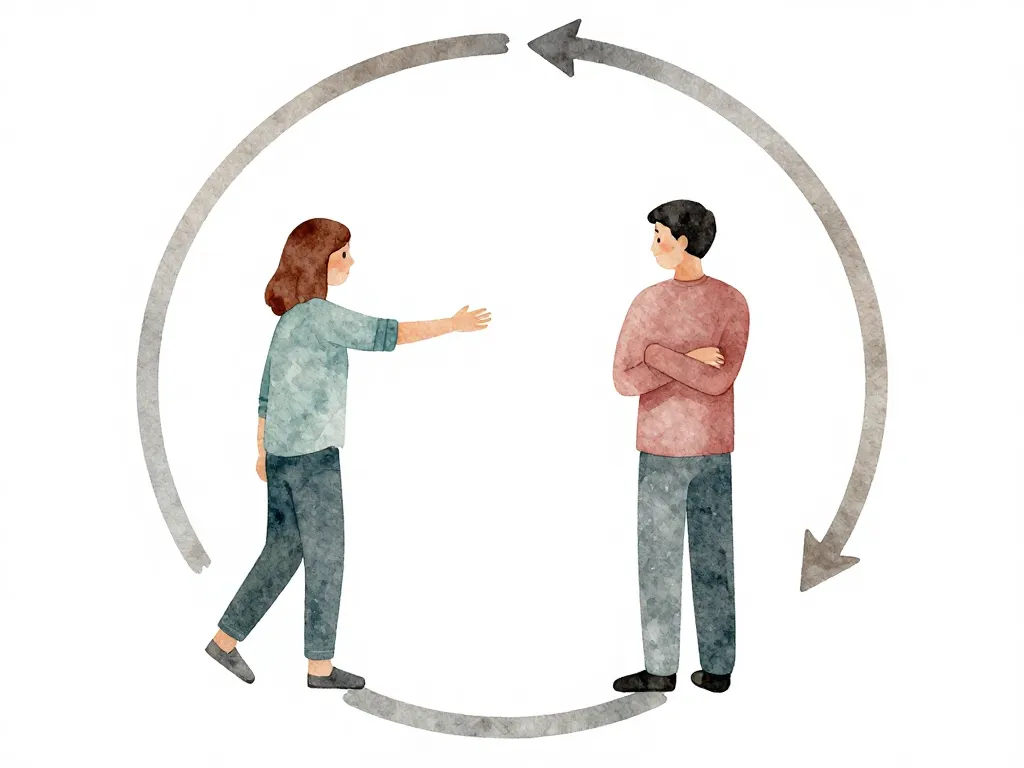
Relationship researchers, including Dr. Sue Johnson (the developer of Emotionally Focused Therapy), have identified a pattern that shows up in the vast majority of intimacy conflicts: the pursuer-withdrawer cycle.
Here's how it works:
- Partner A feels disconnected and reaches out—sometimes through direct requests for sex, sometimes through complaint or criticism.
- Partner B feels pressured or inadequate and pulls away—emotionally, physically, or both.
- Partner A interprets the withdrawal as rejection and pursues harder.
- Partner B feels more overwhelmed and retreats further.
- Both partners end up alone, hurt, and convinced the other person doesn't care.
The cruel irony is that both people want the same thing: closeness, safety, and the feeling that they matter to each other. But their strategies for getting there are in direct opposition.
A Real-World Example
Consider a couple we'll call Maya and Jordan. They'd been together for seven years. Maya often brought up their declining sex life, usually after a long week when she felt particularly disconnected. Jordan would shut down, saying, "I can't just flip a switch."
On the surface, this looked like a mismatch in desire. But in a deeper conversation, here's what emerged:
- Maya wasn't primarily asking for more sex. She was asking for evidence that Jordan still found her attractive. After gaining weight during a difficult pregnancy, she carried deep insecurity about her body. Physical intimacy was her primary way of feeling reassured.
- Jordan wasn't uninterested. He was dealing with work-related anxiety that had tanked his libido, and he felt ashamed about it. Every time Maya brought it up, he heard confirmation that he was failing as a partner.
Neither was the villain. Both were hurting. The argument about frequency was a proxy war for much deeper fears—fears they hadn't found the language to share.
How to Decode Your Own Intimacy Arguments
The next time you find yourselves in this familiar conflict, try these steps before the conversation escalates.
Step 1: Pause and Ask, "What Am I Actually Feeling?"
Before you speak, check in with yourself. Underneath the frustration, what's there?
- Loneliness?
- Rejection?
- Fear that the relationship is fading?
- Shame about your body or desire?
- Exhaustion that has nothing to do with your partner?
Name the emotion, not the complaint. "I've been feeling disconnected from you and it scares me" is a vulnerability. "We never have sex" is an accusation. They might come from the same place, but they land in completely different ways.
Step 2: Share the Need, Not the Critique
Reframe your statement as a bid for connection rather than a critique of your partner's behavior.
Instead of: "You never touch me anymore."
Try: "I miss being physically close to you. It makes me feel safe and loved."
Instead of: "You always pressure me."
Try: "I want to want that closeness too, but I need to feel emotionally connected first. Can we talk about what's getting in the way?"
This isn't about scripting perfect sentences. It's about leading with what you need rather than what your partner is doing wrong.
Step 3: Listen for the Bid Behind Your Partner's Words
When your partner brings up intimacy—even clumsily, even with an edge—try to hear the vulnerable request underneath. Ask yourself: What are they really asking for? What are they afraid of?
This doesn't mean you have to agree, comply, or suppress your own feelings. It means you respond to the fear rather than the frustration.
Example response: "I hear you, and I don't want you to feel unwanted. That's not what's happening for me. Can I tell you what is going on?"
Rebuilding the Bridge: Practical Steps
Once you've identified the real issue—disconnection, not frequency—you can start addressing it directly.
Prioritize Non-Sexual Touch
Physical intimacy exists on a spectrum. When the sexual dimension feels fraught, rebuilding through non-sexual physical connection takes the pressure off while still meeting the need for closeness:
- Hold hands during a walk
- Sit close on the couch, legs touching
- Give a long hug (research suggests 20 seconds or more triggers oxytocin release)
- Touch your partner's shoulder when you walk past them
- Kiss goodbye like you mean it—not a peck on autopilot
These small gestures communicate I see you, I want you near me, you matter—which is the message both partners are usually starving for.
Create a "Desire Ritual" That Isn't About Sex
Many couples wait for desire to magically appear. It rarely does, especially after years together. Instead, create deliberate moments of attention and attraction:
- Leave a note that says something specific: "You looked incredible this morning" rather than a generic "I love you"
- Flirt via text during the workday—not as a prelude to sex, but as an expression of ongoing interest
- Make eye contact during dinner. Actually look at each other.
- Share a memory of a time you were particularly attracted to them
The goal is to feed the emotional ecosystem that physical intimacy grows in.

This is the conversation about your pattern, not about the content of any single argument. Sit down during a calm moment—not in bed, not after a rejection—and name the cycle together.
Try something like:
"I've noticed that when I bring up our physical relationship, you tend to shut down, and then I push harder, and we both end up hurt. I don't think either of us wants that. Can we figure out a different way to talk about this?"
This moves you from opponents to collaborators. You're no longer fighting each other—you're fighting the pattern.
For couples who find these conversations consistently derailing, AI-powered mediation tools like Servanda can provide structured frameworks to keep the discussion productive and help you formalize agreements about how you'll handle these moments differently going forward.
Address the External Factors Honestly
Sometimes the intimacy gap has concrete contributors that need to be acknowledged without shame:
- Stress and workload: Mental load is a libido killer. If one partner is drowning in responsibilities, desire isn't the first casualty—it's the predictable one.
- Health and medication: Antidepressants, hormonal changes, chronic pain, and postpartum recovery all affect desire. This isn't a failure—it's biology.
- Unresolved resentment: If there's an unaddressed conflict simmering in the background, the body often refuses intimacy before the mind does. You can't bypass emotional repair.
- Body image and self-worth: It's hard to be sexually open when you feel uncomfortable in your own skin.
Naming these factors out loud—together—removes the toxic interpretation that someone just "doesn't care enough."
What If the Mismatch Is Real?
Sometimes, after all the emotional unpacking, there is a genuine difference in desire. One partner wants more physical intimacy than the other, and it's not just about disconnection—it's about different baselines.
This is okay. It doesn't mean you're incompatible. It means you need to negotiate honestly, which requires:
- Both partners acknowledging the mismatch without blame. It's not that the higher-desire partner is "too needy" or the lower-desire partner is "withholding." You're just different.
- Finding a middle ground that doesn't leave either person feeling sacrificed. This might mean exploring different forms of physical closeness, adjusting expectations, or finding creative compromises.
- Checking in regularly. Desire fluctuates over a lifetime. What's true now won't be true forever. Build a habit of revisiting the conversation with curiosity rather than dread.
The couples who thrive aren't the ones with perfectly matched libidos. They're the ones who've made it safe to talk about the mismatch without anyone feeling defective.
FAQ
Is it normal to argue about intimacy in a relationship?
Absolutely. Intimacy disagreements are one of the most common sources of conflict in long-term relationships. They don't indicate that something is fundamentally broken—they usually signal that one or both partners have unmet emotional needs that haven't been fully articulated yet.
How do I bring up intimacy issues without starting a fight?
Timing and framing matter enormously. Choose a calm, neutral moment—not right after a rejection or in bed. Lead with your feelings and needs ("I miss feeling close to you") rather than a complaint about your partner's behavior ("You never want to be intimate"). This invites dialogue instead of defensiveness.
What if my partner refuses to talk about our intimacy problems?
A refusal to talk is often a sign of shame, overwhelm, or fear of conflict—not indifference. Try acknowledging the discomfort directly: "I know this is hard to talk about, and I don't want you to feel judged. I just want us to figure this out together." If the avoidance persists, couples therapy with a professional trained in intimacy issues can provide a safer space for both of you.
Can a relationship survive mismatched sex drives?
Yes—many thriving relationships include partners with different levels of desire. What matters isn't the mismatch itself but how you navigate it. Couples who approach the difference with empathy, flexibility, and ongoing communication tend to find solutions that honor both partners' needs.
How do I know if our intimacy issues are about something deeper?
If the same argument keeps repeating despite attempts to resolve it, that's a strong signal that the surface issue isn't the real issue. Pay attention to the emotions that arise during the conflict—if you feel rejected, undesired, or fundamentally inadequate, the argument is likely about emotional connection and security, not about sex itself.
Moving Forward Together
Intimacy arguments are painful precisely because they touch the most tender parts of who we are. But they're also opportunities—signals that someone in the relationship is reaching for connection, even if the reach looks like a complaint or a withdrawal.
The next time you find yourselves in this familiar loop, pause. Look past the words to the person in front of you—someone who, like you, wants to feel chosen, wanted, and safe. That recognition alone won't resolve everything, but it changes the entire foundation of the conversation.
You don't need to have identical desires. You don't need to perform closeness you don't feel. You need to be honest about what's really going on, brave enough to name it, and willing to hear the same honesty from the person you love. The argument about intimacy is, at its core, an argument about belonging. And that's something you can work on together.