
Money Fights in Relationships: It's Not About the Budget
It's 9:47 p.m. on a Tuesday. One partner opens the credit card statement and sees a $280 charge at a home goods store. The other partner sees nothing wrong — the old rug was embarrassing, and the new one was on sale. Within three minutes, they're not talking about a rug anymore. They're talking about who works harder, who sacrifices more, and whether anyone in this house even cares about the future.
Sound familiar? Money fights in relationships are the number-one recurring argument for couples across income levels, according to research from Kansas State University. And most couples try to solve them with spreadsheets, budgeting apps, or silent resentment. None of it sticks — because the real conflict was never about the line items.
The real conflict lives in the invisible money stories each of you carried into the relationship long before you shared a bank account. This article will help you identify those stories, understand why they clash, and start having a fundamentally different kind of financial conversation.
Key Takeaways
- Money fights in relationships are rarely about the purchase itself. They're clashes between deeply held beliefs about what money means — safety, freedom, status, love — formed in childhood.
- Each partner carries "money scripts": unconscious rules about earning, spending, and saving inherited from family, culture, and early life experiences.
- Identifying your money scripts out loud is the single most productive thing you can do before creating any budget together.
- A shared financial plan only works after shared understanding. Skipping the story step is why most budgets fail couples within weeks.
- You don't need to agree on everything. You need to understand why your partner's instinct differs from yours and build agreements that honor both scripts.
Why the Same Money Argument Keeps Coming Back
If you've ever resolved a money disagreement on Sunday and found yourself in the exact same argument by Friday, you're not failing at communication. You're solving the wrong problem.
Most couples treat financial conflict like a math problem: if we just agree on the numbers, the fighting will stop. So they sit down, divide expenses, set limits, and feel briefly hopeful. Then one person buys lunch out three days in a row, or the other quietly transfers money into a savings account the partner didn't know about, and the whole system collapses — not because the math was wrong, but because the meaning underneath was never addressed.

Here's what's actually happening in most money fights in relationships:
- Partner A grew up in a household where money was scarce and unpredictable. Saving feels like survival. Spending without a clear plan triggers genuine anxiety — not preference, anxiety.
- Partner B grew up watching a parent work themselves into exhaustion and never enjoy the money they earned. Spending on something beautiful or fun feels like honoring life. Being told they "can't" spend triggers a sense of being controlled.
Neither person is wrong. Neither person is irresponsible or uptight. They're operating from two completely different emotional operating systems — and neither system is visible to the other.
What Are Money Scripts (and Why Do They Run Your Relationship)?
The term "money scripts" was coined by financial psychologists Dr. Brad Klontz and Dr. Ted Klontz. Money scripts are unconscious beliefs about money that are typically formed in childhood, reinforced through repetition, and carried unexamined into adult life.
They fall into four broad categories:
1. Money Avoidance
Core belief: Money is bad, or rich people are greedy. Behavioral pattern: Ignoring bank statements, under-earning, giving money away compulsively, feeling guilty about having more than others. Origin example: Growing up hearing "money is the root of all evil" or watching a parent resent wealthier neighbors.
2. Money Worship
Core belief: More money will solve everything. Happiness is on the other side of the next raise. Behavioral pattern: Overspending, compulsive buying, workaholism, believing financial success equals personal worth. Origin example: Growing up in a household where a financial windfall temporarily solved a crisis, or where love was expressed through gifts.
3. Money Status
Core belief: Net worth equals self-worth. What you own signals who you are. Behavioral pattern: Keeping up appearances, competitive spending, hiding debt, measuring self against peers. Origin example: Growing up where social standing was tied to visible wealth, or where financial setbacks were treated as shameful.
4. Money Vigilance
Core belief: You must always be watchful and prepared. Financial relaxation is dangerous. Behavioral pattern: Excessive saving, difficulty enjoying purchases, secrecy about finances, anxiety about spending even when well-funded. Origin example: Growing up during or after a family financial crisis, or with a parent who constantly warned about impending disaster.
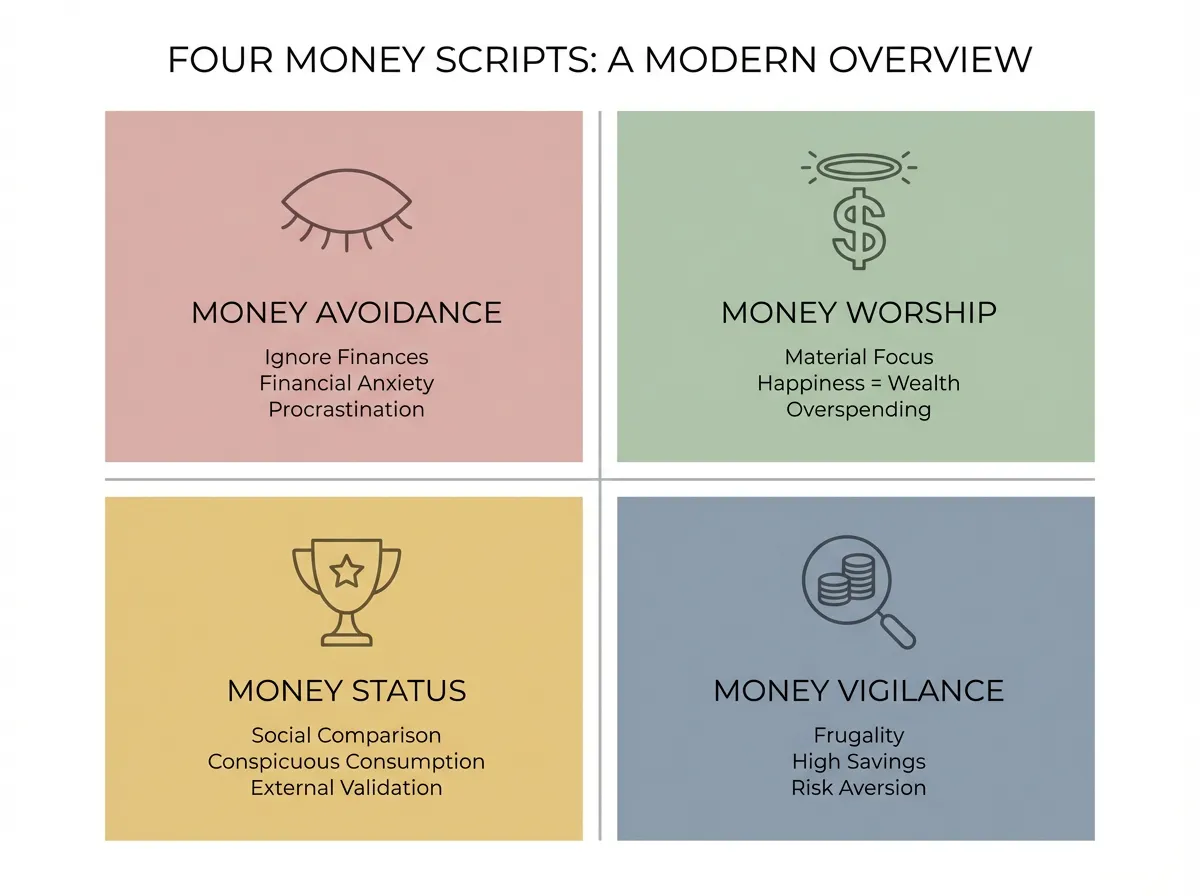
Most people carry a blend of two or three scripts. The friction in your relationship isn't that your partner is "bad with money." It's that your money scripts are colliding — and you're each hearing the other's behavior as a rejection of your deepest beliefs about safety and worth.
That's why it hurts so much. That's why it escalates so fast.
How to Identify Your Own Money Scripts
Before you can have a productive money conversation with your partner, you need to understand your own story first. This isn't navel-gazing. It's the necessary step that makes every future financial discussion less explosive.
Try this exercise alone, before discussing with your partner:
Step 1: Recall Your Earliest Money Memory
Close your eyes and think back to the first time you remember money mattering. Maybe it was overhearing your parents argue about bills. Maybe it was the thrill of your first allowance. Maybe it was the shame of not being able to afford something other kids had.
Write it down in two or three sentences. Don't analyze it yet.
Step 2: List the "Rules" You Absorbed
Complete these sentences quickly, without overthinking:
- Money is ___.
- People who spend freely are ___.
- People who save obsessively are ___.
- If I have enough money, I'll feel ___.
- Talking about money is ___.
- My family's unspoken rule about money was ___.
Step 3: Notice Your Emotional Triggers
Think about the last three money-related tensions with your partner. For each one, write:
- What happened (the event).
- What I felt (the emotion — not what I thought, what I felt in my body).
- What I made it mean (the story I told myself about what my partner's behavior said about them, or about us).
This third column is where your money script lives. "She doesn't care about our future" is a script talking. "He thinks I'm not allowed to enjoy anything" is a script talking.
How to Talk About Money Scripts as a Couple
Once both partners have done the individual work above, you're ready for a different kind of financial conversation. Not a budget meeting — a story-sharing session.
Here's a structure that works:
Ground Rules
- No interrupting. Each person gets uninterrupted time to share.
- No defending. When your partner describes their money story, your only job is to listen and understand.
- No fixing. This conversation is not about solutions. It's about seeing each other clearly.
- Use "I learned" language. Instead of "You always..." or "The right way to...," say "I learned that money meant..." or "In my family, the rule was..."
The Conversation Format
Take turns answering these three prompts:
- "Here's what money meant in my family growing up." Share the memories, the rules, the emotions. Paint the picture.
- "Here's what I think my money scripts are." Name them honestly. "I'm a money vigilant person. I feel physically anxious when we spend without a plan."
- "Here's what I need you to understand about why I react the way I do." This is the vulnerability piece. Not a demand — a request to be seen.
Most couples report that this single conversation — which often takes 45 minutes to an hour — changes the tenor of every financial discussion that follows. Not because the disagreements disappear, but because the interpretation of each other's behavior shifts.
Your partner wasn't hiding that purchase to deceive you. They were following a money worship script that says joy shouldn't require permission. You weren't being controlling when you questioned the expense. Your money vigilance script was sounding a survival alarm.

Building Financial Agreements That Actually Last
Once you've shared your money stories, then you're ready to talk about the practical stuff — and it will go differently this time. Here's how to build agreements that respect both scripts:
1. Name the Script Before the Spreadsheet
Before any budget discussion, spend two minutes naming which scripts are in the room. "Okay, my vigilance is going to flare up when we talk about the vacation fund. Just so you know, that's my stuff, not a judgment on you." This tiny act of self-awareness prevents roughly 80% of escalation.
2. Create "No-Judgment" Personal Spending Zones
Each partner gets a set amount of monthly discretionary money that requires zero explanation or justification. This honors the money worship or money status partner's need for autonomy, while the money vigilant partner gets the reassurance of a defined boundary. The amount doesn't need to be large — it needs to be agreed upon and truly judgment-free.
3. Set Financial Check-Ins That Aren't Ambushes
Schedule a brief monthly money conversation — 20 minutes, same day each month, with a simple agenda:
- What worked this month?
- What felt stressful, and which script was behind it?
- Is there anything we need to adjust?
This rhythm prevents the pressure-cooker effect of waiting until something goes wrong.
4. Write It Down
Verbal agreements are fragile, especially under emotional stress. When you reach a financial understanding — how much goes to savings, what counts as a "big purchase" that warrants discussion, how you'll handle unexpected expenses — write it down in clear, specific terms. Tools like Servanda can help couples create written agreements that prevent future conflicts by giving your decisions a concrete, shareable reference point.
5. Revisit and Revise Without Blame
Financial agreements aren't permanent. Life changes — new jobs, children, unexpected expenses, shifting priorities. Build in a quarterly "revision" conversation where either partner can propose changes without it signaling that the original plan failed. It didn't fail. It served its season.
When Money Fights Signal Something Deeper
Sometimes financial conflict is the surface expression of a larger relationship dynamic. Watch for these patterns:
- Power imbalance: One partner earns significantly more and uses that as leverage in decisions. The money fight is actually about equality and respect.
- Trust rupture: A partner hid debt or a major purchase. The money fight is actually about honesty and safety.
- Enmeshment with family of origin: A partner sends money to their parents or siblings without discussion. The money fight is actually about loyalty and boundaries.
- Different life visions: One partner wants to retire early; the other wants to live fully now. The money fight is actually about how you define a meaningful life.
If your money fights consistently feel like they're about more than money, that's because they are. You may benefit from working with a couples therapist — particularly one trained in financial therapy — to untangle the deeper threads.
FAQ
Why do my partner and I keep fighting about money even when we make enough?
Income level has surprisingly little to do with the frequency of money fights in relationships. Research shows high-earning couples argue about finances just as often as those with tighter budgets. The conflict stems from meaning, not math — different beliefs about what money is for, shaped by childhood experiences and family patterns.
How do I bring up money scripts without my partner getting defensive?
Start with your own story, not theirs. Say something like, "I've been thinking about why I react so strongly when we talk about spending, and I realized it goes back to how I grew up. Can I share that with you?" Leading with your own vulnerability makes it an invitation, not an accusation. Most partners will naturally reciprocate.
Is it better for couples to combine finances or keep them separate?
There's no universally right answer — it depends on what each partner's money scripts need. Some couples thrive with a hybrid model: a shared account for joint expenses and individual accounts for personal spending. The structure matters less than the process of choosing it together, transparently, after understanding each other's financial history.
Can a couples therapist really help with money arguments?
Yes, especially one trained in financial therapy. A skilled therapist can help you identify the emotional patterns underneath your financial disagreements, facilitate the vulnerable conversations that are hard to have alone, and teach you a framework for navigating future financial decisions as a team rather than as opponents.
What's the first thing we should do tonight to stop arguing about money?
Each of you, independently, complete the "earliest money memory" exercise described above. Write down your first significant memory involving money, the unspoken rules your family had, and how those show up in your behavior today. Then share with each other over a low-pressure setting — a walk, a quiet evening — with the sole goal of understanding, not solving.
Conclusion
Money fights in relationships are painful not because your partner is wrong, but because they're operating from a completely different financial origin story — and so are you. The rug purchase, the savings transfer, the credit card statement at 9:47 p.m. — these are surface events. Beneath them are two people trying to feel safe, free, worthy, or in control, using the only money logic they've ever known.
The way forward isn't a better spreadsheet. It's a better understanding of the person sitting across from you — and of yourself. Start with your own money scripts. Share them honestly. Listen to your partner's without judgment. Then build your financial agreements on the foundation of that mutual understanding.
The couples who stop fighting about money aren't the ones who finally agree on every number. They're the ones who finally understand why the numbers feel so loaded — and choose compassion over correction.