
How to Split Chores Without Starting a Fight
It's 9 PM on a Tuesday. The dishes are piled in the sink, the laundry basket is overflowing, and the trash should have gone out this morning. One of you sighs — loudly enough to be heard. The other one bristles. What follows isn't really about the dishes. It's about who noticed them, who always notices them, and who never seems to notice anything at all.
If this sounds familiar, you're far from alone. Research consistently ranks housework among the top five issues couples argue about, right alongside money and intimacy. And the reason these fights keep happening is surprisingly simple: most couples have never sat down and built an explicit, agreed-upon system for splitting chores. Instead, they rely on assumptions, unspoken expectations, and the hope that the other person will "just see" what needs to be done. That approach almost always fails.
This article gives you a concrete framework — not vague advice — to split chores without starting a fight and finally stop the cycle of resentment.
Key Takeaways
- Make the invisible visible. Write down every single household task — including the "invisible" mental labor like scheduling and restocking — so nothing is overlooked or undervalued.
- Negotiate based on preferences and capacity, not 50/50 task counts. Fairness doesn't mean identical workloads; it means both partners feel the arrangement is equitable.
- Create a living agreement, not a one-time conversation. Build in regular, low-stakes check-ins (monthly works well) to adjust the system before resentment builds.
- Separate the standard from the person. Agree on a "good enough" standard for each task so one partner doesn't redo the other's work.
- Treat this as a team project, not a scorekeeping exercise. The goal is a household that runs smoothly, not a ledger of who did more.
Why Couples Fight About Chores (It's Not Really About the Dishes)
Before diving into the how-to, it helps to understand why housework arguments feel so loaded. On the surface, you're debating who should vacuum. Underneath, the argument is usually about three deeper issues:

1. Feeling Unseen
When one partner consistently handles tasks that the other doesn't notice — meal planning, remembering to buy toilet paper, scheduling the vet appointment — they start to feel invisible. The work itself may not be hard, but performing it without acknowledgment is exhausting.
2. Fairness and Respect
An unequal division of housework sends a message, whether intentional or not: My time matters more than yours. Over months and years, that message erodes respect and breeds resentment that spills into every other part of the relationship.
3. Different Standards
One person sees a clean counter; the other sees crumbs. These differing standards create a trap: the partner with higher standards ends up doing more, then resents it. The partner with lower standards feels criticized for never doing things "right."
Understanding these dynamics doesn't solve the problem, but it reframes the conversation. You're not fighting about chores. You're fighting about feeling valued. And that's worth solving well.
Step 1: The Full Task Audit — Make the Invisible Visible
The single most productive thing you can do to split chores without fighting is to write everything down. Everything. Not just the obvious tasks like cooking and cleaning, but the invisible labor that keeps a household running.
Set aside 30 minutes together (not during an argument) and create a master list. Here's a framework to make sure you don't miss anything:
Daily Tasks - Cooking meals - Doing dishes / loading the dishwasher - Wiping down kitchen surfaces - Tidying common spaces - Managing pet care (feeding, walks)
Weekly Tasks - Grocery shopping - Laundry (washing, folding, putting away) - Vacuuming / mopping floors - Cleaning bathrooms - Taking out trash and recycling - Changing bed linens
Monthly / Seasonal Tasks - Deep cleaning (oven, fridge, windows) - Yard work or balcony maintenance - Car maintenance - Organizing closets / storage
Invisible / Mental Labor - Meal planning and keeping a grocery list - Scheduling appointments (medical, dental, vet) - Managing bills and subscriptions - Remembering birthdays and buying gifts - Researching and booking travel - Restocking household supplies - Coordinating childcare, school events, and activities - Tracking what needs to be repaired
This last category — mental labor — is where most couples discover a massive imbalance they've never named. Just seeing it on paper can be a revelation.
Tip: Do this exercise separately first, then compare lists. You'll likely discover tasks the other person didn't even know were happening.
Step 2: Negotiate Based on Preference, Capacity, and Fairness
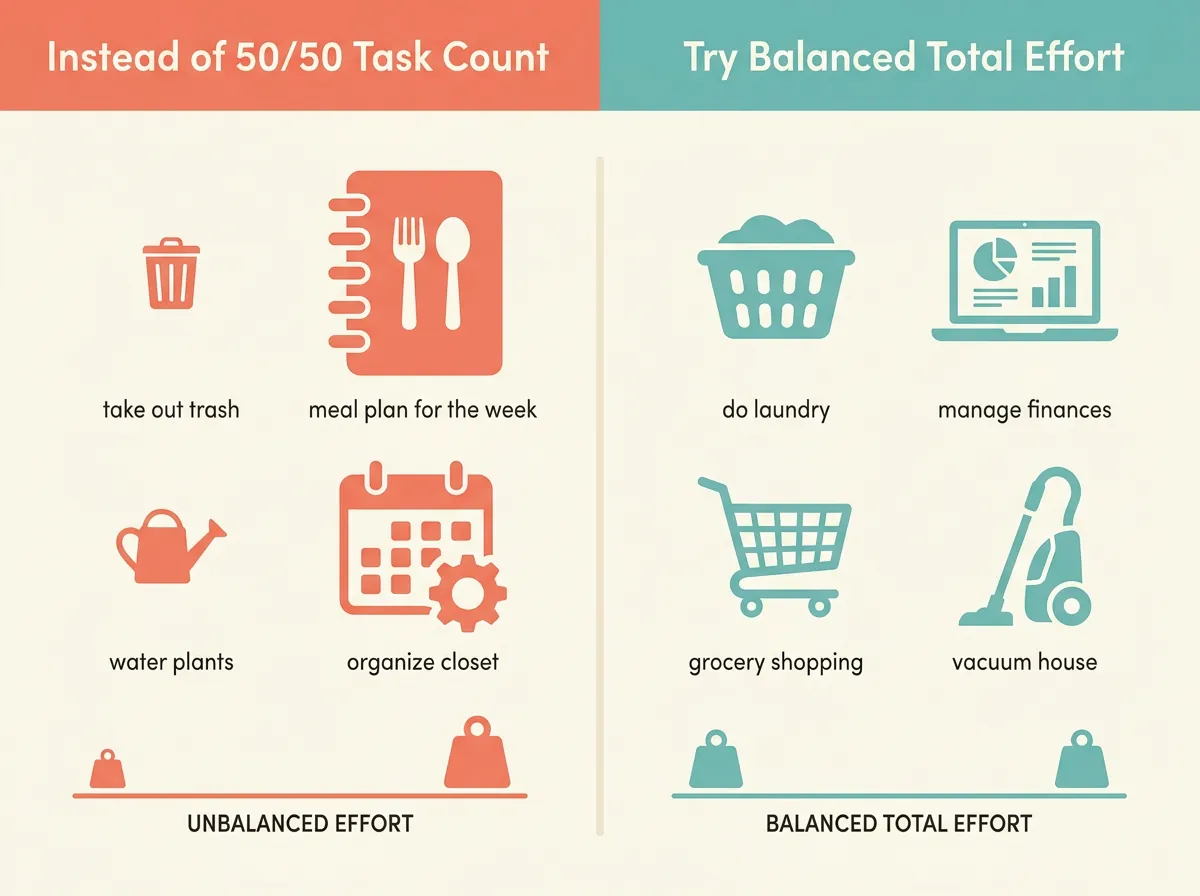
Now that you have your master list, resist the urge to simply split it down the middle. A 50/50 task count doesn't equal a fair division. A task that takes five minutes isn't the same as one that takes an hour. A task you enjoy doing doesn't carry the same weight as one you dread.
Here's a smarter approach:
Rate Each Task
Go through the list together and have each partner rate each task on two scales:
- How much do you mind doing this? (1 = don't mind at all, 5 = strongly dislike)
- How long does this actually take? (Estimate in minutes per week)
Assign Based on Overlap
Start with the easy wins: - If one partner doesn't mind a task and the other hates it, the assignment is obvious. - If both partners dislike a task equally, alternate it or find a way to make it less painful (e.g., listening to a podcast while folding laundry). - If both enjoy a task, consider trading off so neither person loses something they like.
Balance Total Effort, Not Task Count
Add up the estimated time each partner is spending. The goal isn't identical minutes — one partner might work longer hours outside the home, have a health condition, or be handling more childcare. The goal is that both partners look at the arrangement and genuinely say, "This feels fair to me."
This is also where you might consider formalizing what you've agreed upon. Tools like Servanda can help couples create written agreements that prevent future conflicts — turning a verbal understanding into something you can both reference later, which removes the "I thought we agreed..." arguments.
Account for Context Changes
Fairness isn't static. If one partner's work schedule changes, if someone gets sick, or if a baby arrives, the whole arrangement needs to flex. Build this expectation in from the start so renegotiating doesn't feel like a confrontation.
Step 3: Agree on Standards Before They Become Arguments
This step is the one most couples skip — and it's the one that prevents the most fights.
When you assign a task to someone, you also need to agree on what "done" looks like. Otherwise, one partner will inevitably redo the other's work, which communicates: You can't do anything right. Few things kill motivation faster.
Have a brief conversation about each major task:
- "Clean the kitchen" — Does that mean wiping the counters, or does it include cleaning the stovetop and sweeping the floor?
- "Do the laundry" — Does that mean washed and dried, or washed, dried, folded, and put away?
- "Grocery shopping" — Does one person make the list, or does the shopper also handle meal planning?
The key principle: the person doing the task gets to do it their way, as long as it meets the agreed standard. If your partner loads the dishwasher differently than you would, and the dishes come out clean, that's good enough. Let it go.
A couple we'll call Priya and Daniel fought about cleaning for years. Priya felt Daniel's version of "cleaning the bathroom" was superficial. Daniel felt that no matter what he did, Priya would redo it. The breakthrough came when they defined a specific checklist: wipe the mirror, scrub the toilet, clean the sink, mop the floor. Daniel followed the checklist; Priya stopped re-cleaning. The arguments stopped.
Step 4: Build a System, Not a Scoreboard
Once you've negotiated the division and agreed on standards, you need a lightweight system to keep it running. The operative word is lightweight — this shouldn't feel like project management.
Here are a few approaches that work for different couples:
The Shared Checklist
Use a shared note (Google Keep, Apple Notes, or a whiteboard on the fridge) with recurring tasks. Each person checks off their items. No nagging required — the list does the reminding.
The "Anchor Day" Method
Pick one day a week where both partners do a focused block of chores together — say, Saturday morning for 90 minutes. Handle the weekly tasks side by side, then enjoy the rest of the weekend in a clean home. This works well for couples who both hate doing chores alone.
The Ownership Model
Each partner fully owns certain domains. One person owns the kitchen (cooking, dishes, groceries). The other owns laundry and bathrooms. Ownership means you don't wait to be asked, you don't need to coordinate — it's simply yours.

The best system is the one you'll actually use. Try one for a month, then evaluate.
Step 5: The Monthly Check-In (Your Secret Weapon)
No chore system survives forever without maintenance. Schedules change, seasons shift, and small annoyances accumulate if they're not aired out.
Set a recurring monthly check-in — 15 minutes, max — where you ask each other three questions:
- What's working well in our current arrangement?
- Is anything feeling unfair or unsustainable?
- Do we need to adjust anything for the coming month?
The magic of a scheduled check-in is that it gives frustrations a designated place to land. Instead of bringing up the dishwasher in the middle of dinner (when emotions are already elevated), you know that Sunday evening is the time to raise it calmly.
Keep the tone collaborative. This isn't a performance review. It's two people maintaining a system they built together.
Common Pitfalls to Avoid
Even with a good system, certain habits can sabotage your progress:
- Scorekeeping in real time. If you're mentally tallying who did what during the week, you're competing, not collaborating. Trust the system and address imbalances at the check-in.
- Weaponizing chores. "I did the dishes, so you owe me" turns household tasks into a transactional currency. Your home isn't a marketplace.
- Gatekeeping. If you assign a task but then criticize how it's done, you're effectively taking it back. Either accept their method or renegotiate the standard.
- Using "always" and "never." "You never take out the trash" may feel true but invites defensiveness. Be specific: "The trash didn't go out on Monday or Thursday this week. Can we figure out a reminder?"
- Waiting until you're furious to bring it up. Resentment compounds silently. The monthly check-in exists precisely to prevent this.
What If You've Already Built Up Resentment?
If you're reading this after months or years of unequal housework, the system above still works — but you may need to address the existing resentment first.
Acknowledge it directly: "I realize we've been operating without a system, and I think that's led to frustration on both sides. I'd like us to start fresh with something that feels fair to both of us."
This isn't about blame. It's about recognizing that the old approach wasn't working and choosing to build something better. If the conversation itself feels too charged, a neutral third party — a therapist, mediator, or even a structured AI-guided framework — can help you navigate it without escalation.
Frequently Asked Questions
Is splitting chores 50/50 actually fair?
Not necessarily. A 50/50 task split ignores differences in task difficulty, time required, and each partner's overall workload (including paid work, childcare, and mental labor). What matters is that both partners perceive the arrangement as equitable. Focus on balancing total effort and ensuring both people feel respected.
How do you bring up unfair chore division without sounding like you're nagging?
Timing and framing matter more than the words. Choose a calm, neutral moment — not when you're standing over a pile of dirty laundry. Frame it as a team problem: "I think we could use a better system for housework. Can we sit down this weekend and figure something out together?" This positions you as partners solving a shared challenge, not adversaries.
What if my partner agrees to do chores but never follows through?
First, make sure the system includes concrete cues — a shared checklist, a specific day, or a recurring reminder. If tasks are still being dropped, address it at your monthly check-in with specifics rather than generalizations. Ask what's getting in the way. Sometimes the issue is forgetfulness; sometimes the task was a poor fit. Adjust the system, not the person.
Should couples hire help instead of fighting about chores?
If it's financially feasible, outsourcing certain tasks (cleaning, laundry services, meal delivery) can absolutely reduce friction. But it doesn't eliminate the need for a system — someone still has to manage the service, handle tasks that can't be outsourced, and coordinate the household. Think of hiring help as one tool in the toolbox, not a complete solution.
How do you handle chores when one partner works from home?
Working from home doesn't mean being "available" for housework during the day. Set clear boundaries around work hours and treat them as off-limits for chores, just as you would if that partner commuted to an office. Divide tasks based on overall capacity, not physical proximity to the laundry pile.
Moving Forward Together
Splitting chores without starting a fight isn't about finding the perfect spreadsheet or the ideal 50/50 breakdown. It's about building a shared system that both of you designed, both of you agreed to, and both of you can adjust as life changes.
The framework is straightforward: audit every task, negotiate based on preference and capacity, agree on standards, choose a lightweight system, and check in regularly. None of these steps are complicated. What makes them powerful is doing them together, as a team.
The couples who fight least about housework aren't the ones who got lucky with a naturally tidy partner. They're the ones who had the uncomfortable conversation once, built a system, and committed to maintaining it. That conversation is available to you right now — and it starts with a shared list and 30 minutes of honest collaboration.