
Money Fights: What You're Really Arguing About
It starts with a credit card statement. Or maybe it's a new pair of shoes sitting by the door. Or a casual comment about retirement savings at dinner. Within minutes, you're both raising your voices, and somehow the argument has spiraled from a $47 purchase into questions about respect, responsibility, and whether you even share the same values.
If this sounds familiar, you're not alone. Research from Kansas State University found that money fights are the single strongest predictor of divorce — not because of the dollars themselves, but because of what those dollars represent. When you argue about spending, saving, or earning, you're almost never arguing about the numbers on a screen. You're arguing about safety, freedom, fairness, control, or identity.
Understanding what's actually beneath your money fights is the first step toward breaking the cycle. This article will help you decode those arguments, see your partner's perspective more clearly, and build practical strategies that address the real issues — not just the line items.
Key Takeaways
- Money fights are rarely about money. They're typically about deeper needs like security, autonomy, fairness, or identity.
- Your money story shapes your reactions. The financial environment you grew up in creates emotional triggers that follow you into adult relationships.
- Spender vs. saver is a surface label. Beneath those categories are legitimate, competing needs that both deserve respect.
- Naming the real need changes the conversation. When you can say "I need to feel safe" instead of "You spend too much," resolution becomes possible.
- Practical structures reduce emotional escalation. Designated personal spending, regular money check-ins, and shared financial goals prevent the same fight from recurring.
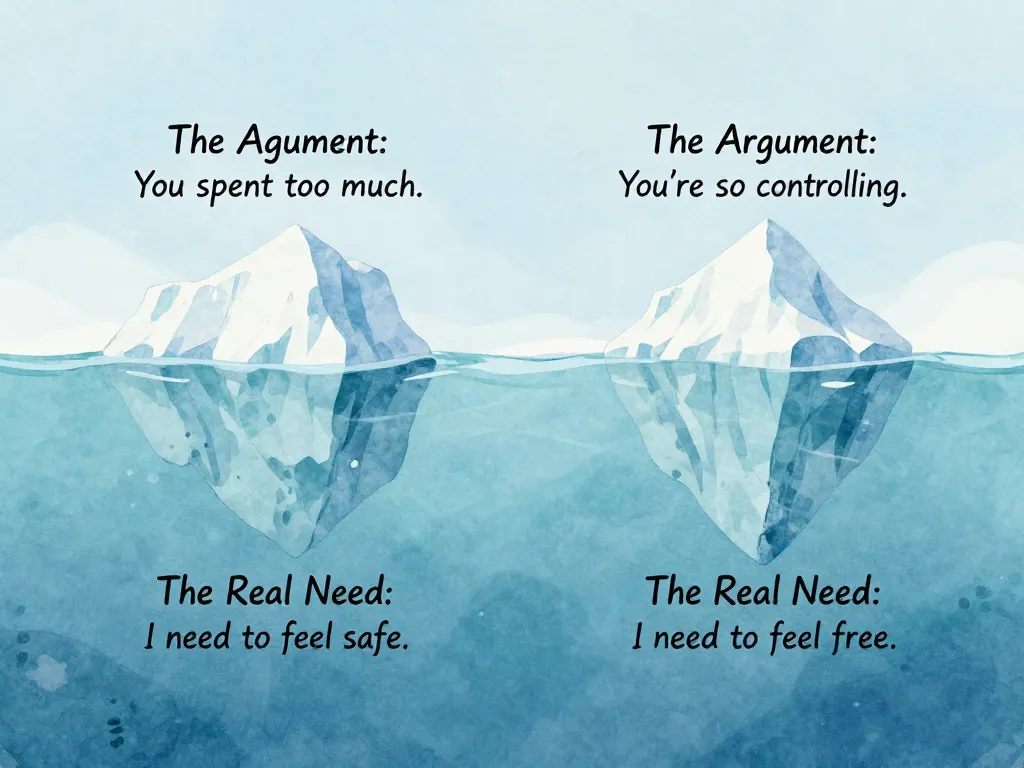
Why Money Fights Are Never Really About Money
Think about the last financial disagreement you had with your partner. Now ask yourself: if your partner had spent the exact same amount on something you fully supported, would you have been upset?
Usually, the answer is no. That's because the fight isn't about the transaction. It's about the meaning you attach to it.
Money is one of the most emotionally loaded topics in any relationship because it touches on nearly every fundamental human need:
- Security — Will we be okay if something goes wrong?
- Freedom — Can I make choices without asking permission?
- Fairness — Are we contributing and benefiting equally?
- Control — Do I have a say in what happens to us?
- Identity — Does how we spend reflect who I am and what I value?
When you fight about money, you're really fighting about one or more of these needs feeling threatened. The problem is that most couples never get past the surface-level debate ("You spent $200 on what?") to identify which need is actually at stake.
The Money Stories You Bring to the Relationship
Every person walks into a relationship carrying an invisible financial autobiography. These aren't just memories — they're emotional blueprints that dictate how you react to money situations, often without your conscious awareness.
How Childhood Shapes Your Money Triggers
Consider two people:
Maya grew up in a household where money was tight. Her parents argued about bills constantly, and one year, the family nearly lost their home. For Maya, a low savings account balance doesn't just feel uncomfortable — it feels existentially threatening. When her partner suggests a spontaneous vacation, she doesn't hear "let's have fun." She hears danger.
Jordan grew up in a household where money was used as control. His father dictated every purchase his mother made and criticized her spending. For Jordan, having to justify buying a new jacket doesn't feel like accountability — it feels like suffocation. When his partner questions a purchase, he doesn't hear concern. He hears control.
Neither Maya nor Jordan is wrong. Both are responding to real emotional conditioning. But without understanding each other's money stories, they'll interpret each other's behavior through the worst possible lens.
Exercise: Share Your Money Autobiography
Set aside 30 minutes with your partner — not during a conflict — and take turns answering these questions:
- What is your earliest memory involving money?
- How did your parents or caregivers talk about money? Was it discussed openly or treated as taboo?
- Was there ever a financial crisis in your family? How did it affect you?
- What did money represent in your household — security, status, freedom, stress?
- What financial behavior in a partner would make you feel most anxious? Most safe?
The goal isn't to solve anything. It's to build context. When you understand why your partner reacts the way they do, their behavior stops looking irrational and starts looking human.

The Four Hidden Conflicts Behind Every Money Fight
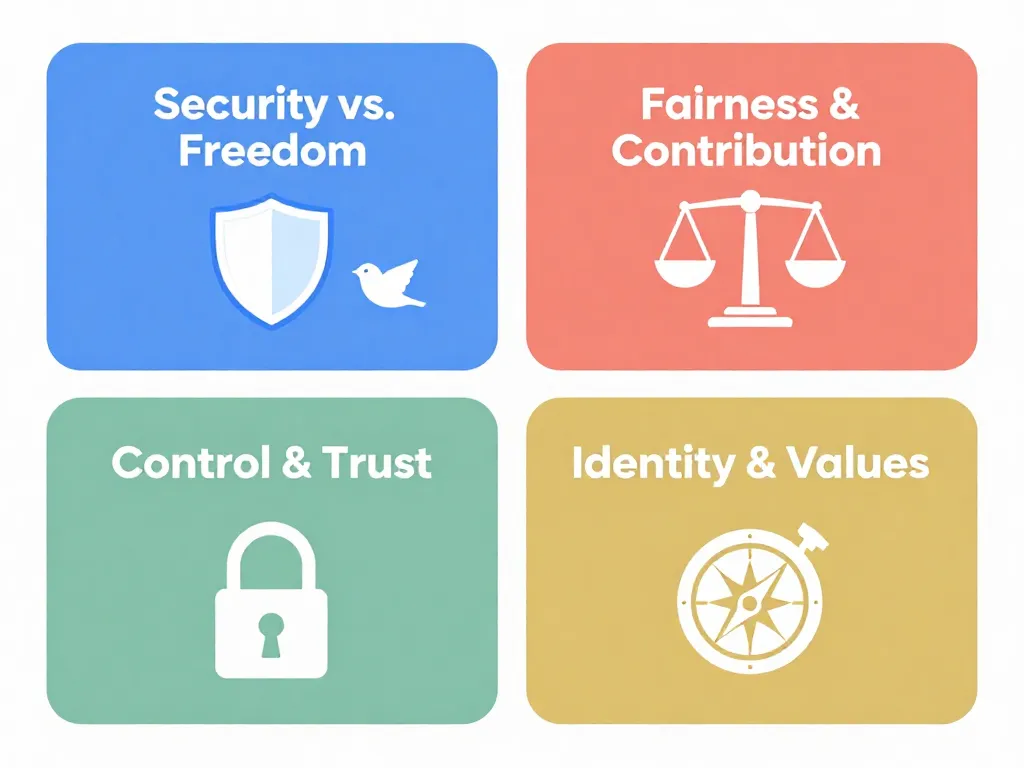
After working through hundreds of financial disagreements, patterns emerge. Most money fights fall into one of four underlying conflict types.
1. Security vs. Freedom
This is the classic saver-vs-spender dynamic, but the labels are misleading. The saver isn't being rigid — they're trying to feel safe. The spender isn't being careless — they're trying to feel alive.
What it sounds like: - "We can't afford that." (Translation: I don't feel safe enough.) - "You never want to enjoy anything." (Translation: I feel trapped.)
What it's really about: Both partners have a legitimate need. One needs enough financial cushion to sleep at night. The other needs enough financial flexibility to feel like life is worth living. The fight persists because each person treats the other's need as a threat to their own.
What actually helps: Define a specific savings threshold that satisfies the security need (e.g., six months of expenses in an emergency fund), and once that threshold is maintained, the freedom-oriented partner gets more latitude. This turns an emotional tug-of-war into a concrete agreement.
2. Fairness and Contribution
This surfaces when partners earn different amounts, when one stays home with children, or when spending feels disproportionate.
What it sounds like: - "I work 50 hours a week and you just bought another..." - "Just because I earn less doesn't mean I get less say."
What it's really about: Value. The higher earner may feel their effort isn't respected. The lower earner (or non-earning partner) may feel their contributions — childcare, household management, emotional labor — are invisible. The fight about the credit card bill is really a fight about whether both people feel equally valued.
What actually helps: Explicitly acknowledge non-financial contributions. Some couples find it useful to agree that all income is shared income, regardless of who earns it. Others prefer proportional contributions to shared expenses. There's no single right answer — but there needs to be an answer you've both agreed to, not just defaulted into.
3. Control and Trust
This one often hides behind the word "transparency." One partner wants to review all purchases; the other feels monitored.
What it sounds like: - "Why didn't you tell me about this charge?" - "I shouldn't need permission to buy lunch."
What it's really about: The monitoring partner may have experienced financial betrayal — a parent who hid debt, an ex who drained a joint account. Their need for visibility is actually a need for trust. The monitored partner may have experienced financial control. Their resistance isn't about hiding anything — it's about preserving dignity and autonomy.
What actually helps: Create a transparency structure that respects both needs. For example: full visibility on shared accounts, but each partner also has a personal account with an agreed-upon monthly amount they can spend with no questions asked. This is sometimes called a "no-judgment fund," and it's remarkably effective at defusing control-based money fights.
4. Identity and Values
Sometimes money fights are really about who you are and what kind of life you want.
What it sounds like: - "Why would you spend money on that?" - "You don't care about the same things I do."
What it's really about: When your partner spends money on something you find frivolous — or refuses to spend on something you find essential — it can feel like a rejection of your values. The partner who wants to donate 10% to charity and the partner who wants to invest it aren't just disagreeing about allocation. They're disagreeing about what kind of people they want to be, and what kind of life they're building together.
What actually helps: Separate the budget conversation from the values conversation. First, talk about what matters to each of you and why. Then build a financial plan that reflects both sets of values, even if imperfectly. Most couples find that compromise becomes easier once they stop feeling like their identity is under attack.
How to Stop the Same Money Fight From Repeating
Understanding the underlying needs is essential, but insight alone doesn't stop recurring arguments. You need structures.
1. Schedule Monthly Money Check-Ins
Pick a regular time — the first Sunday of the month, for instance — to review finances together. This sounds simple, but it's transformative for one reason: it contains the conversation. When you know there's a designated time to discuss money, you're less likely to ambush each other with financial grievances at 10 p.m. on a Tuesday.
Structure for a 30-minute check-in: - 5 minutes: Review last month's spending (facts only, no judgments) - 10 minutes: Discuss any upcoming expenses or financial decisions - 10 minutes: Check progress toward shared goals - 5 minutes: Each person shares one financial appreciation ("I noticed you brought lunch to work this week — thank you")
2. Create a Decision-Making Threshold
Agree on a dollar amount above which both partners need to discuss a purchase before making it. Below that amount, no questions asked. This eliminates the daily friction of micro-managing while preserving collaboration on bigger decisions.
Common thresholds couples use: - $50 for tight budgets - $100–$200 for moderate budgets - $500+ for higher-income households
The number matters less than the agreement itself.
3. Name the Need, Not the Behavior
This is the single most powerful communication shift you can make. Instead of criticizing what your partner did, express what you need.
| Instead of... | Try... |
|---|---|
| "You're so irresponsible with money." | "I need to feel like we have a safety net." |
| "You're so controlling." | "I need to feel trusted to make some choices on my own." |
| "You don't care about our future." | "I need to feel like we're building toward something together." |
| "Why do you waste money on that?" | "Can you help me understand what this means to you?" |
When you name the need, you invite collaboration. When you name the behavior, you invite defensiveness.
4. Write Down Your Agreements
Verbal agreements fade. Memories of what you "decided" diverge. Write down the financial agreements you make together — your spending threshold, your savings goals, your personal fund amounts, your check-in schedule. This isn't about legality or mistrust. It's about clarity. Tools like Servanda can help couples formalize these kinds of agreements in a structured way, so you're not relying on conflicting memories when tension rises.
5. Revisit and Renegotiate
Your financial situation will change. Someone might get a raise, lose a job, have a child, or develop a new priority. Financial agreements aren't permanent. Build in a quarterly or biannual review where you explicitly ask: "Does this still work for both of us?" This prevents resentment from building when circumstances shift but agreements don't.
When Money Fights Signal Something Deeper
Sometimes, recurring money fights are a symptom of a broader relational issue that financial strategies alone can't solve. Consider seeking couples counseling if:
- One partner is hiding purchases, debt, or accounts (financial infidelity)
- Money arguments consistently escalate to personal attacks or withdrawal
- One partner uses financial control to limit the other's independence
- You've tried multiple approaches and the same fight keeps returning with the same intensity
- Money disagreements have spread into general contempt or emotional distance
A therapist who specializes in couples and financial issues can help you untangle the emotional roots that budgeting spreadsheets can't reach.
Frequently Asked Questions
Why do my partner and I keep having the same money fight?
Recurring money fights usually mean you're addressing the surface issue (the specific purchase or expense) without resolving the underlying need (security, freedom, fairness, or control). Until both partners identify and acknowledge what they actually need — not just what they want the other person to stop doing — the same argument will keep cycling back.
Is it normal for couples to fight about money?
Yes. Financial disagreements are among the most common sources of conflict in relationships. Having money fights doesn't mean your relationship is unhealthy — but how you fight about money matters significantly. Couples who can discuss finances without contempt, defensiveness, or stonewalling tend to resolve disagreements more effectively and feel more satisfied in their relationship overall.
Should couples combine finances or keep them separate?
There's no universally right answer. Many couples find that a hybrid approach works best: a shared account for joint expenses and goals, plus individual accounts for personal spending. The structure matters less than whether both partners feel the arrangement is fair and were genuinely part of the decision. If one partner imposed the system, resentment will follow regardless of the model.
How do we talk about money without it turning into a fight?
Timing and structure make an enormous difference. Don't bring up finances when you're already stressed, tired, or in the middle of another conflict. Schedule a specific time for money conversations, start with facts rather than accusations, and use "I need" statements instead of "you always" statements. Having a written agenda — even a simple one — keeps the conversation from spiraling.
What is financial infidelity and how serious is it?
Financial infidelity involves hiding financial information from your partner — secret accounts, hidden debt, undisclosed purchases, or concealed income. It's serious because it erodes trust in the same way other forms of deception do. If you discover financial infidelity, it's worth addressing with professional support, as the trust repair process typically requires more than a conversation.
Moving Forward Together
Money fights are painful not because of the money, but because they touch on some of the most vulnerable parts of who we are — our sense of safety, our need for autonomy, our desire to feel valued, and our vision for the future. When you argue about a purchase, you're really asking your partner: Do you see me? Do you respect what I need? Are we building the same life?
The good news is that these questions have answers. Not perfect ones, and not permanent ones, but workable ones — answers you build together through honest conversation, mutual curiosity, and practical agreements that honor both people's needs.
The next time a money fight begins to surface, pause before reacting. Ask yourself: What am I actually afraid of right now? What do I actually need? Then ask your partner the same question. You might be surprised how quickly the argument transforms when you stop debating the receipt and start addressing what's really at stake.