
One Partner Feels Smothered, the Other Ignored: How to Break the Pursue-Withdraw Cycle
It's 9 p.m. on a Tuesday. Maya sends her third text of the evening: "You haven't said anything about your day. Is everything okay?" On the other side of the couch, Jordan reads the message and feels their chest tighten. They were just decompressing, watching a show, finally unwinding. Now they feel cornered. They don't respond right away. Maya watches the "read" receipt appear and feels a familiar sting in her stomach. Why can't he just talk to me?
Maya feels ignored. Jordan feels smothered. Neither one is wrong — but both are hurting.
This pattern has a name. Relationship researchers call it the pursue-withdraw cycle, and it's one of the most common and destructive dynamics couples fall into. The good news? It isn't a personality flaw in either partner. It's a mismatch in attachment needs — and once you understand it, you can start changing it tonight.
Key Takeaways
- The pursue-withdraw cycle is not about one partner being "needy" and the other being "cold." It's a loop driven by different attachment responses to stress, and both sides feel equally painful.
- Withdrawal is a stress response, not rejection. Understanding this reframe can instantly reduce the pursuer's panic and the withdrawer's guilt.
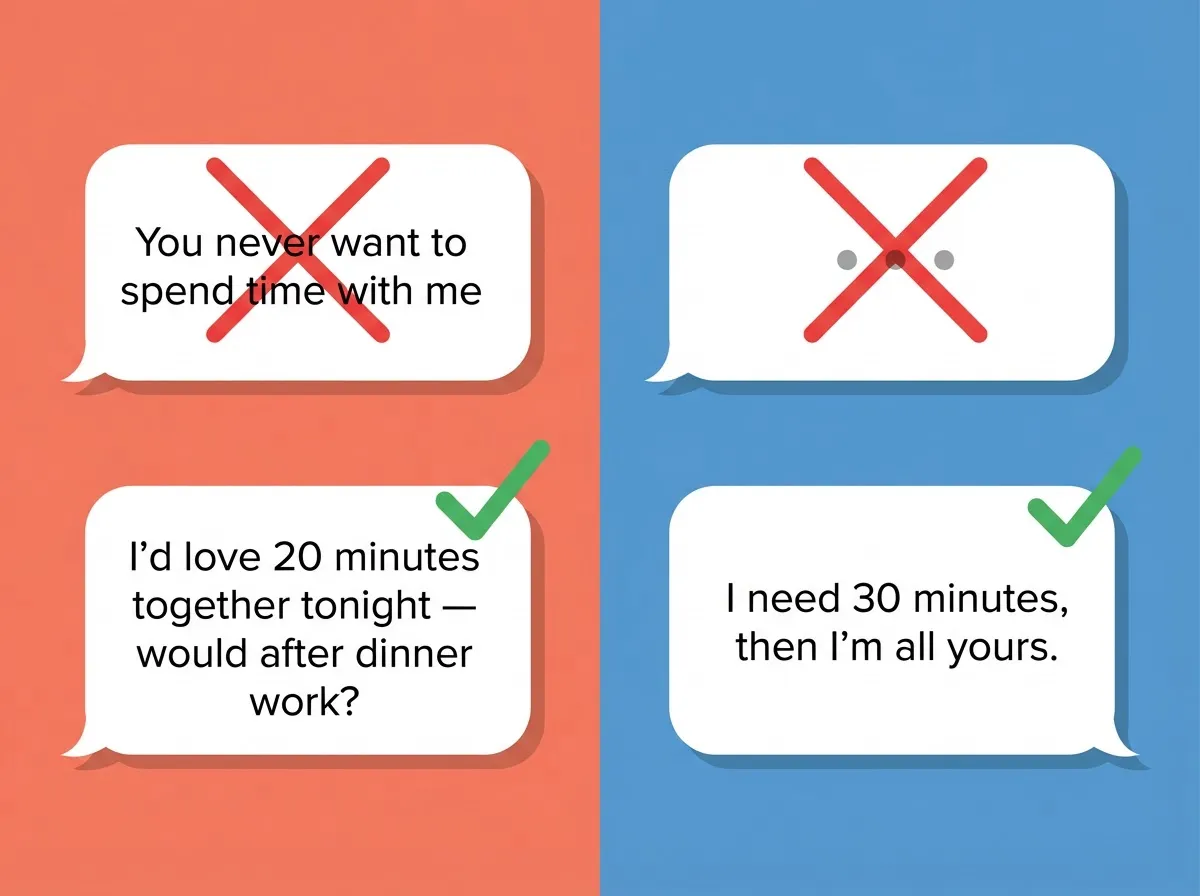
- Pursuers can learn to make requests instead of protests. Shifting from "You never talk to me" to "I'd love 15 minutes to connect tonight" changes the entire interaction.
- Withdrawers can learn to name their need for space without disappearing. Saying "I need 30 minutes to decompress, and then I'm all yours" prevents the pursuer from spiraling.
- A written, agreed-upon reconnection plan eliminates guesswork and stops the same argument from replaying every week.
What the Pursue-Withdraw Cycle Actually Looks Like
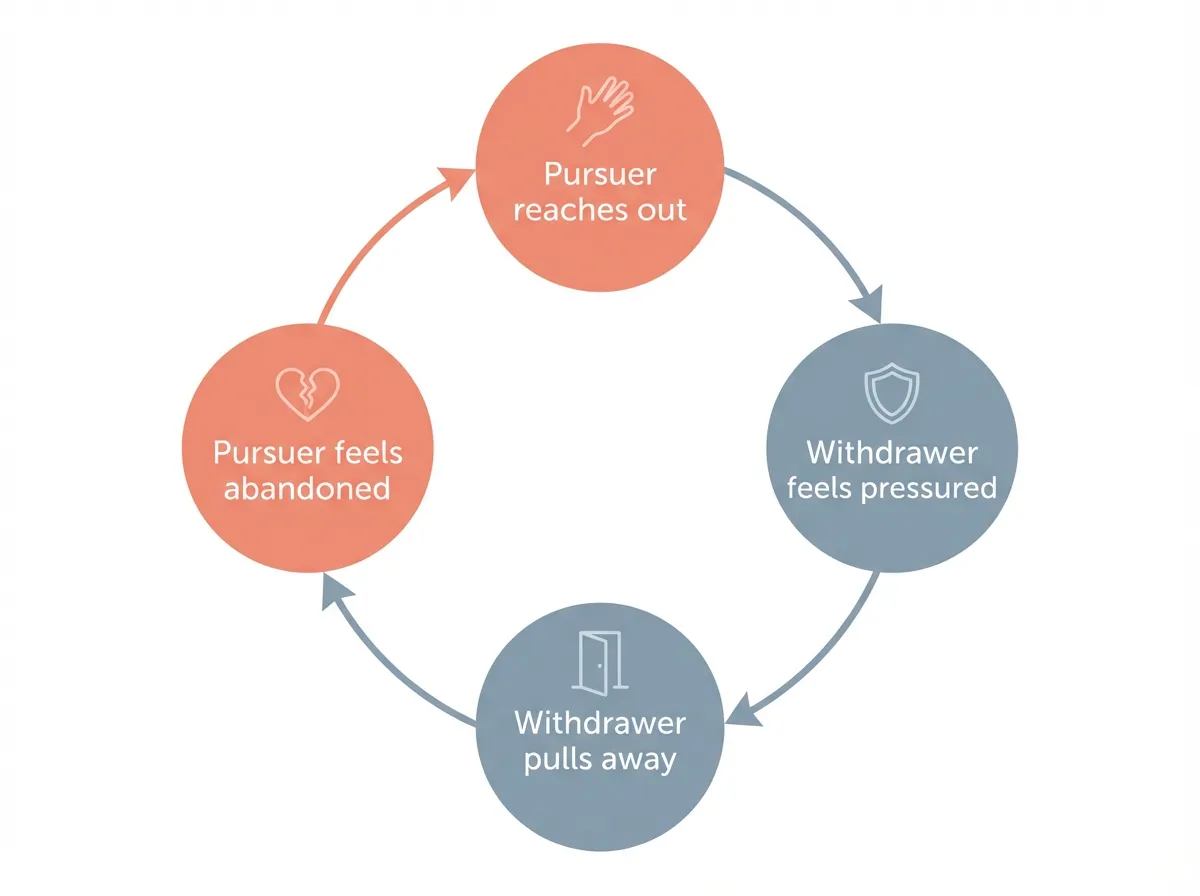
Before we get into solutions, let's make sure we're naming the right problem. The pursue-withdraw cycle shows up in dozens of everyday moments:
- One partner texts frequently throughout the day; the other rarely initiates.
- One wants to "talk about things" after a disagreement; the other wants to "let it go."
- One moves closer during conflict (raising the topic again, following from room to room); the other pulls away (going silent, leaving the room, scrolling their phone).
- One reads silence as rejection; the other reads repeated questions as criticism.
Dr. John Gottman's research found that roughly 65% of couples have some version of this dynamic, and it's the single strongest predictor of relationship dissatisfaction when left unaddressed. But here's what most people get wrong: they assume the pursuer is the problem ("too needy") or the withdrawer is the problem ("emotionally unavailable"). In reality, it's the cycle itself that's the enemy — not either person inside it.
Why It Feels So Personal
When one partner feels smothered and the other ignored, each person experiences a genuine threat:
| The Pursuer's Experience | The Withdrawer's Experience |
|---|---|
| "If I don't reach out, we'll drift apart." | "If I can't get space, I'll lose myself." |
| Silence feels like abandonment. | Repeated contact feels like pressure. |
| Their strategy: seek closeness to feel safe. | Their strategy: create distance to feel safe. |
| Core fear: "I'm not enough for you." | Core fear: "Nothing I do is enough for you." |
Neither of these fears is irrational. They're just incompatible when expressed on autopilot.
Where This Pattern Comes From (It's Not What You Think)
Most couples assume this conflict is about personality: "I'm an extrovert, she's an introvert" or "He's just not a feelings person." But attachment research tells a more nuanced story.
Our attachment styles — shaped by early relationships with caregivers, past romantic experiences, and even cultural norms — create default stress responses. Under relationship stress:
- Anxious attachment leans toward pursuit: more contact, more reassurance-seeking, more emotional processing out loud.
- Avoidant attachment leans toward withdrawal: more space, more internal processing, more need to "figure things out alone."
Neither style is broken. Both developed for perfectly logical reasons. But when an anxiously attached pursuer pairs with an avoidantly attached withdrawer (which happens with remarkable frequency, because we're often drawn to what feels familiar), the cycle self-reinforces:
- Pursuer reaches out → Withdrawer feels pressured → Withdrawer pulls back → Pursuer feels abandoned → Pursuer reaches out more urgently → Withdrawer shuts down further.
This loop can repeat dozens of times a week, in forms as small as an unanswered text or as large as a week-long cold war.
How to Break the Cycle: A Step-by-Step Approach

Breaking the pursue-withdraw pattern doesn't require you to change who you are. It requires you to change what you do in the moments when the cycle activates. Here's how, broken down by role.
If You're the Pursuer: Scripts for Reaching Out Without Chasing
Your instinct to connect is healthy. The issue is that under stress, connection-seeking can sound like criticism, interrogation, or panic — which triggers the exact withdrawal you're trying to prevent.
Practice these shifts:
1. Replace protests with requests
- ❌ "You never want to spend time with me."
- ✅ "I'd really love to have 20 minutes together tonight — no phones, just us. Would after dinner work?"
The first sentence is a global accusation. The second is a specific, time-bound invitation. It gives your partner something concrete to say yes to.
2. Name your feeling without assigning blame
- ❌ "Why are you ignoring me?"
- ✅ "I'm feeling a little disconnected today. It's not your fault — I just miss you."
This one is powerful because it removes the pressure of being accused while still letting your partner know you need something.
3. Give a time frame for your need
- ❌ Texting every 20 minutes until they respond.
- ✅ "No rush on responding — just thinking of you. Talk tonight?"
Time frames reduce urgency, which reduces the withdrawer's stress response.
4. Build in self-soothing before reaching out
Before you send the fourth text or bring up the topic again, pause and ask yourself: Am I reaching out from love, or from anxiety? If it's anxiety, tend to that first — a walk, a journal entry, a call to a friend — and then reconnect from a calmer place.
If You're the Withdrawer: Scripts for Creating Space Without Disappearing
Your need for space is legitimate. The issue is that silent withdrawal — without context — looks identical to rejection. Your partner can't tell the difference between "I need 30 minutes" and "I don't care about you."
Practice these shifts:
1. Narrate your withdrawal
- ❌ Walking out of the room mid-conversation without a word.
- ✅ "I'm starting to feel overwhelmed. I need about 30 minutes to myself, and then I want to come back to this. I'm not leaving the conversation — I'm just pressing pause."
This single sentence can transform the entire dynamic. It gives your partner a timeline, a reason, and a promise of return.
2. Offer a small bid for connection before you retreat
- ❌ Staring at your phone when your partner is trying to talk.
- ✅ A hand on their arm: "I hear you. I want to give this the attention it deserves, and I can't right now. Can we talk at 8?"
Physical touch plus a concrete time communicates care and buys you the space you need.
3. Initiate contact occasionally — even when you don't "need" to
This is the single most effective thing a withdrawer can do to calm the cycle long-term. When you send an unsolicited "thinking of you" text or suggest a date night, it fills your partner's connection tank before it hits empty. That means fewer panicked pursuits later.
4. Be honest about your internal experience
- ❌ "I'm fine. Nothing's wrong."
- ✅ "Honestly, I don't fully know what I'm feeling yet. I need some time to figure it out. But I'm not upset with you."
Withdrawers often go quiet because they genuinely don't have words for their emotions in the moment. Saying that is infinitely better than saying nothing.
Building a Reconnection Agreement Together
The scripts above help in the moment. But to stop the cycle from recurring week after week, you need a shared plan — decided during a calm moment, not during a fight.
Sit down together when things are good and answer these questions:
1. What does "enough connection" look like for each of us?
Get specific. Vague goals like "more quality time" create more arguments. Instead:
- "I need at least 20 minutes of uninterrupted conversation most evenings."
- "I need at least one evening a week that's fully unscheduled."
2. What's our signal that someone needs space?
Agree on a phrase or gesture that means "I'm pressing pause, not walking away." Some couples use:
- A specific word ("Yellow light" — meaning slow down, not stop)
- A hand signal
- A text emoji they've agreed on
3. What's the maximum pause length?
Withdrawers: commit to a time limit. "I'll come back within an hour." Pursuers: commit to honoring that time. This mutual agreement eliminates the guesswork that fuels the cycle.
4. How do we reconnect after a pause?
Do you start with a hug? A check-in question? A walk together? Having a default re-entry ritual prevents the awkward "so... are we okay?" dance that often restarts the whole cycle.
Consider writing these agreements down — even informally. When emotions run high later, having a reference point you both created prevents the "that's not what we said" argument. Tools like Servanda can help couples formalize these kinds of agreements in writing, so they're easy to revisit when the cycle threatens to pull you both back in.
What If We've Been Stuck in This Pattern for Years?
Long-standing pursue-withdraw cycles can feel permanent, but they're not. Research from Dr. Sue Johnson, the developer of Emotionally Focused Therapy (EFT), shows that even deeply entrenched couples can shift this dynamic — often in a matter of weeks — once both partners understand the cycle as the shared enemy.
Here's what helps when the pattern is deeply rooted:
- Name the cycle out loud, together. "We're doing the thing again — I'm chasing, you're retreating. Can we both pause?" Making the cycle visible breaks its automatic power.
- Start with micro-changes. You don't need to overhaul your communication overnight. One narrated withdrawal per day. One soft request instead of a protest. Small shifts compound.
- Seek professional support if you're spinning. A therapist trained in EFT or Gottman Method can help you identify the specific triggers and emotional vulnerabilities driving your version of the cycle.
- Track your progress. The cycle will still activate — the measure of change isn't that it stops happening, but that you catch it faster and recover more smoothly each time.
A Quick Reality Check: This Isn't About Keeping Score
It's tempting to read an article like this and think, "See? They need to change." But the pursue-withdraw cycle is a two-person system. It cannot exist without both roles. That means it also cannot change without both people adjusting.
If you're the pursuer, your work is learning to self-soothe and make softer requests.
If you're the withdrawer, your work is learning to stay present and communicate your need for space explicitly.
Both are hard. Both are brave. And both are necessary.
FAQs
Is the pursuer always the woman in a relationship?
No. While cultural stereotypes suggest women pursue and men withdraw, research shows this pattern crosses gender lines. In many couples, men are the pursuers, and the dynamic is equally common in same-sex relationships. The roles can also flip depending on the topic — you might pursue around emotional connection but withdraw around financial discussions.
Can you be both the pursuer and the withdrawer?
Absolutely. Many people pursue in one area (like quality time) and withdraw in another (like conflict about finances or in-laws). It's also common for roles to shift over the course of a relationship, especially after major life changes like having a child or a job loss.
How long does it take to break the pursue-withdraw cycle?
Most couples notice a shift within two to four weeks of consistently applying new strategies — especially narrating withdrawals and replacing protests with requests. The cycle won't disappear entirely, but you'll catch it earlier and recover faster. Deeply entrenched patterns may benefit from professional support through Emotionally Focused Therapy.
What if my partner refuses to acknowledge the pattern?
You can still change your half of the cycle, and that often shifts the dynamic on its own. If you're the pursuer, making softer requests reduces the withdrawer's defensiveness. If you're the withdrawer, narrating your need for space reduces the pursuer's panic. One person changing their steps often changes the entire dance.
Is wanting alone time a red flag in a relationship?
Not at all. Wanting solitude is a normal, healthy human need. It only becomes problematic when it's used as a punishment (stonewalling) or when it happens without any communication. The difference between healthy space and harmful withdrawal is transparency: "I need time alone" is healthy; vanishing without explanation is not.
Moving Forward Together
The pursue-withdraw cycle thrives on misunderstanding. The pursuer isn't "too needy" — they're expressing a real need for connection in a way that accidentally pushes their partner away. The withdrawer isn't "emotionally unavailable" — they're managing overwhelm in a way that accidentally signals rejection.
Once you both see the cycle as the problem — not each other — everything changes. You stop asking "Why are you like this?" and start asking "How do we handle this together?"
Start small. Try one script from this article tonight. Name the cycle the next time you feel it activating. Write down your reconnection agreement this weekend. You don't need to be perfect. You just need to be on the same team — and now you have the playbook to prove it.