
5 Scripts for Tough Co-Parenting Conversations
Key Takeaways
- You don't need to wing difficult co-parenting conversations. Having a word-for-word script prepared helps you stay calm, focused, and child-centered when emotions run high.
- The BIFF method (Brief, Informative, Friendly, Firm) underpins every script in this article, giving you a reliable framework you can adapt to any situation.
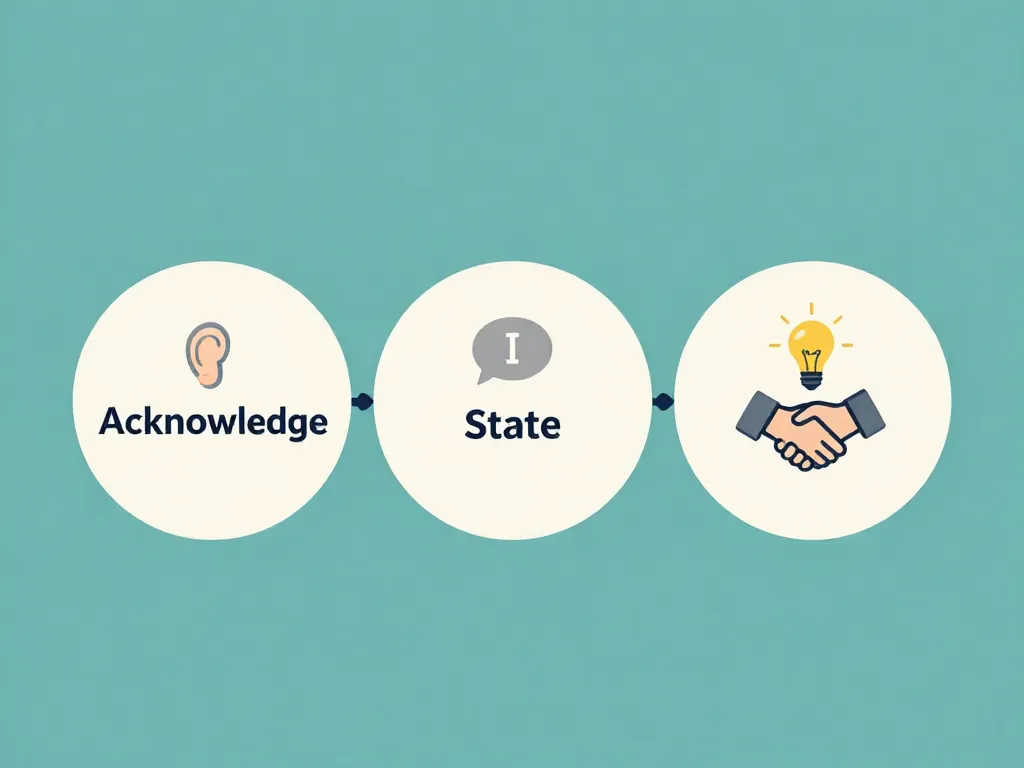
- Each script follows a three-part structure: acknowledge the other parent's perspective, state your concern using "I" language, and propose a specific next step.
- Texting and email are often better than phone calls for high-conflict co-parenting conversations because they give you time to choose your words carefully.
- Practice reading the scripts aloud before you need them. Familiarity reduces the freeze response that derails so many co-parenting discussions.
Introduction
You're staring at your phone. Your co-parent just texted that they want to switch weekends — again — and your chest tightens. You know you need to respond, but every sentence you draft sounds either too aggressive or too passive. So you do nothing. Or worse, you fire back something you'll regret by bedtime.
You're not alone. Research from the Association of Family and Conciliation Courts shows that the majority of co-parenting conflicts escalate not because parents disagree, but because neither parent knows how to phrase their disagreement in a way that moves the conversation forward instead of blowing it up.
This article gives you five word-for-word scripts for the co-parenting conversations that trip people up most. These aren't vague tips. They're actual sentences you can copy into a text, paste into an email, or rehearse before a phone call. Customize them to fit your situation, but let the structure do the heavy lifting.
Why Scripts Work Better Than "Just Communicate"
Telling co-parents to "communicate better" is like telling someone with a flat tire to "just drive." It skips the part that actually matters: the how.
Scripts work because they:
- Reduce cognitive load. When you're flooded with emotion, your brain's prefrontal cortex — the part responsible for rational speech — goes partially offline. A script gives you a cognitive shortcut so you don't have to compose brilliant sentences while your heart is pounding.
- Prevent escalation loops. Most co-parenting arguments follow a predictable pattern: accusation → defensiveness → counter-accusation → shutdown. Scripts interrupt this cycle by keeping your language neutral and solution-oriented.
- Create consistency. When you respond predictably and calmly over time, your co-parent learns that difficult topics can be discussed without a fight. This gradually lowers the temperature of every future exchange.
Every script below uses a three-part structure borrowed from conflict resolution professionals:
- Acknowledge — Show you heard their perspective (even if you disagree).
- State — Express your concern using "I" language instead of "you" accusations.
- Propose — Offer a concrete next step or ask a specific question.
Let's get into the scripts.
Script 1: Responding to a Last-Minute Schedule Change Request
The Situation
Your co-parent texts on Wednesday asking to swap this weekend for next weekend because "something came up."
What Most People Say (and Why It Backfires)
"You always do this. You can't just rearrange the schedule whenever it's convenient for you."
This immediately puts your co-parent on the defensive and frames the conversation as a power struggle instead of a logistics problem.
The Script
"Thanks for letting me know. I understand things come up. This weekend doesn't work for a swap because [specific reason — e.g., I've already made plans with the kids / I have a work commitment next weekend]. Could you suggest two alternative dates that work for you? I'm happy to look at options that work for both of us."
Why This Works
- "Thanks for letting me know" acknowledges without agreeing. It's not sarcastic — it's disarmingly neutral.
- "This weekend doesn't work because [reason]" gives a factual explanation, not an emotional one.
- "Could you suggest two alternative dates" puts the ball back in their court while showing willingness to collaborate.
If They Push Back
"I hear you, and I get that this feels urgent. My schedule genuinely doesn't allow for a swap this weekend. If we need to figure out a longer-term solution for when schedule changes come up, I'm open to setting up a process for that. For now, let's stick with the current plan."
Script 2: Addressing Different Discipline or Parenting Styles
The Situation
Your child comes home and mentions that your co-parent lets them stay up until 11 p.m. on school nights, or that there are no consequences for not finishing homework.

What Most People Say (and Why It Backfires)
"You need to stop letting them stay up so late. They're exhausted every Monday and it's affecting their grades."
Even when you're right, leading with "you need to stop" triggers defensiveness and sounds like you're positioning yourself as the superior parent.
The Script
"Hey, I wanted to check in about bedtime routines. [Child's name] has been really tired on Monday mornings, and their teacher mentioned they're having trouble focusing early in the week. I know we may handle things differently at each house, and that's okay. But I'm wondering if we could agree on a school-night bedtime — something like 9 or 9:30 — so they're getting enough sleep to do well in school. What do you think would work on your end?"
Why This Works
- "I wanted to check in" is collaborative, not accusatory.
- "Their teacher mentioned" introduces a neutral third-party observation, which feels less like a personal attack.
- "I know we may handle things differently at each house, and that's okay" explicitly validates their autonomy before asking for a change.
- "What do you think would work on your end?" invites them to participate in the solution rather than just comply with your demand.
Variation for Higher-Conflict Situations
If your co-parent tends to react badly to any perceived criticism, strip the script down even further:
"[Child's name]'s teacher flagged that they're struggling to focus on Mondays. I'm looking at our routines at both homes to see what might help. Would you be open to us both targeting a 9:30 p.m. school-night bedtime for the next month to see if it makes a difference?"
Script 3: Introducing a New Partner to the Children
The Situation
Either you or your co-parent has a new significant other, and it's time to discuss how and when to introduce them to the kids.
What Most People Say (and Why It Backfires)
"I'm going to introduce the kids to [name] this weekend. Just wanted to give you a heads-up."
Even if you have every right to make this decision, framing it as a done deal robs your co-parent of any sense of involvement in a major moment for their children. Expect an explosion.
The Script (If You're the One Introducing)
"I want to talk with you about something important regarding the kids. I've been seeing someone for [timeframe], and I'm starting to think about when it might be appropriate to introduce them to [child's name]. I know this kind of thing can bring up a lot of feelings, and I respect that. I'd like us to be on the same page about how to handle it so the kids feel secure. Do you have thoughts on what would feel right in terms of timing or how we'd talk to them about it?"
The Script (If Your Co-Parent Is Introducing)
If your co-parent drops this on you and you're struggling:
"Thanks for telling me. I'll be honest — I need a little time to process this. I do want to talk about how the introduction will go so we can make sure the kids feel comfortable. Can we revisit this in a couple of days? In the meantime, could you hold off on introducing them until we've had a chance to discuss it?"
Why This Works
- Naming that it's emotionally loaded ("I know this can bring up a lot of feelings") defuses the elephant in the room.
- Asking for time to process is honest and prevents a reactive response you might regret.
- Requesting a pause before the introduction is reasonable and centered on the children's wellbeing.
Script 4: Splitting an Unexpected Expense
The Situation
Your child needs braces, wants to join a travel soccer league, or had an ER visit. The cost isn't covered by your existing agreement, and you need to discuss who pays what.

What Most People Say (and Why It Backfires)
"The dentist says [child] needs braces. It's $4,500. Your half is $2,250."
Sending someone an invoice they didn't agree to is a guaranteed way to start a fight — even if splitting 50/50 is what your agreement says.
The Script
"[Child's name]'s dentist recommended braces, and I wanted to loop you in before moving forward. The estimated cost is $4,500, and I've looked into whether our dental plan covers any of it — [it covers X / it doesn't cover orthodontics]. Here's what I'm thinking: Our agreement says we split uncovered medical expenses [50/50 / proportional to income]. I want to make sure we're both comfortable before I schedule anything. Would you like to see the treatment plan, or would it help to call the dentist's office together? I'm also open to discussing a payment timeline if that makes things easier."
Why This Works
- "I wanted to loop you in before moving forward" signals respect — you're not making unilateral decisions about their money.
- Providing the specific cost and insurance details reduces ambiguity, which reduces conflict.
- Referencing the agreement keeps the conversation anchored in what you've both already decided, not in emotions.
- Offering a payment timeline shows empathy for their financial situation without making assumptions.
Pro Tip
For expenses over a few hundred dollars, consider formalizing the agreement in writing. Tools like Servanda can help co-parents create clear written agreements about expense-sharing, making it easier to refer back to what was decided and preventing "I never agreed to that" disputes down the line.
Script 5: Requesting a Change to the Custody or Parenting Plan
The Situation
Your work schedule has changed, your child has expressed a preference, or circumstances have shifted enough that the current plan isn't working. You need to propose a modification without it turning into a full-blown custody battle.
What Most People Say (and Why It Backfires)
"This schedule isn't working anymore. We need to change it."
This reads as a demand and, for many co-parents, it triggers a fear response: Are they trying to take my time away?
The Script
"I've been thinking about how our current schedule is working, and I wanted to have an honest conversation about it. My [work schedule / commute / child's activity schedule] has changed, and I'm finding that [specific problem — e.g., the Wednesday pickup is consistently causing me to be 30+ minutes late, which isn't fair to the kids]. I'm not looking to reduce your time — I want to find an arrangement that's actually realistic so neither of us is constantly stressed. Could we look at the schedule together and see if there's an adjustment that gives us both what we need? I have a couple of ideas, but I'd like to hear yours first."
Why This Works
- "I'm not looking to reduce your time" directly addresses the unspoken fear.
- Naming a specific, observable problem ("30+ minutes late") makes this about logistics, not about who's the better parent.
- "I'd like to hear yours first" gives them power in the conversation, which lowers defensiveness.
If They Refuse to Discuss It
"I understand you're not ready to talk about this right now, and I respect that. This is something that does need to be addressed for the kids' sake, so I'd like to revisit it within the next two weeks. If it would help, we could also work with a mediator so we both have support in the conversation. What would you prefer?"
How to Use These Scripts Effectively
Copying and pasting a script into a text message is a start, but here's how to get the most out of them:
1. Customize the Details, Keep the Structure
Swap in your child's name, the specific issue, and your actual circumstances. But don't rewrite the emotional framing — that's where the magic is.
2. Read It Aloud Before Sending
If a sentence feels awkward in your mouth, reword it until it sounds like something you'd actually say. Authenticity matters more than perfection.
3. Choose the Right Medium
- Text or email: Best for schedule changes, expense discussions, and any time emotions are high. You get time to edit before sending.
- Phone call: Better for nuanced topics like introducing a new partner or discussing your child's emotional needs. Tone of voice matters here.
- In-person: Only if you and your co-parent can reliably have calm conversations. If not, stick to writing.
4. Don't Expect Immediate Agreement
The goal of these scripts isn't to "win" the conversation in one exchange. It's to open the door to a productive discussion. If your co-parent needs time, let them have it.
5. Document Everything
After any verbal agreement, follow up in writing:
"Just want to confirm what we discussed — we're going to [specific agreement]. Let me know if I've captured that correctly."
This one habit prevents more conflicts than any script ever could.
Frequently Asked Questions
What if my co-parent doesn't respond to my message at all?
Give them 48-72 hours before following up. Some people need time to process, especially if the topic is emotionally charged. If non-response is a pattern, send a brief follow-up: "Just circling back on this — I'd like to get it sorted by [date] so we can both plan. Let me know your thoughts." If they consistently ignore important messages, document the pattern and consider involving a mediator.
Do these scripts work if my co-parent is high-conflict?
Yes, and they may actually be more important in high-conflict situations. The scripts are designed to be what conflict professionals call "BIFF" — Brief, Informative, Friendly, and Firm. They don't take the bait, they don't escalate, and they don't give a high-conflict person ammunition. That said, if your co-parent is abusive or you feel unsafe, prioritize your safety and work through an attorney or mediator rather than communicating directly.
Should I tell my co-parent I'm using a script?
No. These scripts are frameworks, not deceptions. You're not tricking anyone — you're being intentional about your word choices, which is what every therapist, mediator, and communication expert recommends. Think of it like preparing notes before a work presentation. The preparation makes you more effective, not less genuine.
Can I modify these scripts for use with a parenting coordinator or mediator?
Absolutely. In fact, parenting coordinators often encourage parents to prepare their talking points in advance. You can use these scripts as a starting point and adjust them based on your mediator's communication guidelines. Bring a written version to your session so you don't lose your train of thought under pressure.
What do I do if I've already said the wrong thing?
It's never too late to course-correct. Try: "I want to revisit what I said earlier about [topic]. I don't think I expressed myself well, and I'd like to try again." Then use the appropriate script. Most co-parents will respond to a genuine reset, even if the first attempt went sideways.
Moving Forward, One Conversation at a Time
Difficult co-parenting conversations won't disappear. Your child will keep growing, schedules will keep shifting, and new situations will keep arising. But each conversation doesn't have to feel like defusing a bomb.
The scripts in this article aren't magic — they're tools. Like any tool, they get more effective the more you use them. The first time you send a carefully worded text instead of a reactive one, it might feel strange. By the fifth time, it'll feel like second nature. And somewhere around the tenth time, you might notice something unexpected: your co-parent starts responding differently too.
You don't have to resolve years of conflict in a single message. You just have to send a better one than you did last time. Start with one script. Use it this week. See what happens.
Your kids are watching how you handle hard things — and right now, you're teaching them how to do it well.