
Tone of Voice: The #1 Hidden Relationship Killer
You didn't mean it that way. You were just answering the question. But your partner's jaw tightened, their eyes narrowed, and suddenly you're twenty minutes into a full-blown argument about something that started with "Did you take the chicken out of the freezer?"
Sound familiar?
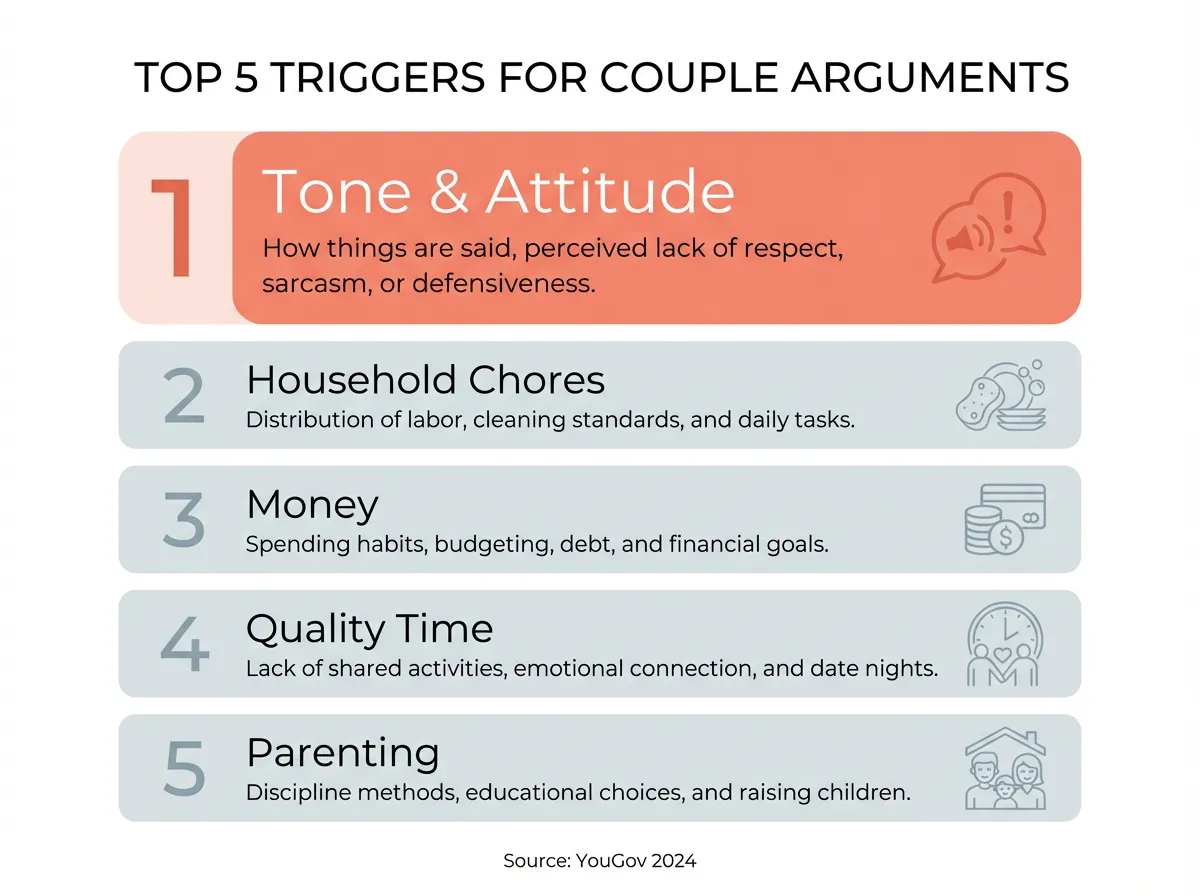
Here's the uncomfortable truth: most couple arguments don't escalate because of what was said. They escalate because of how it was said. A 2024 YouGov survey found that tone and attitude is the single most common trigger for arguments among couples — outranking money, household chores, and even parenting disagreements. Yet almost all relationship advice focuses on choosing the right words. Meanwhile, the real damage is happening in the frequency, rhythm, and emotional texture of your voice before a single "important" word leaves your mouth.
This article breaks down why tone of voice in relationships holds so much destructive power, what's actually happening in your brain when you react to a partner's tone, and — most importantly — what you can do about it starting tonight.
Key Takeaways
- Tone of voice triggers more arguments than any specific topic. YouGov data confirms that perceived attitude is the #1 catalyst for couple conflicts.
- Your nervous system reacts to tone before your brain processes words. This means your partner may be responding to a threat signal you didn't intend to send.
- The "content trap" keeps couples stuck. Arguing about what was said instead of how it landed ensures the real issue never gets addressed.
- Tone is a skill, not a personality trait. Specific, learnable adjustments — like pacing, volume, and vocal warmth — can interrupt escalation cycles.
- Repair attempts matter more than perfection. Catching a harsh tone mid-sentence and correcting it is more powerful than never slipping up at all.
Why Tone of Voice in Relationships Matters More Than Words
In the 1960s, psychologist Albert Mehrabian conducted studies on how people interpret emotional communication. His often-misquoted (but still directionally useful) finding: when words and tone conflict, people believe the tone. If you say "I'm not mad" through gritted teeth with a clipped cadence, no one — least of all your partner — believes the words.
This isn't a flaw. It's a feature of human communication. For most of evolutionary history, we didn't have language. We had pitch, volume, pace, and rhythm. Those channels are older, faster, and more trusted by the brain.
What the Research Actually Shows
The YouGov survey data is striking in its specificity. When asked what triggers arguments most frequently, couples ranked their answers as follows:
- Tone and attitude — the clear frontrunner
- Household chores and division of labor
- Money and spending habits
- Quality time and feeling neglected
- Parenting differences
Notice what's at the top. Not finances. Not sex. Not in-laws. Tone. The thing most relationship advice treats as a footnote is actually the headline.
John Gottman's research at the University of Washington adds another layer. His team can predict divorce with over 90% accuracy, and one of their most reliable markers is what they call a "harsh startup" — beginning a conversation with criticism, contempt, or a hostile tone. If the first three minutes of a conflict conversation are harsh in tone, the conversation fails 96% of the time. Not sometimes. Nearly always.
The Neuroscience: Why Your Partner Reacts Before You Finish Your Sentence
To understand why tone carries such outsized power, you need to understand what's happening below conscious awareness.
The Amygdala Hijack
Your amygdala — the brain's threat-detection center — processes auditory signals in roughly 50 milliseconds. That's about twenty times faster than the prefrontal cortex (the part that interprets word meaning and context). When your partner hears a sharp, clipped, or contemptuous tone, their threat system activates before they've processed your actual sentence.
This is why you get responses like "Why are you yelling at me?" when you don't think you were yelling. Their nervous system detected a threat in your vocal pattern that your conscious mind didn't register sending.
Polyvagal Theory and Vocal Cues
Stephen Porges's polyvagal theory explains this even further. The human ear is specifically tuned to detect safety or danger in vocal frequencies. Warm, melodic, mid-range tones signal safety. Flat, low, monotone, or high-pitched sharp tones signal threat. Your partner's autonomic nervous system is literally scanning your voice for danger — constantly, involuntarily, and before any word content is processed.
This means that when you say, "Can we talk about the budget?" in a flat, low tone with no vocal warmth, your partner's body may be preparing for a fight before you've reached the word "budget."
The Content Trap: Why Couples Argue About the Wrong Thing
Here's the pattern that keeps couples stuck for years:
- Partner A says something in a tone that triggers Partner B's threat response.
- Partner B reacts defensively or with counter-hostility.
- Partner A is confused and hurt because they focus on what they said (which was reasonable).
- The argument becomes about the content — the chicken, the budget, the in-laws — instead of the tone that ignited it.
- Neither partner feels heard, because they're solving different problems.
We call this the content trap. It's the reason couples can argue about the same topic fifty times without resolution. The topic was never the real problem. The felt experience of being spoken to with contempt, dismissiveness, or irritation was.
A Realistic Example
Consider Maya and James (names changed). They came to mediation arguing about household chores — specifically, who cleans the kitchen after dinner. But when they described their arguments in detail, a pattern emerged:
- Maya would ask James if he'd cleaned the kitchen. Her tone, by her own admission, carried "an edge" because she'd asked before.
- James would hear that edge and respond with a defensive, clipped "I said I'd do it."
- Maya would hear his defensiveness and escalate: "You always say that."
- Within ninety seconds, they weren't arguing about the kitchen. They were arguing about respect, reliability, and whether the other person even cared.
The kitchen was never the problem. The tone — and the cascade of nervous system reactions it triggered — was the problem.
How to Change Your Tone: Practical, Non-Obvious Strategies
The advice "watch your tone" is about as useful as "just relax" during a panic attack. You need specific, actionable techniques. Here are strategies grounded in communication research and clinical practice.
1. Master the First Five Words
Gottman's research on harsh startups means the opening of any conversation is disproportionately important. Before you bring up something potentially sensitive, consciously choose to begin with softness.
Instead of: "We need to talk about the credit card bill." (flat, ominous) Try: "Hey, when you have a minute, I want to figure out the credit card stuff together." (warm, collaborative)
The content is nearly identical. The tone is completely different. "We need to talk" activates threat. "When you have a minute" signals respect. "Figure out together" signals partnership.
2. Use the Volume-Down Technique
When you notice a conversation heating up, deliberately lower your volume by about 20%. Not to a whisper — that can feel passive-aggressive — but enough to signal de-escalation to your partner's nervous system.
This works because of a phenomenon called neural entrainment: our nervous systems tend to mirror the vocal patterns around us. When you slow down and soften, you're literally inviting your partner's nervous system to do the same.
3. Name the Tone, Not the Content
This is perhaps the most powerful move a couple can learn. When you feel yourself reacting to your partner's tone, name that — not the words.
Instead of: "I can't believe you'd say that!" (responding to content) Try: "I want to hear what you're saying, but the way it's landing feels harsh. Can you say it differently?"
This does three things simultaneously: - It identifies the real issue (tone, not topic) - It assumes good intent ("I want to hear you") - It offers a concrete path forward ("say it differently")
4. Build a Tone Agreement
Many couples have explicit agreements about finances, parenting, and household responsibilities — but none about how they'll speak to each other when stressed. Consider sitting down during a calm moment and agreeing on specifics:
- "When one of us notices the other's tone shifting, we'll say 'checkpoint' as a neutral signal."
- "We'll start difficult conversations with a physical gesture of connection — a hand on the arm, a moment of eye contact."
- "If either of us can't regulate our tone, we take a 20-minute break. No exceptions, no resentment."
These aren't restrictions. They're guardrails that protect the relationship when emotions are running hot. AI-powered mediation platforms like Servanda can help couples formalize these kinds of agreements in writing, making them easier to revisit and harder to forget when it matters most.

5. Practice the Repair, Not the Perfection
You will not always get your tone right. That's not the goal. The goal is quick repair.
A repair attempt sounds like: - "That came out harsher than I meant. Let me try again." - "I'm hearing myself and I don't like my tone. Give me a second." - "I'm frustrated, but not at you. Sorry it's sounding that way."
Gottman's research shows that successful couples don't fight less — they repair faster. The ability to catch a harsh tone mid-conversation and correct it is actually a stronger predictor of relationship health than never having a harsh tone at all.
The Listener's Responsibility: Tone Perception Isn't Always Accurate
This article would be incomplete without addressing the other side. Sometimes, the tone your partner hears isn't the tone you sent.
Our perception of tone is filtered through:
- Current stress levels: When you're already activated, neutral tones sound hostile.
- Attachment history: If a parent communicated disappointment through sighs and clipped words, your partner's sigh may trigger an outsized response.
- Confirmation bias: If you already believe your partner is annoyed with you, you'll hear annoyance in everything.
This is why both partners bear responsibility. The speaker works to deliver warmth and intention. The listener works to check their filters before reacting.
A simple check-in: "I'm hearing frustration in your voice. Is that what you're feeling, or am I reading into it?" This one question can prevent countless unnecessary escalations.
When Tone Problems Indicate Something Deeper
Sometimes a chronically harsh tone isn't a communication skills issue. It's a symptom.
- Chronic contempt — if one partner consistently uses a mocking, sarcastic, or belittling tone — is what Gottman calls the single greatest predictor of divorce.
- Emotional exhaustion can flatten a person's vocal warmth, making them sound cold or indifferent without intending to.
- Unresolved resentment often leaks out as "edge" in tone long before it's ever stated directly.
If tone issues persist despite genuine effort from both partners, it's worth exploring what's underneath with a professional. The tone may be the messenger, not the message.
Frequently Asked Questions
Why does my partner get so upset about my tone when I didn't say anything wrong?
Your partner's nervous system processes tone roughly 20 times faster than word meaning. Even if your words are perfectly reasonable, a clipped, flat, or sharp tone can trigger a defensive response before they've consciously interpreted your sentence. Their reaction isn't irrational — it's neurological.
How do I bring up my partner's tone without starting another argument?
Timing matters. Don't address it in the heat of the moment with an accusation like "Your tone is terrible." Instead, wait for a calm moment and use an observation: "I've noticed that when we talk about X, there's an edge that makes it hard for me to stay open. Can we figure out a way to flag that in the moment?" This makes it a shared problem, not a personal attack.
Can tone of voice really cause a breakup?
Yes. Research from the Gottman Institute shows that contemptuous tone — mocking, sarcastic, belittling — is the single strongest predictor of divorce. It's not that one eye-roll ends a marriage. It's that a pattern of dismissive or hostile tone erodes trust, safety, and affection over months and years until there's nothing left to repair.
What if I genuinely can't control my tone when I'm angry?
That's a regulation issue, not a character flaw, and it's very common. The most effective strategy is pre-commitment: agree with your partner in advance that when either of you can't control your tone, you take a 20-minute break. This isn't avoidance — it's giving your prefrontal cortex time to come back online so you can speak with intention rather than reactivity.
Is tone more important than the actual words I use?
In emotionally charged conversations, yes. Studies consistently show that when tone and content conflict, people trust the tone. You can use textbook conflict-resolution language, but if it's delivered with sarcasm or coldness, your partner will respond to the feeling, not the words. Warmth in delivery makes even difficult messages land more safely.
Moving Forward: Small Shifts, Big Impact
Tone of voice in relationships is the invisible architecture of every conversation. It determines whether your partner feels safe or threatened, respected or dismissed, loved or tolerated — often before a single meaningful word is spoken.
The good news: you don't have to overhaul your entire communication style overnight. Start with one thing. Maybe it's softening your first five words. Maybe it's lowering your volume when things get heated. Maybe it's simply asking, "Is my tone landing the way I intend?"
These aren't grand gestures. They're micro-adjustments that, over time, fundamentally change the emotional climate of your relationship. Because the couples who last aren't the ones who never slip up — they're the ones who notice, name it, and try again. That's not weakness. That's the actual work of love.