Why Couples Fight About Tone, Not Topics
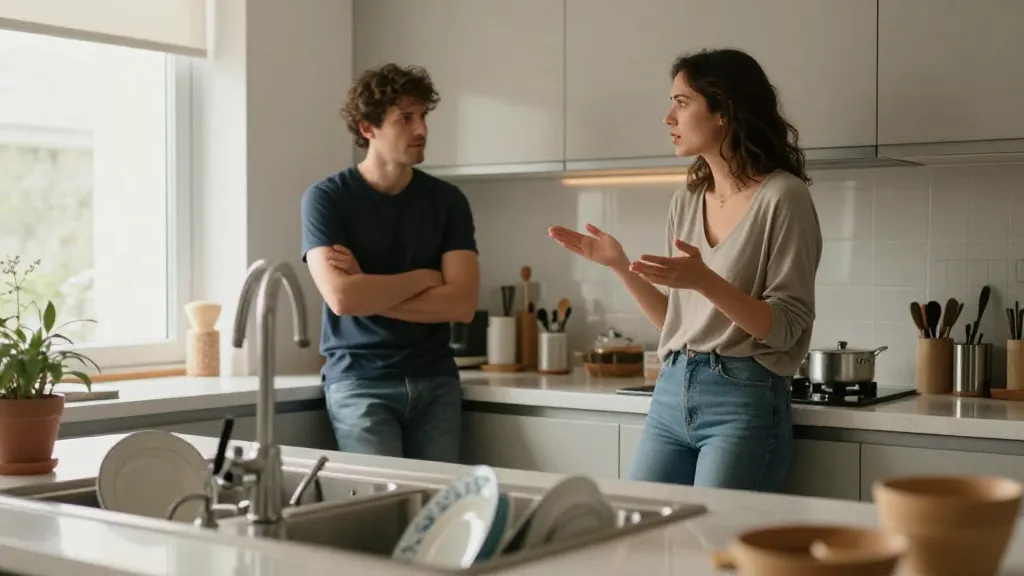
It starts with a dish in the sink. Or maybe a forgotten errand. Your partner says something—the words themselves are harmless enough—but something in the way they say it lands like a slap. Your jaw tightens. You snap back. Within ninety seconds, you're in a full-blown argument about respect, appreciation, and whether anyone in this relationship actually listens.
Sound familiar? You're not alone, and you're not imagining things. Recent research highlighted in Psychology Today confirms what many couples intuitively feel: tone—not the actual topic—is the number one trigger for arguments in romantic relationships. Not money. Not chores. Not parenting disagreements. The how eclipses the what almost every time.
This realization is both disorienting and liberating. Disorienting because it means many of the "solutions" couples chase—splitting finances more fairly, creating chore charts—miss the real problem. Liberating because tone is something you can learn to notice, name, and change starting today.
Key Takeaways
- Tone is the #1 argument trigger in couples, outranking classic topics like money, sex, and household labor.
- Your nervous system reacts to tone before your brain processes words. That's why an innocent sentence can feel like an attack.
- Naming the tone shift out loud ("I notice this feels tense") is more effective than debating who said what.
- Repair attempts matter more than perfect delivery. Couples who recover quickly from tone missteps have stronger relationships than couples who never misstep at all.
- A 5-second pause before responding can interrupt the escalation cycle and give your prefrontal cortex time to catch up.
The Science Behind Why Tone Triggers Us More Than Topics
Here's what's happening under the surface when your partner's tone sets you off: your brain is doing exactly what it evolved to do.
Your Brain Processes Tone Before Words
Neuroscience research shows that the amygdala—the brain's threat-detection center—responds to vocal prosody (pitch, rhythm, volume) faster than the prefrontal cortex can decode the actual meaning of words. In evolutionary terms, this makes sense. A saber-toothed tiger didn't give speeches. Your ancestors survived by reading vocal cues instantly: is this sound safe or dangerous?
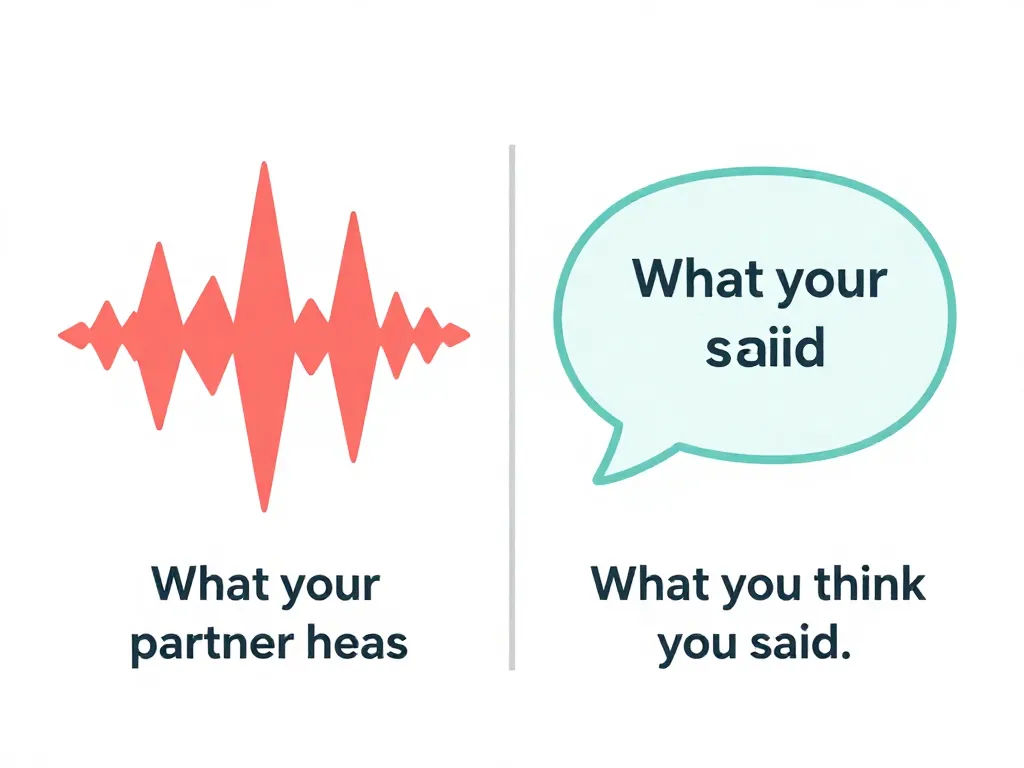
In a modern relationship, this wiring means your partner can say, "Sure, I'll take care of it," and depending on the tone, your nervous system hears either "I've got you" or "You're being unreasonable, and I resent you for asking." The words are identical. The emotional experience is worlds apart.
The Gottman Research on Contempt
Dr. John Gottman's decades of research at the University of Washington identified contempt—communicated almost entirely through tone, facial expression, and body language—as the single strongest predictor of divorce. Not disagreement frequency. Not topic severity. Contempt. Eye rolls, sarcasm, a dismissive scoff. These tonal cues signal something far more threatening than any argument about who forgot to pay the electric bill: they signal, "I don't respect you."
Why "Nothing" Fights Feel So Big
This is why couples often describe their worst arguments as erupting "over nothing." From the outside—and even from the inside—the topic genuinely is trivial. But the tone carried a message that struck at something core: belonging, respect, safety. When your partner asks, "Did you seriously not do that yet?" the topic might be laundry. The tone is saying, "You're incompetent." Your brain doesn't fight about laundry. It fights about incompetence.
How Tone Hijacks an Otherwise Healthy Conversation
Let's trace the anatomy of a tone-triggered argument with a realistic example.

A Scene You Might Recognize
Maya and Jordan have been together for six years. They genuinely like each other. They agree on most things. But lately, small conversations keep detonating.
One evening, Maya asks Jordan about an upcoming family dinner. Her actual words: "Have you called your mom about Saturday?"
But Maya's had a long day. She's asked about this twice before. Without realizing it, her voice carries an edge—a slight rise in pitch at the end, a clipped cadence that signals impatience.
Jordan hears: You never follow through. I have to manage everything.
Jordan responds defensively: "I said I'd handle it. Why do you always have to check up on me?"
Now Maya hears a counter-tone: condescension, dismissal. The conversation about a phone call becomes a 40-minute argument about trust, reliability, and who carries the mental load in the relationship.
Notice: at no point did either person say anything objectively hostile. The words on paper are benign. The tones were not.
The Escalation Ladder
Tone-triggered arguments tend to follow a predictable escalation pattern:
- Triggering tone — One partner delivers a message with unintended (or semi-intended) vocal edge
- Threat detection — The other partner's nervous system flags the tone as hostile
- Defensive counter-tone — The second partner responds with their own sharpness
- Topic abandonment — The original subject disappears entirely
- Meta-argument — The fight shifts to "Why do you always talk to me like that?" or "You're so sensitive"
- Shutdown or blowup — One partner withdraws (stonewalls) or the argument intensifies
If you've ever found yourself mid-argument thinking, Wait, what are we even fighting about?—you've experienced this ladder firsthand.
What Couples Actually Fight About (And What They Think They Fight About)
Surveys consistently rank money, household chores, sex, and parenting as the "most common" relationship arguments. And those topics do generate conflict. But when researchers dig deeper into what actually escalates a disagreement into a fight, tone and perceived disrespect dominate.
A 2023 survey from the Institute for Family Studies found that couples who reported high satisfaction weren't arguing less—they were arguing differently. The distinguishing factor wasn't topic avoidance. It was emotional tone during disagreements.
Here's a useful reframe:
| What couples say they fight about | What's actually triggering the fight |
|---|---|
| Money | Feeling controlled or dismissed when raising financial concerns |
| Chores | Feeling like a request was delivered as a command |
| In-laws | Feeling like your partner's tone shifts to defensiveness when family is mentioned |
| Screen time | Feeling ignored, signaled by distracted or flat vocal tone |
| Parenting decisions | Feeling undermined through a condescending tone in front of children |
The topic provides the stage. Tone writes the script.
5 Practical Ways to Break the Tone Cycle
Understanding the problem is useful. Knowing what to do about it is better. These strategies are drawn from research in affective neuroscience and clinical couples therapy, and each one is something you can try tonight.
1. Name the Tone, Not the Content
When you feel a conversation shifting, resist the urge to argue about the topic and instead name what you're noticing in the tone—starting with your own experience, not an accusation.
- Instead of: "Why are you being rude?"
- Try: "Something about this conversation is starting to feel tense to me. Can we slow down?"
This works because it moves the interaction from limbic reactivity (threat response) to prefrontal processing (reflection). Naming an emotion literally reduces its neurological intensity—a phenomenon researchers call "affect labeling."
2. The 5-Second Pause
When you notice your partner's tone triggering you—or when you catch yourself about to deliver a line with edge—pause for five seconds. This isn't about suppressing emotions. It's about giving your prefrontal cortex time to come online.
Practically, you can: - Take one slow breath - Take a sip of water - Mentally say, "I can respond instead of react"
Five seconds is often enough to choose a different vocal register.
3. Use What Therapists Call a "Soft Startup"
Gottman's research found that 96% of conversations end on the same emotional note they begin on. This means your opening tone essentially predicts the entire interaction.
A soft startup includes: - Starting with "I" instead of "You" — "I've been feeling stressed about the schedule" vs. "You never help with the schedule" - Describing your feeling, not your partner's character — "I feel overlooked" vs. "You're so selfish" - Making a specific, positive request — "Could we sit down for ten minutes tonight to plan the week?" vs. "We need to talk" (which, tonally, sounds like a threat to most people)
4. Repair Early and Often
Here's the most encouraging finding from couples research: successful couples don't avoid tone missteps. They repair them quickly.
A repair attempt can be as simple as: - "That came out harsher than I meant. Let me try again." - "I can hear my tone getting sharp. I'm not frustrated with you—I'm just tired." - "I'm sorry. That sounded dismissive, and I didn't mean it to."
These micro-corrections, offered genuinely, do more for relationship health than weeks of perfectly calibrated communication. They signal: I noticed. I care. You matter more than being right.
5. Debrief After the Storm
Once the emotional charge has dissipated (give it at least 20 minutes—that's how long physiological flooding takes to subside), revisit the interaction together. Not to relitigate who was right, but to understand each other's experience.
Try these debrief questions: - "What did you hear in my tone that upset you?" - "What was I actually feeling when I said that?" - "What would have helped in that moment?"
Some couples find it helpful to write down their tone-related agreements—things like "We'll both try to pause before responding when we feel defensive" or "If one of us says 'I need a softer tone,' the other will take that seriously without defensiveness." AI-powered mediation platforms like Servanda can provide structure for creating these kinds of written agreements when emotions aren't running hot, making it easier to reference them when they eventually do.
When Tone Problems Signal Something Deeper
It's important to distinguish between normal tone friction—which every couple experiences—and patterns that indicate a deeper issue.
Consider seeking professional support if:
- One partner consistently uses contemptuous tone (sneering, mocking, sarcasm as a default) and dismisses feedback about it
- Tone policing becomes a control mechanism — "I'll only listen to you if you say it the right way" used to avoid accountability
- You feel like you're walking on eggshells, constantly monitoring your tone out of fear rather than care
- Repair attempts are routinely rejected — one partner refuses to accept bids for reconnection
These patterns may benefit from work with a licensed couples therapist who can help identify whether tone issues are situational stress responses or symptoms of deeper relational dynamics like attachment insecurity or emotional abuse.
FAQ
Is it normal to fight about tone in a relationship?
Absolutely. Virtually every couple argues about tone at some point because our brains are wired to interpret vocal cues as emotional signals. It becomes a concern only when tone conflicts follow a rigid, recurring pattern where repair is absent and one or both partners feel emotionally unsafe.
How do I tell my partner their tone bothers me without starting another fight?
Timing and framing are everything. Bring it up during a calm moment, not mid-argument. Use language like, "I've noticed that when conversations get tense, I react more to how we're talking than what we're discussing. I think that happens for both of us. Can we come up with a signal for when we need to soften things?" This positions it as a shared pattern, not a personal attack.
What if I don't realize my own tone is the problem?
This is incredibly common—most people are surprisingly unaware of their own vocal tone under stress. Ask your partner to gently point it out in the moment using an agreed-upon phrase (something neutral like "tone check" or even a hand signal). You can also try recording a low-stakes conversation and listening back, which is often eye-opening.
Can tone problems actually end a relationship?
Yes. Gottman's research shows that persistent contemptuous tone is the strongest predictor of divorce, more powerful than the frequency or severity of arguments. Tone communicates respect or the absence of it, and sustained disrespect erodes love over time—even when the words themselves seem fine.
What's the difference between tone policing and setting a boundary about tone?
Tone policing dismisses someone's valid message because of how they delivered it ("I won't listen until you calm down"). Setting a boundary is different—it acknowledges the message while requesting a delivery change ("I want to hear what you're saying, and I'll be able to take it in better if we can both lower the intensity"). The key distinction is whether the goal is to silence or to connect.
Moving Forward: It's Not About Perfection
The point of understanding why couples fight about tone is not to achieve some impossible standard of vocal serenity. You're going to snap sometimes. Your partner is going to use a voice that makes your skin crawl. That's the human condition under stress.
What changes outcomes is awareness—noticing the tone shift as it happens, naming it without blame, and repairing quickly when you miss the mark. The research is clear: couples who recover well from tone missteps are more resilient and more satisfied than couples who try to never misstep at all.
So the next time an argument erupts over "nothing," pause. Check the tone. That's probably where the real conversation lives. And the fact that you're reading this, thinking about these patterns, and looking for ways to do better? That's already a meaningful step toward the kind of relationship where both people feel heard—not just in what they say, but in how they're spoken to.