
The 4 Horsemen: Why Your Arguments Escalate
It starts with something small. A sink full of dishes. A forgotten errand. A text that went unanswered for hours. Somehow, within minutes, you're not talking about dishes anymore — you're talking about everything. Who does more. Who cares less. Who always does this, who never does that.
You both walk away feeling gutted, and neither of you can quite explain how a minor annoyance became a full-blown fight.
If this sounds familiar, you're dealing with what renowned relationship researcher Dr. John Gottman calls the Four Horsemen of the Apocalypse — four destructive communication patterns that hijack everyday disagreements and turn them into relationship-threatening blowups. The good news: once you can name them, you can stop them. This article will help you identify which horseman rides hardest in your relationship and give you word-for-word scripts to unseat each one before it causes lasting damage.
Key Takeaways
- The Four Horsemen — criticism, contempt, defensiveness, and stonewalling — are predictable patterns that escalate arguments far beyond the original issue.
- Contempt is the single strongest predictor of divorce, but every horseman can be countered with a specific, learnable skill called its "antidote."
- Most couples use more than one horseman, and they often appear in a chain reaction: criticism triggers defensiveness, which invites contempt, which leads to stonewalling.
- You don't need to be perfect — you need to be aware. Even catching a horseman mid-sentence and course-correcting makes a measurable difference.
- Concrete scripts and repair phrases can interrupt these patterns in real time, before a disagreement becomes a wound.
What Are the 4 Horsemen and Why Do They Make Arguments Escalate?
In the 1990s, Dr. John Gottman and his research team at the University of Washington studied thousands of couples in what journalists nicknamed "The Love Lab." By observing just fifteen minutes of a couple's conflict conversation, Gottman could predict with over 90 percent accuracy whether they'd still be together years later.
The key variable wasn't what couples argued about — nearly every couple fights about money, chores, sex, or in-laws. The variable that predicted breakups was how they argued. Specifically, Gottman identified four toxic communication behaviors that, left unchecked, erode trust, intimacy, and eventually the relationship itself.
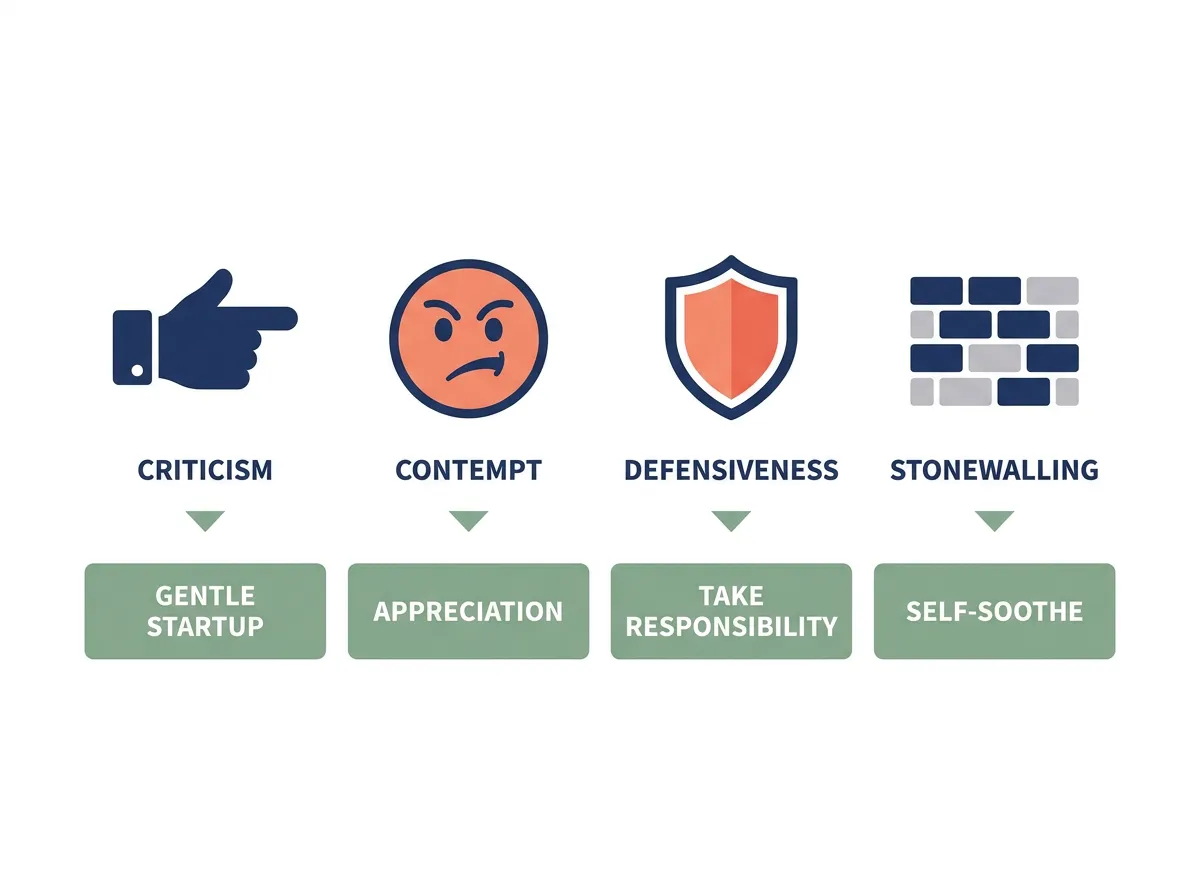
These are the Four Horsemen:
- Criticism — Attacking your partner's character instead of addressing a specific behavior.
- Contempt — Communicating superiority and disgust through sarcasm, mockery, or eye-rolling.
- Defensiveness — Deflecting responsibility by counter-attacking or playing the victim.
- Stonewalling — Shutting down entirely, withdrawing, or refusing to engage.
They tend to appear in this order, building on each other like a chain reaction. Understanding each one — and knowing its antidote — is the single most practical step you can take to stop arguments from escalating.
Horseman #1: Criticism
What It Sounds Like
Criticism isn't the same as a complaint. A complaint focuses on a specific situation: "I was worried when you didn't call to say you'd be late." Criticism makes it personal: "You never think about anyone but yourself. You're so selfish."
Notice the shift. The complaint says, "Here's what happened and how I feel." The criticism says, "Here's what's wrong with you." Words like always, never, and you are are telltale signs.
Why It Escalates Arguments
Criticism puts your partner on trial. When people feel their character is under attack — not just their behavior — they stop listening and start defending. The original issue (coming home late, forgetting an errand) gets buried under a much bigger, much scarier question: Do you even think I'm a good person?
A Realistic Example
María and James have a recurring fight about weeknight dinners. María gets home first and usually cooks. When James walks in at 7:30 without having texted, she doesn't say, "I felt frustrated cooking alone again — can we figure out a plan?" Instead, she says, "You literally don't care about this family. I do everything around here."
James hears: You're a bad partner and a bad father. He didn't hear a request. He heard a verdict.
The Antidote: Gentle Startup
Replace the character attack with a formula Gottman calls the gentle startup: "I feel [emotion] about [specific situation], and I need [specific request]."
Script to try tonight:
"I feel overwhelmed when I handle dinner by myself on weeknights. Could we sit down this weekend and plan who cooks which nights?"
This isn't about being polite for politeness' sake. It's about making it possible for your partner to actually hear you and respond to what you need.
Horseman #2: Contempt
What It Sounds Like
Contempt goes beyond criticism. It communicates that your partner is beneath you. It shows up as:
- Sarcasm dripping with hostility: "Oh, congratulations, you managed to take out the trash. Do you want a trophy?"
- Name-calling: "You're pathetic."
- Eye-rolling, sneering, or mocking body language
- Hostile humor disguised as jokes
Why It's the Most Dangerous Horseman
Gottman's research identifies contempt as the number one predictor of divorce. It doesn't just attack what your partner did — it attacks who your partner is, from a position of moral superiority. Contempt says, "I'm better than you. You're beneath basic respect."
No one can problem-solve from that position. Contempt kills not only the conversation but, over time, the emotional safety the entire relationship depends on. Gottman's research even found that couples with high levels of contempt are more likely to suffer from infectious illness — the stress is that physiologically damaging.

A Realistic Example
Daniel and Priya are arguing about finances. Daniel just found out Priya made an unplanned purchase. Instead of saying how he feels, he sneers: "Wow, real smart. You know, some of us actually think before we spend money. But I guess that's too much to ask from you."
Priya doesn't hear concern about the budget. She hears: You think I'm stupid.
The Antidote: Build a Culture of Appreciation
Contempt grows in an environment of unspoken resentment. The long-term antidote is deliberately building a culture of fondness and admiration — regularly expressing what you respect, appreciate, and value about your partner. Not just during fights, but especially when things are calm.
The in-the-moment antidote is to speak from your own experience rather than from a position of judgment.
Script to try tonight:
"I got anxious when I saw that charge because I've been stressed about our savings goal. Can we look at the budget together?"
Daily practice: Each day, tell your partner one specific thing you appreciate about them. Not "You're great" — something concrete: "Thank you for packing the kids' lunches this morning. I noticed, and it helped." This builds a buffer against contempt.
Horseman #3: Defensiveness
What It Sounds Like
Defensiveness is the almost-universal response to feeling attacked. It takes two common forms:
- Counter-attacking: "Well, you're not exactly perfect either — what about the time you..."
- Playing the innocent victim: "I don't know why you're blaming me. I can't do anything right in your eyes."
Why It Escalates Arguments
Defensiveness feels justified in the moment — you're protecting yourself. But to your partner, it sends a clear message: Your feelings don't matter, and I refuse to take any responsibility. This usually provokes the other person to escalate — they speak louder, bring up more examples, or shift into contempt — because they feel unheard.
Defensiveness is a perpetual motion machine. It keeps the argument spinning without either partner ever landing on the actual issue.
A Realistic Example
Sophie tells Amir, "I've asked you three times to call the landlord about the leak." Amir responds, "I've been slammed at work — you have no idea how much pressure I'm under. Why don't you call the landlord?"
The leak still isn't fixed. Sophie feels dismissed. Amir feels attacked. They're now arguing about who has the harder life instead of about a leaking faucet.
The Antidote: Take Responsibility (Even Partial)
You don't have to accept 100 percent of the blame. You just have to acknowledge your partner's experience and own your piece, however small.
Script to try tonight:
"You're right — you did ask me several times, and I dropped the ball. Work has been intense, but that's not your problem to manage. I'll call tomorrow morning. Can you text me a reminder at 9?"
Notice how this script doesn't require Amir to grovel. He names the reality (he forgot), acknowledges her frustration (she asked multiple times), and proposes a concrete next step. That's enough to break the cycle.
Horseman #4: Stonewalling

What It Sounds Like
Stonewalling is the withdrawal. The shutdown. The blank stare, the monosyllabic answers, the partner who walks out of the room mid-conversation. In heterosexual couples, research shows men stonewall more often — about 85 percent of stonewallers in Gottman's studies were male — but anyone can do it.
Stonewalling often looks like someone choosing not to engage. In reality, it's usually a sign of physiological flooding — the person's heart rate has spiked above 100 beats per minute, their stress hormones are surging, and their prefrontal cortex (the part of the brain responsible for rational thought) has effectively gone offline.
They're not ignoring you to be cruel. They literally cannot process the conversation anymore.
Why It Escalates Arguments
To the partner still talking, stonewalling feels like abandonment. It communicates, "You're not even worth responding to." This often causes the other person to pursue harder — raising their voice, following from room to room, escalating to get any reaction. Which only increases the stonewaller's flooding, creating a pursue-withdraw cycle that can become one of the most destructive dynamics in any relationship.
A Realistic Example
During an argument about holiday plans, Taylor shuts down completely. They stop making eye contact, start scrolling their phone, and respond to every question with "Fine" or "Whatever." Their partner, Jordan, grows increasingly frantic: "Are you even listening to me? Hello? Do you not care at all?"
Taylor isn't being dismissive on purpose. Their nervous system has hit a wall. But Jordan has no way to know that unless Taylor tells them.
The Antidote: Structured Self-Soothing
The antidote to stonewalling is physiological self-soothing — but it requires communicating what you need instead of silently checking out.
Script to try tonight:
"I'm starting to flood and I can't think clearly right now. I'm not abandoning this conversation — I need 20 minutes to calm my nervous system. Let's come back to this at [specific time]."
During the break: - Do something physically calming: walk, breathe deeply, stretch - Don't rehearse the argument or build your case in your head - Set a timer so your partner trusts you'll return
The key commitment: you come back. A break is only an antidote if it ends with re-engagement.
How the 4 Horsemen Work Together: The Escalation Chain
In practice, the horsemen rarely appear in isolation. Here's how a typical escalation chain unfolds:
- Criticism opens the door: "You always forget to..."
- Defensiveness responds: "That's not fair — you do the same thing!"
- Contempt raises the stakes: "God, you're unbelievable. A child could handle this better."
- Stonewalling ends the conversation: One partner goes silent or walks away.
Nothing gets resolved. Both people feel hurt. The issue returns a week later, carrying the emotional residue of every previous fight about it. Over months and years, this cycle creates what Gottman calls "negative sentiment override" — a state where even neutral or positive actions by your partner get interpreted through a negative lens.
The earlier in this chain you intervene, the less damage each argument does.
A Practical Plan to Disarm the Horsemen in Your Relationship
You don't need to overhaul your entire communication style overnight. Start here:
Step 1: Identify Your Default Horseman
Most people have a go-to pattern. Ask yourself honestly: - Do I tend to start conversations with "You always" or "You never"? → Criticism - Do I find myself feeling superior or disgusted during fights? → Contempt - Is my first instinct to explain why I'm not wrong? → Defensiveness - Do I shut down, go blank, or leave the room? → Stonewalling
Step 2: Share Your Discovery With Your Partner
This isn't about blame — it's about building shared awareness. Try: "I've been reading about conflict patterns, and I think I default to [horseman]. I want to work on it. Can I tell you what I've learned?"
Step 3: Agree on a Repair Word
Pick a word or phrase you can both use mid-argument to signal, "A horseman just showed up — let's pause and try again." Some couples use a simple "Can I have a redo?" Others pick a lighthearted code word. The point is to create a shared interruption that doesn't escalate further.
Step 4: Practice the Antidotes When Stakes Are Low
Don't wait for your next big fight to try a gentle startup. Practice these scripts during low-stakes moments — discussing weekend plans, dividing errands, deciding what to watch. Build the muscle before you need it. When emotions run especially high and you find yourselves stuck in a cycle, AI-powered mediation tools like Servanda can provide structure by guiding you both through written agreements so the resolution actually sticks.
Step 5: Debrief After Conflicts
After a disagreement — once you've both cooled down — revisit the conversation briefly: - "What horseman showed up?" - "What triggered it?" - "What could we try differently next time?"
This turns conflicts into data instead of just damage.
FAQ
Is it normal for all four horsemen to show up in a relationship?
Yes. Nearly every couple experiences all four horsemen at some point. The presence of these patterns doesn't mean your relationship is doomed — it's how frequently they appear and whether you learn to counteract them that matters. Gottman's research shows that even highly satisfied couples slip into these behaviors occasionally; what sets them apart is their ability to repair quickly.
Which of the four horsemen is the worst?
Contempt is consistently identified in research as the most destructive of the four horsemen and the strongest single predictor of divorce. Unlike criticism, which attacks behavior, contempt attacks your partner's sense of self-worth from a position of superiority. If contempt has become a regular feature in your arguments, prioritizing its antidote — building a culture of daily appreciation — is especially urgent.
Can you fix the four horsemen without couples therapy?
Many couples make significant progress on their own by learning the framework, practicing the antidotes, and debriefing after conflicts. However, if contempt or stonewalling has become deeply entrenched, or if arguments consistently leave one or both partners feeling emotionally unsafe, working with a Gottman-trained therapist can accelerate the process and provide personalized guidance that articles alone can't offer.
How long does it take to change these argument patterns?
There's no universal timeline, but most couples notice a shift within a few weeks of consistently practicing the antidotes — especially the gentle startup and taking partial responsibility. The goal isn't perfection; it's catching the horseman sooner each time it appears. Over months, the patterns weaken as new habits of repair and de-escalation become more automatic.
What if only one partner is willing to work on this?
Change from one partner still changes the dynamic. If you begin using gentle startups instead of criticism, or take responsibility instead of getting defensive, your partner's response will often shift too — even without them consciously working on it. Relational patterns are like dances: when one person changes their steps, the other person can't keep doing the same moves.
Moving Forward: Small Shifts, Big Impact
The four horsemen aren't character flaws — they're habits. Deeply grooved, often learned-in-childhood habits, but habits nonetheless. And habits can be changed.
You don't need to never criticize, never get defensive, never shut down again. You need to notice sooner, name it honestly, and reach for the antidote — even imperfectly, even mid-sentence.
The couples who thrive aren't the ones who never fight. They're the ones who fight and repair. Every time you catch a horseman, pause, and try again, you're building the muscle that keeps your relationship resilient — not just for tonight's argument, but for the thousands of small and large conflicts that make up a shared life.
Start with one horseman. Learn one script. Try it once this week. That's enough.