
Gottman's Four Horsemen: Why You Really Fight
It's 9:47 on a Tuesday night. The dishes are piled in the sink again. You say something. Your partner says something back. Within ninety seconds, you're no longer talking about dishes — you're relitigating every unresolved frustration from the past six months. The argument ends the way it always does: one of you shuts down, the other walks away, and the dishes are still in the sink.
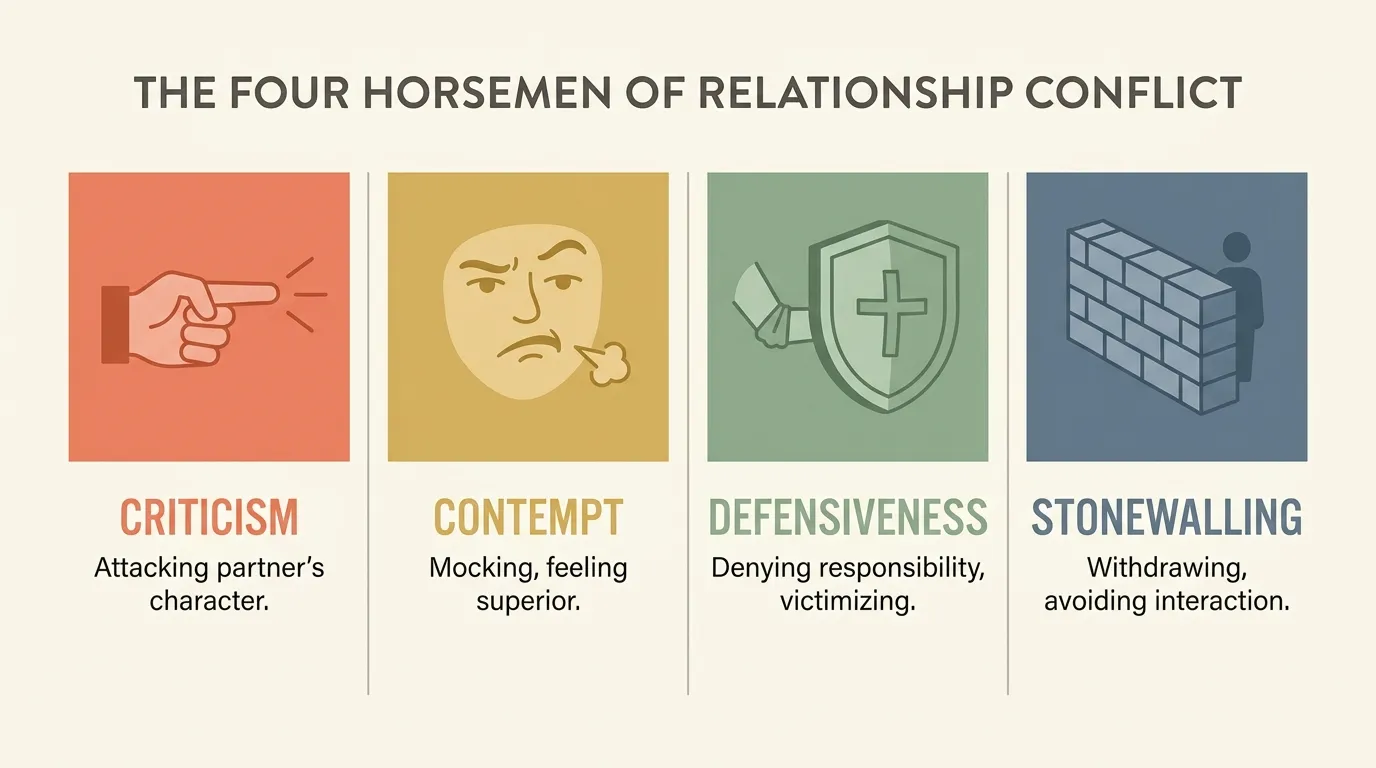
Sound familiar? You're not alone. Most couples believe they fight about chores, money, parenting, or schedules. But decades of research by Dr. John Gottman at the University of Washington reveal something deeper. The topic of the fight is almost never the real problem. The real problem is how you fight. Specifically, Gottman's Four Horsemen — criticism, contempt, defensiveness, and stonewalling — are four toxic communication patterns that predict relationship breakdown with startling accuracy. Recognizing which one you default to is the first step toward breaking the cycle.
Key Takeaways
- The subject of your argument is rarely the actual problem. Gottman's Four Horsemen — criticism, contempt, defensiveness, and stonewalling — are the destructive communication patterns fueling your recurring fights.
- Each horseman has a specific antidote. You don't need to become a perfect communicator; you just need to catch the pattern and apply one concrete correction.
- Contempt is the single strongest predictor of divorce. It signals a fundamental erosion of respect and must be addressed immediately.
- Stonewalling isn't about not caring — it's about being overwhelmed. Understanding the physiology behind it changes how both partners respond.
- You can start changing these patterns today with small, specific language shifts that require no therapist, no workbook, and no weekend retreat.
What Are Gottman's Four Horsemen?
In the early 1990s, Dr. John Gottman and Dr. Robert Levenson brought couples into a research lab nicknamed the "Love Lab" at the University of Washington. They observed thousands of couples during conflict conversations, measuring everything from heart rate to facial micro-expressions. What they found was remarkable: they could predict with over 90% accuracy whether a couple would divorce — not based on what they argued about, but based on the presence of four specific destructive behaviors.
Gottman named them the Four Horsemen of the Apocalypse because, left unchecked, they signal the death of a relationship. They tend to appear in a predictable sequence, each one inviting the next, creating a cascade that turns a minor disagreement into a relationship-threatening pattern.
Let's break each one down — what it sounds like, why it's so damaging, and exactly what to do instead.
Horseman #1: Criticism
What It Sounds Like
Criticism is different from a complaint. A complaint addresses a specific behavior: "I was upset that you didn't take out the trash last night." Criticism attacks your partner's character: "You never take out the trash. You're so lazy and selfish."
Notice the difference. One is about an event. The other is about identity.
Common criticism starters include: - "You always…" - "You never…" - "What's wrong with you?" - "Why can't you just…"
Why It's Destructive
Criticism frames the problem as a character flaw rather than a situational issue. When someone hears "you're selfish," they don't think about the trash — they feel attacked at their core. That triggers defense mechanisms, which sets the stage for Horseman #2 and beyond.
The Antidote: The Gentle Startup
Gottman's research shows that conversations almost always end on the same note they begin. If you start with an attack, you'll end with a fight. The antidote is what he calls a "gentle startup" — expressing your feeling and your need without assigning blame.
Instead of: "You never help around the house. I have to do everything."
Try: "I'm feeling overwhelmed with housework this week. Could we sit down and figure out how to split things differently?"
The formula is simple: I feel [emotion] about [specific situation], and I need [specific request].
This isn't about being soft or walking on eggshells. It's about being precise. You're more likely to get what you actually need when you ask for it clearly.
Horseman #2: Contempt
What It Sounds Like
Contempt goes beyond criticism. It communicates disgust and superiority. It says: I'm better than you. You're beneath me.
Contempt shows up as: - Sarcasm and mockery ("Oh, that's really mature.") - Eye-rolling - Hostile humor - Name-calling - Sneering
A real-world example: Imagine one partner says, "I forgot to pay the electric bill." The contemptuous response isn't frustration — it's something like, "Wow, what a surprise. You can't even handle one simple thing. I don't know why I trust you with anything."

Why It's the Most Dangerous Horseman
Of all four horsemen, contempt is the single greatest predictor of divorce. Gottman's research found that couples who display contempt are more likely to suffer from infectious illnesses, too — the stress is literally making them sick.
Contempt doesn't emerge overnight. It builds from a stockpile of unresolved negative thoughts about your partner. Every unaddressed frustration becomes another piece of evidence in an internal case you're building against them.
The Antidote: Build a Culture of Appreciation
The most effective counter to contempt is a daily practice of noticing what your partner does right. This isn't about ignoring problems. It's about rebalancing the ledger.
Gottman found that stable couples maintain a ratio of at least 5 positive interactions to every 1 negative interaction during conflict. Contempt thrives when that ratio inverts.
Practical steps: - Daily: Tell your partner one specific thing you appreciated that day. Not "thanks for everything" — something concrete, like "I noticed you packed the kids' lunches this morning without being asked. That really helped." - Weekly: Reflect privately on a moment when your partner showed effort, even imperfectly. - During conflict: Before responding, ask yourself: Am I addressing a behavior, or am I attacking their worth as a person?
Horseman #3: Defensiveness
What It Sounds Like
Defensiveness is the almost-automatic response to feeling attacked. It sounds reasonable on the surface — after all, you're just explaining your side. But functionally, defensiveness is a way of saying: The problem isn't me. It's you.
Common forms: - Counter-attacking: "Well, you forgot to pay last month's bill too." - Playing the victim: "I can't do anything right in your eyes." - Making excuses: "I would have done it, but you didn't remind me." - Yes-butting: "Yes, but you don't understand how busy I was."
Why It Escalates Conflict
Defensiveness blocks repair. When your partner raises an issue — even clumsily — and you deflect, they feel unheard. So they push harder, often escalating into criticism or contempt. The cycle feeds itself.
Here's the uncomfortable truth: defensiveness is almost never effective. Research shows it virtually never leads the other person to back down and say, "You know what, you're right, it's actually my fault." It just escalates.
The Antidote: Take Responsibility (Even Partially)
You don't have to accept 100% of the blame. You just have to own your part — even a small sliver.
Instead of: "That's not fair, I was working late every night this week."
Try: "You're right that I didn't follow through on that. I got overwhelmed with work and dropped the ball. Can we figure out a backup plan for weeks like this?"
Owning your piece of the problem does something powerful: it disarms the other person. It shifts the conversation from attack-and-defend to collaborative problem-solving.
Horseman #4: Stonewalling
What It Sounds Like
Stonewalling is withdrawal. It's the partner who goes silent, stares at the wall, walks out of the room, or becomes physically present but emotionally absent. In heterosexual couples, Gottman's research found that men stonewall in approximately 85% of cases, though it can happen in any partner regardless of gender.
From the outside, stonewalling looks like someone refusing to engage. From the inside, it feels like drowning.
Why It Happens (It's Physiological)
This is where the research gets fascinating. Stonewalling typically occurs when a person becomes physiologically "flooded" — their heart rate exceeds 100 beats per minute, stress hormones spike, and their nervous system enters fight-or-flight mode. In that state, the brain literally cannot process complex interpersonal information. The person isn't choosing to be difficult; their body has shut down their capacity for productive conversation.
This is crucial for the non-stonewalling partner to understand. Pursuing someone who is flooded — following them room to room, demanding they engage — almost always makes things worse.

The Antidote: Structured Self-Soothing
The antidote to stonewalling is a mutual agreement to take breaks when flooding occurs. But the break must be structured, not open-ended.
Here's a protocol that works:
- Agree on a signal. A word or phrase that means "I'm flooded and need a pause" — not "I'm done talking." Something like, "I need twenty minutes."
- Set a time to return. The break should last at least 20 minutes (that's how long it takes for stress hormones to clear) but no longer than 24 hours.
- During the break, self-soothe. This means doing something genuinely calming — a walk, deep breathing, listening to music. It does not mean rehearsing your argument or scrolling through your phone fuming.
- Return and re-engage. Come back when you said you would. This builds trust that breaks aren't abandonment.
AI-powered mediation platforms like Servanda can provide structure when emotions run high, helping couples formalize agreements around how they'll handle conflicts — including break protocols — so that stonewalling doesn't become the default escape route.
Why the Surface Fight Is Never the Real Fight
Let's put this all together with a scenario.
Take a couple — call them Maya and Jordan. They fight constantly about Jordan's phone use during dinner. On the surface, it looks like a dispute about screen time. But watch the Four Horsemen enter the room:
- Maya opens with criticism: "You're always on your phone. You don't care about spending time with me."
- Jordan responds with defensiveness: "I was just checking one email. You're overreacting."
- Maya escalates to contempt: "Right, because your work email is so much more important than your actual family."
- Jordan stonewalls: Goes quiet, stares at the plate, shuts down emotionally.
The real issue isn't the phone. It's that Maya feels unimportant and disconnected, and Jordan feels perpetually criticized and unable to do anything right. The phone is just the stage. The Four Horsemen are the actors.
When Maya and Jordan learn to identify the pattern, the conversation changes:
- Maya uses a gentle startup: "I miss connecting with you at dinner. Can we try a no-phones rule during meals?"
- Jordan takes responsibility: "You're right — I've been distracted. Let me put it in the other room."
- If flooding happens, they take a structured break and return.
Same couple. Same dinner table. Completely different outcome.
How to Identify Your Default Horseman
Most people have a go-to pattern. Here's how to figure out yours:
| If you tend to... | Your default may be... |
|---|---|
| Use "you always" or "you never" language | Criticism |
| Feel superior or disgusted during fights | Contempt |
| Immediately explain or counter-attack | Defensiveness |
| Shut down, go silent, or leave the room | Stonewalling |
A helpful exercise: After your next disagreement, write down what you said and did — honestly. Don't edit for how you wish you'd responded. Then compare your behavior to the list above. Most people are surprised by what they find.
You can also ask your partner which pattern they notice most frequently. This requires vulnerability and a genuine commitment to listening without defending — which, yes, is itself an exercise in combating Horseman #3.
Small Shifts, Big Changes
You don't need to overhaul your entire communication style overnight. Gottman's research suggests that even small, consistent changes create significant shifts over time. Here are three things you can start today:
- Catch the first horseman. Criticism is usually the entry point. Before you speak during a disagreement, ask yourself: Am I describing a behavior, or attacking a person?
- Practice the 5:1 ratio outside of conflict. Express appreciation, affection, and interest five times for every one complaint or criticism — not because you're keeping score, but because it builds a reservoir of goodwill that sustains you during hard conversations.
- Agree on a break protocol. Talk with your partner — when you're both calm — about how you'll handle moments when one of you becomes overwhelmed. Decide on a signal, a duration, and a return time.
These aren't dramatic interventions. They're small recalibrations. But applied consistently, they disrupt the horsemen cycle before it gains momentum.
Frequently Asked Questions
Can Gottman's Four Horsemen really predict divorce?
Yes. In Gottman's longitudinal studies, the presence of all four horsemen — particularly contempt — predicted divorce with over 90% accuracy. However, prediction isn't destiny. Couples who learn to recognize and counteract these patterns significantly improve their relationship satisfaction and stability.
What if my partner is the one showing the Four Horsemen, not me?
It's tempting to read about the horsemen and diagnose your partner. But Gottman's research shows that these patterns are almost always reciprocal — criticism invites defensiveness, which invites contempt, which invites stonewalling. The most effective approach is to focus on changing your own default pattern first. When one partner shifts, the dynamic between both partners often shifts with it.
Is stonewalling the same as needing space?
Not exactly. Needing space is healthy and intentional — you communicate that you need a break, you set a time to return, and you use the time to self-soothe. Stonewalling is reactive and typically unannounced — the person shuts down without warning, leaving their partner feeling abandoned. The difference is communication and intent.
How long does it take to change these patterns?
There's no universal timeline, but most couples notice a difference within a few weeks of consistent practice. The key word is consistent. You won't eliminate criticism forever after one good conversation. But each time you catch a horseman and apply the antidote, you're building a new neural pathway. Over time, the healthier response becomes more automatic.
Do all couples experience the Four Horsemen?
Virtually all couples experience at least some of these behaviors, especially during high-stress periods. The issue isn't whether they ever appear — it's whether they become the dominant communication pattern. Happy couples have conflict too; they just repair more quickly and don't let the horsemen take up permanent residence.
Moving Forward
Every couple fights. That's not a sign of failure — it's a sign that two complex people are trying to build a shared life. The question isn't whether you'll have conflict, but whether your conflict will bring you closer or push you apart.
Gottman's Four Horsemen give you a map of exactly where conversations go wrong. Criticism turns a complaint into a character attack. Contempt turns frustration into disgust. Defensiveness turns listening into counter-attacking. Stonewalling turns engagement into withdrawal. But each horseman has an antidote, and each antidote is something you can practice starting tonight.
The dishes will pile up again. The schedule will get complicated. The real question — the one that determines the long-term health of your relationship — is what happens in the first thirty seconds after you open your mouth.
Make those seconds count.