Are Your Relationship Fights Normal? A Guide
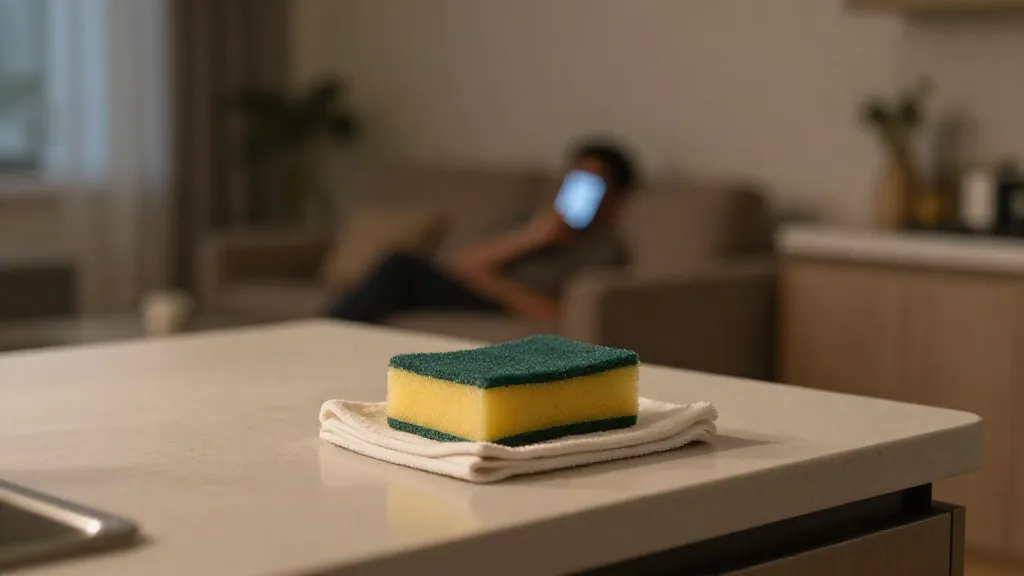
It's 9:47 p.m. on a Tuesday. You just had a 20-minute argument about whose turn it is to unload the dishwasher — and now you're lying in bed wondering if this is what the beginning of the end looks like. Your friend's Instagram shows nothing but date nights and matching pajamas. Meanwhile, you're arguing about dishes. Again.
Here's the truth that nobody posts about: virtually every couple argues about the same handful of topics. The dishes, the in-laws, the budget, the thermostat. Research consistently shows that around 69% of relationship conflicts are perpetual — meaning they never fully resolve because they stem from fundamental differences in personality or lifestyle. That statistic comes from decades of research at The Gottman Institute, and it's not a sign of failure. It's a sign of two separate humans trying to build a shared life.
So if you've been anxious that your relationship fights signal something broken, this guide is for you. We'll walk through what's genuinely normal, what actually predicts breakups, and what you can do starting tonight.
Key Takeaways
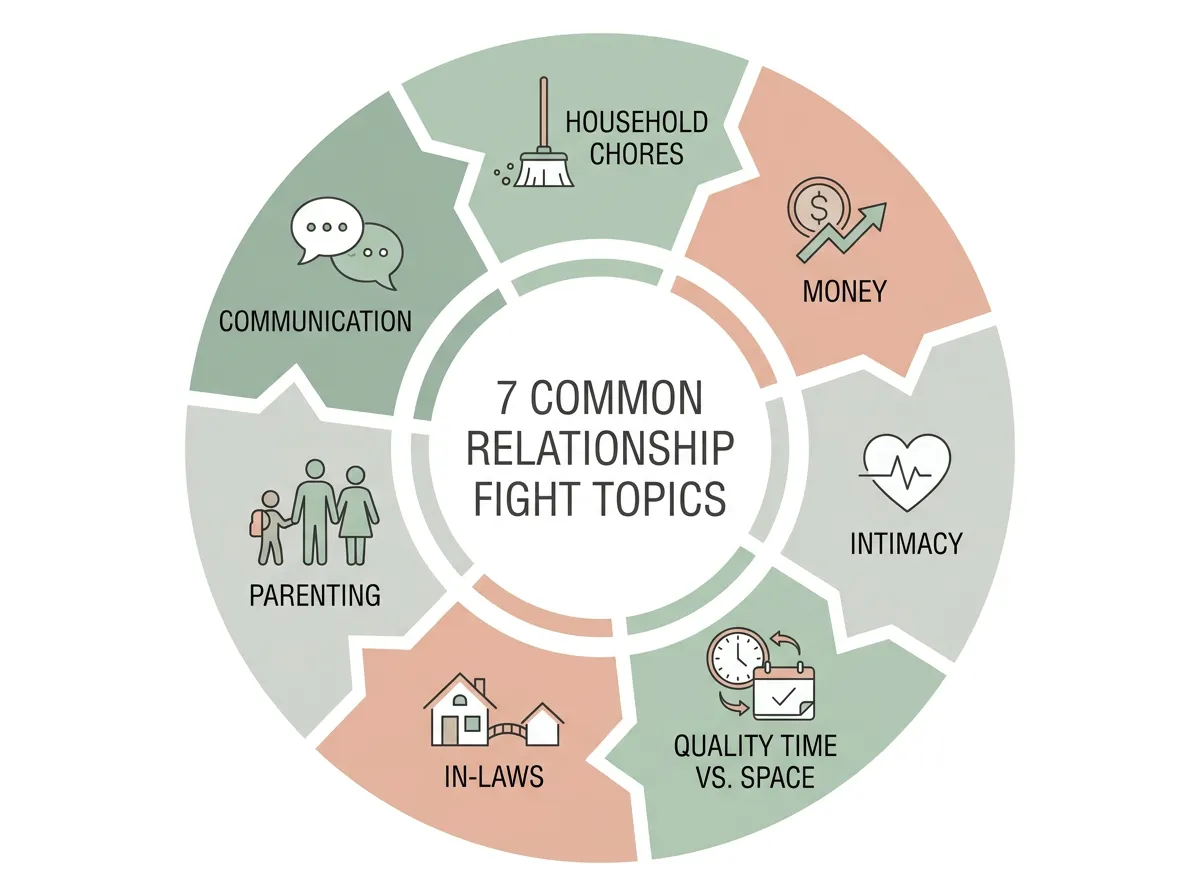
- Most couple arguments revolve around 5-7 universal topics — household chores, money, intimacy, in-laws, parenting, and time management. Having these fights doesn't mean your relationship is failing.
- 69% of relationship conflicts are perpetual and never fully "resolve" — healthy couples learn to manage them with humor, empathy, and compromise rather than trying to eliminate them.
- The frequency of your fights matters far less than how you fight. One destructive pattern — contempt — is the single strongest predictor of breakups.
- Repair attempts are the secret weapon of lasting relationships. A well-timed joke, an apology, or even a hand on the shoulder mid-argument can change the entire trajectory of a conflict.
- You can start shifting your conflict patterns today with small, concrete changes to how you bring up issues and how you respond when your partner does.
The 7 Most Common Relationship Fights (You're Not Alone)
Before we talk about what's dangerous, let's normalize what's universal. Researchers across multiple studies have identified the same recurring themes in couple arguments, regardless of age, culture, or how long partners have been together.
1. Household Chores and Mental Load
The single most frequently cited source of couple conflict. It's rarely about the dishes themselves — it's about feeling like the labor (and the invisible planning behind it) is unevenly distributed. One partner feels like they're carrying the household while the other seems oblivious.
What it sounds like: "I shouldn't have to ask you to notice the trash is full."
2. Money — Spending, Saving, and Financial Priorities
One partner is a saver; the other enjoys spending. Or both agree on goals but disagree on timelines. Money arguments often carry an undercurrent of security, control, and differing values about what "enough" means.
What it sounds like: "We agreed to save for a house, but you just bought a $300 gadget without mentioning it."
3. Intimacy and Physical Affection
Differences in desire, frequency, or the type of physical connection each partner needs. These conversations feel vulnerable, which is exactly why they often come out as frustration instead of honesty.
What it sounds like: "You never initiate anymore" or "I feel pressured when you keep bringing it up."
4. Quality Time vs. Personal Space
One partner craves togetherness; the other needs recharging time alone. Neither need is wrong, but the mismatch can make one person feel rejected and the other feel smothered.
5. In-Laws and Extended Family
Boundaries with family members — how often to visit, how much influence they have, whose side you take during family drama. This fight is really about loyalty and feeling like your partner has your back.
6. Parenting Styles
For couples with children: screen time limits, discipline approaches, bedtime routines, school decisions. Two people raised in different families are essentially merging two operating systems.
7. Communication Itself
"You never listen to me." "You always shut down." The meta-argument — fighting about how you fight — is one of the most common conflicts of all.
If you recognized your relationship in several of these categories, that's not a warning sign. That's statistics.
So When Are Relationship Fights a Problem?
Here's where the conversation gets important. The topic of your fights almost never predicts whether your relationship will last. Couples who argue about money are no more likely to break up than couples who argue about chores.
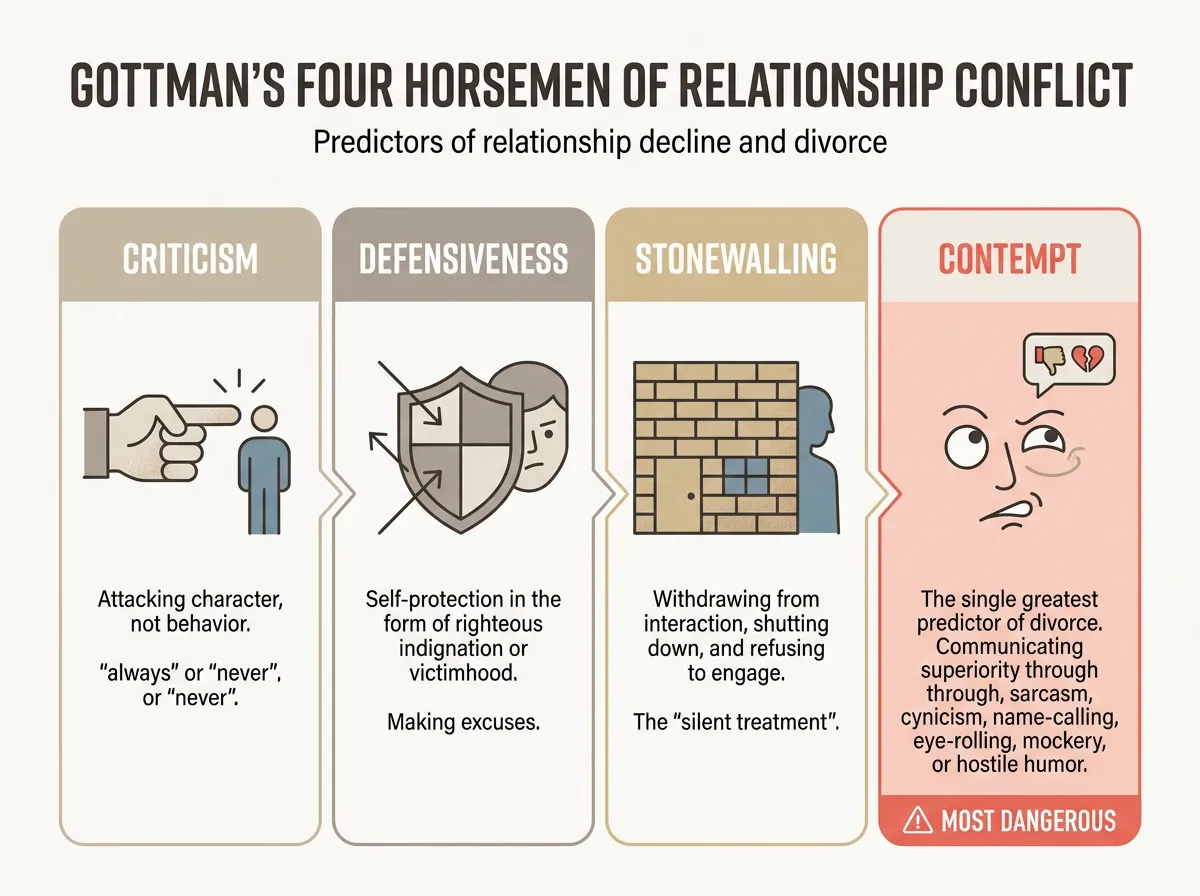
What does predict relationship failure is how you fight — specifically, four toxic communication patterns that researcher Dr. John Gottman calls "The Four Horsemen."
The Four Horsemen of Relationship Conflict
1. Criticism — Attacking your partner's character instead of addressing a specific behavior. - Complaint (healthy): "I was frustrated when you didn't call to say you'd be late." - Criticism (toxic): "You never think about anyone but yourself. You're so selfish."
2. Defensiveness — Responding to a complaint by deflecting blame or playing the victim. - "That's not my fault. If you hadn't spent so long getting ready, we wouldn't have been late."
3. Stonewalling — Shutting down, withdrawing, or refusing to engage. The person physically present but emotionally gone. - Walking away mid-sentence. Scrolling your phone while your partner is talking. Going completely silent for hours.
4. Contempt — The most dangerous horseman. Mockery, sarcasm, eye-rolling, name-calling, and any communication that conveys disgust or superiority. - "Oh, you're going to lecture me about money? That's hilarious." - Mimicking your partner's voice. Sneering. Using words like "pathetic" or "ridiculous."
Why Contempt Is the Real Red Flag
Of these four patterns, contempt is the single strongest predictor of divorce and breakup. Gottman's research found that contempt alone could predict relationship dissolution with over 90% accuracy.
Contempt is different from anger. Anger says, "I'm upset about this situation." Contempt says, "I'm better than you." It erodes the foundation of respect that every relationship needs to survive.
If you're reading this and recognizing contempt in your arguments — either your own or your partner's — that's actually useful information. It doesn't mean your relationship is doomed, but it does mean this is the pattern to address with urgency.
How Healthy Couples Handle the Same Fights
So if happy couples argue about the same things as unhappy couples, what are they doing differently? The research points to a few consistent behaviors.
They Use Soft Startups
The first three minutes of a conflict conversation predict how the entire conversation will go roughly 96% of the time. Couples who start gently — with "I" statements and specific requests — reach resolution far more often than those who open with accusations.
Hard startup: "You always leave your stuff everywhere. This place is a disaster because of you."
Soft startup: "Hey, I'm feeling overwhelmed by the clutter in the living room. Can we figure out a system together?"
Notice the difference isn't about being passive or suppressing your frustration. It's about describing your experience without assigning your partner a villain role.
They Make Repair Attempts — and Accept Them
A repair attempt is any gesture — verbal or nonverbal — that de-escalates tension during a conflict. It might be:
- A touch on the arm
- Saying "I'm sorry, let me rephrase that"
- A well-timed joke ("Okay, we sound insane right now")
- "Can we pause and start this over?"
- "I hear you. I don't agree yet, but I hear you."
The magic isn't just in making repair attempts — it's in receiving them. In struggling relationships, repair attempts get ignored or rejected. The partner extends an olive branch, and the other swats it away. In thriving relationships, both people are actively looking for the olive branch.
They Accept Influence
Accepting influence means being open to your partner's perspective actually changing your mind. It doesn't mean caving on everything. It means approaching disagreements with genuine curiosity: Could they be right? Is there something here I'm not seeing?
Research shows that couples where both partners accept influence from each other have dramatically higher satisfaction and longevity.

A Practical Framework for Your Next Argument
Theory is useful, but you need something you can actually do at 9:47 p.m. on a Tuesday. Here's a concrete framework:
Before the Conversation
- Check your body. If your heart rate is above 100 bpm, you're physiologically flooded and can't think clearly. Take 20 minutes to calm down — not to stew or rehearse your argument, but to genuinely regulate. Walk, breathe, listen to something soothing.
- Identify the specific behavior, not the character flaw. "Left dishes in the sink" is a behavior. "Is a lazy person" is a character judgment.
- Know your ask. What specifically would you like to be different going forward?
During the Conversation
- Start with your feeling and observation. "When [specific thing happened], I felt [emotion]." Keep it to one issue at a time — no kitchen-sinking.
- Ask for their perspective. "How do you see it?" Then actually listen to the answer.
- Look for the repair attempts. If your partner tries to de-escalate, let them. This is not losing — this is winning together.
- Find the compromise. With perpetual problems (most of them), you're not looking for a solution. You're looking for a way to live with the difference that respects both people.
After the Conversation
- Follow through. If you agreed to something, do it. Broken agreements erode trust faster than the original conflict.
- Revisit without re-litigating. Check in a week later: "Hey, how do you feel about how we're handling the chore thing? Is this working for you?"
When you reach agreements that matter — especially around recurring fights about finances, household responsibilities, or parenting — consider putting them in writing. Tools like Servanda help couples create structured, written agreements that keep both people accountable, so you don't have the same argument next Tuesday night.
The Difference Between "A Lot of Fights" and "Bad Fights"
Let's address the frequency question directly, because it's what drives a lot of the anxiety.
There is no magic number of arguments per week or month that separates healthy from unhealthy relationships. Some couples argue frequently and are deeply satisfied. Some rarely argue and are quietly miserable.
What matters is the ratio. Gottman's research identified a 5:1 ratio in stable relationships: for every one negative interaction during conflict, there are at least five positive ones. The positive interactions include humor, affection, genuine interest, empathy, and simple acknowledgment.
So if you argued three times this week but also laughed together, held hands during a movie, texted something kind, asked about each other's day, and cooked dinner side by side — your ratio is probably healthy.
If you argued once this week but spent the other six days in cold silence, that single argument might matter a lot more.
When to Seek Help
Some situations go beyond what a blog post or a framework can address. Consider professional support if:
- Contempt has become a regular feature of your arguments
- One or both partners feel emotionally or physically unsafe during conflicts
- You've been having the same fight for months or years with zero movement
- Arguments escalate to yelling, threats, or breaking things
- You've stopped fighting entirely — not because things are good, but because you've given up
Couples therapy is not a last resort. It's skill-building. The couples who benefit most are often the ones who go before things feel catastrophic.
Frequently Asked Questions
How often do normal couples fight?
There's no single "normal" frequency. Research suggests most couples have some form of disagreement multiple times per month. What matters isn't how often you argue but whether you can repair afterward and maintain a strong positive-to-negative interaction ratio (at least 5:1 during conflict).
Is it a bad sign if we fight about the same things over and over?
Not necessarily. Around 69% of couple conflicts are perpetual, meaning they recur because they're rooted in fundamental personality or lifestyle differences. Healthy couples don't eliminate these conflicts — they learn to discuss them with empathy and humor instead of hostility.
What's the number one thing couples fight about?
Household chores and the division of labor consistently top the list in relationship research, closely followed by money and finances. Both topics tend to involve deeper underlying themes of fairness, respect, and feeling valued by your partner.
Can fighting actually be good for a relationship?
Yes — when done constructively. Conflict surfaces unmet needs, clarifies expectations, and can deepen understanding between partners. Couples who avoid all conflict often accumulate resentment that eventually surfaces in more damaging ways. The goal isn't zero conflict; it's conflict that leads to growth.
How do I stop a fight from escalating?
The most effective move is a genuine repair attempt: acknowledge your partner's point, use humor to break tension, or simply say "I want to understand you — can we slow down?" If either person is physiologically flooded (racing heart, shallow breathing), take a 20-minute break before continuing. Returning to the conversation calmer almost always produces a better outcome.
Moving Forward Together
If you came to this article worried that your relationship fights mean something is wrong, I hope you're leaving with a different perspective. The fights themselves — about dishes, money, in-laws, time — are remarkably universal. They don't make your relationship broken. They make it human.
What does deserve your attention is how you fight. Contempt, defensiveness, stonewalling, and chronic criticism are patterns worth interrupting — and they can be interrupted. Soft startups, repair attempts, accepting influence, and maintaining that 5:1 positive ratio are all learnable skills.
You don't need to become a couple who never argues. You need to become a couple who argues well — and then makes dinner together afterward. That's not just achievable. For most couples, it's closer than they think.