I have sat across from a lot of couples who came in to talk about money or in-laws and spent the first forty minutes on the dishwasher. Not the dishwasher itself. The eleventh iteration of a conversation about the dishwasher that has never once produced a different Tuesday.
What almost always turns out to be missing is not love, effort, or goodwill. It's a written chore division agreement for couples: a document with a task, one owner, a frequency, a deadline, and a stated consequence when somebody misses. Verbal agreements about housework have a shelf life of roughly nine days in my experience. Written ones with a miss clause survive months.
This is the walkthrough. What to say, when, what your partner will say back, and how to answer that without the whole thing collapsing into a scorecard fight.
Why does the dishes argument keep coming back after you already agreed?
Because "I'll be better about the dishes" is not an agreement. It's a mood. It has no owner beyond an implied one, no definition of finished, no time by which it must happen, and no agreed response when it doesn't.
Here is the failure mode I watch play out most often. Rachel asks Tom to "help more with the kitchen." Tom genuinely intends to. On Thursday he wipes the counters but leaves the pans soaking, because in his head the kitchen is now handled. Rachel comes down Friday morning to a sink of grey water and concludes he ignored her. Tom hears the sigh and concludes nothing he does registers. Neither of them is lying about their experience. They never defined done.
The second reason it recurs: the noticing is itself the work, and it's invisible in every verbal deal. Someone has to know the toilet paper is running low before it runs out. Pew Research Center's April 2023 report on marriage and household labor found that even in marriages where spouses earn about the same, wives put in roughly 4.6 more hours a week on caregiving and about 2 more hours on housework, while husbands log more leisure. The gap isn't usually about who's willing to scrub. It's about who's tracking.
A written agreement fixes both problems by assigning tracking as a task with a name next to it.
When should you have the chore conversation?
Not within four hours of a chore incident, and not at night. Sunday morning, coffee already made, both of you fed, phones in another room, forty-five minutes on the calendar with an end time you both said out loud.
The timing matters more than people believe. John Gottman's lab at the University of Washington found it could predict the outcome of a fifteen-minute conflict conversation from the first three minutes with startling accuracy. A harsh start almost never recovers. If you open this while standing over an unemptied dishwasher at 11pm, you are not having the agreement conversation. You are having the twelfth fight, with a notebook.
So you schedule it in advance, in a low-stakes moment:
"Can we take forty-five minutes Sunday morning to actually write down who does what? Not to relitigate anything. I want a list on paper so I stop nagging you and you stop feeling nagged."
That last clause does real work. You are naming a benefit for them, not just relief for you.
What do you actually say to open it?
Open with the pattern, not the person, and put yourself in the pattern. The first ninety seconds decide whether the next forty minutes are a negotiation or a trial.
A version I've heard work, almost verbatim, from a client named Dana:
"I want to say up front that I don't think you're lazy and I'm not keeping score. I think we've never actually decided anything, so every week I end up deciding by default and resenting it, and you end up getting corrected for things you didn't know were yours. I hate that for both of us. Can we just assign it all and be done?"
What you do not say, ever, in the first ninety seconds: "I do everything around here." It's the fastest route to a defensive counter-inventory, and then you're two people reciting résumés at each other.
Then make the first move concrete:
"I'll start. I'll take all the laundry, start to finish, including putting it away. That's mine, permanently, I don't want to talk about it again. What do you want to own outright?"
Claiming something first, generously and unconditionally, changes the temperature of the room more than any framing technique I know.
"I do plenty already." What do you say back?
Agree with it, sincerely, and then move the conversation from volume to visibility. Arguing about whether they do enough is unwinnable, because both of you have complete data on your own effort and partial data on theirs.
The four things you'll hear, and what to say:
"I do plenty. You just don't notice."
"You're probably right that I don't see all of it. That's exactly the problem I want to fix. If it's written down, I'll know what you're carrying and I'll stop assuming."
"I'll just do it when I get to it. I don't need a deadline." This is the one that sinks agreements. Hold the line here.
"The problem isn't that it doesn't get done. It's that I don't know if it will, so I'm carrying it in my head until it does. The deadline isn't a leash. It's the thing that lets me put it down."
"This feels like a contract. We're not roommates."
"Roommates who write it down argue less than couples who don't. I'd rather be slightly unromantic on Sunday than resentful on Wednesday."
"Fine. Just tell me what to do." Refuse this one outright. It's the mental load restated as compliance.
"No. That keeps me as the manager, and managing is the part I'm tired of. I need you to pick things and own them, including remembering they exist."
One rule for the whole conversation: nobody gets assigned a task they didn't verbally accept. Assigned chores get done resentfully or not at all. Chosen ones stick.
What goes in a chore division agreement for couples template?
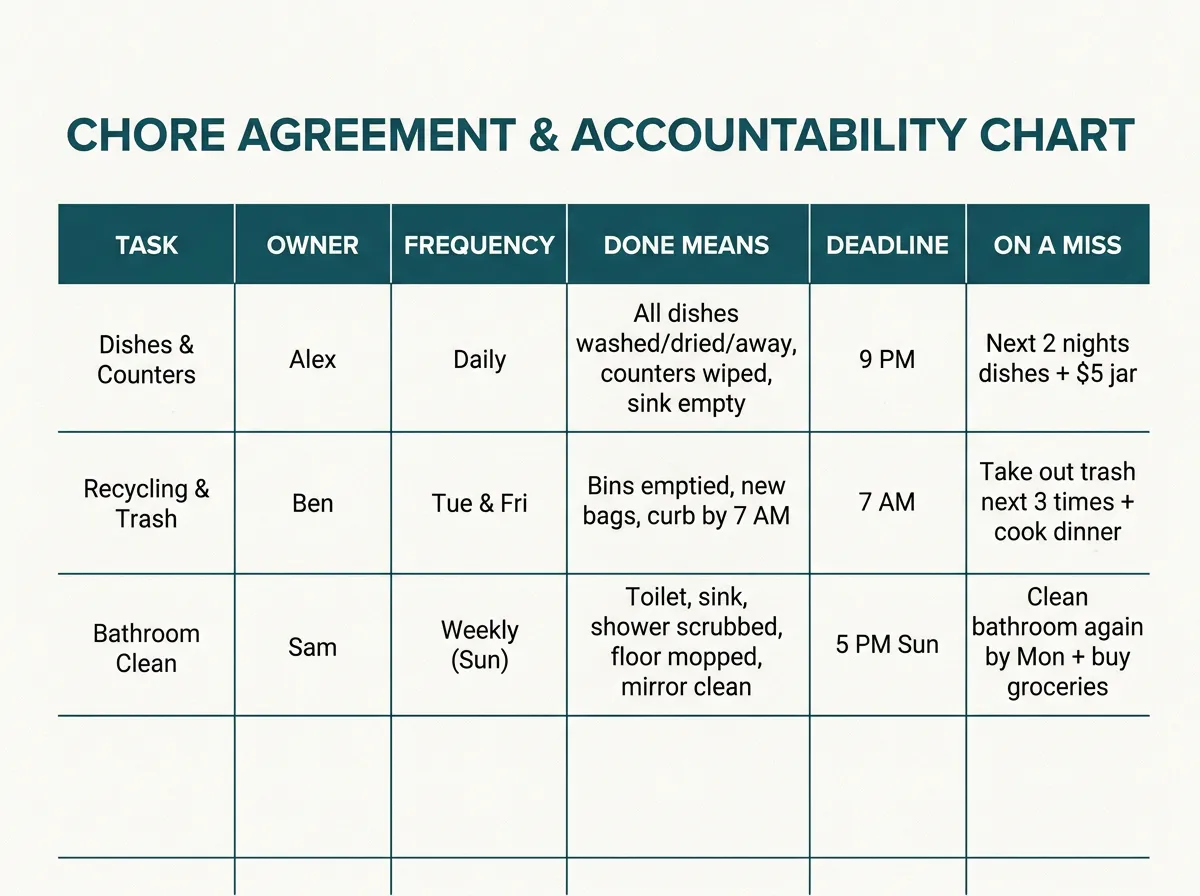
Six columns, and the last two are the ones that make it different from every list you've made before: Task, Owner, Frequency, Done means, Deadline, On a miss. One owner per task. Never two.
Build the task inventory first, before assigning anything. Twenty minutes, both of you calling out everything, including the invisible items: booking the dentist, remembering the nephew's birthday, noticing the car needs an oil change, restocking dish soap before it runs out. Most couples land between 40 and 60 line items. The list itself is often the moment something shifts, because one person sees the length of it for the first time.
Then assign. Here's a real filled section, lightly anonymized:
| Task | Owner | Frequency | Done means | Deadline | On a miss |
|---|---|---|---|---|---|
| Kitchen reset | Marcus | Nightly | Sink empty, counters wiped, dishwasher running | 10:00pm | Dana names it once, next morning, no tone. Marcus does it plus tomorrow's. |
| Laundry, all of it | Dana | 2x/week | Washed, folded, put away in drawers | Sun + Thu | Marcus names it once. Dana does it within 24h. |
| Consumables restock (TP, soap, coffee, meds) | Marcus | Weekly | Nothing in the house at zero | Saturday | If we run out, Marcus buys it that day, wherever he has to go. |
| Bathrooms | Dana | Weekly | Toilet, sink, mirror, floor | Saturday | Named once. Done within 24h. |
| Trash + recycling out | Marcus | Weekly | At curb night before | Tuesday 9pm | Marcus drives it to the dump station Saturday. |
| Kid dentist/doctor scheduling | Dana | As needed | Appointment booked and in shared calendar | Within 3 days of reminder | Named once. Marcus takes over that booking. |
| Meal planning + grocery order | Marcus | Weekly | Order placed for Sunday delivery | Friday 8pm | Marcus cooks from scratch or pays for takeout, his call. |
Notice that "Done means" is doing heavy lifting. "Kitchen" is a fight. "Sink empty, counters wiped, dishwasher running" is a checkbox. Any task where the two of you have different standards needs this column filled in with more detail than feels necessary. Write down the standard of the person who cares more about it, because they're the one who will otherwise redo it and be angry.
If you want the document to feel like something more than a note in your phone, tools like Servanda help couples turn this kind of arrangement into a written agreement both people have actually signed off on, which matters more than it sounds like it should. People treat a signed document differently from a whiteboard.
What happens when someone misses? Write that part down first.
The miss clause is the entire reason the agreement works, and most couples skip it because it feels punitive. It isn't punitive. It's the pre-negotiated alternative to a sigh, a passive-aggressive text, or a week of silence.
Three rules that hold up:
One naming, no tone. The non-owner gets exactly one flat sentence: "Hey, kitchen." Not "So are we doing the kitchen tonight or..." That's it. No second reminder. The second reminder is nagging, and it transfers the tracking back to you, which defeats the point.
The consequence is more of the same task, never a favor owed. "You missed trash, so you owe me a foot rub" turns housework into currency and it corrodes fast. "You missed trash, so it's a Saturday dump run" keeps it inside the domain. Make the makeup slightly inconvenient. That's the whole mechanism.
Three misses in a month means the task is wrong, not the person. This clause has saved more agreements than any other. Marcus missed the 10pm kitchen reset four times in three weeks. He wasn't refusing. He works late Thursdays and was walking in at 10:40. They moved it to "before I leave for work," and it never came up again. Write it in: After three misses on the same task in 30 days, we renegotiate the task instead of arguing about it.
How do you keep the chore agreement alive past week three?
A twenty-minute review on the last Sunday of every month, on the calendar with an alert, for the first six months. Skip this and the agreement quietly reverts to whoever notices first, usually within five weeks.
Three questions, in this order. What did we miss most? What was miscategorized (someone's carrying something that isn't on the list)? What changed in our schedules that breaks a deadline? Then edit the document and re-save it with the date.
One warning about month two. The person who was previously doing more often feels a strange irritation once things get fairer, because the agreement makes visible how long the imbalance ran. That's normal and it passes. Say it out loud if you feel it: "I'm not mad at you, I'm mad at four years of it." Then move on.
Dana and Marcus came back for a review session in November. She said the thing that stuck with me was not the clean kitchen. It was that she'd stopped doing the mental scan when she walked in the door.