
Money Arguments in Relationships: A Survival Guide
It's Tuesday evening. One of you opens the credit card statement and sees a $400 charge you weren't expecting. The other says, "It was on sale — I actually saved us money." Within three minutes, you're no longer talking about the purchase. You're relitigating every financial decision from the last six months, and someone is sleeping on the couch.
If this sounds familiar, you're not alone. Money arguments in relationships are among the most frequent, most intense, and most destructive fights couples have. Research from Kansas State University found that financial disagreements are the single strongest predictor of divorce — stronger than arguments about kids, chores, or intimacy. Yet most couples never receive any practical guidance on how to talk about money together. They just keep having the same fight on repeat.
This guide is designed to break that cycle. Not with vague advice about "being open," but with concrete strategies you can put into practice this week.
Key Takeaways
- Money fights are rarely about money. They're about safety, control, values, and trust. Addressing the emotional layer underneath is what actually resolves them.
- Identify your money personality — and your partner's. Understanding whether each of you tends toward saving or spending (and why) removes judgment from the conversation.
- Create a "yours, mine, ours" financial structure. A shared system with built-in personal autonomy reduces friction dramatically.
- Schedule regular money dates. Proactive, low-stakes financial check-ins prevent small tensions from becoming explosive arguments.
- Set a spending threshold you both agree on. One clear number — above which you consult each other — eliminates the most common trigger for money fights.
Why Couples Fight About Money (It's Not What You Think)

On the surface, money arguments in relationships look straightforward: one person spent too much, or saved too little, or hid a purchase. But underneath nearly every financial disagreement is something much more personal.
Money is a proxy for some of our deepest needs:
- Security. The partner who panics about spending may have grown up in a household where money was scarce or unpredictable.
- Freedom. The partner who resists budgeting may associate financial control with feeling trapped or micromanaged.
- Worth. When one partner earns significantly more, the other may feel a power imbalance that neither has named.
- Values. A disagreement about whether to renovate the kitchen or max out a retirement account is really a disagreement about what matters most right now.
Until you address this emotional layer, you'll keep solving the wrong problem. You'll negotiate a budget, break it, fight about it, and start over.
The Childhood Money Blueprint
Each of you walked into this relationship with decades of financial programming you probably never examined. Consider these questions — separately, then together:
- What did your parents say (or never say) about money when you were growing up?
- Was money a source of stress, conflict, or silence in your household?
- What's the first money-related emotion you can remember feeling?
- What does "enough money" feel like to you — what would need to be true?
These aren't therapy exercises for the sake of it. They're diagnostic tools. When you understand why your partner reacts the way they do around money, their behavior stops looking irrational and starts looking like self-protection.
The 4 Money Personality Types (And Why Opposites Attract)
Financial psychologists generally identify four broad money tendencies. Most people are a blend, but one or two will dominate:
| Type | Core Drive | Strength | Blind Spot |
|---|---|---|---|
| Saver | Security | Discipline, preparedness | Rigidity, anxiety about any spending |
| Spender | Enjoyment | Generosity, living fully | Impulsiveness, avoidance of long-term planning |
| Avoider | Peace | Low materialism | Ignoring bills, debt, or financial reality |
| Vigilant Planner | Control | Organization, foresight | Obsessiveness, difficulty sharing financial power |
Here's the pattern that drives most couple conflict: savers and spenders pair up with remarkable frequency. The saver is initially attracted to the spender's spontaneity and warmth. The spender admires the saver's stability. Then they share a bank account, and the very traits that attracted them become the traits that infuriate them.
Recognizing your respective types isn't about labeling each other. It's about depersonalizing the conflict. "You're irresponsible" becomes "You're a spender who values experience, and I'm a saver who values security, and we need a system that honors both."
A Practical Framework: The "Yours, Mine, Ours" System
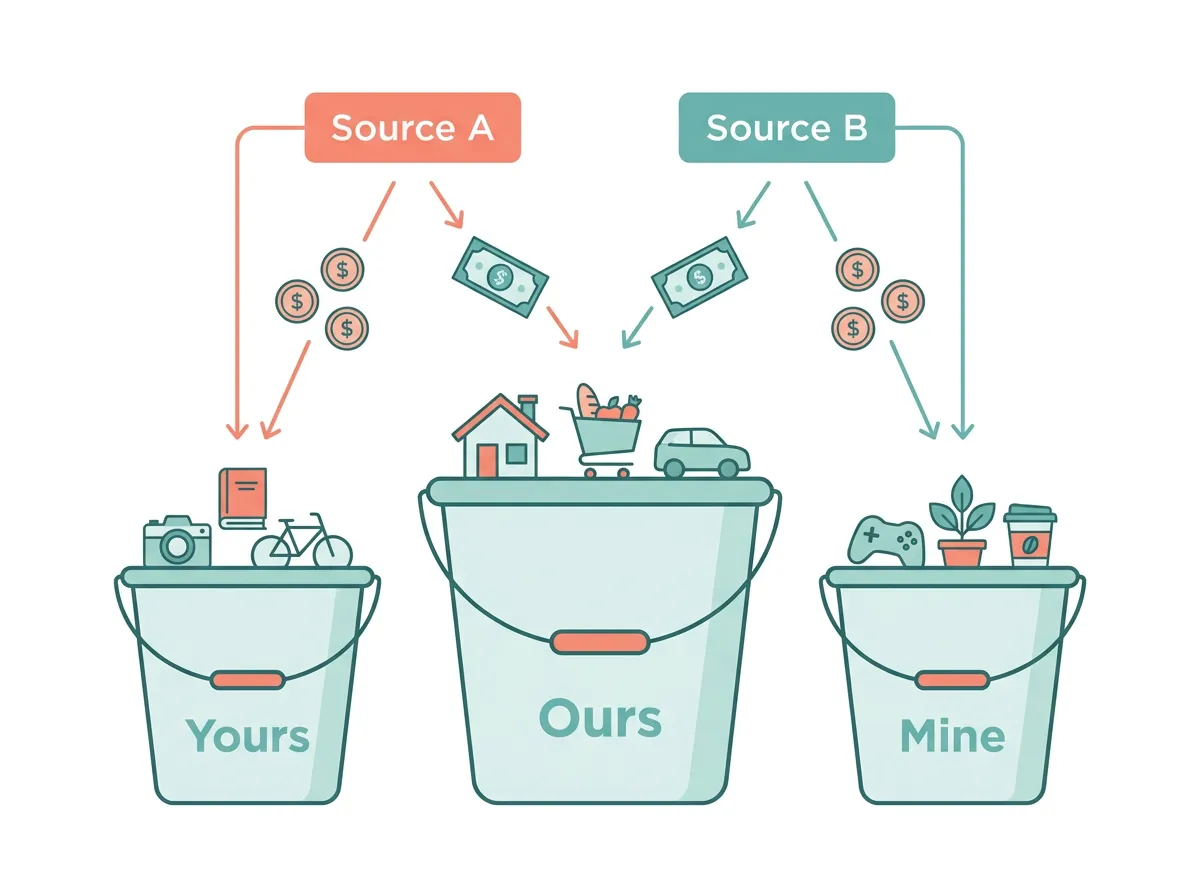
One of the most effective structures for reducing money arguments in relationships is deceptively simple. Instead of one joint account (which creates constant negotiation) or completely separate finances (which creates disconnection), you create three buckets:
1. The "Ours" Account
This covers all shared expenses: rent or mortgage, utilities, groceries, insurance, kids' costs, joint savings goals. Both partners contribute to it — either equally or proportionally based on income.
Proportional contributions often feel more equitable than equal ones. If one partner earns $80,000 and the other earns $40,000, splitting everything 50/50 means the lower earner is contributing a far larger percentage of their income. A 60/40 or proportional split based on earnings acknowledges this reality without creating resentment on either side.
2. The "Yours" and "Mine" Accounts
After contributing to the shared account, each partner keeps a personal spending fund. This money is theirs — no questions asked, no justification needed.
This is where the magic happens. The saver can let their personal fund accumulate and feel the peace that comes with watching a number grow. The spender can buy concert tickets or a new jacket without triggering a conflict. Autonomy within structure is the goal.
3. How to Set It Up — A Step-by-Step
- List every shared expense for the past three months. Calculate your true monthly joint cost.
- Add 10-15% as a buffer for irregular expenses.
- Decide on your contribution method (equal or proportional).
- Set up automatic transfers on payday so the system runs without willpower.
- Agree on a review schedule — quarterly works for most couples.
The Spending Threshold: One Number That Prevents Most Fights
Ask couples what starts their worst money fights, and the answer is almost always a variation of: "They bought something without telling me."
The fix is a spending threshold — a specific dollar amount above which both partners agree to consult each other before purchasing. Below that number, no questions asked.
There's no universal right number. For some couples it's $50. For others it's $200 or $500. The amount matters less than the agreement itself. What you're really establishing is a boundary of mutual respect.
Ground rules for the spending threshold:
- "Consulting" doesn't mean asking permission. It means giving your partner the chance to weigh in.
- If you disagree, the default is to wait 48 hours before purchasing. Most impulse-driven disagreements resolve themselves with time.
- The threshold applies to both partners equally, regardless of income difference.
- Review the number annually — what works at 25 may not work at 40.
Money Dates: Turning Financial Talks Into a Routine, Not a Crisis

Most couples only talk about money when something goes wrong — a bill is overdue, a purchase feels excessive, tax season arrives. This means every financial conversation carries the weight of a problem. No wonder it escalates.
Money dates flip this dynamic. They're short, scheduled, low-pressure check-ins about finances. Here's a format that works:
The 30-Minute Monthly Money Date
First 10 minutes — Review: - Where are we relative to our budget this month? - Any surprise expenses coming up? - How are our savings goals tracking?
Next 10 minutes — Decide: - Any purchases or financial decisions to make together? - Do we need to adjust anything for next month?
Final 10 minutes — Dream: - What are we working toward? (Vacation, house, debt payoff, early retirement) - How does our current trajectory connect to that vision?
Tips to make money dates sustainable:
- Pair them with something pleasant — a favorite meal, a coffee shop you both like, a glass of wine after the kids are in bed.
- No ambushes. If something needs discussion, put it on the agenda in advance so neither person feels blindsided.
- Celebrate progress. If you paid off a credit card or stayed under budget, acknowledge it.
- Keep a shared document or spreadsheet so you're both looking at the same numbers.
When Income Is Unequal: Navigating the Power Imbalance
Income disparity is one of the most sensitive — and least discussed — sources of money arguments in relationships. The higher earner may feel entitled to more decision-making power. The lower earner may feel guilt, resentment, or reluctance to spend.
Some principles that help:
- Name the imbalance directly. Pretending it doesn't exist gives it more power, not less.
- Separate earning from contributing. If one partner manages the household, cares for children, or supports the other's career, they're contributing enormous economic value that doesn't show up in a paycheck.
- Avoid the phrase "my money." If you've committed to a partnership, it's a shared financial life. Language shapes how you both feel about access and ownership.
- Make financial decisions together regardless of who earns more. Unilateral financial control — even well-intentioned — erodes trust over time.
Financial Infidelity: What to Do When Trust Is Already Broken
Secret credit cards. Hidden debt. Undisclosed accounts. Financial infidelity — concealing significant financial information from a partner — affects an estimated 40% of couples in some form.
If this has happened in your relationship:
- Disclose fully. Half-truths prolong the damage. Put all accounts, debts, and obligations on the table.
- Separate the financial problem from the trust problem. You'll need to solve both, but they require different approaches. The debt can be restructured. The betrayal needs emotional repair.
- Create transparency systems. Shared access to all accounts, monthly reviews, and written agreements about financial boundaries going forward. Tools like Servanda can help couples formalize these agreements in writing, creating clear accountability without relying on memory or assumptions.
- Consider professional help. A financial therapist (yes, they exist) specializes in exactly this intersection of money and emotion.
The Fights You Should Actually Be Having
Not all money disagreements are unhealthy. Some financial conflicts are necessary — they surface real differences in values and priorities that need to be worked through, not papered over.
Healthy financial disagreements sound like:
- "I want to prioritize paying off student loans. You want to save for a down payment. How do we sequence this?"
- "I feel anxious when our emergency fund drops below three months of expenses. Can we talk about what would help me feel safer?"
- "I noticed we're spending $600 a month on dining out. I'm not saying we should stop — I want to talk about whether that aligns with what we both want."
Unhealthy financial arguments sound like:
- "You always..." / "You never..."
- "If you earned more, we wouldn't have this problem."
- "It's my money and I'll do what I want."
- Silence, followed by an explosion two weeks later.
The difference isn't whether you disagree. It's whether you're addressing a specific issue with curiosity, or attacking a person with contempt.
FAQ
How do you stop fighting about money in a relationship?
Start by creating systems that remove daily negotiation — a shared budget, a spending threshold, and personal accounts for discretionary spending. Then schedule regular, low-pressure financial check-ins so money conversations happen proactively instead of reactively. Most money fights are triggered by surprise and a lack of shared structure, not by fundamental incompatibility.
Should couples combine finances or keep them separate?
Neither extreme works perfectly for most couples. A hybrid approach — one shared account for joint expenses, plus individual accounts for personal spending — tends to strike the best balance between partnership and autonomy. The right structure depends on your specific situation, but the key is agreeing on a system together rather than defaulting into one.
What do you do when your partner hides spending from you?
Address it directly but without accusation. Say something like, "I found out about [specific purchase/debt], and I feel hurt that it was hidden from me. I want to understand what happened and figure out how we move forward." Then focus on building transparency — shared account access, regular check-ins, and agreed-upon spending thresholds. If the pattern continues, consider working with a financial therapist.
Is it normal for couples to argue about money?
Absolutely. Financial disagreements are the most common source of recurring conflict in relationships. Having money arguments doesn't mean your relationship is failing — it means you're two people with different histories, values, and risk tolerances trying to build a shared life. What matters is whether you have productive tools for working through those disagreements or whether the same fight keeps repeating without resolution.
How do couples with different incomes split bills fairly?
Many couples find that proportional splitting — where each partner contributes a percentage of their income rather than an equal dollar amount — feels more equitable. For example, if one partner earns 65% of the household income, they cover 65% of shared expenses. This ensures both partners retain similar proportions of personal spending money, which reduces resentment and power imbalance.
Conclusion
Money arguments in relationships aren't a sign that something is fundamentally broken. They're a signal that you and your partner need better systems, more understanding of each other's financial wiring, and a structure that gives you both security and freedom.
The couples who navigate money well aren't the ones who never disagree. They're the ones who've built a framework — spending thresholds, shared accounts, personal funds, regular check-ins — that makes the disagreements smaller, less frequent, and more productive.
Start with one step this week. Have the childhood money conversation. Set a spending threshold. Schedule your first money date. You don't have to overhaul your entire financial life overnight. You just have to stop avoiding the topic and start building the system that makes your partnership feel fair to both of you.
The Tuesday evening credit card fight doesn't have to be your story anymore.