
The Housework Argument That Never Ends (Fix It)
It's 9:47 p.m. on a Tuesday. The kitchen counter is cluttered with dishes from dinner, the laundry hamper is overflowing again, and someone has left a wet towel on the bed. One partner sighs — loudly. The other partner tenses up, already knowing what's coming. Within minutes, you're replaying a script you've both memorized: "I always have to..." meets "You never notice when I..." meets "Fine, just tell me what to do."
The housework argument is one of the most common recurring fights couples have, and it's one of the most corrosive. Not because dishes actually matter that much, but because what's underneath the argument — feeling unseen, unappreciated, and stuck carrying a burden alone — matters enormously. The mainstream conversation around "invisible labor" has named the problem, but most advice stays frustratingly vague. This article gives you a concrete, step-by-step chore-audit method and reframes the fight so you can actually end the cycle.
Key Takeaways
- The housework argument is rarely about chores. It's about feeling valued, respected, and seen by your partner.
- Invisible labor is real and measurable. A structured chore audit makes the hidden work visible so you can divide it fairly.
- "Just tell me what to do" is part of the problem. When one partner becomes the household manager, the mental load stays unbalanced even if tasks get split.
- Fair doesn't mean 50/50. It means both partners feel the arrangement is sustainable and neither feels exploited.
- Written agreements beat verbal promises. Documenting your new system prevents backsliding and removes ambiguity.

Why the Housework Argument Keeps Coming Back
If you've tried to solve this before — made a chore chart, had a calm conversation over coffee, even read articles like this one — and the fight still returned, you're not failing. You're just treating the surface while the root stays untouched.
It's Not About the Dishes
Research from the Gottman Institute consistently finds that recurring arguments in relationships are rarely about their stated topic. The housework argument is actually a proxy fight about three deeper needs:
- Feeling valued. When one partner consistently handles more household labor, the unspoken message received is: My time and energy matter less than yours.
- Feeling like a team. Couples who fight about chores often describe feeling like roommates or, worse, like a parent managing a child.
- Feeling seen. Invisible labor — the planning, noticing, remembering, and anticipating that keeps a household running — is exhausting precisely because it goes unacknowledged.
Until you address these underlying needs, no chore chart in the world will hold.
The "Mental Load" Problem
You've probably encountered the concept of mental load (sometimes called "cognitive labor"). It refers to the ongoing, invisible work of managing a household: remembering that the dog needs a vet appointment, noticing the toilet paper is low before it runs out, keeping track of which kid has a field trip on Thursday, knowing when the car registration expires.
This labor is real work. It takes time, energy, and mental bandwidth. And in heterosexual couples, it still falls disproportionately on women — even in relationships where both partners work full-time and where the man considers himself an equal participant.
The critical mistake many couples make: they try to split tasks without ever addressing who owns the management of those tasks. Saying "I'll do laundry if you tell me when" still leaves one person as the project manager of the entire household.
The Chore Audit: A Concrete Method That Actually Works
Abstract conversations about fairness tend to devolve into defensiveness. What you need instead is data. A chore audit gives both partners a clear, shared picture of what's actually happening — no guessing, no score-keeping from memory, no "I feel like I do more" versus "Well I feel like I do more too."
Step 1: The Full Task Dump (Do This Separately)
Each partner independently writes down every single household task they can think of — not just the ones they do, but every task that exists. Include:
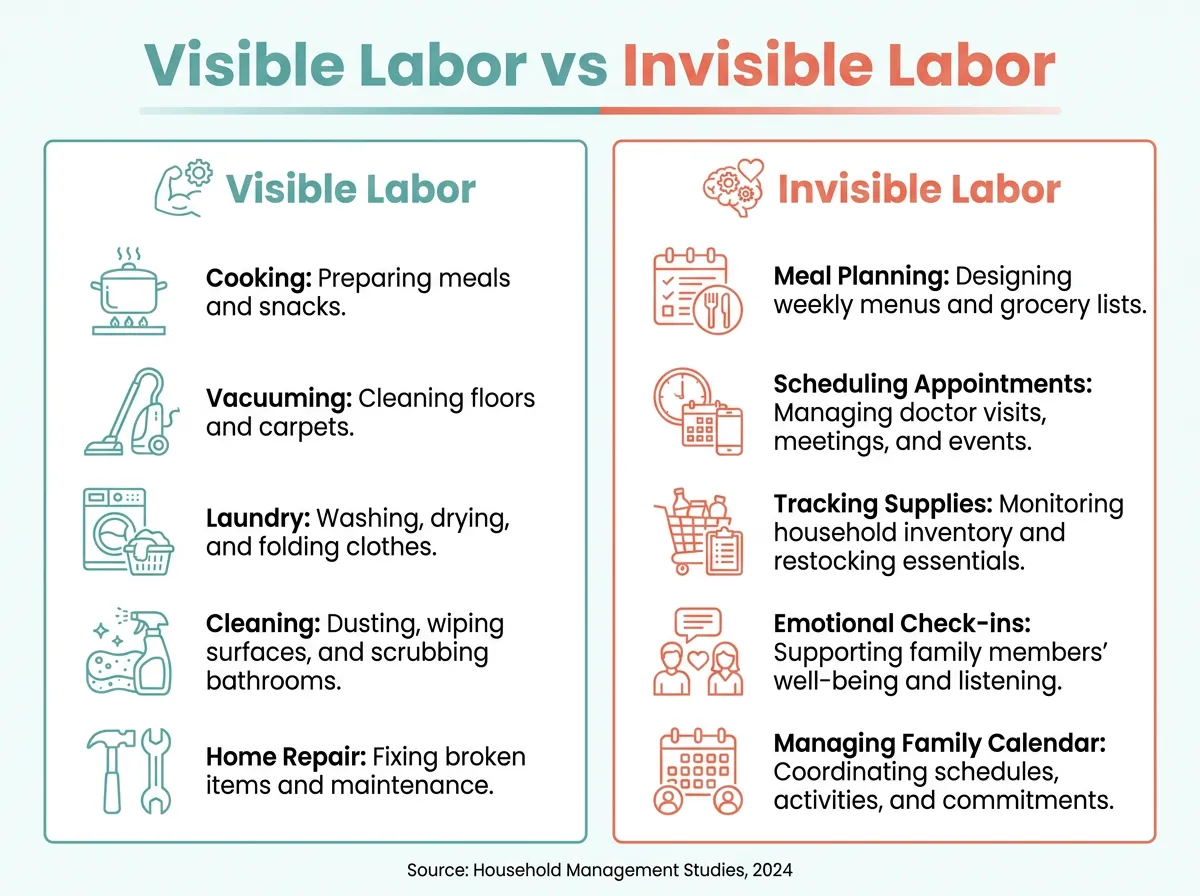
- Visible tasks: Cooking, dishes, vacuuming, mowing the lawn, taking out trash
- Invisible tasks: Meal planning, grocery list creation, scheduling appointments, researching schools, remembering birthdays, monitoring supplies
- Emotional labor: Checking in on aging parents, managing social plans, being the "default parent" the school calls
- Maintenance tasks: Changing air filters, renewing subscriptions, updating passwords, filing taxes
Most couples are stunned by how long this list gets. That's the point.
Step 2: Mark Who Currently Does What
Come together and merge your lists into one master list. For each task, honestly mark:
- Who does it (Partner A, Partner B, Shared, or Nobody)
- Who manages it (Who notices it needs doing? Who remembers the timeline? Who follows up?)
- How often (Daily, weekly, monthly, as-needed)
- How draining it is (Low / Medium / High — because scrubbing a toilet and folding laundry are not equally taxing)
This step often produces a pivotal moment. The partner who thought they were contributing equally suddenly sees forty items in one column and twelve in the other. Or the partner who felt they "did everything" realizes their partner handles a category of tasks they'd completely overlooked.
Neither reaction is wrong. Both are valuable.
Step 3: Identify the Gaps
Look at your completed audit together and ask:
- Are there tasks on this list that nobody is doing consistently? (These are the ones that create surprise blow-ups.)
- Is the management labor concentrated on one person?
- Are the high-drain tasks evenly distributed, or is one partner stuck with all the tasks that feel like drudgery?
- Are there tasks one of you actively doesn't mind — or even enjoys — that the other person dreads?
Step 4: Redesign the System Together
This is where most advice articles tell you to "have an open conversation about fairness." That's not enough. Here's a more specific framework:
Principle 1: Ownership, not delegation. Don't assign tasks that still require one person to remind, check, or manage. If Partner B owns the laundry, that means they notice when it needs doing, they do it, and they don't wait to be asked. Full ownership.
Principle 2: Play to preferences where possible. If one of you finds cooking meditative and the other finds it miserable, that's useful information. Divide based on energy cost, not just time cost.
Principle 3: Outsource or eliminate before you divide. Before you fight over who scrubs the shower, ask: Can we afford a cleaning service every two weeks? Can we use grocery delivery? Can we simplify meals on weeknights? Removing tasks from the list is always better than redistributing resentment.
Principle 4: Set a review date. Any new system will need adjustment. Put a date on the calendar — two weeks out — to check in. Ask each other: Is this working? What needs to change? This prevents the slow drift back to old patterns.
The Conversation Behind the Conversation
The chore audit is a tool, but tools only work when both people are willing to pick them up. If your partner dismisses the idea, gets defensive at the data, or agrees to changes and then doesn't follow through, the issue isn't logistics. It's relational.
What to Do When Your Partner Gets Defensive
Defensiveness during the housework argument usually sounds like:
- "You're keeping score."
- "Nothing I do is ever good enough."
- "Just tell me what you need and I'll do it."
- "I work longer hours, so it's fair that you handle more at home."
These responses aren't evil — they're protective. Your partner may genuinely feel they're contributing, or they may feel ashamed that they're not and cover it with pushback.
Try reframing the conversation away from blame:
- Instead of: "You never help with anything" → Try: "I've been feeling really burned out, and I think we need to look at how things are split. Can we do that together?"
- Instead of: "You don't even notice the mess" → Try: "I think some of the work I do might be invisible to you — not because you don't care, but because it happens in the background. I'd love to make it visible."
The goal is to move from prosecution to collaboration. You're not building a case against your partner. You're building a case for a better system.

When "Fair" Doesn't Mean "Equal"
Some couples get stuck on a rigid 50/50 split that doesn't account for reality. If one partner works 60-hour weeks and the other works part-time, a perfectly equal task split might feel unfair to both of them — for different reasons.
Fairness is subjective. What matters is that both partners feel:
- Their contribution is seen and valued
- The arrangement accounts for each person's capacity (work hours, health, caregiving responsibilities)
- Neither person is stuck with only the tasks nobody wants
- The system can be renegotiated as circumstances change
A couple where one partner handles 70% of housework can be perfectly happy — if that arrangement was consciously chosen, openly discussed, and balanced by other forms of contribution.
How to Make the New System Stick
The first two weeks after a chore conversation tend to go well. Motivation is high. Then life happens, old habits creep back, and three months later you're having the same fight.
Here's how to prevent that:
1. Write It Down
Verbal agreements are easy to remember differently. Write down who owns what — even if it feels overly formal. A shared Google Doc, a note on the fridge, or a tool like Servanda that helps couples create written agreements and revisit them can prevent the slow erosion of accountability.
2. Build in Check-Ins
Schedule a brief weekly or biweekly household check-in. Keep it short (10-15 minutes) and structured:
- What's working well?
- What's falling through the cracks?
- Does anything need to shift this week?
This removes the need for one partner to "bring it up" — which often gets labeled as nagging. The check-in is a built-in, no-blame space.
3. Lower Your Standards (Strategically)
If one partner takes over a task and does it differently than the other would, that's okay. Refolding the towels your partner already folded, or re-loading the dishwasher "the right way," sends a clear message: Your effort isn't good enough. That's a fast track back to the old dynamic where one partner stops trying.
Unless it's a health or safety issue, let go of how. Focus on whether.
4. Express Gratitude — Even for Expected Tasks
This one gets pushback: "Why should I thank someone for doing what they're supposed to do?" Because recognition is fuel. Saying "Thanks for handling dinner tonight" doesn't mean the task was optional or heroic. It means you noticed. And being noticed is the core need underneath this entire fight.
A Realistic Example
Jamie and Alex (names changed) came to couples counseling over — what else — housework. Jamie worked from home and handled nearly all the cooking, cleaning, laundry, grocery shopping, and household management. Alex worked in an office and handled yard work, car maintenance, and trash duty.
On paper, both felt they were contributing. But Jamie was spending roughly 20+ hours a week on household tasks versus Alex's 4-5 hours. More importantly, Jamie managed everything — Alex's contributions only happened when Jamie reminded or asked.
They did a chore audit together. The visual impact of seeing the imbalance on paper — rather than arguing about it in the abstract — shifted the conversation entirely. Alex didn't realize that "meal planning" and "scheduling the kids' doctor appointments" were even tasks. They redesigned their system: Alex took full ownership of dinners three nights a week (including planning and shopping for those meals), all laundry, and managing the family calendar. Jamie let go of controlling how Alex did those tasks.
Two months later, the housework argument had stopped. Not because the division was perfect, but because both felt seen.
FAQ
How do you split chores fairly in a relationship?
Start with a full chore audit: list every household task (including invisible ones like planning and scheduling), note who currently does each, and redesign the system based on ownership — not delegation. Fair doesn't always mean 50/50; it means both partners feel the arrangement respects their time and energy.
Why does the housework argument keep happening even after we talk about it?
Because most conversations focus on tasks without addressing the real issue: feeling valued and seen. Without a concrete system, written agreements, and regular check-ins, couples tend to drift back into old patterns within weeks.
What is invisible labor in a relationship?
Invisible labor (also called mental load or cognitive labor) is the behind-the-scenes work of running a household — planning meals, remembering appointments, noticing supplies are low, tracking deadlines. It's mentally draining and often goes completely unacknowledged because it doesn't produce a visible result.
How do I bring up the chore imbalance without starting a fight?
Frame it as a team problem, not a personal attack. Try: "I've been feeling burned out and I think we should look at how our household tasks are split — together." Avoid words like "never" and "always," and come with curiosity rather than a list of grievances.
Should couples use a chore chart?
A chore chart can help, but only if it includes ownership (not just task assignment), accounts for invisible labor, and gets reviewed regularly. A static chart that one partner made and the other ignores will make things worse, not better.
Moving Forward
The housework argument isn't a life sentence. It's a signal — a persistent, annoying signal that something in your partnership needs recalibrating. The fight was never really about who wiped down the counters. It was about whether both of you feel like you're in this together.
A chore audit gives you shared data instead of competing narratives. A redesigned system gives you clarity instead of assumptions. Written agreements and regular check-ins give you durability instead of two good weeks followed by backsliding.
You don't need a perfect split. You need a conscious one — where both partners feel seen, heard, and valued. Start the audit this weekend. You might be surprised by what you learn about each other.