
Money Fights in Relationships: A Childhood Problem
It's Tuesday night. The credit card statement just arrived. She sees a $300 charge for new fishing gear. He sees three separate charges from a home décor store. Within minutes, the kitchen table becomes a courtroom. She says he's reckless. He says she's controlling. They've had this exact argument — different dollar amounts, same bitter ending — at least a dozen times this year.
Here's what neither of them realizes: this fight started long before they ever shared a bank account. It started when she was nine years old, watching her mother hide grocery receipts from her father. It started when he was seven, hearing his dad say, "We work hard so we can enjoy life." The money fights in relationships that feel so present and urgent are almost never about the number on the receipt. They're about two childhoods colliding.
This article unpacks the invisible force behind your financial disagreements — your childhood money blueprint — and gives you a practical path toward ending the cycle.
Key Takeaways
- Your money fights have roots in childhood. Each partner carries a "money blueprint" — a set of unconscious beliefs formed by watching how their family handled money, scarcity, and security.
- Spending vs. saving arguments are often security vs. freedom arguments in disguise. Understanding the emotional need behind each position changes the conversation entirely.
- You don't need to agree on every purchase — you need to understand each other's financial origin story. Sharing your money memories builds empathy that budgets alone cannot.
- Practical exercises like the Money Memory Timeline can surface hidden beliefs and transform repetitive arguments into genuine understanding.
- Written financial agreements based on shared values (not just numbers) prevent the same fight from recurring month after month.

What Is a Childhood Money Blueprint?
A childhood money blueprint is the collection of beliefs, emotions, and automatic responses you developed around money before you were old enough to earn any. It's not a formal education. It's an absorption — the things you witnessed, overheard, and felt in your body during the formative years when your brain was building its model of how the world works.
These blueprints form through:
- Direct observation: Watching a parent clip coupons obsessively, or watching a parent spend freely after payday
- Emotional atmospheres: Growing up in a household where money conversations were tense and whispered, or open and casual
- Pivotal events: A parent losing a job, a family bankruptcy, an inheritance that changed everything, a move to a smaller house
- Explicit messages: "Money doesn't grow on trees," "You have to spend money to make money," "Rich people are greedy," "We can't afford that"
By the time you're an adult choosing a partner, your money blueprint is already fully operational. It runs in the background like an operating system you never consciously installed. And the person you fall in love with? They're running a completely different operating system.
Why Money Fights in Relationships Are Really Identity Conflicts
When your partner questions your spending, it doesn't feel like a conversation about a credit card charge. It feels like an attack on who you are. That's because money behavior is tied to identity — specifically, the identity you built in response to your childhood environment.
The Scarcity Blueprint
Consider someone who grew up watching their family struggle. Maybe the electricity got shut off once. Maybe they wore hand-me-downs and felt the quiet shame of it. As an adult, this person may:
- Feel physical anxiety when the savings account dips below a certain number
- View unnecessary purchases as reckless, even dangerous
- Equate financial security with love and responsibility
- Interpret a partner's spending as a threat to survival, even when they're financially comfortable
This isn't about being "cheap." This is a nervous system that learned, early and deep, that running out of money means running out of safety.
The Abundance Blueprint
Now consider someone who grew up in a household where money flowed more freely — or where a parent used spending as a way to express love, celebrate, or cope with stress. As an adult, this person may:
- Feel that earning money creates a right to enjoy it
- Experience rigid budgeting as suffocating or punitive
- Use spending to self-soothe, connect, or feel alive
- Interpret a partner's frugality as joylessness or distrust
This isn't about being "irresponsible." This is a person whose early experiences taught them that money is a tool for living, not just a shield against catastrophe.
When a scarcity blueprint partners with an abundance blueprint — which happens remarkably often, because we're drawn to people who complement our blind spots — every financial decision becomes a proxy war between two worldviews. She's not arguing about the fishing gear. She's arguing for safety. He's not arguing about the home décor budget. He's arguing for the right to feel free.
The Four Most Common Childhood Money Blueprints in Couples
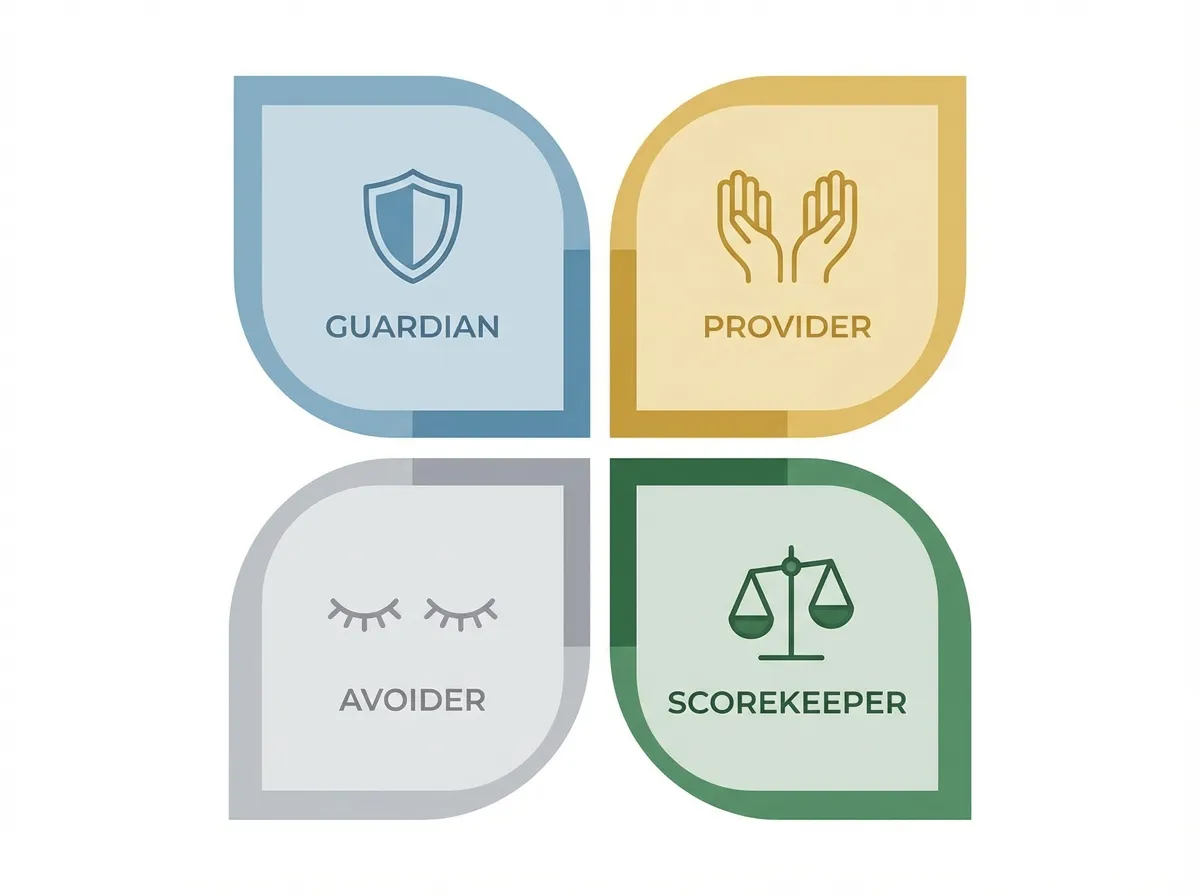
While every person's financial history is unique, most money blueprints cluster around four patterns. Recognizing yours — and your partner's — is the first step toward disarming the conflict.
1. The Guardian
Childhood experience: Financial instability, loss, or a parent who was hyper-vigilant about money Adult behavior: Prioritizes saving, emergency funds, and long-term security. May resist spending even when it's reasonable. Can become controlling around household finances. Core fear: "If we're not careful, we'll lose everything."
2. The Provider
Childhood experience: Witnessed a parent who expressed love through financial generosity, or grew up feeling deprived and vowed to give their family more Adult behavior: Wants to spend on family experiences, gifts, and comfort. May overextend financially to feel like a good partner or parent. Core fear: "If I can't provide abundance, I'm failing the people I love."
3. The Avoider
Childhood experience: Money was a source of conflict, shame, or confusion in the household. Financial topics were either volatile or completely taboo. Adult behavior: Ignores bank statements, resists budgeting conversations, may hide purchases or debts. Shuts down when money arguments begin. Core fear: "Money conversations will destroy this relationship like they destroyed my parents'."
4. The Scorekeeper
Childhood experience: Grew up in an environment where fairness was inconsistent — one sibling got more, one parent controlled all the money, or resources were allocated based on behavior or favoritism. Adult behavior: Tracks who spent what, insists on splitting things precisely, may feel resentful if they perceive financial imbalance in the relationship. Core fear: "If I don't watch the numbers, I'll be taken advantage of."
Most people are a blend of two types, and blueprints can shift depending on financial stress. The point isn't to label yourself or your partner into a box. It's to recognize that beneath every money argument is a story — and that story started long before you two met.
How to Identify Your Own Money Blueprint
You can't change a pattern you can't see. Here's a practical exercise called the Money Memory Timeline that therapists specializing in financial conflict often recommend.
The Money Memory Timeline Exercise
- Set aside 30 minutes alone — this is individual work before it becomes a couples conversation.
- Draw a timeline of your life from birth to age 18.
- Mark every money-related memory you can recall. Don't filter. Include: - Arguments you overheard about money - Times you felt ashamed, proud, scared, or excited about money - Messages a parent or caregiver said repeatedly about finances - The first time you understood your family's financial position relative to others - Any moment when money (or the lack of it) changed your family's life
- For each memory, write one sentence about what you concluded from that experience. For example: "When Dad lost his job and Mom cried every night, I concluded that not having savings is the most dangerous thing that can happen to a family."
- Circle the three memories that still feel emotionally charged. These are the roots of your blueprint.
Once both partners have completed this individually, share your timelines with each other. Not to debate. Not to problem-solve. Just to understand.

From Understanding to Action: Rewriting the Money Argument
Insight is valuable, but it doesn't pay the electric bill. Once you understand each other's money blueprints, you need a practical framework for making financial decisions together without re-triggering old wounds.
Step 1: Name the Blueprint, Not the Behavior
The next time a financial disagreement surfaces, pause and try this language:
- Instead of: "You're being ridiculous about this purchase."
- Try: "I think my Guardian blueprint is activating right now. I'm feeling anxious, and I know it's not entirely about this specific expense."
This small shift moves the conversation from accusation to vulnerability. It's remarkably difficult to stay angry at someone who just told you they're scared.
Step 2: Separate the Practical from the Emotional
Not every money conversation needs to be a deep dive into childhood. Some decisions are genuinely practical. Create two distinct types of money conversations:
- Logistics talks: Budget reviews, bill payments, upcoming expenses. Keep these short, scheduled, and task-oriented.
- Values talks: How you each feel about your financial life, what financial security means to each of you, and what you want money to make possible. These are longer, less frequent, and more exploratory.
Many couples make the mistake of mashing these together — trying to discuss the emotional weight of retirement savings while also figuring out who's paying the water bill. Separate them.
Step 3: Build a "Both/And" Financial Agreement
Most money arguments operate on an either/or framework: either we save aggressively or we enjoy our money. A healthier approach is to build a financial agreement that honors both blueprints.
Here's a simple structure:
- Security baseline: Agree on a savings threshold that helps the Guardian-type partner feel safe. This isn't negotiable — it's the floor.
- Freedom allocation: Agree on discretionary spending amounts for each partner that require no explanation or justification. This honors the Abundance-type partner's need for autonomy.
- Shared goals fund: Identify one or two financial goals you're genuinely excited about together — a trip, a home renovation, an investment. This gives your money a shared story, not just competing ones.
- Review rhythm: Set a recurring date (monthly or quarterly) to revisit the agreement. Life changes. Blueprints evolve. The agreement should too.
When you're ready to formalize these kinds of agreements, tools like Servanda can help you create written, structured commitments that both partners can reference — especially useful when emotions run high and memory gets selective.
Step 4: Create a Conflict Protocol for Money Talks
Even with understanding and agreements, money fights will still happen. Plan for them:
- Agree on a pause word. When either partner feels their childhood blueprint taking over, they can say the word (some couples use something lighthearted, like "blueprint" or "rewind"), and both partners take a 20-minute break before continuing.
- No money conversations after 9 PM. Fatigue amplifies every trigger.
- No financial decisions during a fight. If you're arguing, the only decision is to stop arguing and schedule a follow-up conversation within 48 hours.
What Happens When You Don't Address the Blueprint
Couples who never examine their childhood money stories tend to follow a predictable escalation pattern:
- The Repetition Phase: The same argument recycles every few weeks, with slight variations.
- The Avoidance Phase: One or both partners stop bringing up money entirely, creating financial secrets, hidden accounts, or unspoken resentment.
- The Erosion Phase: Trust deteriorates. Money becomes a symbol of everything wrong in the relationship. Fights about money start bleeding into fights about parenting, household responsibilities, and intimacy.
- The Crisis Phase: A major financial event — job loss, unexpected expense, discovery of hidden debt — detonates the accumulated tension.
Research consistently identifies money as one of the top predictors of relationship distress and divorce. But it's not the money itself. It's the unexamined stories we carry about what money means.
A Real-World Example
Mark and Denise (names changed) had been married for eleven years and fighting about money for ten of them. Mark grew up in a family where his father was the sole earner and controlled every dollar. His mother had to ask permission to buy new shoes. Mark's blueprint: money is power, and the person who earns more gets more say.
Denise grew up in a household where her parents divorced partly over financial deception. Her father had hidden significant debt. Denise's blueprint: financial transparency isn't optional — it's the only thing that keeps a relationship safe.
Their fights looked like this: Denise wanted full visibility into every account, every transaction, every financial decision. Mark experienced this as surveillance — the same controlling dynamic he'd watched his mother endure. He'd resist, withhold information, or make purchases without telling her. Denise would discover them and feel the same betrayal her mother felt.
Neither of them was wrong. Both of them were wounded.
Once they mapped their money blueprints and shared them with each other, the dynamic shifted. Denise understood that Mark's secrecy wasn't deception — it was a fight for autonomy. Mark understood that Denise's need for transparency wasn't control — it was a fight against the thing that destroyed her family. They built an agreement: full transparency on shared accounts, individual discretionary accounts with no reporting requirement, and a monthly money check-in where they opened with one sentence each about how they were feeling about their finances, not just the numbers.
The fights didn't disappear overnight. But they changed shape. They went from accusations to conversations.
Frequently Asked Questions
Why do my partner and I always fight about money even though we make enough?
Income level has very little to do with financial conflict in relationships. Money fights are driven by differing values, fears, and childhood experiences around money — not by how much you earn. A couple making $300,000 can fight just as bitterly as a couple making $50,000 if their underlying money blueprints clash.
Can you actually change your money blueprint?
You can't erase your childhood experiences, but you can become conscious of them and choose new responses. Think of it like learning a second language — your first financial "language" will always feel natural, but with practice, you can become fluent in a new way of relating to money. Most couples see significant shifts within a few months of working on this together.
Should couples have joint or separate bank accounts?
There's no universally right answer. What matters more than the account structure is whether it reflects a conscious agreement that honors both partners' needs. Many couples find a hybrid approach — shared accounts for household expenses and goals, plus individual accounts for personal spending — provides both transparency and autonomy.
How do I bring up money blueprints without my partner getting defensive?
Start with your own story, not theirs. Share a memory from your Money Memory Timeline and what you realized about yourself. When people feel like they're being analyzed, they shut down. When they see their partner being vulnerable first, they tend to open up. Frame it as curiosity about each other, not as a diagnostic exercise.
When should couples seek professional help for financial disagreements?
If money arguments regularly escalate to yelling, shutting down, or making threats; if one partner is hiding debt or spending; or if you've tried multiple times to have productive money conversations and can't get through them — it's time to bring in a therapist who specializes in financial conflict. There's no shame in it. These patterns took decades to form, and sometimes you need a guide to untangle them.
Conclusion
The money fights in your relationship aren't a sign that you chose the wrong partner or that one of you is bad with money. They're a sign that two people with two very different childhoods are trying to build one shared life — and that's genuinely hard work.
The path forward isn't a better budgeting app or a stricter spending plan. It's understanding the invisible blueprints you each carry, sharing those stories with genuine curiosity, and building financial agreements rooted in empathy rather than control.
Your partner isn't the enemy. Their childhood taught them something different about money than yours taught you. When you stop fighting about the credit card statement and start exploring why it triggers such strong reactions, you stop having the same argument on repeat — and start having a relationship where money is a tool for building your life together, not a weapon for relitigating the past.