
Why You Fight Over Nothing (And What It Means)
It starts with a cupboard door left open. Or a text that wasn't returned quickly enough. Or the "wrong" tone of voice when someone asks what's for dinner.
Twenty minutes later, you're both in separate rooms, hearts pounding, wondering how that turned into this. The argument feels enormous, but when you try to explain it to a friend the next day, you can barely articulate what it was about. "It was stupid," you say. "We were fighting over nothing."
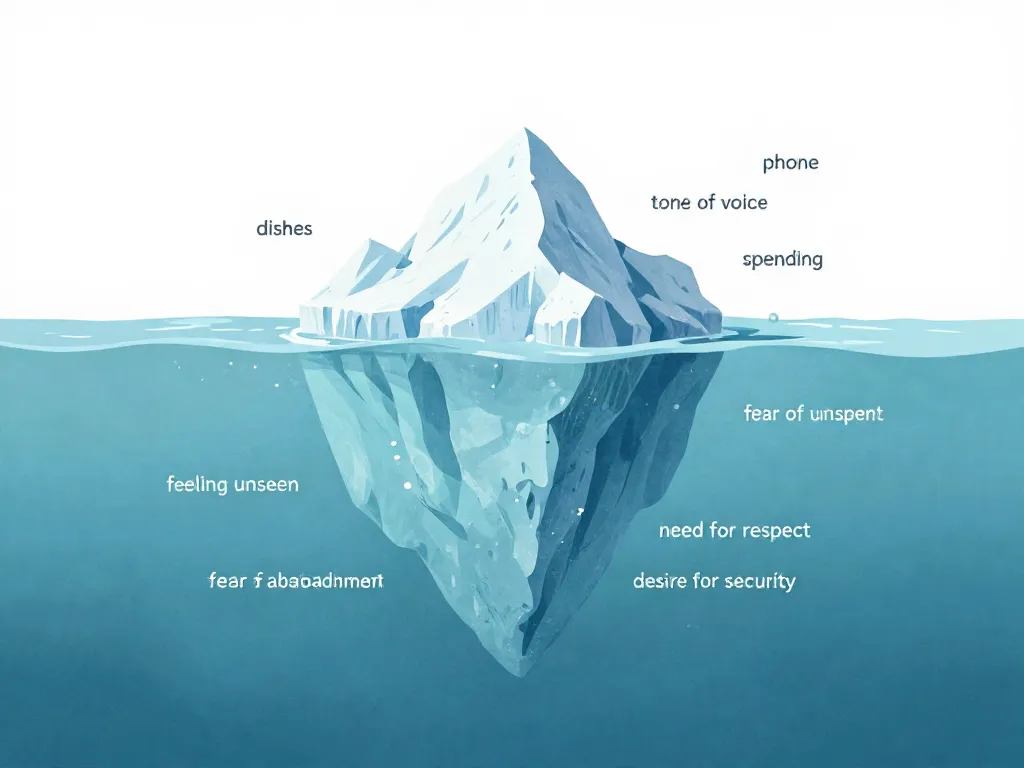
But here's the thing: you weren't fighting over nothing. You were fighting over something so important that neither of you had the words for it in the moment. Research in relationship psychology consistently shows that the surface-level triggers in couple arguments — the dishes, the thermostat, the way someone sighed — are rarely the real issue. They're doorways into deeper, unspoken needs that are going unmet.
This article will help you decode those fights, understand what's actually happening beneath the surface, and give you concrete tools to break the cycle.
Key Takeaways
- "Silly" fights are rarely silly. They almost always signal a deeper unmet need — for respect, security, appreciation, or connection.
- Recurring arguments follow a pattern. If you keep fighting about the same trivial things, you're stuck in an emotional loop that won't resolve until you name the real issue.
- The trigger is not the topic. Learning to separate what started the fight from what the fight is actually about is one of the most powerful relationship skills you can build.
- You don't need to eliminate conflict — you need to fight about the right thing. Redirecting the conversation to the underlying need changes everything.
- Small, specific actions matter more than grand gestures. Asking one better question in the heat of a moment can prevent hours of pain.
The Science Behind Fighting Over Nothing
Dr. John Gottman, whose research lab has studied thousands of couples over four decades, found that 69% of relationship conflicts are perpetual — meaning they never fully resolve. They resurface again and again, often wearing different disguises.
That argument about loading the dishwasher? It showed up last month as an argument about who forgot to buy milk. And before that, it was about who always has to be the one to plan weekends.
The content changes. The feeling underneath doesn't.
This happens because most recurring couple fights are rooted in what attachment researchers call core emotional needs — the fundamental things every person needs to feel safe and valued in a relationship:
- Feeling seen: "Do you notice what I do?"
- Feeling prioritized: "Am I important to you?"
- Feeling respected: "Do you value my opinion?"
- Feeling safe: "Can I count on you?"
- Feeling desired: "Do you still want me?"
When one of these needs is threatened — even subtly, even unintentionally — our nervous system responds as though something genuinely dangerous is happening. That's why a cupboard door left open can produce the same physiological response as a much more serious betrayal. Your body doesn't distinguish between "my partner left the cabinet open" and "my partner doesn't respect our shared space, which means they don't respect me, which means I'm not safe here."
The escalation happens in milliseconds, below conscious awareness. By the time you're raising your voice, your brain has already run through a chain of meaning-making that sounds absurd when stated aloud — but feels absolutely real.
What Your "Silly" Arguments Are Really About
Let's translate some of the most common surface-level fights into what they're actually about. See if any of these feel familiar.
The Chores Fight
Surface: "You never clean up after yourself."
Underneath: "I feel like I'm carrying the weight of our life together alone, and that makes me feel like you don't see my effort — or worse, that you think my time matters less than yours."
Core need: Feeling seen. Feeling respected. Fairness.
The Phone Fight
Surface: "You're always on your phone."
Underneath: "When I'm trying to connect with you and you're scrolling, I feel like I'm not interesting enough to hold your attention. It triggers a fear that I'm losing you to something — or someone — else."
Core need: Feeling prioritized. Feeling desired.
The Logistics Fight
Surface: "Why didn't you tell me we had plans on Saturday?"
Underneath: "When decisions get made without me, I feel like I'm not a real partner in this relationship. I feel controlled, or invisible."
Core need: Feeling respected. Feeling included.
The Tone Fight
Surface: "Don't talk to me like that."
Underneath: "The way you just spoke to me reminded me of every time someone made me feel small. I need to know that you see me as an equal, not someone to manage."
Core need: Feeling safe. Feeling respected.

The Spending Fight
Surface: "You spent how much on that?"
Underneath: "Money represents security to me. When you spend without discussing it, I feel like our future — and my sense of safety — isn't something you take seriously."
Core need: Feeling safe. Feeling like a team.
None of these translations are universal. Your version might be different. But the structure is consistent: a small trigger activates a deep need, and the fight happens in the gap between them.
How to Decode Your Own Fights
The next time you find yourself in a fight that feels disproportionate to its cause, try this process — not during the fight itself, but after you've both cooled down.
Step 1: Name the Trigger (Without Judgment)
Write down or say aloud what actually happened. Not your interpretation of it — just the event.
- "The kitchen was messy when I got home."
- "They didn't respond to my text for three hours."
- "They made a joke about me in front of friends."
Keep it factual. One sentence.
Step 2: Track the Feeling Chain
Ask yourself: What did I feel first? Not anger — anger is almost always a second emotion. What came before it?
Common first feelings include: - Hurt - Embarrassment - Loneliness - Fear - Inadequacy - Invisibility
Then ask: What did that feeling make me believe? This is where the core need reveals itself.
- "I felt hurt → which made me believe they don't care about my comfort → which made me feel like I don't matter."
Step 3: Say the Underneath Part Out Loud
This is the hardest step and the most important one. Instead of saying, "You always leave the kitchen a mess," try saying:
"When I came home and the kitchen was messy, I felt like my effort to keep things together isn't noticed. I think I need to hear that you see what I do."
That's a completely different conversation. It's vulnerable. It's specific. And it gives your partner something they can actually respond to.
Why You Keep Having the Same Fight
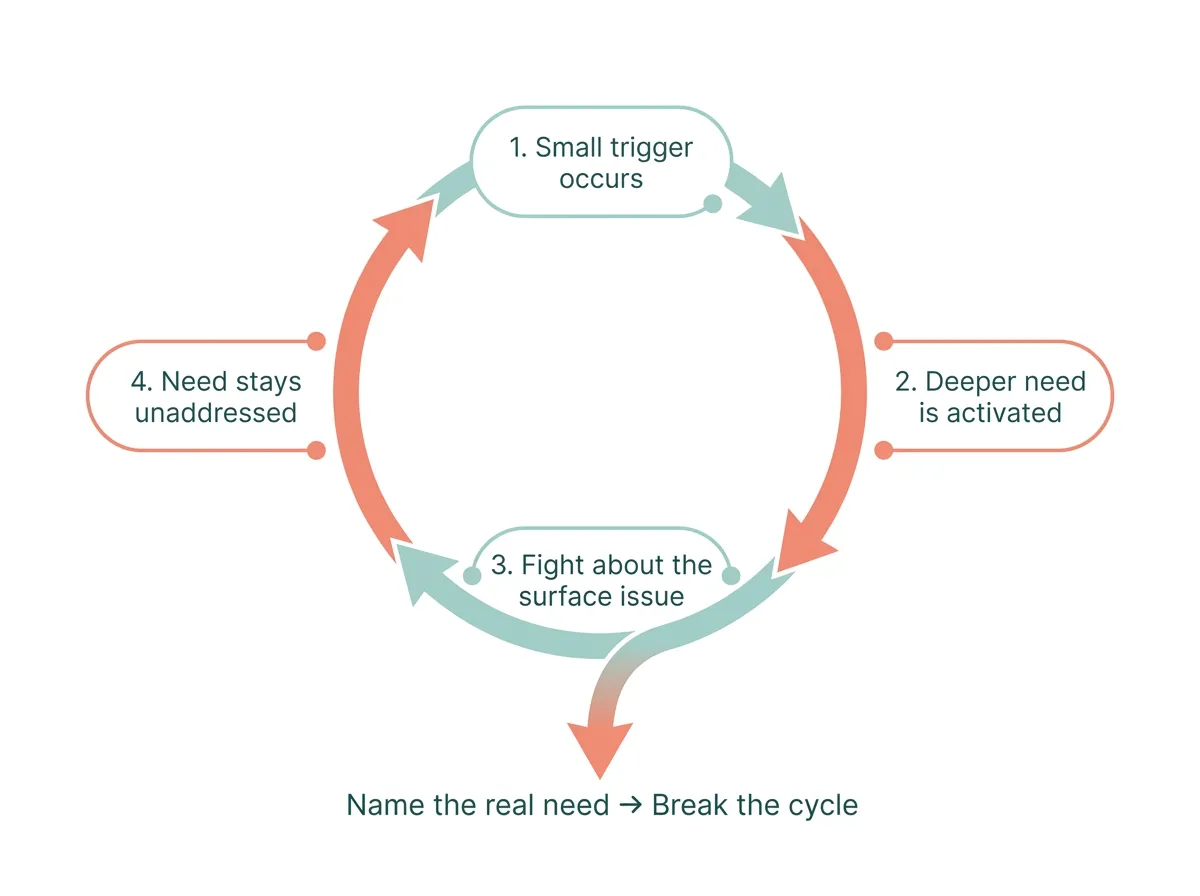
If you and your partner have the same argument on rotation — different details, same emotional flavor — it's likely because the underlying need has never been directly addressed.
This isn't anyone's fault. Most of us were never taught to identify our emotional needs, much less articulate them clearly during conflict. We default to talking about the trigger because it's concrete. "You left the dishes out" is easier to say than "I'm afraid you're taking me for granted."
But here's what happens when you only address the trigger:
- The behavior might change temporarily. Your partner loads the dishwasher for a week.
- The need stays unmet. You still don't feel seen.
- A new trigger appears. Now it's about how they forgot to pick up the dry cleaning.
- The fight returns in a new costume. Same intensity, different topic.
This cycle can go on for years — even decades — if neither partner learns to look beneath the surface. It's not that you're incompatible. It's that you're solving the wrong problem.
Breaking the Cycle: Practical Strategies
Here are five things you can start doing this week to fight over nothing less often — and fight about what matters more effectively.
1. Establish a "What's This Really About?" Practice
Agree together that either partner can pause a disagreement by asking, gently: "Can we check — what's this really about for you?"
This isn't a weapon or a dismissal. It's a genuine invitation to go deeper. The tone matters enormously. Practice it when you're not fighting so it doesn't feel like an ambush when you are.
2. Use "I Feel [X] When [Y]" — But Make It Specific
You've probably heard the "I feel" formula before. The problem is it often gets used vaguely: "I feel bad when you do that." That doesn't give your partner enough to work with.
Be precise: - "I feel dismissed when my suggestion gets overruled without discussion." - "I feel anxious when plans change at the last minute because predictability helps me feel secure."
3. Separate the Repair from the Solution
After a fight, couples often rush to fix the logistics — "Fine, I'll clean the kitchen every night" — without repairing the emotional damage. Repair comes first.
Repair sounds like: - "I'm sorry I raised my voice. You didn't deserve that." - "I can see this hit something deep for you. I want to understand it." - "I don't want to be on opposite sides. Can we start over?"
Once you've reconnected emotionally, the practical solution often becomes obvious — and far less contentious.
4. Write Down Your Patterns
Keep a low-effort log of arguments for a few weeks. Just note: what triggered it, what you felt underneath, and what you think you actually needed. After several entries, patterns will emerge that are nearly impossible to see in the moment.
If you find that your patterns lead to the same unresolved issues, tools like Servanda can help you and your partner create structured, written agreements around recurring friction points — turning vague promises into concrete commitments you can both refer back to.
5. Learn Each Other's Emotional Vocabulary
People express unmet needs differently. One person withdraws. Another gets critical. Another makes jokes. Another gets hyper-logical.
Ask your partner — outside of conflict — "When you shut down during a fight, what are you usually feeling?" and "What do you most need from me in that moment?"
These conversations build a shared language that makes future conflicts shorter, less painful, and more productive.
When Fighting Over Nothing Becomes a Bigger Problem
Not every fight over nothing is a simple case of unspoken needs. Sometimes, frequent, intense fights over trivial triggers can signal:
- Chronic stress or burnout — When your nervous system is already maxed out, even minor irritations feel overwhelming.
- Unprocessed resentment — If old hurts were never addressed, they leak into every new interaction.
- Attachment insecurity — If early life experiences taught you that relationships are unreliable, you may be hypervigilant to signs of rejection.
- Contempt creeping in — Gottman's research identifies contempt — the sense that your partner is beneath you — as the single strongest predictor of divorce. If your fights have shifted from frustration to disdain, that's a signal to seek professional support.
There's no shame in reaching out to a couples therapist. Recognizing that your fights have outgrown your current toolkit isn't failure — it's awareness.
Frequently Asked Questions
Is it normal for couples to fight over small things?
Absolutely. Research suggests that the majority of couple disagreements are about everyday, mundane topics. What matters isn't whether you fight over small things, but whether those fights are masking deeper issues that never get addressed. Frequent, intense reactions to minor triggers usually point to unmet emotional needs rather than a fundamental incompatibility.
How do I stop getting so angry over little things in my relationship?
Start by recognizing that the anger itself isn't the problem — it's a signal. When you feel a disproportionate reaction building, pause and ask yourself what you felt before the anger arrived (often hurt, fear, or loneliness). Over time, naming that first emotion and sharing it with your partner will reduce the intensity of your reactions because the real need is finally getting airtime.
Why does my partner pick fights about nothing?
They're likely not picking fights — they're reacting to something that feels genuinely threatening to them, even if it looks trivial from the outside. A pattern of starting arguments over small things often means your partner has an emotional need (to feel heard, valued, or secure) that isn't being met. Instead of asking "why are you making a big deal out of this," try asking "what's this really about for you?" The answer may surprise you both.
Can arguing too much ruin a relationship?
Frequent arguing doesn't necessarily predict relationship failure — how you argue does. Couples who fight with contempt, stonewalling, or personal attacks are at much higher risk than couples who fight with curiosity and a willingness to repair. If your arguments consistently end with emotional distance rather than understanding, it's worth examining your conflict patterns and possibly seeking professional guidance.
What's the difference between healthy and unhealthy conflict in a relationship?
Healthy conflict stays focused on the issue, includes vulnerability, and ends with some form of emotional repair — even if the problem isn't fully solved. Unhealthy conflict involves personal attacks, bringing up old grievances as ammunition, or one partner shutting down entirely. The key distinction: healthy conflict leaves both people feeling understood, even if they still disagree.
Moving Forward Together
The fact that you fight over nothing doesn't mean your relationship is broken. In many ways, it means the opposite — you care enough to react, even when you can't articulate why.
The work isn't eliminating conflict. It's learning to fight about the real thing instead of the stand-in. It's building the courage to say "I feel invisible" instead of "you never do the dishes." It's asking your partner what's underneath their frustration rather than defending yourself against the surface accusation.
This shift doesn't happen overnight. It's a practice — awkward at first, then gradually more natural. But couples who learn to decode their fights consistently report feeling closer, more understood, and more secure in their relationship.
The next time you're mid-argument about something that seems absurdly small, try pausing. Take a breath. And ask yourself — or each other — what is this really about?
The answer is almost always worth hearing.